How to Evaluate a Folding Sawhorse Sample Before Bulk Production
Table of Contents
- What Should a Folding Sawhorse Sample Evaluation Establish?
- A Step-by-Step Folding Sawhorse Sample Inspection Checklist
- How to Record Sample Test Results
- What to Do When a Folding Sawhorse Sample Fails
- When Is a Folding Sawhorse Sample Ready for Bulk Production?
- Using the Jingyan NH-SH001 as a Sample Evaluation Example
- Frequently Asked Questions
- Final Recommendation: Approve the Evidence, Not Just the Sample
Approving a folding sawhorse sample is an important step between selecting a product and committing to a bulk order. A sample may look acceptable in photographs and appear to work during a quick demonstration, yet still reveal problems when its dimensions, folding mechanism, stability, finish, or packaging are checked against the actual purchasing requirements.
For importers, distributors, private-label brands, and purchasing managers, the objective is not simply to decide whether a sample looks good. It is to determine whether the product meets the agreed specification, performs as expected, and can be supplied consistently during mass production.
A sample should be approved against documented requirements, not personal impressions alone. The buyer and manufacturer need to agree on what will be checked, which results are acceptable, how deviations will be handled, and which version of the product becomes the reference for production.
This process matters whether the product is a standard folding sawhorse or a heavy duty folding sawhorse with a specified load rating. A successful sample evaluation does not guarantee that every production unit will be identical, but it gives both parties a clearer basis for controlling quality and resolving problems before they affect a large order.A broader review of stability, material, and construction quality can also help buyers define the requirements that the sample must meet.
This guide explains how to inspect a folding sawhorse sample, organize practical tests, document the results, and make a more defensible decision before bulk production begins.
What Should a Folding Sawhorse Sample Evaluation Establish?
A useful sample evaluation answers four questions.
First, does the sample match the approved product specification? Second, do its functions work as intended? Third, do the inspection and test results meet the agreed acceptance criteria? Finally, has the manufacturer addressed any outstanding issue before production approval?
These questions are related, but they are not interchangeable. A product may have the correct dimensions while its folding mechanism operates poorly. Another sample may open and close smoothly but have a component, color, or marking that does not match the approved requirements.
1.Confirm the Requirements Before Testing
Before opening the sample, prepare the documents against which it will be evaluated. Depending on the order, these may include the product specification sheet, approved drawing, bill of materials, color reference, packaging requirements, labeling artwork, test plan, and purchase order.
The documents should identify the exact model and configuration. If two models look similar but differ in hooks, leg structure, working height, or other features, the sample must be checked against the correct version.
Record the requirements that can be measured or verified. These might include open and folded dimensions, product weight, materials, color, number of hooks, adjustment functions, stated load capacity, and included accessories.
Do not rely on a verbal promise when a requirement affects product acceptance. If the buyer needs a particular dimension, material, load rating, marking, or packaging format, put that requirement in the approved specification or another controlled order document.
2.Distinguish the Development Sample From the Approved Production Reference
Not every sample has the same purpose.
An early development sample may be used to discuss product design or identify changes. A pre-production sample should represent the configuration intended for the order. Once the buyer approves the final version, a retained reference sample or an agreed set of photographs and records can help prevent later misunderstandings.
Terminology differs among companies, so the important point is to define the sample’s status in writing.
If the supplier changes a hinge, plastic component, surface treatment, material, color, or packaging after approval, the buyer should determine whether that change requires a new review or sample approval. A sample that has already passed inspection should not silently become a different product during production.
A Step-by-Step Folding Sawhorse Sample Inspection Checklist
A structured checklist makes sample evaluation easier to repeat. The following sequence moves from product identity and visible condition to measurements, operation, performance, and delivery presentation.
1. Check Product Identity and Completeness
Start by confirming that the delivered sample is the correct model. Compare its product code, configuration, color, supplied accessories, and identifying labels with the order documents.
Count the components and accessories included in the sample. If the agreed configuration includes hooks, support components, or other attachments, confirm that they are present and correctly fitted.
Check whether the sample includes the expected instruction sheet, warnings, labels, and packaging components if these are part of the approved order. Missing accessories or incorrect product identification should be recorded even when the main structure appears satisfactory.
A clear identification check prevents the team from testing the wrong variant and approving results that do not apply to the intended product.
2. Inspect Appearance and Workmanship
Examine the sample under adequate lighting. Look for visible damage, cracks, sharp edges, loose components, inconsistent finishes, obvious deformation, or other defects that could affect safety, use, or product presentation.
For a metal folding sawhorse, inspect the frame, joints, connecting points, coating, and any areas specified for corrosion protection. Check for visible coating damage, rough finishing, exposed metal where the approved specification requires coverage, and signs of poor assembly.
For plastic and rubber components, inspect the molded surfaces, edges, attachment points, and contact areas. Look for cracks, incomplete molding, excessive flash, deformation, or components that are not seated correctly.
Not every cosmetic mark has the same importance. The acceptance criteria should distinguish safety-related or functional defects from minor appearance variations. Buyers should also agree on how visible defects will be judged under normal inspection conditions rather than relying on subjective descriptions such as “looks fine.”
3. Measure the Open and Folded Dimensions
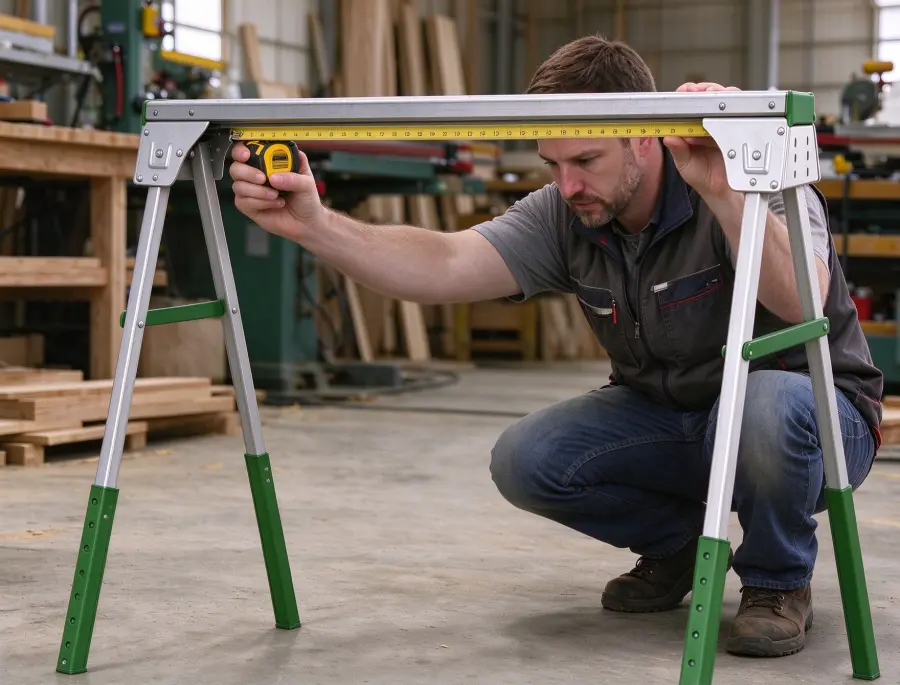
Use suitable measuring equipment to verify the dimensions specified for the product. Depending on the design, these checks may include overall working length, width, height, folded length, folded thickness, and the position of important connection points.
Measure the product in the correct configuration. The legs must be opened or folded as required by the specification, and adjustable parts should be set to the documented measurement position.
Record the actual result alongside the specified value and permitted tolerance. If a dimension falls outside the agreed tolerance, do not replace the recorded value with an estimate or approve it merely because the difference appears small.
Dimensional checks also help reveal problems that a visual inspection may miss. For example, an incorrectly positioned connection point may make a leg difficult to operate or prevent the folded product from reaching its intended profile.
4. Test the Folding and Locking Mechanism
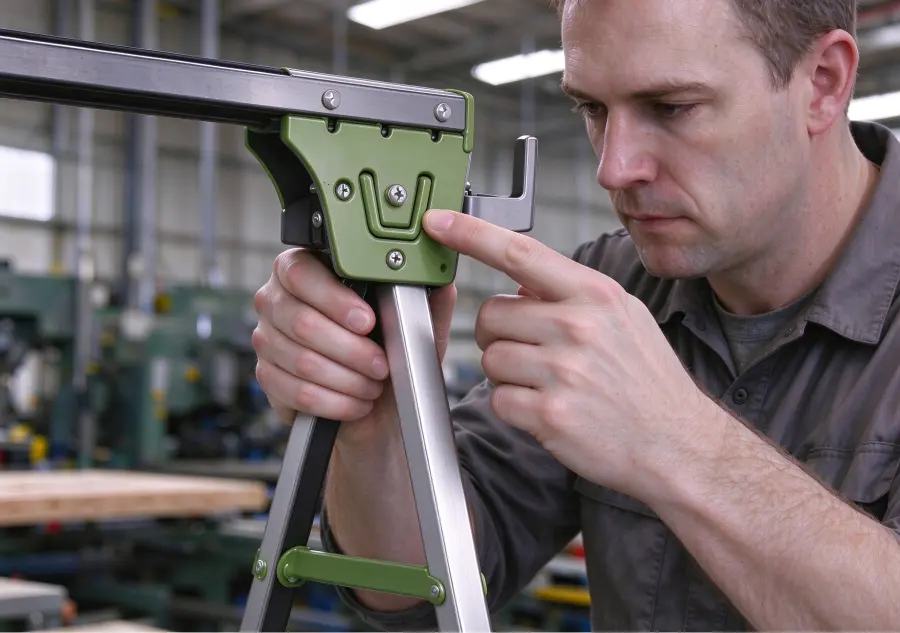
A folding sawhorse must transition reliably between its storage configuration and its working configuration. Open and fold the sample according to the product instructions, paying attention to the movement of each leg, hinge, pin, latch, or locking feature.
Check whether the mechanism operates smoothly, whether the legs reach the intended position, and whether each required lock engages correctly. Note excessive resistance, unusual noise, looseness, misalignment, incomplete engagement, or the need to force a component into place.
Repeat the operation using the cycle count agreed in the inspection plan. One successful opening does not establish that the mechanism will remain functional after repeated operation.
If the product includes a height-adjustment feature, verify every specified adjustment position and confirm that the locking arrangement engages as intended. If hooks or other attachments are included, check their fit and function separately.
A mechanism should not pass simply because it can be forced into the correct position. The movement and locking behavior should match the approved design and the acceptance criteria agreed before testing.
5. Check Stability and Contact With the Floor
Set the sawhorse on a level, suitable test surface and fully open the structure according to the instructions. Confirm that the required locks are engaged before assessing stability.
Observe whether all intended feet contact the surface, whether the frame sits in the expected position, and whether there is unexpected rocking or movement under the agreed evaluation conditions. Examine the feet and contact pads for correct installation, visible damage, and fit.
If the product is designed for height adjustment, repeat the stability check at the positions specified in the test plan. Do not assume that satisfactory behavior at one height proves that every permitted position performs identically.
Record any wobble, incomplete contact, loose joint, or inconsistent leg position. The team should evaluate these results against the approved acceptance criteria and investigate defects that could affect safe support.
A sawhorse sample should never be considered acceptable solely because it stands upright on the floor. The relevant question is whether its structure behaves as specified in the intended working configuration.
6. Verify Load Performance Against the Approved Test Plan
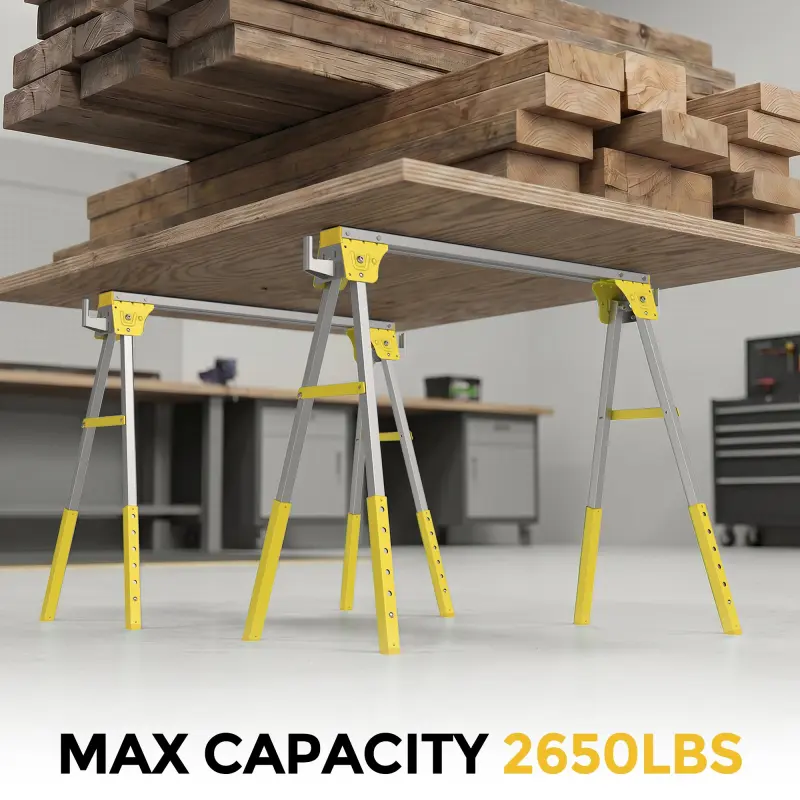
Load testing requires particular care because the result affects how the product can be specified and marketed. Start by confirming the rated capacity, the unit of rating, the intended loading arrangement, and the manufacturer’s approved test method.
For a product rated as a pair, verify that the test plan applies to the matched pair and clearly defines how the load is distributed. A pair rating should not automatically be treated as the allowable load for one individual sawhorse.
The test should use suitable equipment, a controlled setup, and the agreed loading procedure. Record the test arrangement, applied load, duration or test sequence where relevant, observed movement, and final condition. Any permanent deformation, unexpected unlocking, structural damage, or other failure criteria should be defined before the test begins.
Do not invent a universal proof-load value or cycle count. The acceptance level depends on the product specification, applicable market requirements, and the test method agreed by the responsible parties. If a standard or third-party test report is required, identify the exact requirement before testing.
Keep people clear of the test area, never position anyone beneath a loaded structure, and do not improvise a load test using unstable weights or uncontrolled equipment.
For a broader explanation of how to interpret published ratings, buyers can also review the factors that affect sawhorse load capacity.
7. Check Finish, Corrosion Protection, and Component Fit
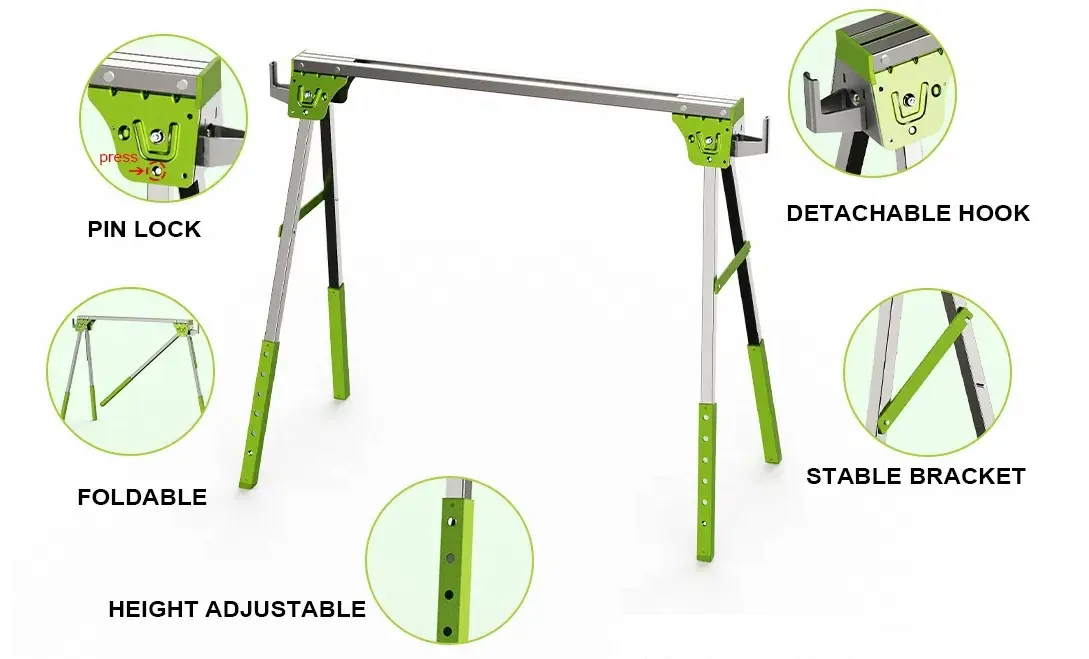
Surface and component checks should reflect the actual specification and intended market. Examine the frame finish, coating coverage, connection points, and the fit between metal, plastic, and rubber components.
Where corrosion resistance is a contractual requirement, agree on the applicable test method and acceptance criteria before relying on a sample result. A brief visual check cannot establish long-term corrosion performance by itself.
Check whether fitted components remain secure during normal operation and whether assembly is consistent across the sample. If a component appears loose, a buyer should determine whether the issue comes from an out-of-tolerance part, incorrect assembly, or an unclear requirement.
The objective is to identify problems that may recur in mass production and determine what must be corrected before the sample is approved.
8. Inspect Labels, Instructions, and Packaging
The product may meet its functional requirements yet still be unsuitable for release because its labeling or packaging is wrong.
Compare product markings, model identification, warnings, barcode labels, printed instructions, and packaging artwork with the approved files. Check that all required information is legible and positioned as specified.
If the sawhorse is supplied with protective packaging, inspect whether the packaging holds the product securely and protects relevant surfaces and components during the agreed handling and transport conditions. Look for avoidable movement, exposed contact points, missing protective materials, and packaging dimensions that do not match the order requirements.
For private-label orders, this is the stage to verify the approved brand artwork and packaging version. A correct product in the wrong branded package is not a complete pass for the order.
How to Record Sample Test Results
An inspection is more useful when another person can understand what was tested and why the sample passed or failed. Keep a record for each evaluated model and configuration.
| Inspection item | What to record | Basis for acceptance |
|---|---|---|
| Product identity | Model, version, color, sample reference | Matches the approved order documents |
| Appearance | Observed defects and photographs | Agreed visual criteria |
| Dimensions | Required values, actual measurements, tolerance | Approved drawing or specification |
| Folding operation | Observed movement and test cycles | Agreed functional test plan |
| Locks and adjustments | Engagement, fit, and operation | Approved design and functional criteria |
| Stability | Surface, setup, adjustment position, observations | Agreed stability test method |
| Load test | Setup, rating, applied load, duration, results | Approved test protocol |
| Components | Materials, attachments, missing or loose parts | Bill of materials and approved sample |
| Labels and packaging | Artwork, markings, instructions, packing condition | Approved files and packaging specification |
| Final decision | Pass, fail, or conditional hold; corrective action | Buyer and supplier approval requirements |
Use actual observations rather than vague descriptions. Instead of writing “folding feels bad,” record where resistance occurs, which component is involved, and whether the problem repeats. Photographs or short videos can help show the issue, but they should supplement rather than replace measurements and written results.
If a test cannot be completed, mark it as pending. Do not treat an untested item as passed.
What to Do When a Folding Sawhorse Sample Fails
Record the issue and assess its impact. A defect that could affect structural integrity, stability, locking, or another safety-critical function should be treated more seriously than a minor appearance issue.
The buyer and supplier should agree on the classification and disposition of each deviation. Depending on the nature of the problem, the response may involve correction, replacement components, a revised sample, additional testing, or rejection.
Do not allow a critical or unresolved functional issue to be waived informally just to preserve the production schedule.
1.Classify the Deviation
2.Identify the Cause and Agree on Corrective Action
The supplier should investigate whether the issue is linked to design, dimensions, raw materials, component quality, tooling, assembly, or unclear instructions.
The corrective action should identify what will change, who is responsible, and what evidence is required to verify the result. If the correction affects a component or assembly process, the buyer should determine whether other checks need to be repeated.
A statement that the problem has been “fixed” is not enough on its own. The corrected sample or relevant evidence should demonstrate that the agreed requirement is now met.
3.Re-Test and Re-Approve the Corrected Sample
After a correction, repeat the failed test and any related checks that could be affected by the change. For example, a change to a leg connection may require more than a dimensional recheck because it can also affect folding behavior, locking, and stability.
Record the new sample version and keep the previous result for traceability. The final approval should identify which version has passed, so the production team does not accidentally work from an outdated sample.
When Is a Folding Sawhorse Sample Ready for Bulk Production?
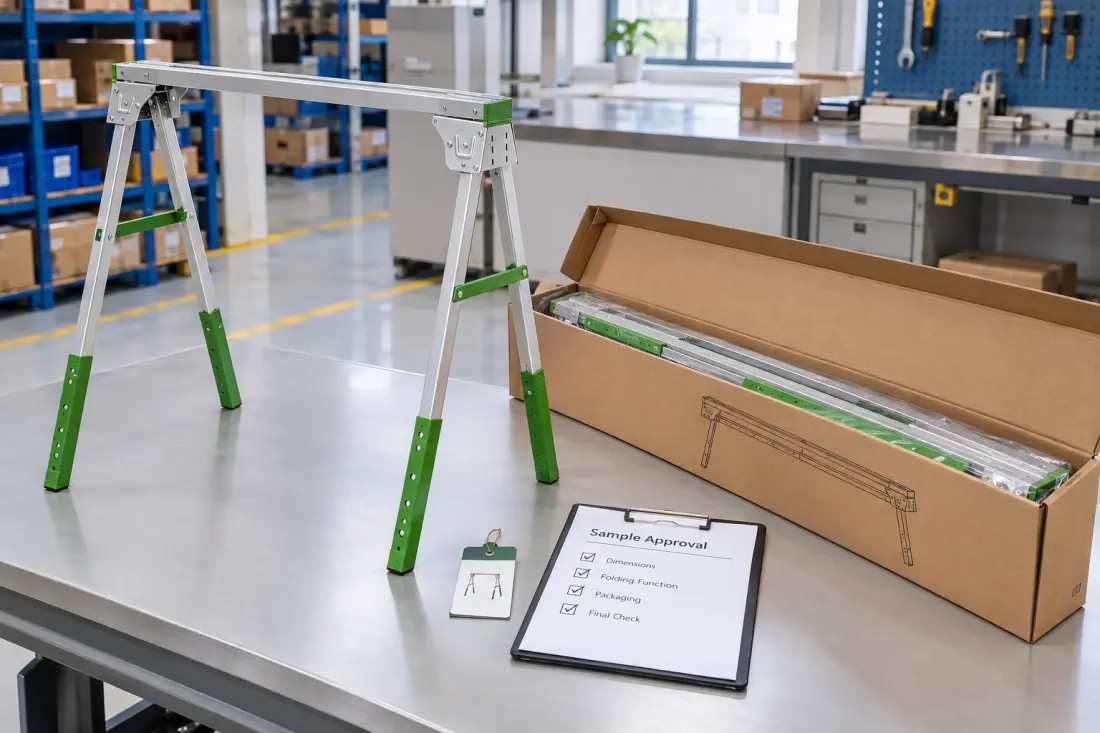
Bulk production should start only after the required checks are complete and the approval conditions have been met.
1.Confirm Specification and Test Completion
All mandatory inspection items should have a recorded result. Any required load, functional, or compliance tests should be complete, and unresolved deviations should be addressed according to the agreed procedure.
If the buyer has approved a conditional change, document its exact scope. Conditional approval should not become a blanket permission to vary other specifications.
2.Approve the Final Reference Sample
The final approved sample should represent the product that the supplier is expected to manufacture. Record the model, version, materials, color, essential dimensions, accessories, markings, and packaging configuration.
Depending on the purchasing arrangement, the reference may include a physical sample retained by the buyer or supplier, signed drawings, a controlled specification sheet, and dated photographs. The method should give both parties an unambiguous reference when production begins.
3.Agree on Production Controls and Change Management
Sample approval is a starting point for production control, not a substitute for it. The buyer and supplier should agree on how components and assembly will be checked during production, how nonconforming units will be handled, and which changes require renewed approval.
If the supplier changes a material, component, tooling detail, or functional mechanism, the impact on the approved design should be assessed. A significant change may require a new sample or repeat testing before the revised configuration is released.
For importers and private-label brands, written approval reduces the risk of differences between the tested sample and the products eventually delivered.
Using the Jingyan NH-SH001 as a Sample Evaluation Example
The Jingyan NH-SH001 folding sawhorse is one example of a product that can be evaluated against a defined product specification.
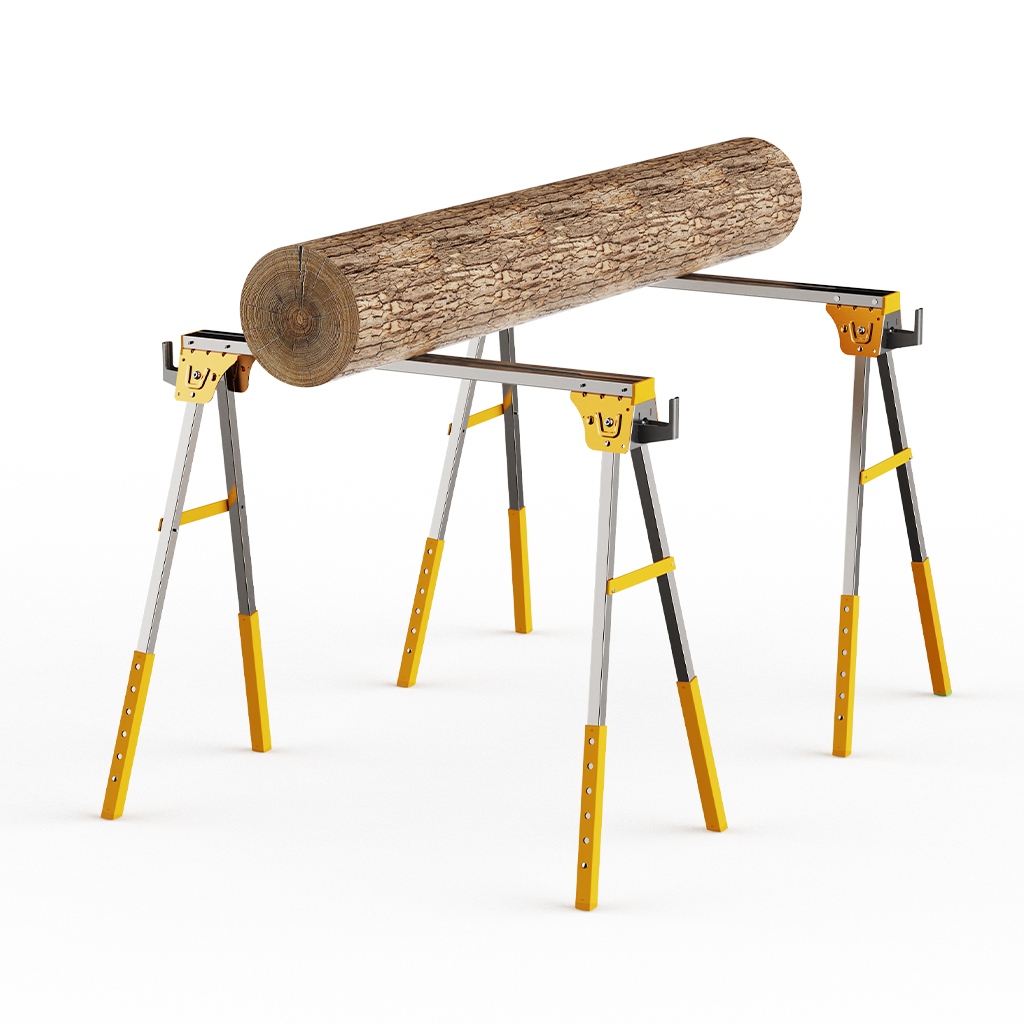
Its product information identifies a metal, PP, and TPR construction; green, yellow, and blue color options; open dimensions of 88.7 × 43 × 72.6 cm; folded dimensions of 78 × 10.7 × 9.7 cm; a product weight of 4.5 kg; two hooks; and a stated load capacity of 2,650 lb per pair.
A buyer evaluating this model should confirm that the received sample matches the configuration and dimensions required for the order. The folding mechanism, leg engagement, hooks, finish, and packaging should then be checked against the approved criteria. The stated load rating must be assessed under the agreed test protocol rather than inferred from the product’s appearance.
This is also a practical way to evaluate a metal folding sawhorse with plastic and rubber components: check the metal structure and the fitted components separately, then verify that the assembled product functions as intended.
For buyers considering Ningbo Jingyan Tool Industrial Co., Ltd. as a manufacturing partner, the company provides product development, mold design, manufacturing, quality control, and OEM/ODM services.These capabilities are relevant to a sourcing discussion, but the sample and order requirements should still be confirmed for the exact product and project.
Frequently Asked Questions
1.How Many Folding Sawhorse Samples Should a Buyer Evaluate?
The number depends on the product configuration, order risk, supplier arrangement, and agreed inspection plan. One sample can help verify the design, but it cannot prove that every unit in a future production batch will be identical. Buyers should agree on whether they need a development sample, a pre-production sample, or additional samples to evaluate variation.
2.Should a Buyer Approve a Sample Before Confirming the Bulk Order?
For a product where dimensions, locking mechanisms, load performance, branding, and packaging matter, written sample approval before mass production is a prudent purchasing control. The exact approval process should be agreed with the supplier and reflected in the purchase documents.
3.Can a Sample Pass Even if Its Appearance Is Not Perfect?
4.Does a Sample Load Test Prove That Every Production Unit Is Safe?
5.What Should Be Included in a Sample Approval Record?
Final Recommendation: Approve the Evidence, Not Just the Sample
If a problem is found, document it, agree on corrective action, and verify the corrected version before authorizing production. Once the sample passes, preserve a clear reference and define how changes and production quality will be controlled.
For OEM brands, importers, and distributors, the most useful sample approval is one that turns expectations into measurable requirements before a bulk order is manufactured. That gives both buyer and supplier a clearer basis for producing, inspecting, and delivering the intended folding sawhorse consistently.
Ralated Products