How to Differentiate Folding Sawhorses in a Competitive Tool Market
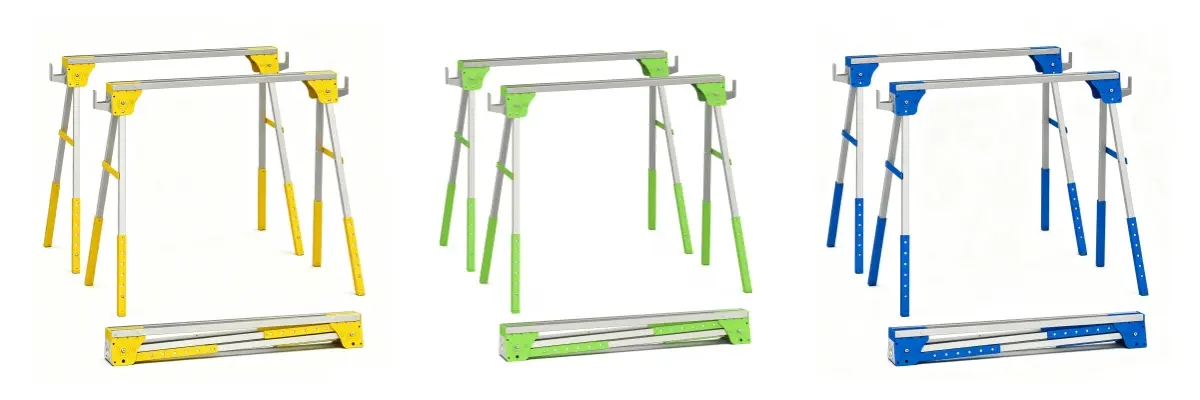
The folding sawhorse market is crowded with products that can look remarkably similar at first glance. Many models use familiar metal frames, folding legs, adjustable structures, hooks, compact storage designs, or combinations of metal and plastic components. For a distributor, retailer, or tool brand, this creates a commercial challenge: when competing products appear to offer the same basic function, what gives one folding sawhorse a clear reason to be selected, stocked, or branded?
Product differentiation is not simply about adding more features. It is about creating a product proposition that is recognizable, relevant to a defined buyer group, commercially practical, and difficult to confuse with another SKU.
For B2B buyers, this distinction matters because a folding sawhorse is rarely evaluated as an isolated tool. It is usually part of a product assortment, retail category, private-label program, construction tool range, or professional workshop portfolio. A product that is technically capable but commercially indistinct can become difficult to position against competing items.
This article explains how brands, distributors, wholesalers, and retailers can approach folding sawhorse differentiation from a product and market perspective. The focus is not on simply choosing the strongest or cheapest model. Instead, it examines how specifications, feature combinations, appearance, packaging, SKU architecture, target customer definition, and OEM capabilities can work together to create a stronger market position.
- Why Differentiation Matters in the Folding Sawhorse Market
- What Product Differentiation Really Means for a Folding Sawhorse
- Differentiate According to the Buyer, Not the Entire Market
- Turn Specifications Into a Market Proposition
- How a Real Folding Sawhorse Can Be Differentiated: The NH-SH001 Example
- Build Differentiation Beyond the Physical Product
- Differentiation for Distributors and Retail Buyers
- Avoid Weak Forms of Folding Sawhorse Differentiation
- A Practical Folding Sawhorse Differentiation Framework
- Why Supplier Capability Can Become Part of Product Differentiation
- How to Make Folding Sawhorses Easier to Sell
- Differentiation Should Support Long-Term Product Strategy
- Folding Sawhorse Differentiation Checklist for B2B Buyers
- FAQ About Folding Sawhorse Product Differentiation
- Conclusion: Make the Product Different for a Reason
Why Differentiation Matters in the Folding Sawhorse Market
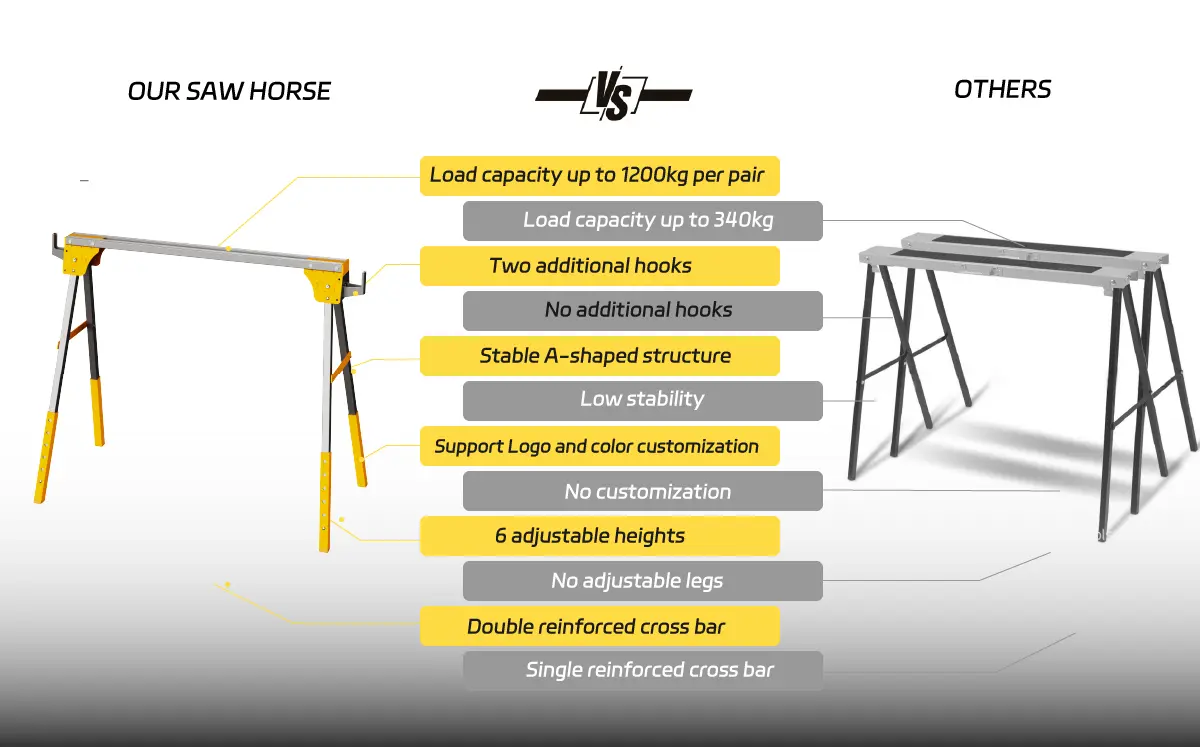
The central problem in a competitive tool category is rarely a lack of products. It is usually a lack of clear product identity.
When several folding sawhorses appear similar, buyers may compare them primarily through price, basic specifications, or a small number of visible features. This creates pressure on suppliers and brands because a product can become a commodity even when its underlying engineering is perfectly adequate.
For B2B sellers, differentiation can influence several commercial decisions.
A distributor may need a product that fills a specific position within a professional tool range. A retailer may want an item that can be understood quickly on a shelf or product page. A private-label brand may need recognizable features that separate its SKU from similar products already available through competing channels.
The objective, therefore, is not to make every folding sawhorse completely unique.
The objective is to make the product meaningfully different for the customer who is expected to buy it.
Differentiation Is More Than Adding Features
A common mistake is to treat differentiation as a feature-counting exercise.
One model may have adjustable legs. Another may have hooks. A third may use a different color. A fourth may fold thinner. If the features are simply accumulated without a clear market purpose, the result can be a product with a long specification sheet but no strong identity.
A better approach is to ask:
- Which buyer problem is this feature solving?
- Can the benefit be recognized quickly?
- Does the feature fit the intended market position?
- Does it support the product’s visual identity?
- Can it be communicated clearly in packaging and online listings?
- Does it create a useful distinction from competing products?
The most effective differentiation usually comes from the combination of several compatible characteristics, rather than from a single isolated specification.
Feature Identity Versus Feature Quantity
A folding sawhorse with six generic features may be less distinctive than one with three features that work together.
For example, adjustable height, integrated hooks, and a compact folding structure can form a coherent proposition around flexibility and portability. The value is not simply that the product has three features. The value comes from how those features collectively support a specific positioning.
That difference is important for B2B procurement because a buyer is not purchasing a list of specifications. The buyer is purchasing a product that must eventually be merchandised, explained, compared, and sold.
A Useful Differentiation Test
A simple test is to remove the brand name and product photo from a competitor comparison.
If the sales team cannot explain why a product belongs in a different position from another SKU within a few sentences, the product may not yet have a strong commercial identity.
Can the Difference Be Understood Quickly?
The strongest differentiation should be understandable through a small number of visible or easily communicated characteristics.
A buyer should be able to recognize:
What is distinctive?
Who is it for?
Why would this product deserve a position in my assortment?
Those three questions should guide the rest of the product strategy.
What Product Differentiation Really Means for a Folding Sawhorse
For a folding sawhorse, differentiation can be built across several layers rather than one single feature.
The first layer is the physical product. This includes its structure, foldability, adjustment, accessories, materials, dimensions, and visible construction.
The second layer is the product configuration. Two products may use similar components but combine them differently, creating different use cases or commercial identities.
The third layer is the market presentation. Color, packaging, photography, naming, feature hierarchy, and product-page messaging influence how quickly buyers understand the product.
The fourth layer is the commercial program behind the product. OEM support, private-label development, custom colors, packaging options, sample support, and production flexibility can make one supplier more useful to a brand than another.
This means a folding sawhorse can be differentiated without inventing an entirely new category.
1.Differentiation Is More Than Adding Features
A product architecture is the way the main components work together to create a recognizable product proposition.
For example, a metal folding sawhorse can be positioned not simply as another metal stand, but as a coordinated system combining:
- A reinforced structural frame
- Adjustable working height
- Compact folding
- Integrated hooks
- Non-slip support elements
- A recognizable color system
- A defined target market
Each characteristic contributes to the overall identity.
The important point is that the architecture should be coherent.
A feature should exist for a reason. It should support either functionality, usability, visual recognition, commercial positioning, or some combination of these.
2.Create a Feature Stack Instead of a Feature List
A useful product-development method is to build a feature stack.
At the base is the essential structural function. Above that are productivity-oriented features. Then come convenience features. Finally, the product can receive visual and branding elements that make the proposition recognizable.
For example:
Base function → Adjustable support → Integrated organization → Compact storage → Brand-specific appearance
This creates a logical story.
A product page can then communicate more than “folding metal frame with hooks.” It can communicate a deliberate product concept designed around flexible working conditions and efficient storage.
This distinction becomes particularly useful when a brand sells several sawhorses in one product range.
Differentiate According to the Buyer, Not the Entire Market
Not every buyer values differentiation in the same way.
A professional tool distributor may prioritize assortment gaps and reliable positioning.
A hardware retailer may care more about shelf recognition, packaging communication, and a clear price-feature relationship.
A private-label brand may prioritize customization and exclusive visual identity.
A contractor-focused brand may emphasize jobsite-oriented features and rugged positioning.
Therefore, trying to create a single universal proposition can weaken the product.
1.Differentiation for Tool Distributors
Distributors often manage multiple brands and product categories. Their challenge is not simply finding a functional folding sawhorse; it is finding a product that fills a commercially useful position within their existing range.
A distributor may already have a basic model. Adding another nearly identical SKU can create internal competition.
A more useful approach is to define a different role.
For example:
- Entry-level compact model
- Mid-range adjustable model
- Feature-rich professional model
- Premium private-label model
- Contractor-focused configuration
The exact segmentation depends on the distributor’s portfolio, but the principle is consistent: each SKU should have a reason to exist.
2.Differentiation for Retailers
Retail buyers often need a product that communicates quickly in both physical and digital environments.
This makes visual differentiation more important.
A distinctive color, clear feature hierarchy, recognizable shape, and useful packaging information can reduce the amount of explanation needed from the salesperson or online product page.
Retail differentiation should therefore extend beyond the product itself.
The product image, headline, packaging, specification table, and feature icons should all communicate the same positioning.
3.Differentiation for Private-Label Brands
Private-label customers have an additional challenge.
They are not simply sourcing a product. They are building an identity around the product.
This makes OEM customization an important part of differentiation.
Custom logo placement, Pantone color matching, packaging design, product naming, labeling, and selected structural modifications can turn a common product platform into a more recognizable brand asset.
The goal is not necessarily to redesign everything.
It can be more commercially efficient to start with a proven product architecture and customize the elements that matter most to brand recognition.
Turn Specifications Into a Market Proposition
Specifications are necessary, but specifications alone rarely create strong differentiation.
Consider a listing that says:
“Metal frame, adjustable legs, folding design, hooks.”
That description tells the buyer what the product contains, but it does not clearly explain its market position.
Now consider a different approach:
“A compact adjustable folding support system designed for brands serving mobile woodworking and jobsite users, with integrated utility hooks and a recognizable high-visibility product format.”
The second version connects the features to a commercial purpose.
1.Use Specifications as Evidence of Positioning
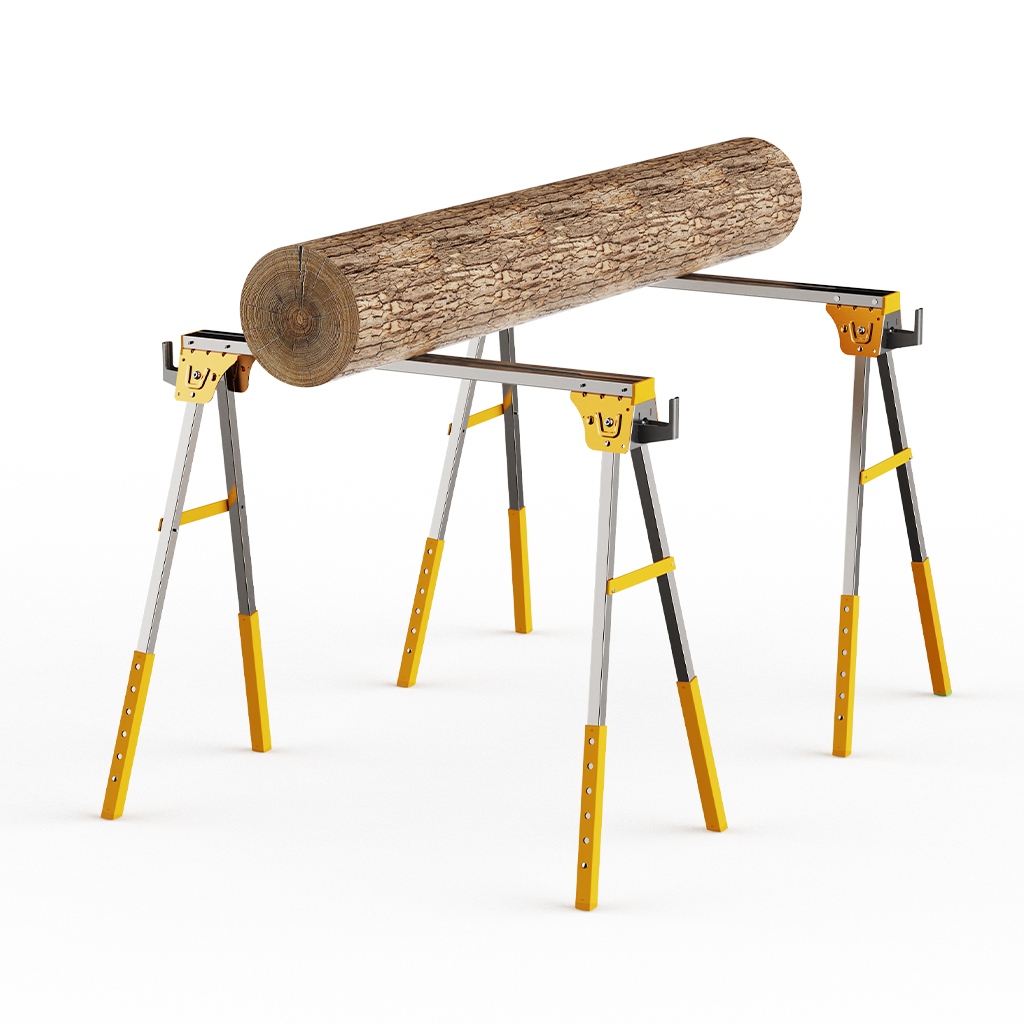
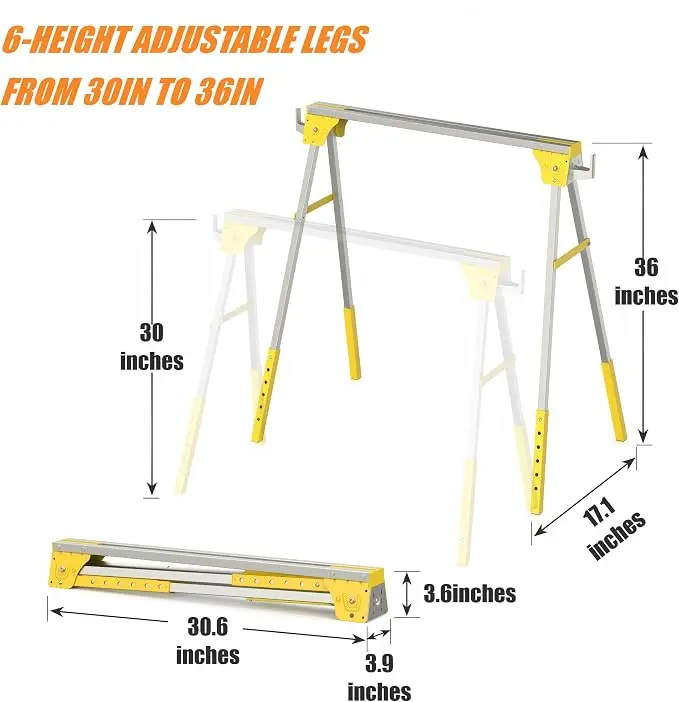
For example, the NH-SH001 folding sawhorse configuration includes:
- Metal + PP + TPR construction
- Height adjustment
- Two integrated hooks
- 4.5 kg unit weight
- 2650 lbs per pair load capacity
- 88.7 × 43 × 72.6 cm unfolded dimensions
- 78 × 10.7 × 9.7 cm folded dimensions
- Green, yellow, and blue color options
The important marketing question is not whether every specification must appear repeatedly.
The better question is:
Which specifications support the intended market position?
For a portable professional tool range, compact folded dimensions may become an important positioning element.
For a jobsite-oriented product, visible color and utility hooks may contribute more to product identity.
For a private-label brand, color, packaging, and logo customization may be more commercially important than adding another generic feature.
2.Avoid Turning Every Specification Into a Selling Point
A common mistake in B2B product marketing is treating every measurable characteristic as equally important.
They are not.
A strong product page should create a hierarchy:
Core proposition → key differentiators → supporting specifications → technical details
This hierarchy helps buyers understand the product faster.
It also makes the SKU easier for distributors and retailers to position internally.
How a Real Folding Sawhorse Can Be Differentiated: The NH-SH001 Example
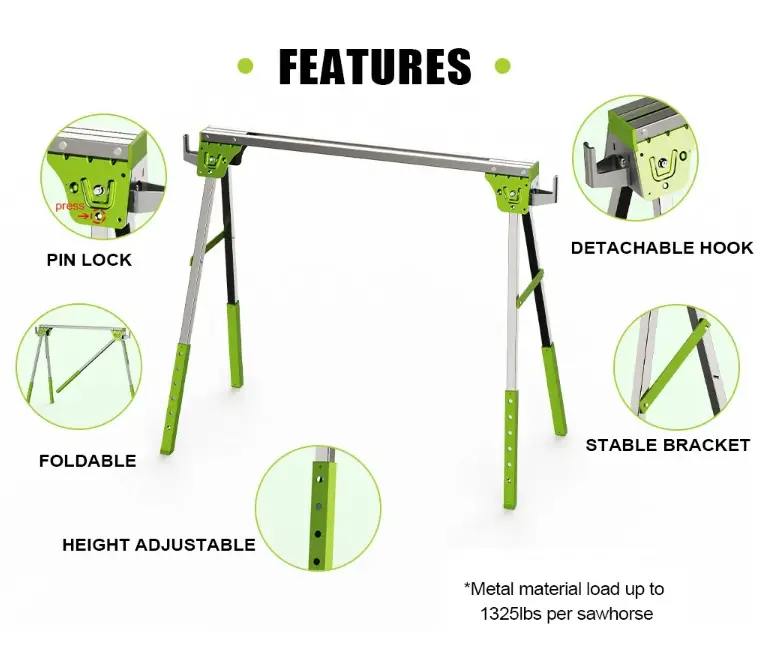
The NH-SH001 provides a useful example of how a folding sawhorse can be positioned through feature combination rather than a single headline specification.
The product is available in green, yellow, and blue and combines a metal structure with PP and TPR components. It also includes height adjustment and two integrated hooks, while the folding structure reduces its storage thickness significantly.
These characteristics create several opportunities for differentiation.
1.Differentiate Through Functional Combination
The product’s value is not simply that it has adjustable legs.
The more meaningful proposition is the relationship between:
adjustability + folding portability + integrated hooks + professional visual identity
Together, these features can support a market position around flexible, practical jobsite support.
That is different from marketing each feature independently.
2.Differentiate Through Visual Recognition
Color can play an important role in tool merchandising.
For example, a yellow version can create a high-visibility appearance suited to professional jobsite-oriented merchandising. Green and blue variants can support different retailer or private-label assortments.
Color should not be treated as decoration alone.
For a brand, it can become part of:
- SKU identification
- packaging recognition
- category organization
- product photography
- brand consistency
- retailer assortment planning
This is especially relevant when a manufacturer provides color matching or private-label support.
2.Differentiate Through Visual Recognition
For B2B buyers, product differentiation may also come from the supplier’s ability to adapt the product.
A supplier capable of supporting logo printing, Pantone color customization, packaging customization, and selected structural modifications can offer more flexibility than a supplier that only sells a fixed catalog item.
This is where product differentiation and supplier differentiation begin to overlap.
A retailer may receive a folding sawhorse.
A private-label brand may receive a folding sawhorse that has been adapted into its own product system.
That is a fundamentally different commercial proposition.
Build Differentiation Beyond the Physical Product
A product can be well differentiated physically and still look generic online.
For B2B tool brands, the product presentation should reinforce the physical proposition.
1.Product Photography Should Show the Difference
Product photography should not simply show the sawhorse standing against a white background.
A differentiated product presentation can use a sequence such as:
- Full product view
- Folded and unfolded comparison
- Close-up of distinctive features
- Color variants
- Product in a professional environment
- Packaging or private-label presentation
- Detail view of hooks, adjustment, or frame construction
This gives buyers multiple ways to recognize the product.
2.Packaging Should Support Positioning
Packaging is especially important for retail-facing buyers.
The front of the package should communicate the primary product proposition.
The side or back can explain secondary features.
Avoid placing every specification in the same visual hierarchy.
Instead, organize the communication around:
What it is → Why it is different → Who it is for → Key specifications
This makes a folding sawhorse easier to sell without relying entirely on salesperson explanation.
3.Product Naming Can Create Separation
Product names should also help distinguish SKUs.
Instead of repeatedly naming every product simply “Folding Sawhorse,” a range may use product-family naming based on its commercial position.
For example:
- Compact Folding Sawhorse
- Adjustable Folding Sawhorse
- Folding Sawhorse with Utility Hooks
- Professional Folding Sawhorse
- Private-Label Folding Sawhorse Series
The objective is not to stuff keywords into product names.
The objective is to make the assortment easier to understand.
Differentiation for Distributors and Retail Buyers
For B2B customers, differentiation has another dimension: commercial usability.
A distributor may sell the same product across several channels. A retailer may have limited category space. A brand may need to justify why a new SKU deserves a place beside an existing product.
This makes the commercial package important.
1.Give Each SKU a Clear Role
A practical assortment should avoid unnecessary overlap.
For example, if two products have nearly identical dimensions, appearance, target user, and price position, the retailer may struggle to understand why both should be stocked.
Instead, define clear roles around:
- Feature level
- Target customer
- Product appearance
- Packaging
- Price position
- Brand identity
- Channel
The more clearly these roles are separated, the easier it becomes to manage the range.
2.Use Portable Saw Horses as a Positioning Opportunity
Portability is already familiar in this category, so simply saying that a product is portable is usually not enough.
The differentiation opportunity is to define what portability means for the target channel.
For one buyer, portability may mean fitting into a service vehicle.
For another, it may mean efficient warehouse storage.
For a retailer, it may mean a compact package and easy handling.
For a professional user, it may mean quick transition between jobsites.
The word “portable” becomes commercially useful only when it is connected to a specific buyer need.
Avoid Weak Forms of Folding Sawhorse Differentiation
Not every difference is a valuable difference.
Some forms of differentiation can add complexity without giving buyers a meaningful reason to choose the product.
1.Too Many Similar Features
Adding hooks, trays, clips, color variations, accessories, or small adjustments can make a product look more advanced.
But if the target buyer does not value them, they may only increase product complexity.
2.Cosmetic Changes Without Market Purpose
A new color alone does not necessarily create a new market position.
Color becomes more powerful when it supports a recognizable product family, retailer assortment, private-label brand identity, or professional visual language.
3.Generic Claims
Statements such as “premium,” “professional,” “high quality,” or “heavy duty” are widely used across the tool industry.
They are weak differentiators when they are not supported by a clear reason.
A stronger approach is to show the underlying product characteristics and explain what commercial role they serve.
4.Copying Competitor Feature Language
Another weak approach is to reproduce the same feature sequence used by competitors.
Even if the product itself is different, the presentation may still appear generic.
A stronger strategy is to define the product proposition first and then organize the specifications around that proposition.
A Practical Folding Sawhorse Differentiation Framework
For a brand or distributor developing a new product, a simple framework can help organize the decision.
1.Step 1 — Define the Intended Position
Start with the commercial role.
Is this an entry-level product, a professional mid-range SKU, a feature-rich model, a private-label product, or a specialist offering?
2.Step 2 — Identify the Three Most Important Differentiators
Choose only the characteristics that genuinely separate the product.
For example:
Adjustable + compact folding + integrated organization
This is easier to communicate than a long feature list.
3.Step 3 — Match Features to Buyer Expectations
Ask whether each differentiator matters to the target customer.
A feature that matters to a contractor may not matter to a mass-market retailer.
4.Step 4 — Make the Difference Visible
Use shape, color, product photography, packaging, naming, icons, and product descriptions to reinforce the same proposition.
5.Step 5 — Separate SKUs Clearly
Each SKU should have a defined role in the product portfolio.
Avoid creating products that compete directly against each other without a clear reason.
6.Step 6 — Add Brand-Level Customization
For private-label programs, consider:
- Logo placement
- Pantone color
- Packaging
- Labels
- Product naming
- Selected structural changes
- Accessories or configuration options
7.Step 7 — Validate the Commercial Story
Before mass production, ask:
Can a buyer explain the product difference in one sentence?
If the answer is no, the differentiation strategy may still be too complicated.
Why Supplier Capability Can Become Part of Product Differentiation
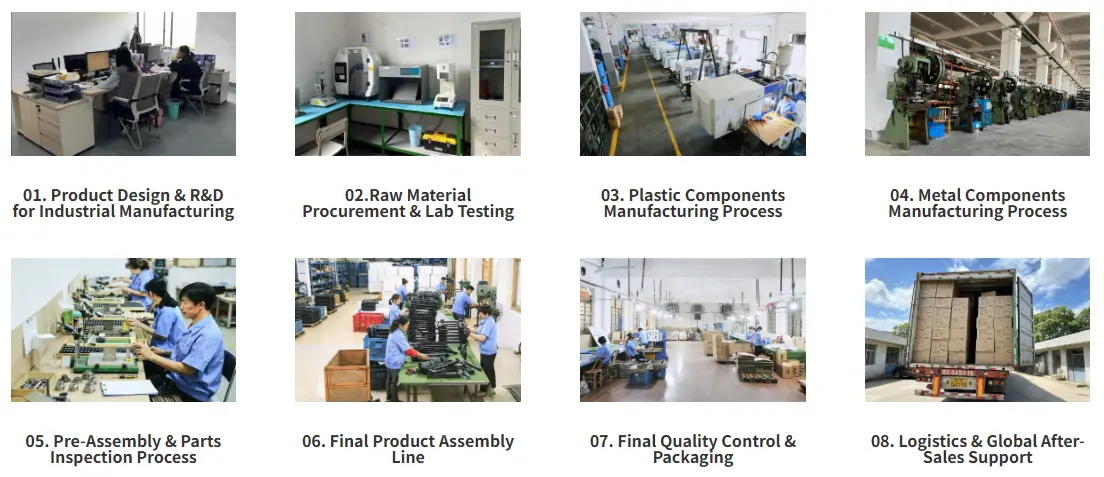
For B2B buyers, the product is only one part of the decision.
Two suppliers may offer products with similar specifications, yet provide very different levels of development support.
This is particularly important for brands that plan to build a long-term tool assortment.
Ningbo Jingyan Tool Industrial Co., Ltd. has operated since 2003 and combines R&D, mold development, production, quality control, and customer service within its manufacturing system. Its production base covers approximately 16,000㎡ and includes more than 50 sets of production equipment.
For a folding sawhorse project, this type of manufacturing structure can support differentiation at several stages, from product configuration and plastic component development to packaging and OEM/ODM adaptation.
The point is not that factory size automatically makes a product better.
The more relevant question is whether the supplier has enough development and manufacturing capability to turn a market position into a repeatable product program.
For brands building their own range, that distinction can be commercially important.
How to Make Folding Sawhorses Easier to Sell
A differentiated product should also be easier for the next person in the supply chain to sell.
A distributor needs a clear product story.
A retailer needs a clear product page.
A sales representative needs a short explanation.
A private-label brand needs a recognizable identity.
Therefore, differentiation should eventually become a sales communication system.
A useful structure is:
Product identity → Three key differentiators → Supporting specifications → Target users → OEM/customization options
This format can be adapted for websites, catalogs, product packaging, trade-show materials, quotations, and sales presentations.
The product then becomes easier to understand across multiple channels without changing its basic identity.
Differentiation Should Support Long-Term Product Strategy
The strongest folding sawhorse differentiation is not necessarily the most dramatic.
It is the differentiation that can survive beyond a single marketing campaign.
A useful product position should remain meaningful when:
- The product enters another market
- A retailer creates a new listing
- The brand expands its tool range
- A new color is introduced
- Packaging changes
- Another related SKU is developed
This is why product architecture and SKU strategy matter.
A clear product platform can support several configurations while maintaining a recognizable family identity.
For OEM and private-label buyers, that can reduce the need to develop completely separate products for every market.
Folding Sawhorse Differentiation Checklist for B2B Buyers
Before launching or sourcing a new folding sawhorse, review the product against the following questions:
Market Position
- What role does the product fill?
- Which buyer segment is the priority?
- What competing SKU is it intended to differentiate from?
Product Identity
- What are the three most recognizable features?
- Do those features work together as a coherent proposition?
- Is the product visually distinguishable?
Commercial Presentation
- Can the difference be explained quickly?
- Does packaging reinforce the same message?
- Do product images make the unique characteristics obvious?
Assortment Strategy
- Does the SKU have a clear reason to exist?
- Will it overlap with another product in the same range?
- Can the product support future variants?
OEM Capability
- Can color, logo, packaging, or selected specifications be customized?
- Can the supplier support samples and production at the required scale?
- Can the product concept be maintained consistently during mass production?
A product that performs well on these questions has a stronger foundation for market differentiation than a product that simply contains more features.
FAQ About Folding Sawhorse Product Differentiation
1.What is the most important factor when differentiating a folding sawhorse?
There is no single universal factor. Effective differentiation usually comes from a coherent combination of product features, target customer, visual identity, and commercial positioning.
2.Does adding more features make a folding sawhorse more competitive?
Not necessarily. More features can increase complexity without creating stronger customer value. The better approach is to select features that support a clear market position.
3.How can a retailer differentiate one folding sawhorse from another?
Retailers can use product role, color, packaging, feature hierarchy, naming, price position, and target customer to create clearer separation between SKUs.
4.Can a metal folding sawhorse be differentiated without redesigning the whole structure?
Yes. Differentiation can come from feature combinations, color, branding, packaging, accessories, product configuration, and market positioning without requiring a completely new platform.
5.How does OEM customization help differentiate a folding sawhorse?
OEM customization can help a brand create a stronger identity through logo placement, color matching, packaging, product naming, and selected structural modifications.
6.Is portability enough to differentiate folding sawhorses?
Usually not by itself. Portability becomes more meaningful when connected to a particular buyer need, such as jobsite movement, vehicle storage, warehouse handling, or compact retail packaging.
7.Should every folding sawhorse SKU have different hardware?
No. A product family can share a proven platform while differentiating selected features, appearance, accessories, packaging, or commercial positioning.
8.What should a brand ask a folding sawhorse manufacturer?
The discussion should cover more than price. Buyers should ask about product customization, sample development, manufacturing capabilities, quality control, packaging, color matching, MOQ, lead time, and long-term production consistency.
Conclusion: Make the Product Different for a Reason
The folding sawhorse market does not need products to become different simply for the sake of being different.
It needs products to become clearer in purpose.
For brands, distributors, and retailers, the stronger strategy is to identify a target position, select a small number of meaningful differentiators, combine them into a coherent product architecture, and then reinforce that identity through appearance, packaging, SKU strategy, and OEM customization.
A successful folding sawhorse therefore should not only answer:
“What features does this product have?”
It should also answer:
“Why does this product deserve a distinct position in the market?”
That is the foundation of sustainable product differentiation.
For manufacturers supporting B2B tool programs, the same principle applies at the supplier level. A factory becomes more valuable when it can move beyond supplying a standard product and help convert a buyer’s market position into a consistent, scalable product program.
For brands and distributors evaluating a new folding sawhorse range, that is where product development, OEM capability, and commercial strategy begin to work together.
Related products