Lightweight Folding Hand Truck: What Does It Mean for Retail Buyers?
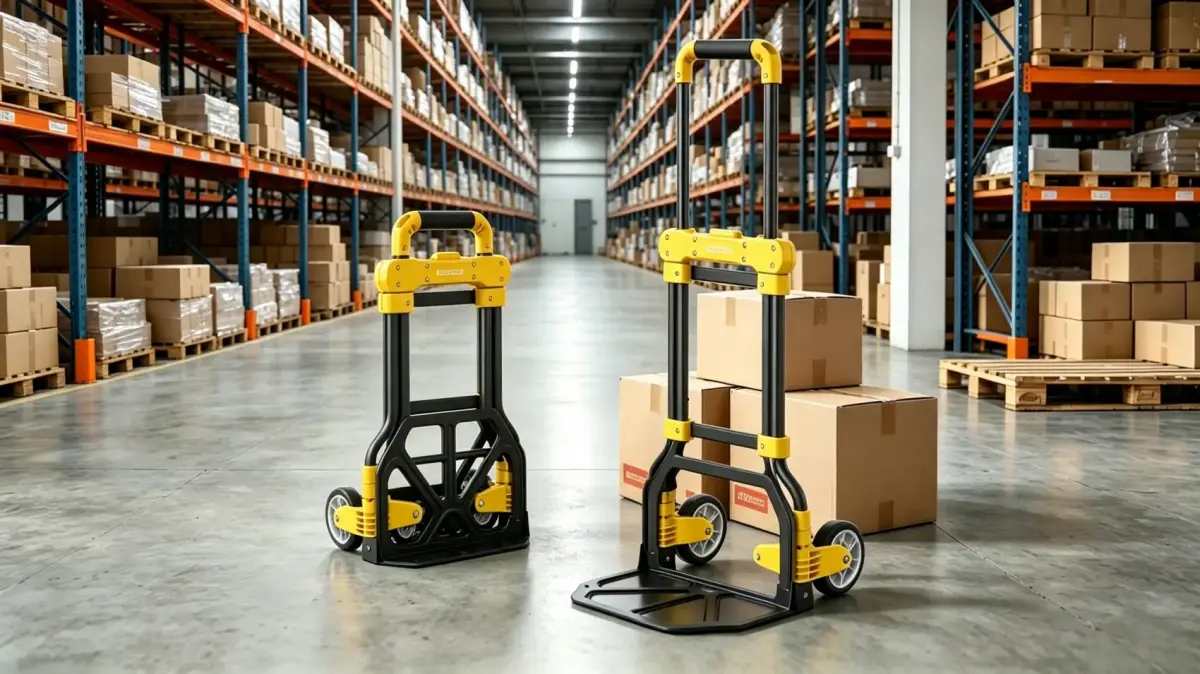
For a retail buyer, a lightweight folding hand truck is not simply a product with a low number on the specification sheet. The more important question is what that lower weight means in a real retail environment.
A hand truck may be used by store employees to move cartons from a receiving area, restock shelves, transfer merchandise between departments, handle returns, or transport supplies through a backroom several times a day. In these situations, product weight can directly influence how easy the equipment is to pick up, maneuver, position, and store between tasks.
That makes lightweight design a commercial consideration rather than just a convenience feature.
For retailers and distributors, however, the goal should not be to find the lightest possible hand truck. A product that is extremely light but cannot provide sufficient structural stability, durability, or practical load performance may create more problems than it solves. The better approach is to evaluate how efficiently the product converts its weight into usable handling performance.
This article explains what lightweight design really means for retail buyers, how it can affect day-to-day store operations, what trade-offs should be considered, and how buyers can evaluate a lightweight model before adding it to their product assortment.
- 1. What Does “Lightweight” Really Mean in a Retail Hand Truck?
- 2. Why Weight Matters More in Retail Than Many Buyers Expect
- 3. How Lightweight Design Affects Retail Product Positioning
- 4. How to Evaluate the Weight-to-Performance Balance
- 5. Why Lightweight Design Can Matter During Retail Restocking
- 6. What Retail Buyers Should Ask a Lightweight Hand Truck Supplier
- 7. How Retail Buyers Can Decide Whether a Lightweight Model Belongs in the Assortment
- FAQ About Lightweight Folding Hand Trucks for Retail Buyers
- Ready to Evaluate a Lightweight Hand Truck for Your Retail Market?
What Does “Lightweight” Really Mean in a Retail Hand Truck?
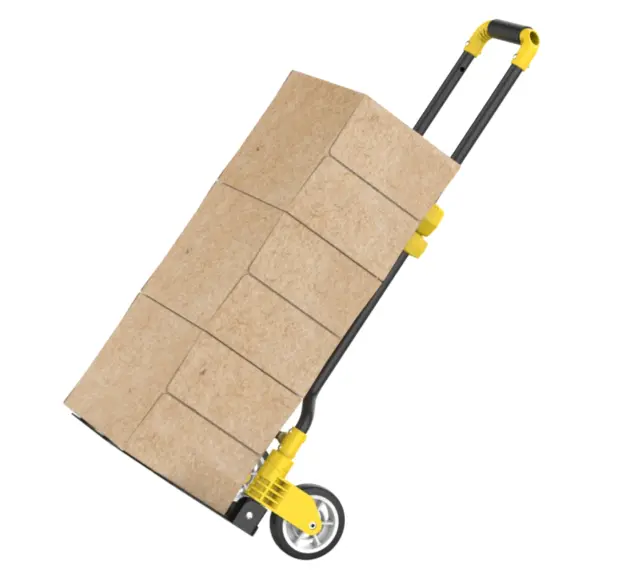
When buyers see the word “lightweight,” they often assume it simply means a lower product weight.
That definition is incomplete.
For retail applications, lightweight design should be understood as the relationship between the product’s physical weight, handling effort, load capability, maneuverability, and frequency of use.
A 4 kg product that is awkward to control may be less practical than a 5 kg product with better balance and smoother movement. Likewise, a lightweight structure that feels unstable under normal retail loads may not provide the commercial value expected from a supposedly easy-to-handle product.
1.Lightweight Should Mean Easier Handling
The first benefit retailers should look for is reduced physical effort.
Store employees may need to move the same equipment repeatedly throughout a working day. A hand truck that is easier to lift, reposition, or pull into position can become more convenient in these repetitive tasks.
This matters particularly in environments where employees do not use dedicated material-handling equipment for every movement. A compact store backroom, supermarket, retail warehouse, or showroom may require workers to move products manually between different areas.
In that context, lower equipment weight can reduce the effort required to start each handling task.
The benefit is not limited to carrying the hand truck itself. It can also influence how quickly employees reposition it before loading merchandise, move it around shelving, or put it away after use.
2.Lightweight Does Not Mean Weak
A common procurement mistake is to treat low weight and low strength as opposite ends of a simple scale.
In reality, product engineering is more complicated.
A manufacturer may reduce unnecessary material, optimize component design, use different material combinations, or redesign joints and structural elements without simply making the entire product weaker.
For retail buyers, the better question is therefore not:
“How light is the product?”
It is:
“How much practical handling performance does the product provide at its working weight?”
That distinction becomes particularly important when the product will be sold through multiple retail channels or used by employees with different levels of experience.
3.Lightweight Should Be Considered in Relation to the Product’s Intended Load
A hand truck intended for small cartons and frequent store replenishment does not necessarily need the same construction philosophy as equipment designed for very heavy industrial loads.
This gives retail buyers more room to evaluate weight intelligently.
For example, a product designed for routine merchandise movement may prioritize:
- Easy repositioning
- Comfortable handling
- Smooth movement
- Fast deployment
- Convenient storage
- Sufficient load support
- Consistent everyday performance
The objective is not to maximize one specification. It is to create a balanced retail product.
Why Weight Matters More in Retail Than Many Buyers Expect
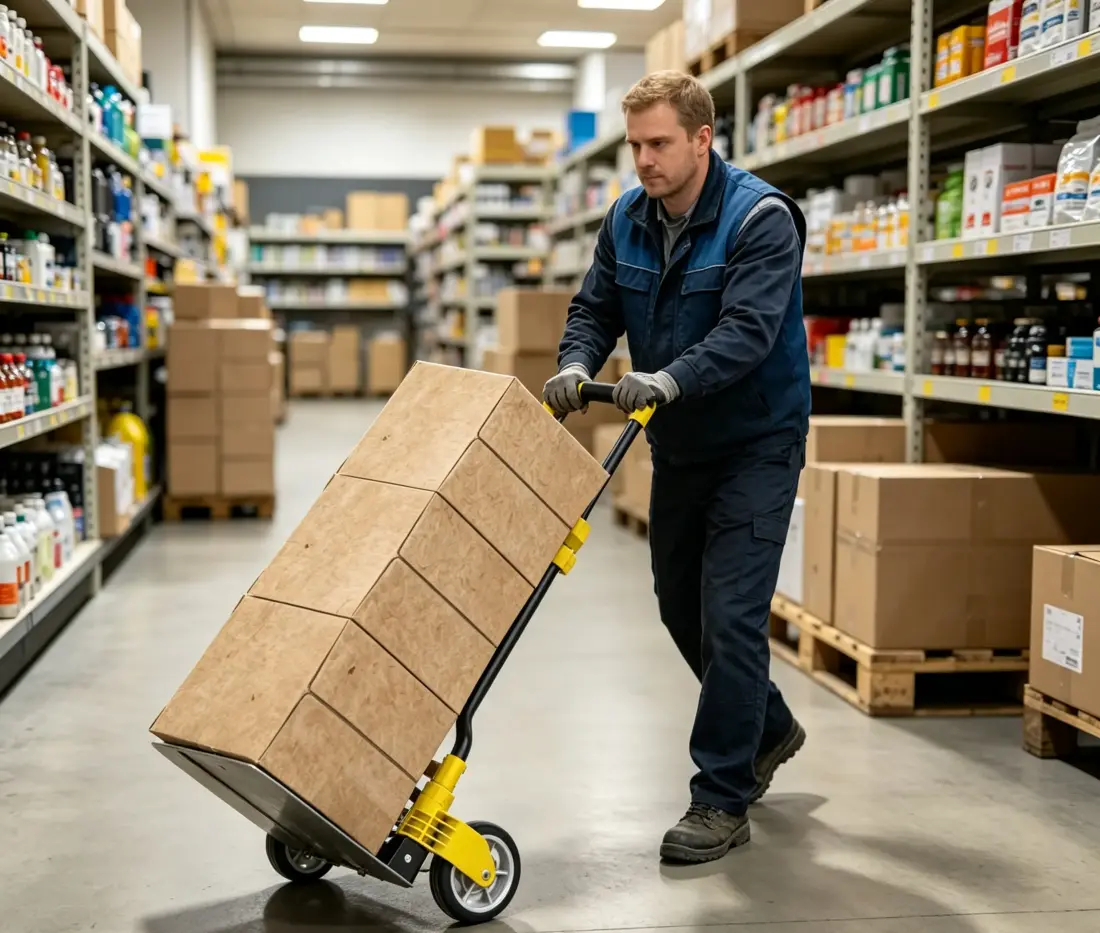
Retail environments create a different set of requirements from heavy industrial handling.
The same hand truck can be used dozens of times during the week, and sometimes many times during a single shift. Employees may move it through narrow backroom areas, around shelves, between storage zones, or from receiving areas to the sales floor.
That repeated movement changes the value of lightweight design.
1.Frequent Repositioning Makes Weight More Important
Imagine two similar hand trucks.
One is slightly heavier but has no meaningful advantage for the intended retail application. The other is lighter while still offering suitable load support and stable operation.
The lighter option may be easier for employees to reposition whenever the handling direction changes.
This becomes relevant when:
- Merchandise arrives in multiple small batches
- Shelves need frequent replenishment
- Different departments share the same equipment
- The hand truck moves between the backroom and sales floor
- Employees need to put the equipment away after use
In other words, retail handling is often about frequency rather than maximum load alone.
The product may not be asked to carry its maximum rated load every time. It may instead be moved, deployed, loaded, unloaded, and repositioned repeatedly throughout the day.
2.Retail Employees May Need to Handle the Equipment Before Loading It
One overlooked part of the user experience is what happens before the merchandise is even placed on the hand truck.
Someone has to:
- Take the hand truck to the required area.
- Position it correctly.
- Prepare it for use.
- Load the goods.
- Move the goods.
- Unload them.
- Return the equipment.
A lower-weight product can make the equipment itself easier to manage during these steps.
That is why retail buyers should assess the complete handling sequence, not just load capacity.
3.Easier Handling Can Support More Flexible Store Operations
Retail stores frequently change their operational priorities.
One day the equipment may be used for carton handling. Another day it may be used for shelf replenishment, moving promotional merchandise, transporting store supplies, or assisting with internal transfers.
A lightweight hand truck can be attractive because employees can take it where it is needed without treating the equipment itself as a major handling burden.
This does not make lightweight design a universal solution. It simply means the product can fit better into work environments where mobility and repeated repositioning matter.
How Lightweight Design Affects Retail Product Positioning
For distributors and retail buyers, the product is not only an operating tool. It is also part of a product assortment.
That means weight can influence how the product is positioned and who the intended customer is.
1.Lightweight Can Support a More Accessible Product Positioning
A lighter hand truck may appeal to customers who prioritize portability and convenience rather than maximum industrial capacity.
Potential retail positioning can include:
- Store and stockroom handling
- Delivery and service use
- Small business operations
- Office material movement
- Light commercial transportation
- General merchandise handling
This does not mean the product has to be marketed as a consumer-only item.
A lightweight hand cart can still have strong commercial positioning when its construction and load performance are appropriate for professional use.
The important point is that the product proposition becomes broader than “heavy-duty equipment.”
2.Product Weight Can Influence Who Feels Comfortable Using It
Retail buyers should also consider the actual people who will use the product.
Different users have different expectations. Some customers may value maximum load capacity above everything else. Others may care more about whether one person can easily pick up, move, and store the equipment.
For distributors, understanding this distinction can help create a clearer product assortment.
Instead of offering several models that are all positioned around “more capacity,” a retailer may find value in having a model designed around ease of handling and portability.
That gives the assortment another clear selling point.
3.Lightweight Should Be a Benefit, Not the Entire Product Story
A common mistake in retail product positioning is turning one specification into the entire marketing message.
“Only 3.69 kg” may attract attention, but weight alone does not tell the buyer whether the product is useful.
A stronger product story combines weight with meaningful benefits:
Lightweight + suitable load capacity + practical construction + easy handling + reliable everyday use.
That combination gives the retailer more substance to communicate.
How to Evaluate the Weight-to-Performance Balance
This is one of the most important sections for procurement teams.
A lightweight hand truck should not be selected simply because its weight is lower than competing models. Buyers need to determine whether the product has reduced unnecessary weight while preserving the performance expected in the target market.
1.Start With the Required Retail Load
Before comparing product weights, define the typical load.
A retailer that primarily handles packaged merchandise may have very different requirements from a business transporting dense industrial materials.
Consider:
- Typical carton weight
- Maximum routine load
- Frequency of heavy loads
- Type of merchandise
- Surface conditions
- Distance of movement
- Frequency of daily use
The goal is to establish a realistic operating range.
For a broader product-selection framework, buyers can also review our guide on how to choose a folding hand truck.
If the required retail workload is moderate, there may be no commercial reason to carry a significantly heavier structure simply because it has a much higher theoretical capacity.
2.Consider the Frame and Material Combination
The material system matters because product weight is determined by more than one component.
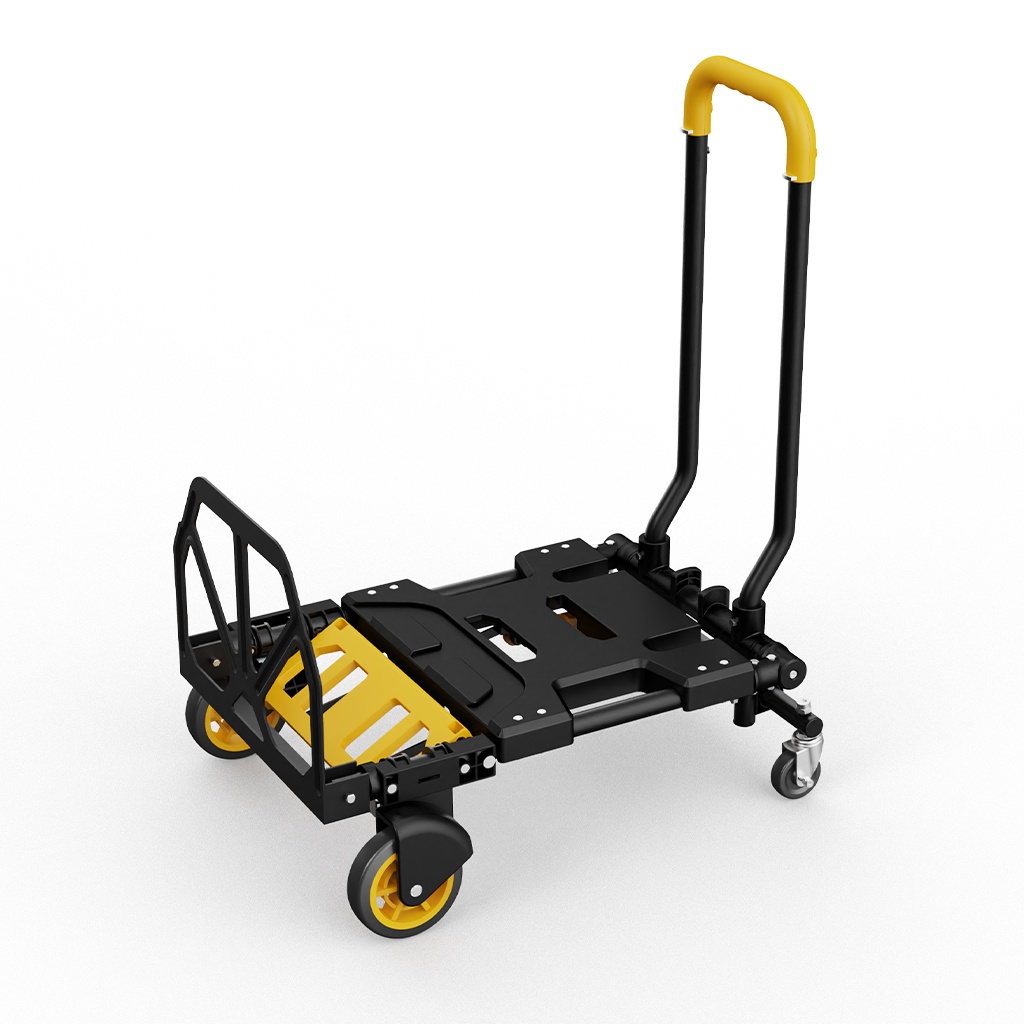
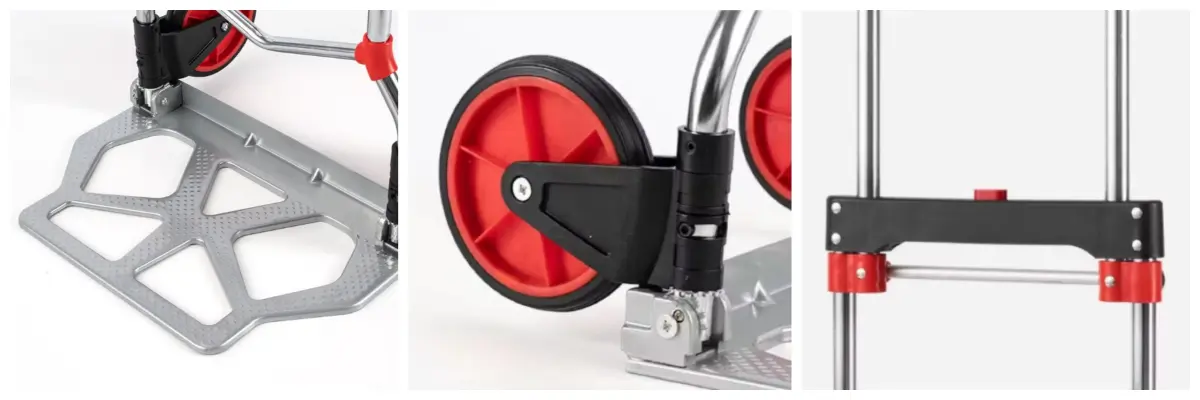
The folding hand truck discussed in this article uses a TPU + PA + iron construction. The combination allows the product to maintain a practical structural framework while controlling overall weight.
For buyers, the lesson is not that one material combination is automatically better than another.
Instead, ask the supplier:
- Which parts provide the main structural support?
- Which parts are optimized for weight reduction?
- What materials are used in the frame and key connection areas?
- How are moving components tested?
- How is consistency maintained between production batches?
These questions help buyers understand whether “lightweight” comes from thoughtful design or simply from reducing material.
3.Check Weight Together With Load Capacity
The example product has a 3.69 kg product weight and a listed 100 kg load capacity.
That combination is more meaningful than the weight figure alone because it shows the buyer how the manufacturer has positioned the product.
The important procurement question is whether that combination matches the retailer’s intended market.
For a retailer, a lighter structure may create greater value when its capacity remains sufficient for the common loads customers are expected to handle.
4.Look at Movement, Not Just Static Strength
Retail buyers sometimes focus heavily on laboratory-style specifications.
Yet a product may feel different in actual use.
The buyer should consider:
- How easily the product starts moving
- Whether the wheels roll smoothly
- How stable it feels when turning
- How easy it is to reposition
- Whether the handle feels practical
- Whether the product remains comfortable during repeated use
These factors are especially relevant when a lightweight model is intended for frequent retail handling.
The product’s value comes from the combination of weight and usability, not weight alone.
Why Lightweight Design Can Matter During Retail Restocking

Among retail applications, restocking is particularly relevant to lightweight design.
Restocking is repetitive by nature. Employees may move cartons, products, packaging materials, or supplies from one location to another many times during a working day.
1.Repeated Short-Distance Movement Changes the Buying Decision
A retailer does not always need equipment designed for long-distance transportation.
Many store operations involve short, repeated movements:
- Receiving area to stockroom
- Stockroom to shelf
- Backroom to sales floor
- One department to another
- Storage area to promotional display
In these situations, a hand truck that is easy to reposition may be more practical than a heavier model optimized for occasional high-load handling.
This is where a lightweight folding hand cart can have a clear retail use case.
2.Indoor Flooring Can Make Wheel Selection Important
Lightweight design should not be evaluated independently from wheel design.
For retail stores, noise and floor protection can matter because equipment may operate near customers, displays, polished flooring, or finished commercial surfaces.
The example product uses TPU wheels designed for smooth, low-noise movement and non-marking indoor use.
For procurement teams, this is a useful reminder: a lighter frame does not create the full user experience.
The wheels, handle, frame, and moving joints all contribute to whether the product feels practical during daily retail operations.
3.Lightweight Design Can Support Faster Equipment Rotation Between Tasks
A store may have shared equipment rather than one hand truck assigned to every department.
When the same unit must move between teams, handling convenience becomes more important.
Employees are less likely to treat a lightweight product as difficult-to-move equipment. It can be repositioned as store needs change.
That flexibility can make a product more useful without relying on a more complicated product design.
What Retail Buyers Should Ask a Lightweight Hand Truck Supplier
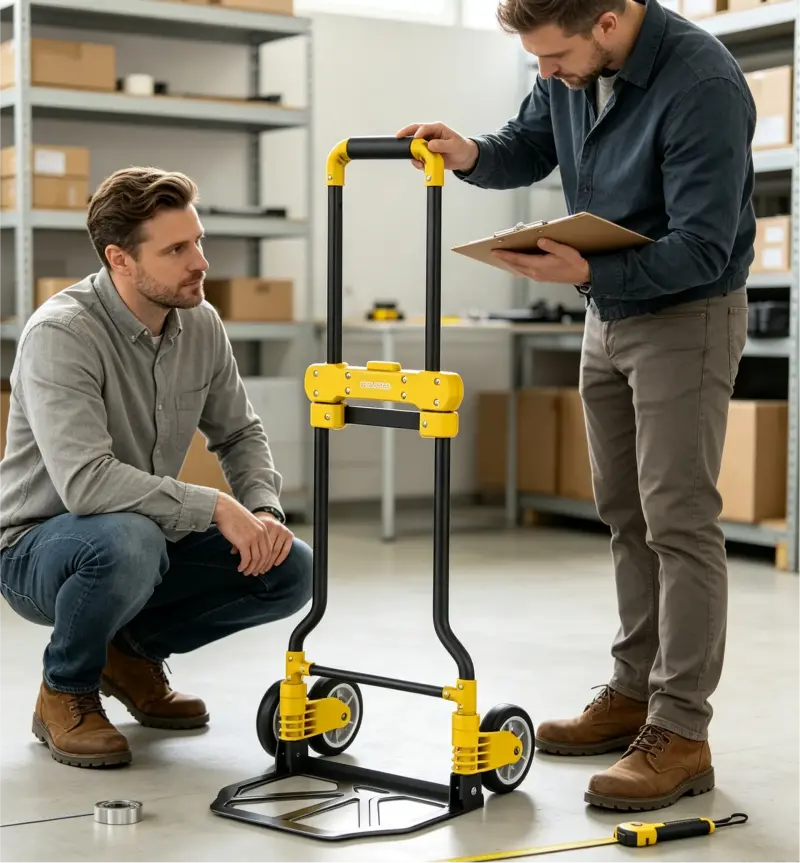
Retail procurement should not stop at comparing the numbers shown on a product sheet.
The supplier needs to demonstrate that the product can actually support the retailer’s intended positioning.
1.Ask How the Supplier Defines “Lightweight”
The word can mean different things to different manufacturers.
Ask for:
- Net product weight
- Gross shipping weight
- Material structure
- Load capacity
- Open configuration
- Folded dimensions
- Wheel material
- Available colors
- Packaging details
The goal is to make sure you are comparing products on the same basis.
2.Ask Whether Lightweight Design Has Been Tested
A low product weight is more meaningful when it is backed by controlled production and quality inspection.
Ask the supplier how it checks:
- Structural stability
- Folding performance
- Wheel function
- Handle performance
- Load performance
- Component consistency
A manufacturer with integrated production and quality-control capabilities can provide more useful evidence than a supplier that only resells finished products.
For an OEM or private-label buyer, this distinction matters even more because the supplier needs to reproduce the same product specifications across production batches.
3.Ask for a Sample Before Finalizing the Retail Program
Photos and specifications are useful, but a physical sample provides information that a product sheet cannot fully communicate.
When evaluating a sample, ask several people to use it rather than letting only one buyer test it.
Observe:
- How easy it is to pick up
- How easy it is to pull
- How stable it feels
- How the wheels behave indoors
- How quickly users understand the operating method
- Whether the product feels appropriately robust
This creates a more realistic understanding of the retail user experience.
How Retail Buyers Can Decide Whether a Lightweight Model Belongs in the Assortment
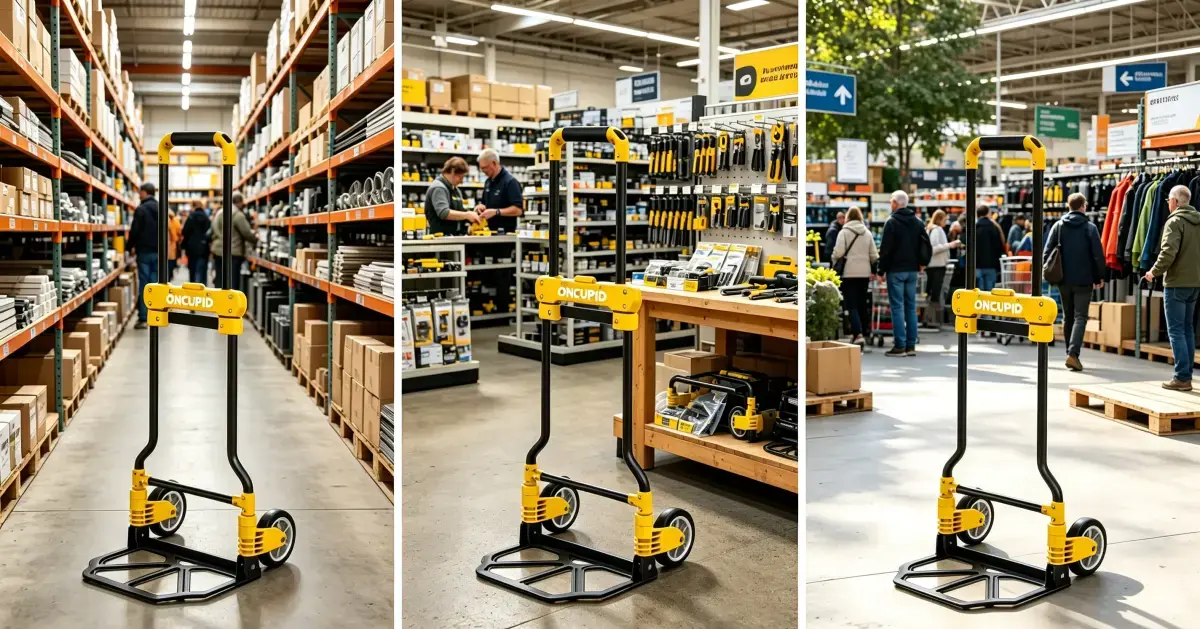
The final decision should connect product characteristics to the retailer’s commercial strategy.
1.Lightweight Makes Sense When the Customer Values Convenience
A lightweight model is particularly attractive when the target customer values:
Portability, frequent handling, easy repositioning, compact everyday equipment, and practical commercial use.
It may be less suitable when the primary requirement is maximum industrial load performance.
This is not a question of which product is universally better.
It is a question of which product is better matched to the customer segment.
2.Match the Product to the Selling Environmen
Retail buyers should ask where and how customers are likely to use the hand truck.
For example:
| Retail Environment | What Lightweight Design Can Offer |
|---|---|
| Supermarkets | Easier shelf replenishment and backroom movement |
| Hardware stores | Practical handling of merchandise and supplies |
| Convenience stores | Easier movement of frequent small loads |
| Office supply retailers | Portable handling for commercial customers |
| Logistics-related retail channels | Convenient vehicle and delivery use |
| General merchandise stores | Broad everyday handling application |
This type of positioning gives the buyer a clearer reason to stock the product.
3.Evaluate the Product as a Retail SKU
The final question is commercial:
Does the product have a clear reason to exist in the assortment?
A lightweight model can be valuable when it fills a specific customer need rather than simply duplicating an existing heavy-duty product.
Retail buyers should therefore compare:
- Customer profile
- Intended use
- Product weight
- Load requirement
- Ease of handling
- Wheel performance
- Product appearance
- Color options
- Packaging
- OEM possibilities
- Expected retail positioning
This creates a better basis for SKU selection than comparing weight alone.
FAQ About Lightweight Folding Hand Trucks for Retail Buyers
1.Is a lightweight folding hand truck suitable for retail use?
Yes, provided its load capacity, construction, wheels, and overall design match the intended retail application. Lightweight design can be particularly useful for repetitive store handling, restocking, and frequent repositioning.
2.Does lightweight mean the hand truck is less durable?
3.What is a good weight for a lightweight hand truck?
There is no universal “correct” weight. Buyers should evaluate product weight together with load capacity, structure, wheel design, and intended application. For example, the product discussed in this article weighs 3.69 kg and has a listed 100 kg load capacity.
4.Why do retailers care about hand truck weight?
Because retail equipment is often moved and repositioned repeatedly. Lower equipment weight can make the product easier for employees to handle before, during, and after merchandise movement.
5.Should a retailer choose the lightest available hand truck?
No. The objective is not minimum weight at any cost. Buyers should look for the best balance between weight, load capability, structural performance, usability, and durability.
6.Can lightweight hand trucks be customized for retail brands?
Yes. Depending on the manufacturer, customization may include color, logo, packaging, and other OEM/ODM requirements. Buyers should confirm available customization options, minimum order quantities, sample procedures, and production lead times with the supplier.
Ready to Evaluate a Lightweight Hand Truck for Your Retail Market?
For retail buyers, lightweight design is valuable when it solves a real handling problem.
The strongest lightweight product is not simply the one with the lowest product weight. It is the one that offers a practical combination of easy handling, appropriate load capacity, dependable construction, smooth movement, and a clear customer use case.
For example, a 3.69 kg folding hand truck with a listed 100 kg load capacity can provide a useful benchmark for buyers looking for a lighter commercial handling solution. The right model, however, should always be evaluated against the actual requirements of the target retail market.
Jingyan Tools supports OEM and ODM manufacturing for buyers that need product, color, logo, packaging, or market-specific customization. The company has an integrated manufacturing system covering R&D, mold development, production, quality control, and customer service, which can be useful when a retailer needs more than a standard off-the-shelf product.
A lightweight hand truck should make the product easier to handle without making its performance harder to trust.
Related products