What Should B2B Buyers Look for in a 3 Tier Cart with Wheels?
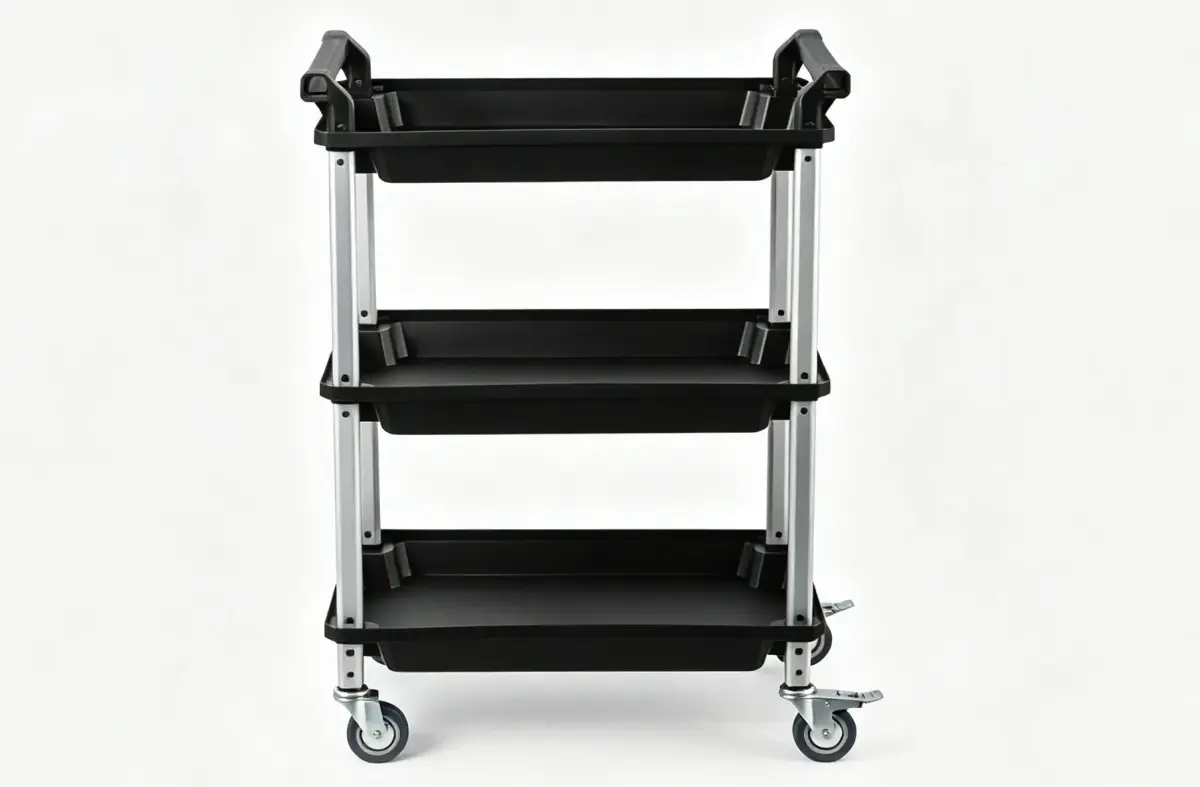
When a business is sourcing a 3 tier cart with wheels, the product photo is only the beginning of the evaluation process.
For a B2B buyer, a three-tier cart needs to do more than look practical in a catalog. It needs to fit the intended application, provide useful storage space, handle the expected load, remain manageable during movement, maintain consistent quality, and come from a supplier capable of supporting repeat orders.
That makes the buying decision very different from choosing a cart for occasional personal use.
An importer may need a specification that fits an existing product line. A distributor may need dependable quality across repeated orders. A private label brand may need custom colors and packaging. An industrial buyer may care more about dimensions, load capacity, and daily handling. The same basic three-tier design can therefore require different commercial specifications depending on the target market.
The most useful question is not simply:
“Which three-tier cart looks best?”
A better question is:
“Which three-tier cart meets the actual requirements of my market, my customers, and my supply chain?”
This guide explains the main factors B2B buyers should evaluate when sourcing a 3 tier cart with wheels, from application and dimensions to product construction, quality control, manufacturing capability, and commercial support.
- 1. Start With the Intended Use and Working Environment
- 2. Check Overall Dimensions and Usable Shelf Space
- 3. Evaluate Load Capacity for Real-World Use
- 4. Examine Material Construction and Structural Design
- 5. Review Mobility and Day-to-Day Handling
- 6. Check Quality Control and Product Consistency
- 7. Evaluate the Manufacturer, Not Just the Product
- 8. Review Packaging, Logistics, and Commercial Practicality
- 9. Use a Practical B2B Buying Checklist
- 10. What a Suitable Three-Tier Cart Should Look Like for B2B Buyers
- FAQ About Buying a 3 Tier Cart with Wheels
- Final Takeaway
Start With the Intended Use and Working Environment
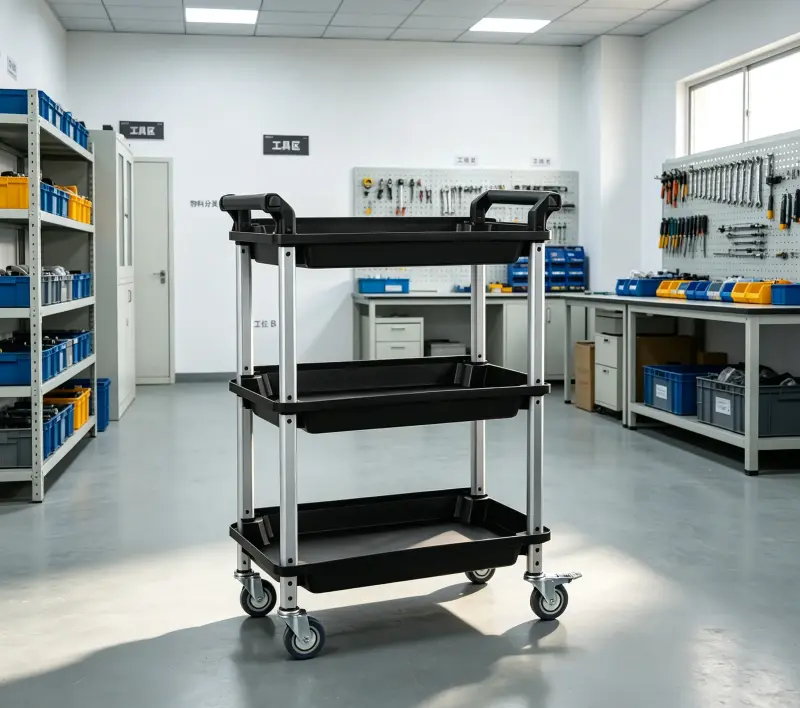
Before comparing suppliers, define what the cart is expected to do.
A 3 tier cart with wheels can be used to organize tools, transport small components, hold maintenance supplies, or support other routine handling tasks. However, the ideal product specification can change significantly from one business application to another.
A distributor serving professional workshops may need a different product profile from a retailer targeting home organization. A facility service company may have different priorities from a warehouse equipment supplier.
The buyer should therefore establish the intended application first.
1.Define What the Cart Needs to Carry
Start by identifying the typical items that will be placed on the shelves.
Depending on the end application, these may include:
- Hand tools
- Spare parts
- Small components
- Maintenance supplies
- Cleaning supplies
- Packaging materials
- Workshop consumables
- General storage items
The important point is that the product should be evaluated against the actual items it needs to hold, rather than against a generic description such as “three-tier utility cart.”
A buyer should consider not only the weight of the contents, but also their size, shape, distribution, and frequency of handling.
For example, a buyer supplying maintenance teams may need three shelves for mixed tools and consumables. Another buyer may need the shelves for boxes or small parts. Even though both customers are looking for a three-tier cart, their expectations for usable shelf area and clearance may be different.
This is why a product specification should be connected to the intended use from the beginning.
2.Think About the End User's Working Environment
The working environment is equally important.
Before placing an order, consider questions such as:
- Will the cart mainly be used indoors?
- How frequently will it be moved?
- Will it operate between workstations?
- Does it need to fit through narrow areas?
- Will the user access the cart from multiple sides?
- Will it be stored against a wall when not in use?
- Is the cart mainly being used for organization, transportation, or both?
- Will one person be responsible for moving it?
These questions help turn a broad product search into a clear purchasing specification.
For B2B buyers, this early definition is valuable because it also gives the manufacturer better information when recommending dimensions, materials, packaging, or possible customization.
A product should not be considered successful simply because it meets the category definition of a three-tier cart.
It should solve the specific handling and storage problem that the buyer is trying to solve.
Check Overall Dimensions and Usable Shelf Space
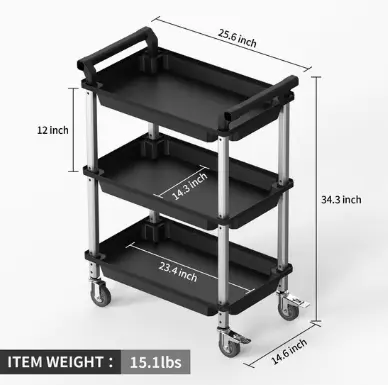
Once the intended application is clear, the next step is to evaluate the physical dimensions.
Many product listings provide only overall width, height, and depth. Those numbers are useful, but they are not enough for B2B purchasing.
A buyer also needs to know how much usable shelf space is actually available and how much vertical room exists between the shelves.
For example, a three-tier rolling utility cart with an overall size of approximately 25.6 inches wide × 34.3 inches high × 14.6 inches deep may fit a particular workspace, but that information alone does not tell the buyer how much usable storage the three shelves provide.
1.Evaluate the Overall Footprint
The cart’s overall footprint affects both usability and logistics.
If the product is too wide, it may be inconvenient in restricted work areas. If it is too deep, it may interfere with surrounding equipment or reduce available aisle space. If it is too tall, it may not fit beneath certain counters, shelves, or work surfaces.
For wholesalers and distributors, overall dimensions can also affect warehouse storage and shipping arrangements.
For private label buyers, the external dimensions may influence:
- Carton design
- Packaging material
- Pallet configuration
- Container utilization
- Warehouse space
- Shipping cost
This means dimensions should be assessed from two perspectives:
Will the end customer be able to use the product comfortably?
and:
Can the buyer store, package, and ship the product efficiently?
Both questions matter in a B2B purchase.
2.Look at Shelf Dimensions and Clearance
The phrase “three-tier cart” does not tell a buyer how useful each tier actually is.
A product can have three shelves but provide very different storage capacity depending on shelf width, depth, and clearance.
For example, the Jingyan model has shelf dimensions of approximately 23.6 inches wide × 19.5 inches deep, with approximately 12 inches of clearance between shelves.
These measurements provide much more useful information than simply stating that the product has three levels.
Buyers should therefore request:
- Overall width
- Overall depth
- Overall height
- Shelf width
- Shelf depth
- Clearance between shelves
- Product weight
- Wheel dimensions
- Carton dimensions
A dimension drawing or complete specification sheet is particularly useful when several internal departments need to review the product before approval.
Purchasing can check the commercial specification. Product teams can verify the dimensions. Packaging teams can assess the carton. Warehouse teams can consider storage. Quality teams can establish the approved product reference.
That is far more reliable than making a purchasing decision from product photography alone.
Evaluate Load Capacity for Real-World Use
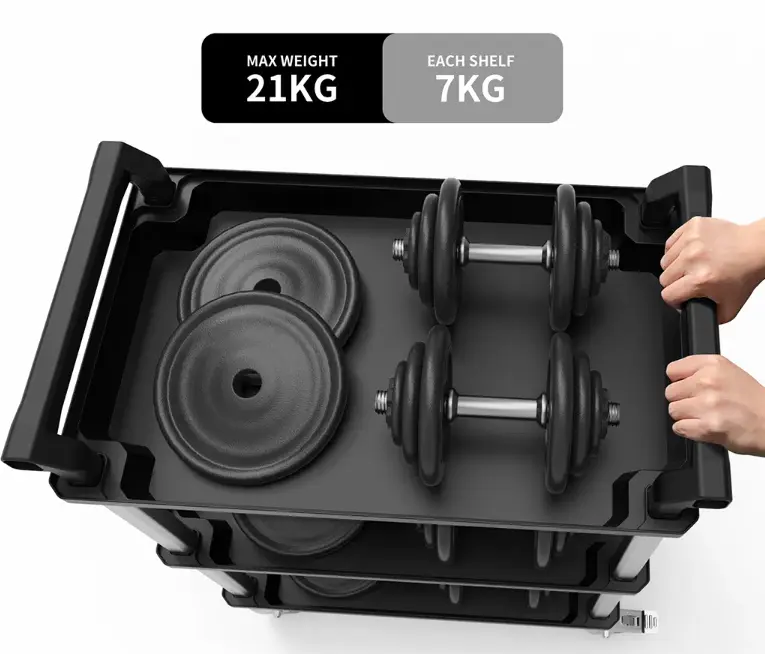
Load capacity is often one of the first numbers a buyer notices.
However, the largest advertised load rating is not automatically the best product choice.
A B2B buyer should understand how the stated capacity relates to actual use and how the supplier defines the rating.
For example, the referenced Jingyan three-tier cart has a stated 300 lb load capacity. That specification is useful, but the purchasing team should still understand the conditions behind the number.
1.Understand the Difference Between Static and Moving Loads
A cart that is standing still experiences different conditions from one being pushed through a working environment.
During movement, the product can experience:
- Rolling resistance
- Changes in direction
- Starting and stopping
- Uneven load distribution
- Repeated movement
- Minor impacts
This is why B2B buyers should not evaluate load capacity in isolation.
The important question is:
What type of load does the rating represent, and does that rating make sense for the intended application?
A buyer carrying lightweight maintenance supplies may have different requirements from a customer carrying dense mechanical components.
The load should also be considered in relation to how the product is used. A cart may be loaded once and left stationary, or it may be loaded and moved repeatedly throughout the day.
2.Ask How the Load Capacity Was Tested
A professional supplier should be able to explain the basis of its load rating.
Relevant questions may include:
- Was the load evenly distributed?
- Was the test static or dynamic?
- Was the entire assembled cart tested?
- Were individual shelves evaluated?
- Were repeated loading cycles considered?
- Were the frame and wheel system evaluated together?
The purpose of asking these questions is not to make the procurement process unnecessarily complicated.
It is to make sure the buyer understands what the specification actually means.
For B2B procurement, a clearly defined specification is more useful than a large but unexplained number.
The final selection should therefore match the expected application and provide an appropriate performance margin.
Examine Material Construction and Structural Design
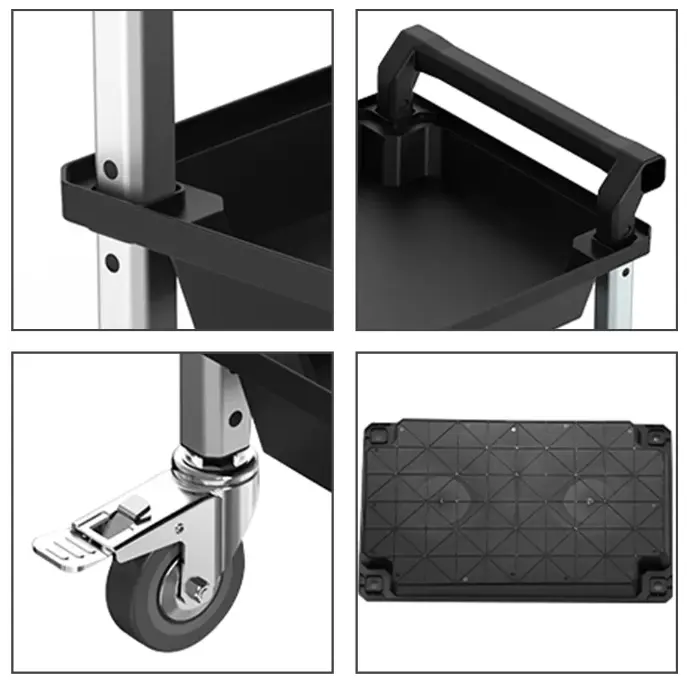
Material selection should be evaluated as part of the entire product structure.
The label “plastic cart” does not tell a buyer enough about the product. Different polymers, thicknesses, molding methods, reinforcement structures, and frame designs can produce very different results.
The same principle applies to metal carts.
Instead of asking only:
Is it plastic or metal?
B2B buyers should ask:
How are the materials combined and engineered for the intended application?
1.Evaluate the Shelf Material
For a plastic rolling cart, buyers should understand:
- What material is used?
- How are the shelves formed?
- How thick and rigid are the shelves?
- How are the shelves connected to the frame?
- Is the construction intended for repeated use?
- Is the material appropriate for the intended environment?
The referenced Jingyan three-tier model uses high-density polypropylene for the shelf structure together with thickened aluminum tubing for the supporting frame.
This illustrates why material should be evaluated in context.
The right question is not simply whether a cart is made from plastic.
The better question is:
Does the selected material provide the required balance of weight, strength, durability, and practical usability for the intended market?
2.Examine the Frame Structure
The supporting frame also deserves attention.
A buyer can ask about:
- Tube construction
- Wall thickness
- Connection method
- Joint stability
- Structural rigidity
- Assembly quality
A professional supplier should understand how these components work together.
For example, shelf material and frame material cannot be considered completely independently. The shelf needs to remain appropriately supported, while the frame needs to maintain stability as the loaded cart is moved.
The quality of the finished product therefore depends on the relationship between the components, not just the individual material names.
3.Consider Long-Term Product Consistency
For a B2B buyer, product quality means more than one successful sample.
A distributor or private label customer may purchase multiple batches over an extended period. The same product needs to remain consistent across those orders.
Important consistency points include:
- Dimensions
- Material characteristics
- Color
- Assembly
- Packaging
- Product labeling
- Functional performance
A strong sample is useful, but repeatable production is what supports a sustainable B2B product line.
This is why supplier production control deserves as much attention as the first sample itself.
Review Mobility and Day-to-Day Handling
A cart with wheels is purchased partly because it can be moved.
That makes mobility an important part of the buying decision, but B2B buyers should think beyond the simple question of whether wheels are included.
The real issue is how the complete cart behaves during routine movement.
1.Understand the Cart's Movement Pattern
Different customers may move the same type of cart in very different ways.
A product may be:
- Moved occasionally within one room
- Repositioned several times per day
- Pushed between workstations
- Used for short-distance internal transport
- Frequently turned around equipment or furniture
These patterns can influence what the buyer expects from the product.
For this reason, it is more useful to describe the intended movement pattern to a manufacturer than simply to ask for “good wheels.”
The buyer should explain where the cart will operate, how frequently it will move, and what type of handling is expected.
That allows the supplier to evaluate the product as a complete system rather than focusing on one component.
2.Balance Mobility, Stability, and Control
A cart that is easy to push is not automatically better.
The product also needs to remain predictable when the user changes direction or stops.
For professional applications, buyers should think about the relationship between:
Mobility + stability + controllability
This balance is particularly relevant when the product is expected to be used frequently by professional users.
The important point for this buying guide is not to select a particular wheel design. Instead, the buyer should establish whether the finished cart’s movement characteristics match the intended application.
Detailed wheel selection should be treated as a separate technical evaluation when necessary.
Check Quality Control and Product Consistency
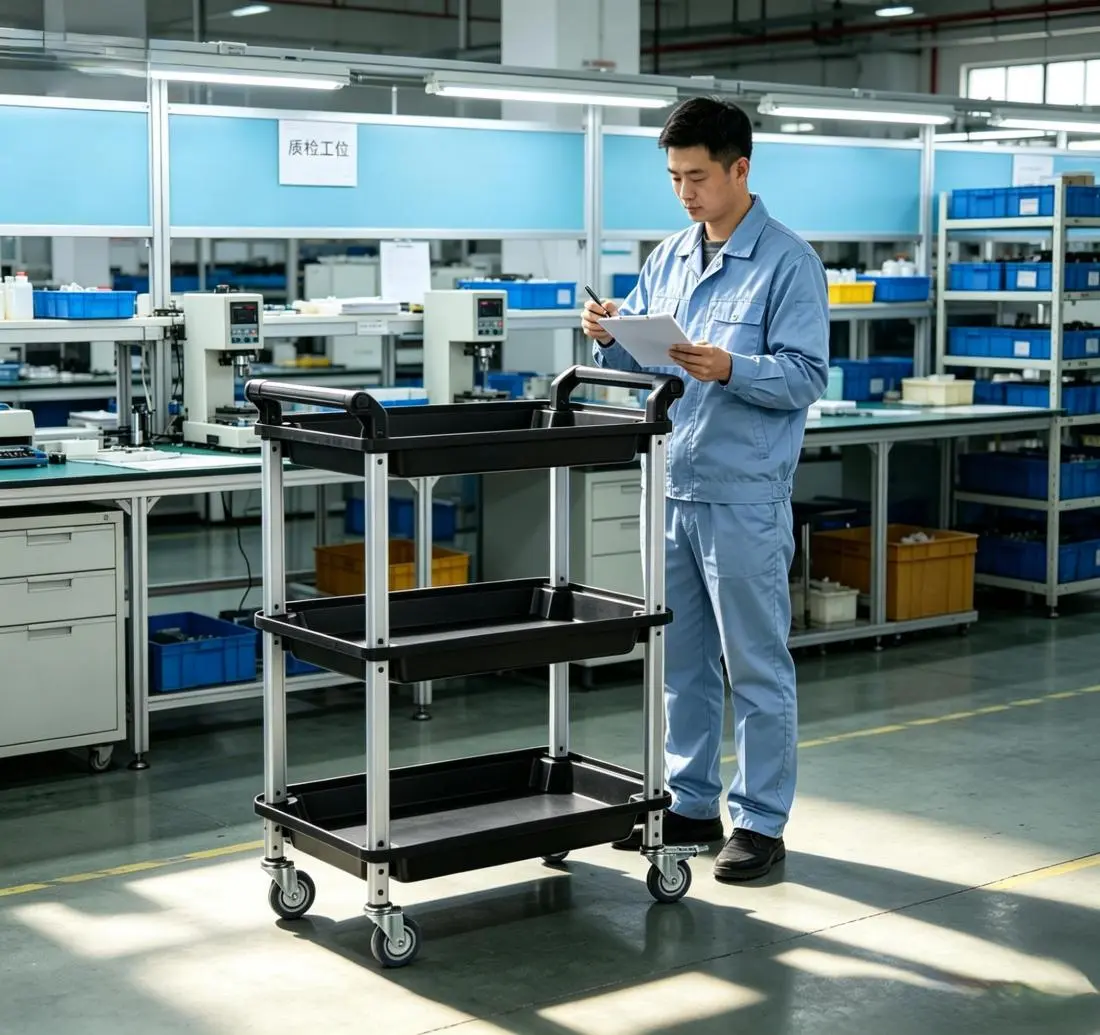
A B2B buyer is generally not purchasing one cart.
The buyer is selecting a product that may need to be produced repeatedly and sold or used across multiple markets.
That makes the supplier’s quality control process a core purchasing consideration.
1.Evaluate the Supplier's Quality Process
A reliable manufacturing process should cover key stages such as:
- Incoming material inspection
- Production process control
- Assembly inspection
- Functional testing
- Final inspection
- Packaging verification
The exact process will depend on the manufacturer and product, but the fundamental idea is the same:
quality should be controlled throughout production rather than checked only after everything is finished.
For a private label buyer, this matters because the product may eventually become part of a broader brand portfolio.
Inconsistent dimensions, color variation, packaging changes, or functional differences between batches can create downstream problems for the buyer.
2.Ask for Supporting Quality Information
Depending on the destination market and purchasing program, buyers may request:
- Test reports
- Certification documents
- Material information
- Inspection records
- Product drawings
- Packaging specifications
- Sample approval documentation
The exact documents required will vary by market and product category.
The purpose is to establish a clear reference point before mass production.
3.Use Sample Approval as a Production Baseline
A sample should do more than help the buyer decide whether the product “looks good.”
The approved sample should ideally establish the expected baseline for:
- Appearance
- Dimensions
- Color
- Components
- Functional performance
- Packaging
- Branding
This becomes particularly important as order volume increases.
A supplier that can clearly communicate the relationship between the approved sample and later production batches provides valuable confidence to B2B buyers.
Evaluate the Manufacturer, Not Just the Product
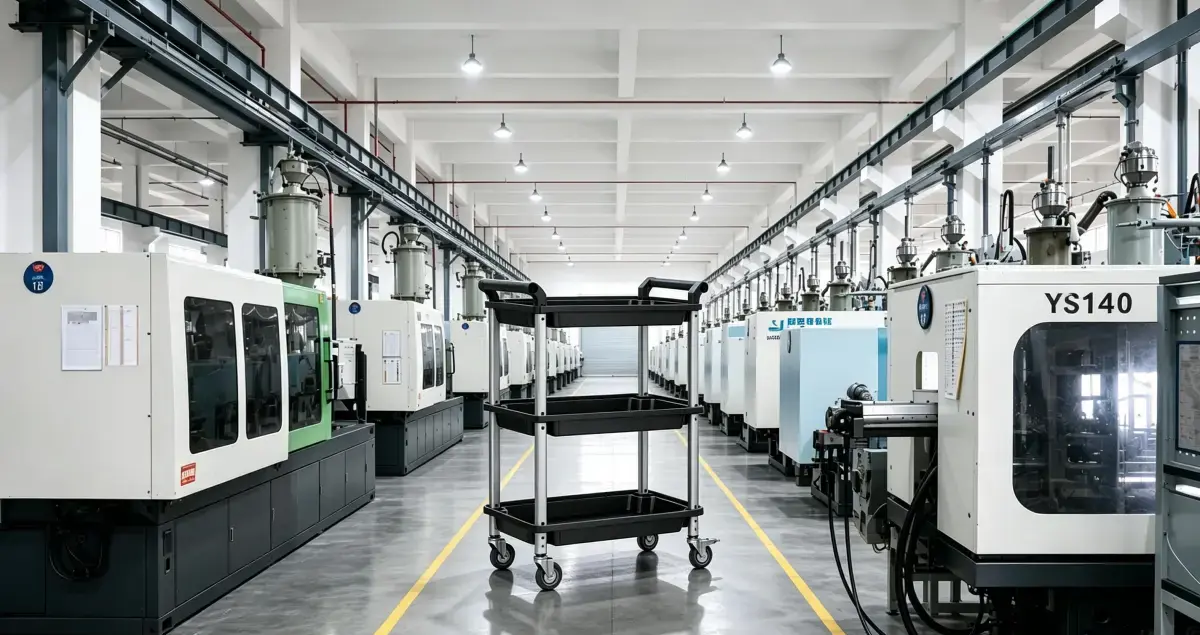
A suitable cart can still become a difficult purchase if the supplier cannot support the buyer’s commercial requirements.
This is especially relevant for importers, distributors, wholesalers, retailers, and private label brands that may need the product repeatedly rather than as a one-time purchase.
1.Look for In-House Manufacturing Capability
When evaluating a manufacturer, look beyond the sales presentation and consider which important production processes are controlled internally.
Relevant capabilities may include:
- Product development
- Mold design
- Injection molding
- CNC machining
- Stamping
- Assembly
- Quality control
- Packaging development
In-house capability can become particularly valuable when the buyer needs a product that differs from a standard catalog version.
For example, a buyer may eventually need:
- Custom colors
- Brand logos
- Product labeling
- Retail-ready packaging
- Revised dimensions
- Structural adjustments
- Market-specific configurations
The more of these processes a supplier can coordinate directly, the easier it can be to move from a standard product to a commercially customized program.
2.Consider OEM/ODM Capability Early
OEM and ODM should not be viewed only as solutions for completely new product development.
For a three-tier cart, customization may involve relatively practical changes such as:
- A different shelf color
- Brand application
- Packaging design
- Labels
- Component changes
- Product dimensions
The appropriate level of customization depends on the buyer’s market and the manufacturer’s engineering and tooling capabilities.
For a distributor or private label brand, discussing these requirements early can help avoid selecting a supplier that can produce the standard product but cannot support the next stage of the business.
3.Evaluate Production Scale and Supply Stability
Ningbo Jingyan Tool Industrial Co., Ltd. was founded in 2003 and operates a 16,000㎡ self-owned production base with more than 140 professionals and over 50 sets of production equipment.
Its production structure includes R&D, mold design, production, quality control, and customer service.
For a B2B buyer, however, factory size is not the final decision factor.
The more useful question is:
Can the manufacturer consistently produce the required specification at the required volume and continue supporting the product as the business develops?
Jingyan’s broader manufacturing capability includes plastic product production, mold development, and tool-related product manufacturing, which supports an OEM/ODM approach for buyers looking beyond a fixed catalog specification.
Review Packaging, Logistics, and Commercial Practicality
A product can perform well in use and still create commercial problems if its packaging and logistics are not properly considered.
For B2B buyers, the product has to work across the entire supply chain.
1.Check Shipping and Packaging Dimensions
Before placing a larger order, request information such as:
- Product dimensions
- Carton dimensions
- Carton weight
- Units per carton
- Pallet configuration
- Container loading information
For a distributor, this information helps with warehouse planning.
For a retailer, it can affect shelf and fulfillment strategy.
For an importer, it can influence container utilization and landed cost.
The physical product and its packaging therefore need to be evaluated together.
2.Consider Wholesale, Retail, and Private Label Requirements
Different business models create different packaging expectations.
A wholesaler may prioritize efficient shipping cartons.
A retailer may need:
- Barcode labels
- Retail-ready packaging
- Product inserts
- Assembly instructions
- Market-specific labeling
A private label customer may need the packaging, labeling, and visual presentation to match an existing brand identity.
This is why the purchasing decision should consider both:
Product fit + supply-chain fit.
The best product is not necessarily the one with the longest feature list.
It is the one that can be supplied, packaged, transported, and sold according to the buyer’s commercial requirements.
Use a Practical B2B Buying Checklist
After evaluating the product and supplier individually, bring the information together into one purchasing framework.
1.Check Product Fit
Before approving the product, confirm:
- Does the overall size fit the intended environment?
- Are the shelf dimensions sufficient?
- Is the shelf clearance suitable?
- Does the load rating match the application?
- Is the construction appropriate?
- Is the mobility suitable for the expected use?
This part of the evaluation answers:
Will the product work for the end customer?
2.Check Supplier Fit
Then evaluate the manufacturer:
- Can the supplier provide stable production?
- Can samples be approved before mass production?
- Is quality control documented?
- Can product specifications be customized?
- Is OEM/ODM support available?
- Can packaging be customized?
- Can the supplier support repeat orders?
This answers:
Can the supplier support the product after the initial purchase?
3.Check Commercial Fit
Finally, consider the business side:
- Does the MOQ fit the purchasing model?
- Are production lead times workable?
- Is packaging appropriate?
- Can the supplier support future orders?
- Is communication efficient?
- Can the supplier adapt as the product line develops?
A strong procurement decision should satisfy all three:
Product fit + Supplier fit + Commercial fit
A product that performs well but cannot be supplied consistently is not an ideal B2B solution. Likewise, an excellent manufacturer is not the right supplier if the product itself does not match the customer’s application.
What a Suitable Three-Tier Cart Should Look Like for B2B Buyers
There is no single three-tier cart that is perfect for every market.
The right product depends on the intended application and the buyer’s commercial requirements.
However, a suitable B2B product should provide a sensible balance between:
usable storage, practical dimensions, appropriate load capacity, mobility, structural performance, manufacturing consistency, and supply flexibility.
For example, the referenced Jingyan 3-Tier Rolling Utility Cart uses high-density polypropylene shelves and thickened aluminum tubing. Its overall dimensions are approximately 25.6 × 34.3 × 14.6 inches, with shelf dimensions of approximately 23.6 × 19.5 inches, 12-inch clearance between shelves, and a stated 300 lb load capacity.
These specifications should not be interpreted as proof that one design is universally better than every alternative.
Instead, they give a B2B buyer measurable information to compare against the requirements of a specific market.
That is the most useful standard throughout the buying process:
Does the specification solve the customer’s actual problem?
1.Why Manufacturer Collaboration Matters
Ningbo Jingyan Tool Industrial Co., Ltd. is a B2B manufacturer established in 2003, with capabilities spanning product development, mold design, manufacturing, quality control, and customer service.
The company provides OEM/ODM manufacturing support, which can be relevant when an importer, distributor, or private label brand needs more than a standard product listing.
Customization may involve product appearance, branding, packaging, dimensions, or other product requirements depending on the development scope.
The company also maintains quality and compliance systems with certifications and qualifications including ISO 9001, CE, RoHS, FDA, BSCI, and CPC, supporting its global B2B manufacturing positioning.
For buyers, the practical lesson is simple:
The right supplier should be able to support both the current product requirement and the next stage of the business.
FAQ About Buying a 3 Tier Cart with Wheels
1.What should I check first when buying a 3 tier cart with wheels?
Start with the application.
Define what the cart needs to carry, where it will be used, how often it will move, and what physical constraints exist in the working environment. Then evaluate dimensions, shelf space, load capacity, construction, mobility, and supplier capability.
2.Is a higher load capacity always better?
No.
A higher rating does not automatically make a cart more suitable. The important factor is whether the rated capacity matches the real application and provides an appropriate margin for expected use.
3.What dimensions should B2B buyers request from a supplier?
At minimum, request overall width, depth, height, shelf dimensions, clearance between shelves, product weight, wheel information, and carton dimensions.
For larger purchasing programs, also request packaging and pallet information.
4.Why should buyers request a sample before mass production?
A sample allows the buyer to verify the actual product against the specification.
The evaluation can cover dimensions, appearance, color, components, stability, functional performance, packaging, and branding before the larger order is produced.
5.What should private label buyers ask a manufacturer?
Private label buyers should discuss product customization, logo application, colors, packaging, labels, dimensions, MOQ, sample approval, production lead time, and long-term supply capability.
6.Can a standard three-tier cart be customized for different markets?
In many cases, yes.
The specific customization scope depends on the manufacturer, tooling requirements, and target specification. Possible areas include colors, branding, packaging, dimensions, components, and structural changes.
Final Takeaway
For B2B buyers, choosing a 3 tier cart with wheels should never be based on the product photo alone.
A strong purchasing decision should evaluate the complete commercial picture:
application → dimensions → shelf usability → load capacity → construction → mobility → quality control → packaging → manufacturer capability → customization support
The goal is not simply to find a cart with three shelves and wheels.
The goal is to find a product that can perform the required job, fit the customer’s environment, meet the target market’s expectations, and be supplied consistently by a manufacturer capable of supporting future orders.
For importers, wholesalers, distributors, retailers, and private label brands, this broader evaluation can reduce sourcing risk and create a stronger foundation for long-term product sales.
Jingyan Tools combines product development, manufacturing, quality control, and OEM/ODM support for B2B customers. For buyers evaluating a three-tier cart program, discussing the target application, required specifications, branding, packaging, and purchasing plan directly with the manufacturer can make the sourcing process more precise from the beginning.
The right three-tier cart is not simply the one with the most features. It is the one that best fits the buyer’s application, commercial model, and long-term supply requirements.
Related products