Customization Service and Production Process
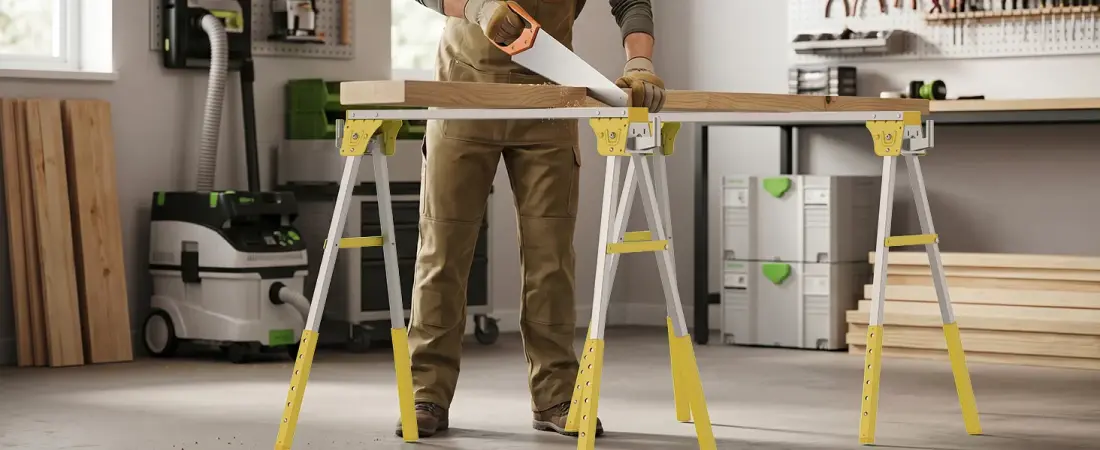
A metal folding sawhorse can look like a simple tool – a metal frame with legs that collapse – but professional buyers know the difference is in the engineering details. A truly professional folding sawhorse must balance sturdy performance with reliable folding and long-term durability. Heavy-duty construction should go hand-in-hand with precise joint mechanisms, stable foot design, and consistent manufacturing. Instead of judging by thick steel alone, buyers should examine how the design controls force and movement through the system: from the working surface through the frame, joints, legs, and feet to the ground. In other words, every component and connection must work together to meet professional demands.
This article dives deep into the design and quality factors that set a metal folding sawhorse apart for professional use. We will explore frame construction, hinge and locking systems, load paths, material interfaces (metal, plastic, rubber), adjustment features, manufacturing controls, and testing. By understanding these aspects, B2B buyers and brands can better evaluate a folding sawhorse as a reliable tool product rather than just a catalog item.
- Beyond a Strong Frame: Complete Structural Design
- Folding Architecture: The Core Engineering System
- Locking Mechanisms for Safe, Stable Use
- Load Path: Ensuring Performance Under Load
- Material Interfaces: Metal Frame with Other Components
- Height Adjustment Integrated with Structure
- System Stability: Legs, Feet, and Geometry
- Manufacturing Consistency and Quality Control
- Surface Protection and Finish
- Durability and Testing
- Professional Buyers: What to Ask and Verify
- NH-SH001 Example: Design Integration
- Evaluating a Sample Before Production
- Why OEM/Engineering Support Matters
- How to Judge if a Sawhorse Is Truly Professional
- FAQ
- Final Takeaway: Integrated Design is Key
Beyond a Strong Frame: Complete Structural Design
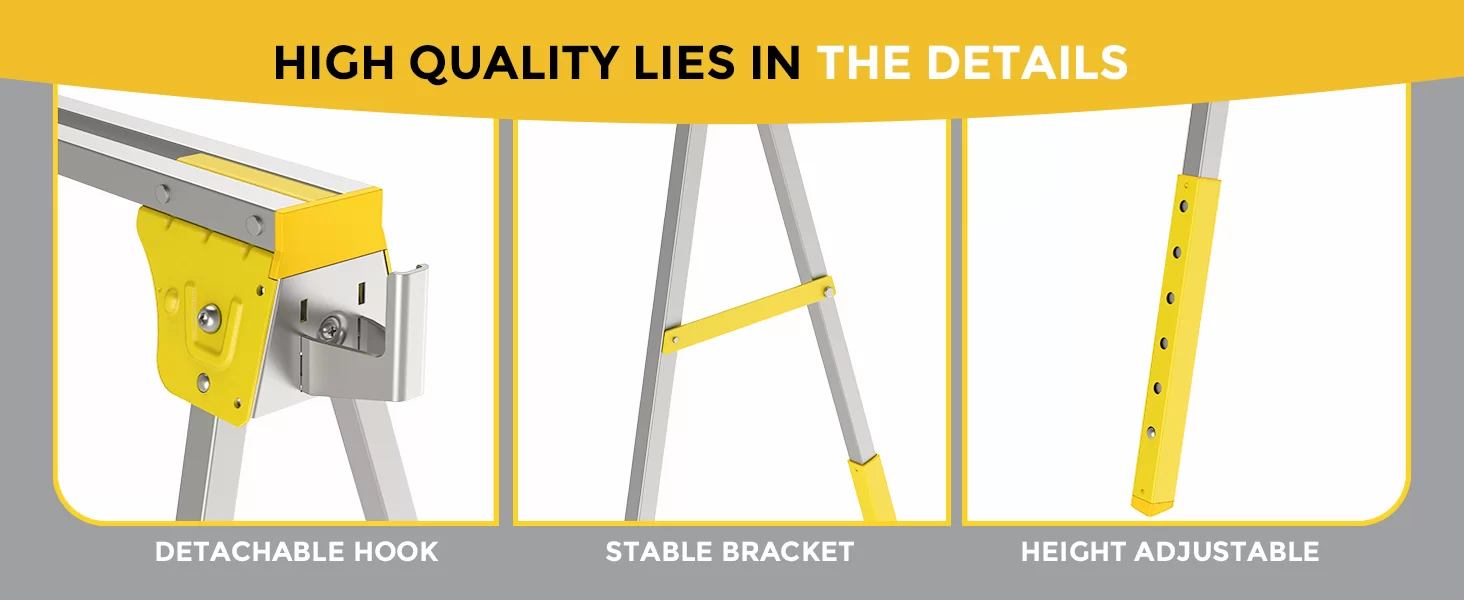
Choosing a metal folding sawhorse for professional use starts with the frame, but it cannot end there. A heavy steel frame improves load-bearing capacity, but frame geometry and construction details are equally important. For example, the NH-SH001 model from Jingyan Tools uses a reinforced metal frame that provides rigidity, but it also includes strategic bracing, welded joints, and angled supports to control flex and spread forces properly. Simply making the frame thicker would add weight without solving potential weak points.
In practice, the load path should flow through components designed for it. If work material rests on the top surface, the force should primarily pass through the thickest steel sections, crossbars, and brace members, then into the legs and feet. Weak spots like a small connector or thin bracket should not end up carrying the majority of a load. In a well-designed sawhorse, extra bracing is placed near high-stress areas (for instance, under the top bar or between legs) to create a predictable path for forces. This means stability is engineered in, not assumed.
Even within the frame, geometry matters. The shape of the steel tubing (rectangular vs. round), the angles at which legs splay, and the presence of gussets or cross braces all influence stiffness. A rectangular tube might resist bending better in one direction, while an angled crossbar can prevent lateral sway. A professional design uses these elements together: the NH-SH001’s “A-frame” style with an angled brace helps it remain rigid under load. The result is that when fully set up, the metal frame stays firm and does not twist or buckle easily under heavy weight.
1.Key Frame Characteristics
- Reinforced Steel Tubes: Use thick-walled steel sections sized for intended loads.
- Cross Braces and Gussets: Welded supports between legs and under the top to limit flex.
- Angled Leg Design: Legs that splay outward increase the base footprint for stability.
- Consistent Joinery: Welds or rivets should penetrate fully to avoid weak joints.
A robust frame provides the foundation, but it works only if all other parts of the sawhorse are equally considered. The next sections show how the folding mechanism and other design details build on that foundation.
Folding Architecture: The Core Engineering System
The folding mechanism itself is a core part of what makes a metal sawhorse professional. If poorly designed, the joints and hinges become the weak link in an otherwise strong structure. A folding sawhorse must provide controlled movement when collapsing or setting up, and total rigidity when locked into position.
1.Design of Hinge and Pivot Points
Every folding sawhorse has hinges or pivots at the top of the legs. These components see repeated motion (opening and closing) and can be subject to impact when the unit is set down. Professional models typically use heavy-duty steel pins, bushings, or reinforced hinges that limit wear and maintain alignment over time. Sometimes, double-pin designs or extra bushings are used to distribute stress and prevent metal-on-metal rubbing.
In contrast, a cheap unit might use a thin stamped hinge or plastic pin that bends or loosens easily. A professional design will include:
- Tight Tolerances: Pins and holes sized so the legs fold smoothly without play.
- High-Strength Materials: Hardened steel pins and reinforced hinge plates.
- Protective Covers: Some designs shield joints from dust or moisture to reduce wear.
2.Controlled Movement and Stability
The goal of the folding architecture is controlled movement with reliable locking. When you open the sawhorse legs, you should feel them swing freely until they reach the fully deployed position. At that point, a mechanism (see next section) locks them in place. The transition from folded to locked should be smooth and give clear feedback.
A poorly designed hinge may wiggle or snap, causing instability. Professional designs often include a stop or detent that holds the leg at just the right angle before locking. This helps align all four legs in one motion. When multiple folding points exist (e.g. double-hinged legs or telescoping parts), each must have a similar controlled action.
In summary, the folding hardware must enable ease of use without sacrificing stability. High-quality metal folding sawhorses achieve this balance, often with features like spring-loaded pins or one-touch levers that guide the legs precisely. The goal is that after thousands of cycles, the sawhorse still sets up the same way every time.
Locking Mechanisms for Safe, Stable Use
After unfolding the sawhorse, a locking mechanism secures the structure. This is critical: a strong frame and hinge mean little if the legs can slip during use. Professional models use clear, robust locks to prevent accidental collapse under load.
1.Simple, Clear Locks
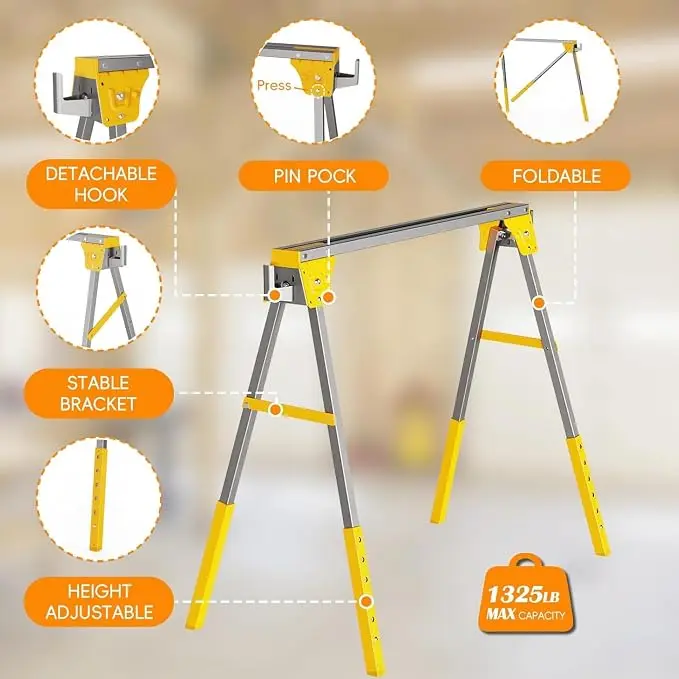
A good lock should be easy to engage and unengage, with an obvious “click” or visual indicator when the legs are fully locked. For example, some sawhorses use a spring-loaded latch that snaps into a hole in the leg when extended. Others use a sliding pin or hook that swings into position. The key is that the user can verify by feel or sound that the structure is secure.
Designers of professional sawhorses avoid complicated locking steps. The NH-SH001, for instance, uses a one-touch locking lever that automatically engages as the legs swing out. The user simply opens the legs fully and hears it lock. This convenience is important on busy job sites.
2.Preventing Unintentional Movement
A locking system must withstand working forces. Even if the legs are properly engaged, the lock must not slip when weight is added. This often means:
- Positive Engagement: The lock mechanically blocks motion, rather than relying on friction.
- Redundancy: Some designs add a secondary safety catch or strap as backup.
- Ample Contact Area: Larger lock surfaces reduce stress per unit area.
Equally important is durability. A flimsy pin or thin latch will deform or wear out under repeated stress. Professional design may use machined metal parts (not just stamped sheet metal) for locking elements, and test them through many cycles. This ensures the locked position remains solid and that the sawhorse does not unexpectedly collapse when it shouldn’t.
Load Path: Ensuring Performance Under Load
Understanding the load path is vital for a professional metal sawhorse. When you place a heavy board or a bundle of material on the sawhorse, the force should travel cleanly through the structure to the ground, without creating a weak point. In short, the structure must be analyzed like an engineered system.
1.Force Distribution Through the Sawhorse
In a proper design, the top surface transmits load into the strongest parts of the frame. Imagine a plank on the sawhorse: its weight applies force to the top bar. If that bar is well-supported by cross braces and welds, the force splits evenly into each leg. Each leg then carries its share down to the floor through the feet.
A poor design might let the force concentrate on one leg or one side. For example, if a load is placed off-center and the top tube bends, one inside edge of the tube might carry most of the weight, overstressing a single leg. To prevent this, professional sawhorses often have crossbars under the top or diagonal braces that ensure even load sharing.
2.Capacity Ratings with Context
Manufacturers often list a pair load capacity, such as 2,650 lbs per pair for NH-SH001. B2B buyers should understand what these ratings actually represent before comparing products. For a deeper discussion of load ratings and testing methods, see How Much Weight Can a Sawhorse Hold? A Buyer’s Guide to Load Capacity.They usually assume an evenly distributed load across both sawhorses. Real-world use can differ – materials may sag in the middle or shift.
Thus, a smart buyer asks:
- Was the capacity tested as a uniform load or a center point load?
- Were safety factors applied (often 2× or more for professional equipment)?
- How does the structure manage tip-over or imbalance?
For instance, heavy loads on the ends of the top bar may cause tipping if the feet do not extend beyond the bar ends. Professional models usually have legs that extend wider than the top tube, preventing the base from becoming narrower than the load. This detail – legs splaying beyond the top ends – is a design feature that most casual designs miss. It means your load is less likely to tip the sawhorse.
Material Interfaces: Metal Frame with Other Components
Although the main frame is metal, many folding sawhorses incorporate plastic or rubber parts in key places. The choice is not simply about whether metal or plastic is “better”; each material should be assigned to the part where it performs best. Buyers comparing the broader material question can also refer to Metal vs Plastic Sawhorses: Which Is Better for Buyers? For example, the NH-SH001 uses polypropylene (PP) connectors and thermoplastic rubber (TPR) feet along with its metal frame. This hybrid construction is common: it combines the strength of steel with the benefits of other materials.
1.Roles of Different Materials
-
Metal (Steel): Used for the frame and structural legs. Provides primary strength and rigidity. Steel is chosen for the frame because it can be formed into the desired geometry and handle high loads without excessive weight. In the NH-SH001, the metal frame “improves overall stability, load-bearing performance and structural strength”.
-
Polypropylene (PP): Often used for non-structural connectors or accessories. PP is lighter and corrosion-resistant. In professional sawhorses, PP components may serve as hinge covers, angle brackets, or parts of locking mechanisms. They help reduce weight and cost, and can be molded precisely. The Jingyan design notes that PP “provides lightweight characteristics, better corrosion resistance, and easy transportation”.
-
Thermoplastic Rubber (TPR): Used for feet or grips. The feet of the legs often have TPR pads to increase friction with the floor. TPR is chosen because it grips surfaces well, improving stability. The NH-SH001’s TPR feet improve “anti-slip performance, user safety, and surface protection”. Without good feet, a heavy sawhorse could slide on smooth floors or dig into softer ground.
2.Designing Effective Interfaces
Where metal meets plastic, careful design is needed. For example, if a PP part screws into a metal bracket, the fit must be precise to avoid looseness. Over time, plastic can creep (deform) under stress, so parts must either be designed to snap in place or be easily replaceable. A high-quality supplier will ensure that polymer parts do not become the first failure point: they will specify tight tolerances and inspect these joints in production.
In summary, professional sawhorse design uses each material for what it does best. Steel carries the load, PP shapes the mechanism or connections, and TPR provides grip. This is not haphazard; it requires engineering each interface. For example, ensure that the metal leg and TPR foot align so the pad sits flat on the floor. When each component is optimized for its role, the result is a durable, safe product.
Height Adjustment Integrated with Structure
Many professional folding sawhorses offer height-adjustable legs. This feature adds versatility but must be designed carefully so it doesn’t compromise stability. Treat adjustment as part of the whole leg assembly, not just an add-on.
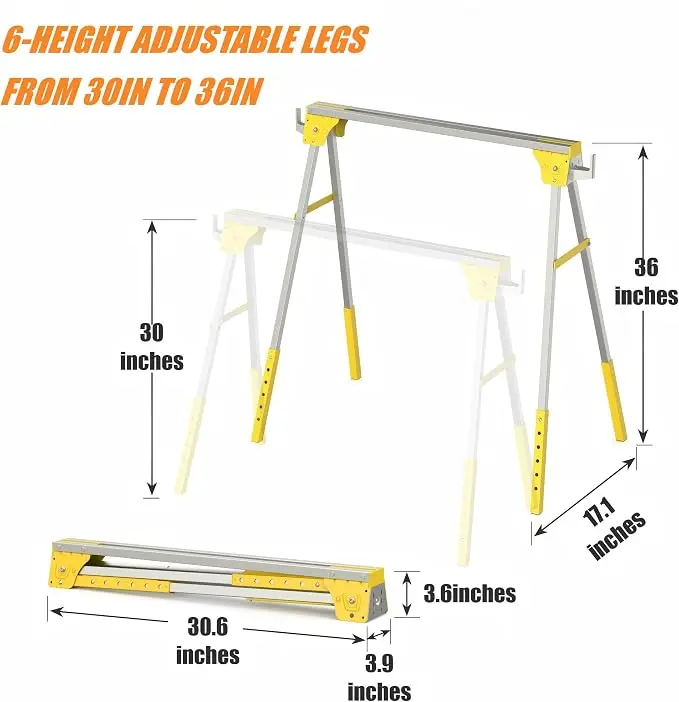
A telescoping leg introduces extra holes or collars, which are new potential failure points. If the adjustment mechanism (like a pin or clamp) is too loose, the leg could wobble. If it’s too stiff, it could be hard to change height. A well-designed adjustable sawhorse ensures that at any height, the leg still matches the designed geometry. For example, the NH-SH001 supports height adjustment without altering its fold-flat behavior.
1.Adjustment Must Lock Firmly
An adjustable leg usually locks into place with a pin, bolt, or lever. Professional use demands this lock be as strong as the rest of the structure. That means:
- The lock should resist shear (so your board doesn’t tilt the leg).
- The pin or bolt should fit snugly (no slop).
- There should be multiple hole positions for flexibility, but each hole can concentrate stress, so plate thickness and roundness must be controlled.
A buyer should verify that when legs are extended to their maximum and locked, the sawhorse still feels solid. If possible, check that height adjustment components were tested similarly to the main legs.
System Stability: Legs, Feet, and Geometry
Stability in a professional setting is multi-faceted. It’s not enough to have a strong frame; the sawhorse must remain steady under load in real conditions.
1.Leg Spread and Symmetry
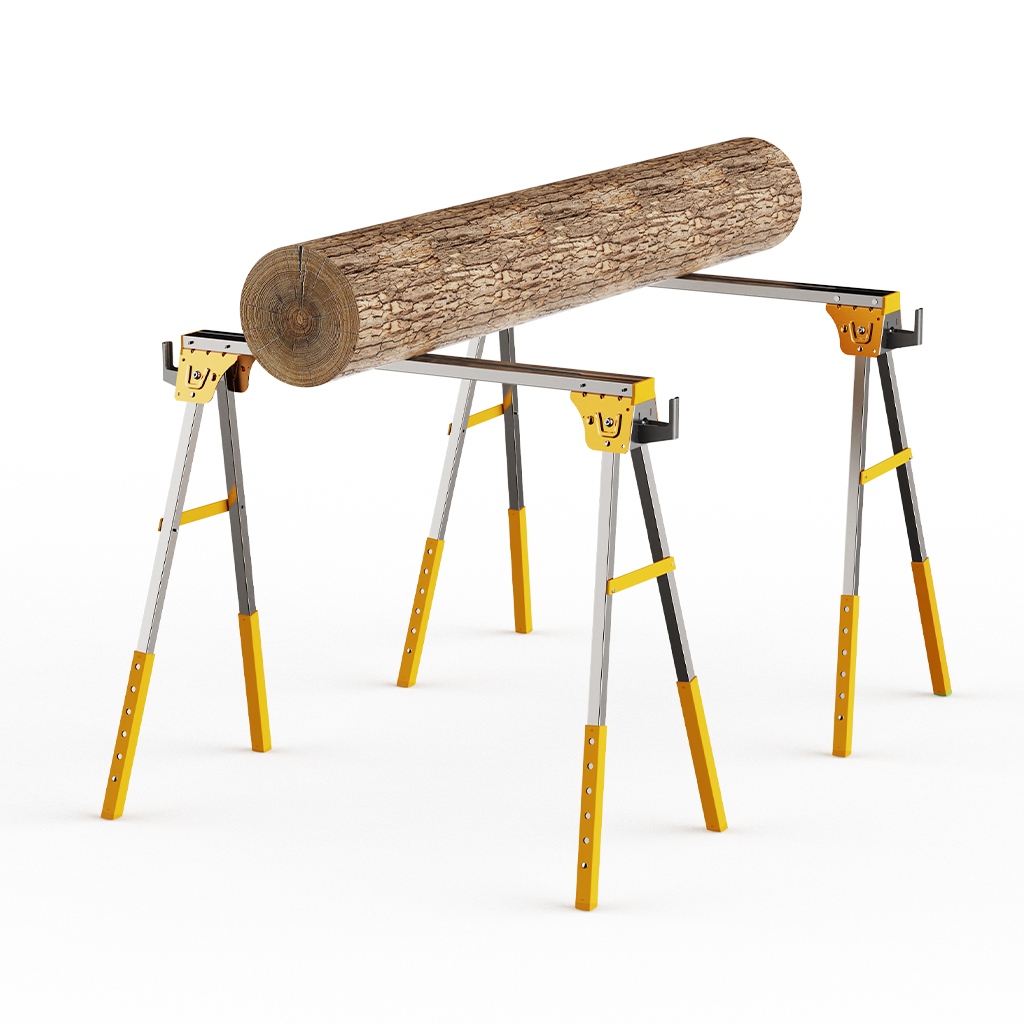
Legs should spread wide enough to resist tipping in any direction. Typically, legs are angled outward from the top, forming an A-shape. This means if a load shifts left or right, the legs still catch it. Some designs add cross-braces between legs (forming an “H” or “X”) to prevent them from splaying too far or moving under side loads. The NH-SH001 uses an A-frame with a crossbar under the top, improving sideways stiffness.
Symmetry helps too. If both sides of the sawhorse are mirror images, the product can be manufactured more consistently. The left and right leg assemblies can be nearly identical, which simplifies inspection and replacement. In contrast, a nonsymmetric design would require separate checks for each side.
2.Feet Design and Ground Contact
Never underestimate the importance of the feet. The foot pads are the ultimate interface with the ground. For safety:
- They should stay attached to the legs firmly (no wobble).
- They should extend at least to the ends of the legs so the base remains wide. If a load is placed at the end of the top, you don’t want the sawhorse pivoting off the edge.
- The bottom surface should be flat and textured for grip.
Proper feet can prevent slip or sinking. For a sawhorse expected to move across different surfaces (workshops, outdoor sites, trucks), TPR or rubber feet will grip concrete, wood, and even some soil better than bare metal. Additionally, they protect floors from scratches. All of this ensures the sawhorse holds position exactly as intended by the frame design.
Manufacturing Consistency and Quality Control
A design is only as good as its production quality. Two identical engineering drawings can lead to different products if manufacturing varies. Professional folding sawhorses rely on tight manufacturing controls:
- Tube Cutting and Bending: The steel tubes must be cut and bent precisely. Small errors in length or angle can prevent the legs from folding or locking properly. For example, if one leg is even a millimeter shorter due to a cut error, the sawhorse may rock or resist folding. Good suppliers use jigs and quality systems to ensure each tube matches design specs.
- Welding and Assembly: Welds must be placed correctly and fully penetrated. A weak weld at a joint can break under load. Manufacturers should check for distortions – welding can twist a tube – and compensate accordingly.
- Plastic and Metal Fitting: If PP parts or pins are inserted into metal, the holes need correct sizing. Too tight and the part won’t fit; too loose and it will rattle. Professional assembly often uses fixtures to align parts before fastening.
- Batch Consistency: Each production lot should be inspected. If an inspector detects misalignment or defects in a sample, the batch is flagged. For Jingyan, the defect rate is reported at <0.1%. That level of quality suggests rigorous checks.
For buyers, asking a supplier about process is key. A factory tour or inspection report can reveal whether there is real process control. Does the manufacturer use quality management standards (like ISO 9001)? Do they have incoming material checks and final assembly checks? All these impact whether each folding sawhorse leaving the plant performs like the last one.
Surface Protection and Finish
In professional use, a metal sawhorse can face harsh conditions: moisture, dust, chemicals, physical abrasion. The surface finish protects the metal and conveys quality:
- Coating: Many metal sawhorses use powder coating or plating. A robust finish prevents rust and scratches. For example, a bright yellow powder coat on a folding sawhorse is not just visual; it indicates corrosion-resistant paint that can handle outdoor use.
- Touch-up: Quality manufacturers inspect for scratches or bare spots. Even a small chip can rust quickly.
- Consistency: Paint thickness should be uniform. Blotchy or thin areas can be weak points.
A buyer might ask: “How is the finish applied? Do you test samples for durability?” Good answers mention salt spray tests or paint thickness checks. In any case, the external finish must match the product’s intended environment. A jobsite sawhorse used outdoors needs more protection than a tool for indoor woodworking shops.
Durability and Testing
“Professional” implies something built for repeated use. This is especially important for products whose folding mechanism is operated repeatedly throughout their service life. Buyers evaluating long-term performance can also review Long Lasting Folding Sawhorse for a broader look at durability considerations. A sawhorse may be set up and collapsed hundreds or thousands of times over its life. Manufacturers of professional-grade equipment often include durability tests:
- Load tests: Applying weight cycles to ensure no permanent bending.
- Cycle tests: Folding/unfolding the sawhorse many times to ensure the joints don’t loosen.
- Environmental tests: Exposing to humidity or impact to simulate work conditions.
For example, Jingyan Tools reports each sawhorse is load-tested before shipment, with a defect rate below 0.1%. Buyers should look for documented testing. If the factory has an in-house testing lab, it’s a good sign.
In the field, a durable sawhorse is one that stays reliable despite abuse. It should withstand being kicked, set down hard, or even dropped short distances (to some extent) without breaking.
Professional Buyers: What to Ask and Verify
When sourcing a metal folding sawhorse for your business, consider these engineering-focused questions:
- Structure and Loads: “What is the main load path? Which member carries most of the force?” This reveals if the design concentrates stress on a safe area.
- Folding Mechanism: “Which parts of the sawhorse move during folding? How are the pivot points reinforced?” You want to ensure moving parts are durable.
- Locking Design: “How does the locking mechanism work? Can you demonstrate it under load?” You’re checking if the lock truly engages without manual effort and holds under force.
- Material Treatment: “What surface treatment is applied to the metal parts? How thick is it, and is it tested for corrosion?” This tells you how well it holds up outdoors or in humid environments.
- Quality Checks: “What inspections are done during production? Do you test each batch or sample load-test the finished products?” A factory that inspects dimensions and does sample drop tests is more reliable.
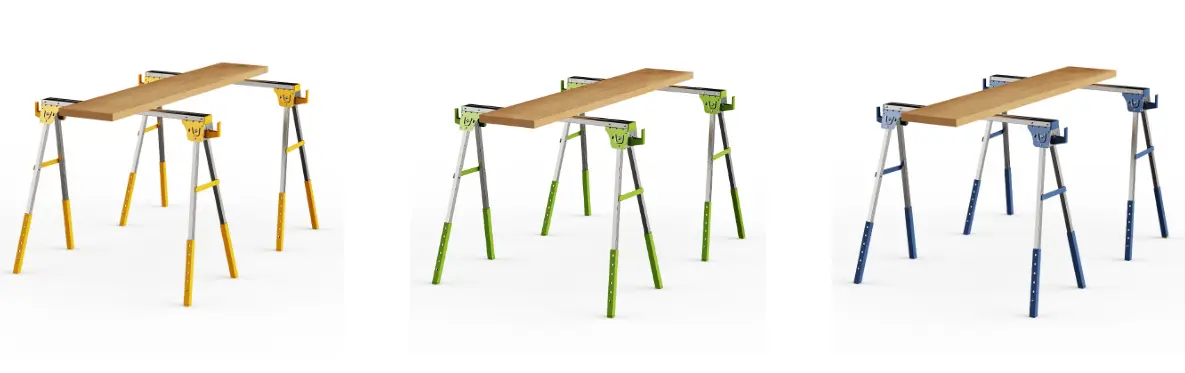
- Private-Label Support: “Can the design be modified? What OEM/ODM options are available?” If you want to brand it, the ability to change color or add a logo (like Jingyan Tools offers) is important.
Asking about these points helps separate a supplier with solid engineering practices from one with just a good price.
NH-SH001 Example: Design Integration
As an example, consider the Jingyan NH-SH001 folding sawhorse as a case study. This product integrates the elements we’ve discussed:
- Metal Frame: The core support is a heavy steel A-frame (with cross-brace) that carries the load.
- Folding System: Robust hinges allow quick setup and collapse.
- Locking: A one-touch lever locks the legs in place firmly.
- Material Mix: It uses PP for some connectors and handles, TPR on the feet, combining materials as needed.
- Adjustability: The legs adjust in height while retaining stability.
- Capacity: It’s rated 2,650 lbs per pair, showing it was engineered for heavy loads.
- Quality: Jingyan claims rigorous testing and supports small OEM trials, indicating attention to manufacturing.
By looking at a product like NH-SH001, a buyer can see how a theoretical design translates into a real tool. Details like its folded thickness (9.7 cm) illustrate portability, while its load rating confirms strength. However, a professional buyer would still follow up by verifying the supplier’s capability.
Evaluating a Sample Before Mass Production
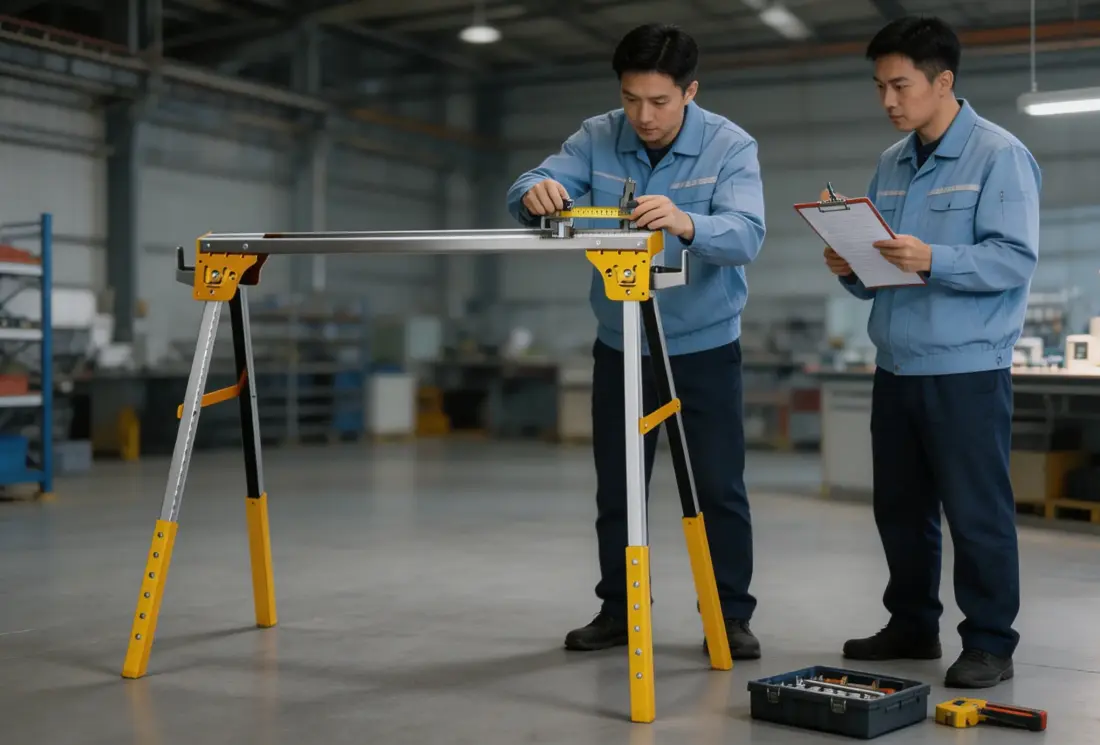
Physical samples are invaluable, especially for folding sawhorses. Here’s a quick checklist:
- Inspect Geometry: Check unfolded and folded sizes. Are legs straight? Does each leg reach the same length? The NH-SH001, for example, should fold flat to 9.7 cm thickness.
- Test Folding Action: Open and close the unit many times. Feel for smoothness, consistency, and any catching. Listen for metal-on-metal noises. Under load (if safe to do so), see if the folding parts hold position.
- Check Locking: Engage and release the lock repeatedly. Ensure it fully retracts the pin or lever. Test it under some weight to see if it slips.
- Load Simulation: If possible, apply weight (even manually pressing down) on the top and check for bending or excessive deflection. The top surface should stay level under moderate load.
- Examine Finish: Look for paint or coating uniformity, welder marks, burrs, or loose fasteners. The feet and grips should be firmly attached.
Make notes of any alignment issues, uneven finishes, or wobbles. A single prototype can be forgiven some imperfections, but the supplier should address them before volume production.
Why OEM/Engineering Support Matters
Private-label and OEM buyers should value a supplier’s engineering communication just as much as the product itself. When customizing a folding sawhorse for a brand, changes may be needed (e.g. logo, color, packaging, even minor structural tweaks).
A professional supplier will have a clear process: specifications and requirements → prototype design → sample validation → tooling → pilot run → mass production. For brands and distributors that need customization rather than a standard catalog product, OEM & ODM manufacturing can be an important part of supplier evaluation. They should be willing to share drawings or 3D models, discuss material choices, and adapt to your market needs. For example, Jingyan Tools emphasizes their OEM/ODM service and in-house development capabilities, which is attractive if you plan to modify the design for your customers.
In contrast, if the supplier treats you like a mere reshipper of an off-the-shelf product, you lose flexibility. Engineering capability matters because it underpins consistent quality as your order scales up.
How to Judge if a Folding Sawhorse Is Truly Professional
Rather than relying on one feature, evaluate the product on multiple tests:
- Structural Test: Does the sawhorse hold the intended load without bending? Are all four legs solidly on the ground?
- Mechanical Test: Do the hinges, locks, and adjustment points operate smoothly and repeatedly without play?
- Usability Test: Can an average worker fold and unfold it without tools? Are locks intuitive?
- Manufacturing Test: If you compare several samples or batches, are they consistent? Do measurements match spec sheet?
- Commercial Test: Can it be shipped, labeled, and sold easily (meaning it’s a marketable design)? Does it fit your brand image?
A product that passes all these is truly “professional grade”. For buyers, this com
Frequently Asked Questions (FAQ)
1.Q:Does “metal folding” automatically mean professional quality?
A: Not automatically. The use of metal is just one aspect. True professional quality comes from how the metal is used (frame design, thickness, bracing), plus the quality of joints, locks, and finish. It’s the whole design that counts.
2.Q:What is more important: thicker steel or better geometry?
A: Geometry and design usually outweigh mere thickness. A well-placed brace or gusset can improve strength more than arbitrarily adding metal. Quality design ensures the load spreads correctly, whereas extra metal adds weight without solving hidden weak points.
3.Q: Why are folding hinges often the weak link?
A: Because hinges are moving parts that endure repeated use. Over time, a hinge can loosen, wear out, or even fail if not properly engineered. In a professional product, these hinges are robust (often steel with bushings) and precisely aligned to minimize wear.
4.Q: How should I test a sample sawhorse?
A: Check all the points mentioned above: geometry, folding action, locks, and finish. Try different heights, lock mechanisms, and a bit of load. Also inspect welds and paint. Any obvious defect or misalignment should be reported before placing a larger order.
5.Q: Can a metal folding sawhorse mix materials?
A: Yes. In fact, mixing is common: metal frames with plastic connectors or rubber feet. That’s fine if done correctly. The key is that each material serves its purpose (e.g. steel for structure, rubber for grip) without compromising the metal’s integrity.
6.Q: What should I ask the supplier
A: Questions about structure (“Where is the strongest support?”), folding (“How are the joints reinforced?”), manufacturing (“How do you ensure weld quality?”), and quality control (“Do you test each batch?”) help verify their capabilities. A reliable supplier should have clear answers and be transparent.
7.Q: Is the Jingyan NH-SH001 a good reference?
A: Yes, as an example of how design choices come together. It uses a strong metal frame, a controlled folding system, height adjustability, and high load rating. Looking at its specs and design features can help you form your own checklist.
Final Takeaway: Integrated Design is Key
In the end, a professional metal folding sawhorse is defined by how its parts work together, not any single attribute. The metal frame, folding joints, locks, adjustable legs, and feet all contribute to final performance. A heavy-duty grade results from thoughtful design: guiding forces through the right paths, securing movements when needed, and ensuring each component is made and tested to industrial standards.
For B2B purchasers, this means evaluating a folding sawhorse as an engineered product platform, not a random tool. Look beyond the spec sheet. Check the design logic and manufacturing consistency. Assess whether the supplier supports your needs (custom branding, bulk supply, and long-term reliability).
Choosing the right metal folding sawhorse is about matching engineered capability to real-world use. The ideal product will meet your load and workflow demands, and still fold down for easy transport. It should feel solid and safe in operation and come with the backing of quality assurance. In short, it should be built for professional use from the ground up – and that integrated design approach is exactly what makes one sawhorse truly “professional” while another is merely “made of metal.”
For further details on customization, OEM support, or technical inquiries, buyers are encouraged to contact the manufacturer and discuss target specifications, branding, and production requirements directly.
Related products