How Collapsible Saw Horses Improve Storage and Transportation Efficiency

For importers, wholesalers, distributors, and tool brands, the cost of a sawhorse is only one part of the purchasing decision. A product that appears competitively priced at the factory can become much less attractive when it occupies excessive warehouse space, requires oversized packaging, or uses transportation capacity inefficiently.
This is where collapsible saw horses can offer a practical supply-chain advantage.
The basic idea is simple: a sawhorse that can be folded into a significantly more compact form requires less space when it is not being used. For commercial buyers, however, the real value goes beyond saving a few centimeters on a warehouse shelf. Folding construction can influence how products are packed, palletized, stored, transported, replenished, and eventually displayed in the sales channel.
That makes folding design a logistics consideration, not simply a product feature.
For a distributor managing hundreds or thousands of units, even a small improvement in storage density can become meaningful over time. The same applies to import shipments, where carton dimensions and available loading space can have a direct effect on transportation efficiency.
This article examines how folding sawhorses can improve storage and transportation efficiency and what B2B buyers should consider when evaluating these products for wholesale or private-label sourcing.
- 1. Why Storage and Transportation Matter When Buying Sawhorses
- 2. How Folding Design Changes the Storage Equation
- 3. How Collapsible Saw Horses Improve Warehouse Efficiency
- 4. How Folding Saw Horses Improve Transportation Efficiency
- 5. Why Packaging and Loading Should Be Evaluated Together
- 6. What Commercial Buyers Should Evaluate in a Folding Sawhorse
- 7. Choosing a Supplier for Folding Saw Horses
- 8. How Jingyan Tools Approaches Folding Sawhorse Manufacturing
- 9. FAQ About Collapsible Saw Horses and Logistics Efficiency
- 10. Conclusion: Folding Design Can Become a Supply-Chain Advantage
Why Storage and Transportation Matter When Buying Sawhorses

A sawhorse is often evaluated through familiar product characteristics such as material, stability, load capacity, height, durability, and working applications. Those factors remain important, but commercial buyers face another question that end users may not consider in the same way:
How efficiently can the product move through the supply chain?
A supplier may offer a strong and reliable sawhorse, but if every unit occupies a large fixed footprint from the factory to the distributor’s warehouse, the product can create unnecessary logistics pressure.
For B2B purchasing, the product exists in several different states during its commercial life:
- packed at the factory;
- loaded into cartons;
- palletized for export;
- transported internationally;
- received at a warehouse;
- held as inventory;
- moved to a retail or distribution location;
- and eventually transported again to the end user.
A product that is compact in its inactive state has an opportunity to use space more efficiently during many of these stages.
This is one of the main reasons folding saw horses have become relevant to commercial buyers looking beyond product performance alone. The folding mechanism is useful not only when the tool is being carried to a jobsite, but also when the product is being stored before and after sale.
1.The Hidden Cost of a Large Product Footprint
Warehouse space is rarely free.
Every product requires a certain amount of floor area, shelf space, aisle clearance, handling space, and inventory organization. Large rigid products can become difficult to stack or position efficiently, especially when their working dimensions are much larger than their actual storage requirement.
For a traditional fixed sawhorse, the full frame remains open even when the product is sitting idle. That means the warehouse must accommodate the product’s working geometry rather than its minimum possible storage profile.
A folding product changes that relationship.
Once collapsed, the sawhorse can occupy a much narrower profile, making it easier to position against racks, pallets, walls, storage fixtures, or other inventory. The benefit becomes more noticeable when the product is stocked in large quantities.
For a buyer managing several hundred units, the difference between “working size” and “storage size” is no longer a minor design detail. It becomes part of inventory efficiency.
How Folding Design Changes the Storage Equation

The biggest advantage of a collapsible design is the ability to separate working volume from storage volume.
A sawhorse needs to open wide enough and stand high enough to perform its job. It does not necessarily need to occupy that same space while sitting in a warehouse, shipment, stockroom, or distribution center.
This distinction is important because commercial products spend a large proportion of their life in inactive or transitional states. For commercial buyers, folding sawhorse products can therefore be evaluated not only by their working performance but also by how efficiently they can be stored and moved.
1.A Smaller Folded Profile Is Easier to Store
A folding sawhorse can be placed into storage with its legs and frame brought closer together. This creates a thinner product profile and can simplify several warehouse tasks.
It may allow:
- more units to fit within the same allocated storage area;
- more flexible pallet arrangements;
- easier positioning in narrow warehouse spaces;
- simpler manual handling;
- and better separation between product inventory and operating aisles.
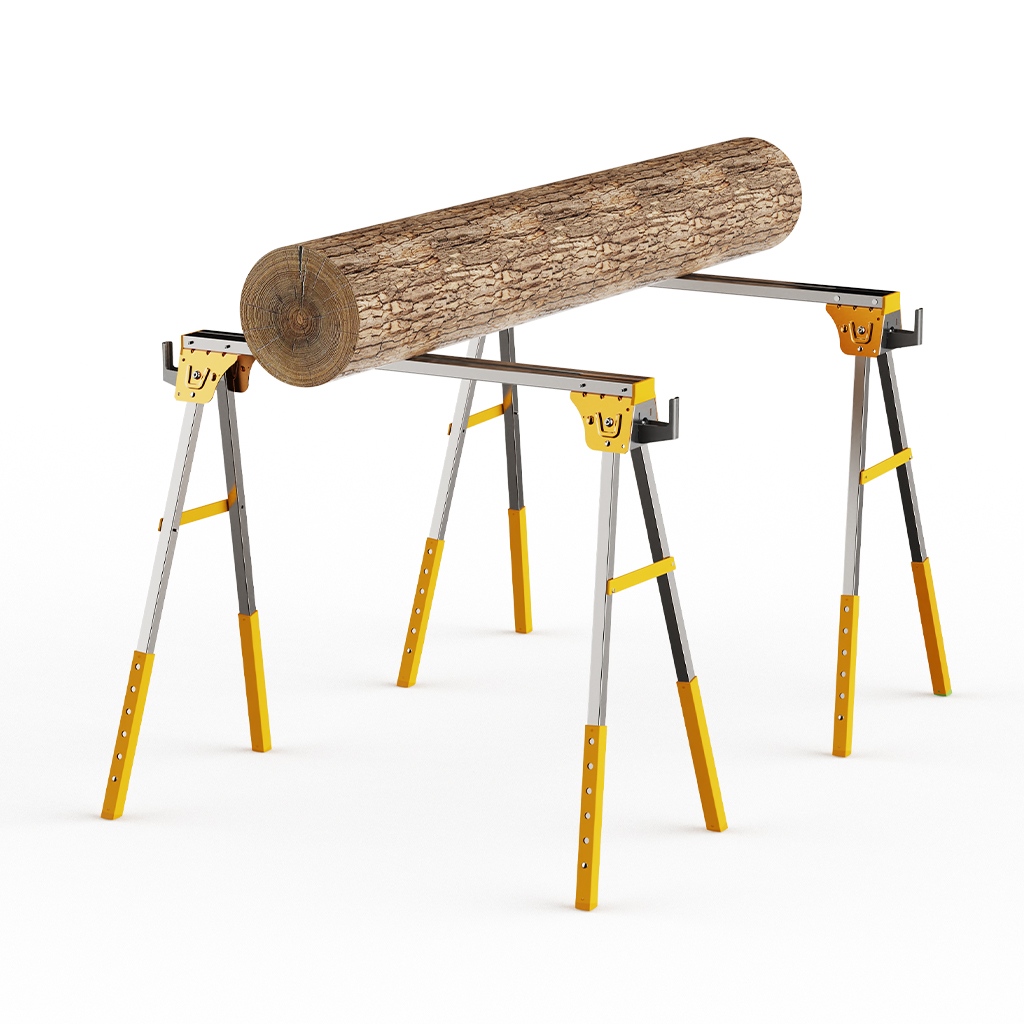
For example, one ONCUPID NH-SH001 folding sawhorse has an unfolded dimension of approximately 88.7 × 43 × 72.6 cm and a folded dimension of approximately 78 × 10.7 × 9.7 cm. Its net weight is around 4.5 kg.
The significance of these figures is not that every buyer will achieve a specific percentage of space savings. Warehouse results depend on carton design, pallet configuration, stacking rules, and local handling practices. The more useful point is that folding changes the physical profile that the buyer needs to manage during storage.
2.Folding Can Improve Inventory Organization
A compact storage profile can also make SKU management easier.
When inventory is densely stocked, warehouse staff need to locate, separate, count, and move products without creating unnecessary handling steps. A narrow folded product is generally easier to arrange consistently than a fully open frame.
This can be particularly useful when a distributor carries multiple versions of the same product, such as:
- different colors;
- different hook configurations;
- different height-adjustment options;
- or different packaging formats.
Standardized storage orientation can make inventory easier to identify and replenish.
In this situation, folding is not just about “taking up less room.” It can also contribute to more predictable warehouse organization.
How Collapsible Saw Horses Improve Warehouse Efficiency

The impact of collapsible saw horses becomes clearer when looking beyond static storage and considering day-to-day warehouse operations.
Warehouse efficiency depends on how easily products can be received, stored, moved, counted, picked, and prepared for shipment. A product with a compact inactive profile can support several of these activities.
1.Better Use of Warehouse Aisles and Storage Zones
Large rigid products can create awkward gaps around shelves and pallets. Those gaps may not be large enough for another product but still consume valuable warehouse capacity.
Foldable products can often be positioned more closely together, especially when the folded profile is relatively thin.
This does not automatically mean every warehouse can simply double its inventory capacity. Real results depend on pallet rules, safety clearances, stacking limits, packaging, and local warehouse systems.
However, a smaller product profile gives warehouse planners more flexibility when allocating storage space.
That flexibility can be commercially valuable during high-inventory periods, seasonal purchasing cycles, or the launch of a new product line.
2.Easier Internal Material Handling
A folding sawhorse can also simplify internal movement.
Instead of handling a fully open frame, warehouse workers can move the product in a collapsed configuration before it is unpacked or prepared for final delivery.
This can reduce the amount of awkward clearance required around the product during certain warehouse tasks.
For distributors with centralized warehouses, the advantage can extend to:
- stock transfers;
- order picking;
- staging before shipment;
- secondary packaging;
- and loading preparation.
The effect is operational rather than dramatic, but operational improvements become more important as order volume grows.
3.More Flexible Inventory Scaling
One of the challenges of B2B purchasing is that inventory does not remain constant.
A distributor may need to carry more stock before a seasonal sales period and less during slower months. The amount of storage available, however, may remain fixed.
Folding products give buyers greater flexibility because inventory can be compressed during periods when it is not being actively moved.
This is particularly relevant for products that may be purchased in bulk but sold gradually.
A compact storage profile can therefore support a broader inventory strategy rather than simply reducing shelf occupancy.
How Folding Saw Horses Improve Transportation Efficiency

Storage is only one side of the equation.
For international buyers, transportation can be even more important because products may travel through several logistics stages before reaching the customer.
A typical supply chain may involve factory handling, domestic transportation, export consolidation, ocean or air freight, destination warehousing, and regional distribution.
At each stage, available space is limited.
1.Folded Dimensions Can Influence Carton Design
One of the first logistics benefits of folding construction is packaging flexibility.
A product that can be compressed before packing gives packaging engineers more room to optimize carton dimensions around the product rather than designing the carton around its fully open working shape.
This may help reduce unnecessary empty space inside the carton.
The packaging team can then consider:
- carton length and width;
- product orientation;
- number of units per carton;
- protective material requirements;
- carton stacking strength;
- and pallet compatibility.
The goal is not simply to make the carton as small as possible.
An efficient export package must balance compactness with product protection, handling requirements, and carton strength.
2.More Efficient Use of Pallet and Container Space
Transportation costs are often influenced by volume as well as weight.
When products are relatively lightweight but physically bulky, transportation space can become a limiting factor. Folding construction gives suppliers and buyers another tool for managing cubic volume.
For collapsible saw horses, the folded profile may allow more compact grouping inside export cartons, which can improve the utilization of pallets, trucks, or containers.
The actual benefit depends on the final packaging specification and loading plan, so buyers should not evaluate logistics efficiency using product dimensions alone.
Instead, they should ask suppliers for commercial packaging information such as:
- carton dimensions;
- units per carton;
- carton gross weight;
- pallet quantity;
- pallet dimensions;
- and loading quantity for the intended shipment method.
These numbers provide a much clearer picture of logistics performance than the product’s open size by itself.
3.Lower Transportation Pressure Does Not Always Mean Lower Freight Cost
This distinction is important.
A smaller folded product can improve loading efficiency, but freight pricing depends on many factors, including route, carrier, shipping method, chargeable weight, container utilization, and market conditions.
Therefore, a folding design should not automatically be presented as a guarantee of a specific freight-cost reduction.
A more accurate commercial argument is that folding construction creates additional opportunities to optimize transportation space.
For a buyer comparing several products, that can still be a meaningful advantage.
Why Packaging and Loading Should Be Evaluated Together

One common sourcing mistake is to evaluate the product and the packaging separately.
For a folding sawhorse, these two elements are closely connected.
A product may fold well but still be packaged inefficiently. Likewise, an excellent carton design may not deliver much benefit if the product itself cannot be compacted.
1.Product Design and Packaging Should Work as One System
A well-planned folding structure can influence:
- how the product nests inside the carton;
- how multiple units are arranged;
- how much protective material is necessary;
- how cartons are stacked;
- and how many cartons can be placed on a pallet.
This is why B2B buyers should discuss packaging early in the sourcing process rather than waiting until the purchase order is finalized.
For private-label programs, this becomes even more important.
A customized brand package may require specific carton dimensions, printed graphics, barcode placement, retail-ready presentation, or additional protective components. Those requirements should be evaluated against the folded product configuration before final packaging approval.
2.Retail Packaging and Wholesale Packaging May Have Different Priorities
Not every buyer needs the same packaging strategy.
A distributor purchasing bulk cartons for warehouse fulfillment may prioritize:
- maximum units per carton;
- strong cartons;
- pallet efficiency;
- and low handling complexity.
A retail brand may place more emphasis on:
- shelf-ready presentation;
- product visibility;
- printed packaging;
- color consistency;
- barcode placement;
- and consumer-facing dimensions.
The folding mechanism can support either strategy, but the final packaging should be designed around the intended sales channel.
What Commercial Buyers Should Evaluate in a Folding Sawhorse
The logistics advantage of folding construction is meaningful, but it should not be evaluated in isolation.
A product that saves storage space but creates reliability problems is not a good commercial solution.
For this reason, buyers should look at folding design as one part of a broader sourcing evaluation.
1. Folded Dimensions
Ask for the exact folded dimensions, not only the open working dimensions.
The folded dimensions should be considered alongside:
- carton dimensions;
- pallet dimensions;
- warehouse storage requirements;
- and transportation configuration.
This gives buyers a realistic picture of the product’s logistics profile.
2. Folding Mechanism Reliability
A folding mechanism must tolerate repeated opening and closing without becoming loose or difficult to operate.
For commercial sourcing, the important question is not simply whether the product folds.
The better question is:
Will the folding mechanism remain consistent after repeated use and throughout the intended product lifecycle?
This connects logistics efficiency with product durability.
If a folding mechanism becomes difficult to operate, the theoretical benefits of the design become less useful in real-world use.
3. Packaging Efficiency
Request the supplier’s complete packaging data.
Useful figures include:
- units per carton;
- carton size;
- net weight;
- gross weight;
- pallet configuration;
- and available loading data.
This is especially important when comparing suppliers with similar-looking products.
Two sawhorses may have nearly identical working dimensions but very different carton efficiency.
4. Product Weight
Weight matters because logistics efficiency is not purely a volume issue.
A product needs to balance:
- structural strength;
- portability;
- packaging weight;
- handling requirements;
- and freight considerations.
A lightweight folding sawhorse can be easier to handle, but buyers should still confirm that the frame, joints, feet, and connecting components are appropriate for the intended workload.
5. Load Capacity and Stability
A compact product is only commercially valuable if it performs its primary function reliably.
When evaluating a heavy-duty folding model, buyers should check the rated capacity, test method, weight distribution conditions, and stability.
For example, the NH-SH001 model is specified at up to 2,650 lbs per pair under the manufacturer’s stated load rating. Buyers who need a deeper understanding of how much weight a sawhorse can hold can also review the related load-capacity guide.
The key is to treat capacity as part of the overall product specification rather than allowing the logistics benefit to overshadow working performance.
6. OEM and Private-Label Capability
For tool brands, logistics efficiency is only one part of the sourcing equation.
A supplier should also be able to support:
- customized colors;
- logo application;
- packaging development;
- product modifications;
- tooling;
- and quality control.
When these services are available through one manufacturing partner, buyers can reduce the number of separate suppliers involved in product development.
That can simplify communication and shorten the path from concept to production.
Choosing a Supplier for Folding Saw Horses
For importers and distributors, supplier capability can determine whether the theoretical benefits of folding construction become real commercial advantages.
A supplier should be able to discuss not only the product itself but also how it will be manufactured, packed, tested, and prepared for shipment.
1.Manufacturing Experience Matters
A folding sawhorse contains moving structural elements, so manufacturing consistency is important.
Buyers should look for evidence of:
- controlled component production;
- reliable metal processing;
- injection-molded components where applicable;
- consistent assembly;
- inspection procedures;
- and repeatable product quality.
A manufacturer with in-house engineering and production capabilities may also be better positioned to optimize the folding structure and packaging together.
2.Ask for Logistics Data Before Finalizing the Order
One of the simplest ways to compare suppliers is to request the same logistics data from each candidate.
A useful supplier comparison sheet can include:
| Item | Supplier A | Supplier B | Supplier C |
|---|---|---|---|
| Open dimensions | |||
| Folded dimensions | |||
| Product weight | |||
| Carton dimensions | |||
| Units per carton | |||
| Gross carton weight | |||
| Pallet quantity | |||
| Loading quantity | |||
| MOQ | |||
| Lead time |
This approach helps buyers evaluate logistics efficiency using real commercial information rather than relying on marketing claims. For a broader purchasing framework, buyers can also use this folding sawhorse buying guide when comparing product and supplier requirements.
3.A Folding Design Can Also Create Product-Line Opportunities
For distributors and brands, compact products can be easier to position across different sales channels.
A folding sawhorse may work as part of:
- a portable tool range;
- a contractor-focused assortment;
- a workshop product line;
- a space-saving tool collection;
- or a private-label home improvement range.
The key commercial advantage is not necessarily that the product is “smaller.”
It is that the product becomes easier to transport, store, merchandise, and manage across multiple points in the supply chain.
How Jingyan Tools Approaches Folding Sawhorse Manufacturing

For buyers evaluating a folding sawhorse supplier, manufacturing infrastructure can be as important as the product itself.
Jingyan Tools, operated by Ningbo Jingyan Tool Industrial Co., Ltd., has been manufacturing industrial tools since 2003. The company operates a self-owned production base of more than 16,000㎡ and has more than 140 professionals across R&D, mold development, production, quality control, and related functions.
The factory also operates more than 50 sets of production equipment, including injection molding, CNC machining, stamping equipment, and an in-house mold workshop.
For folding tool products, this type of vertically integrated manufacturing capability can support closer coordination between structural components, molded parts, tooling, assembly, and quality control.
The company provides OEM and ODM services for global distributors, importers, and tool brands, allowing commercial buyers to discuss product customization and packaging requirements alongside manufacturing requirements.
For buyers considering a folding sawhorse program, this can be particularly useful when the objective is not simply to purchase an existing SKU, but to develop a product that fits a specific market, brand, package, or distribution strategy.
FAQ About Collapsible Saw Horses and Logistics Efficiency
1.Are collapsible saw horses better for warehouse storage?
They can be, especially when the folded profile is significantly smaller than the working configuration. The main advantage is that the product can occupy less space while it is inactive, giving warehouses more flexibility in inventory arrangement and storage planning.
2.Do folding saw horses reduce shipping costs?
Not necessarily in every shipment. Folding construction can improve the use of available transportation volume, but actual freight cost depends on packaging, loading configuration, shipping method, weight, destination, and carrier pricing.
The best approach is to compare carton dimensions and loading quantities rather than assume a fixed saving.
3.Why are folded dimensions important for B2B buyers?
Because the folded dimensions influence packaging, palletization, warehouse storage, and transportation planning. Open dimensions describe working performance, while folded dimensions help describe the product’s logistics profile.
4.What should I ask a supplier about packaging?
Ask for carton dimensions, units per carton, gross weight, pallet configuration, loading quantity, and whether customized retail packaging is available.
5.Are folding saw horses suitable for wholesale and distribution?
Yes. Their compact storage profile can be particularly useful for distributors and wholesalers that purchase in volume and need to manage warehouse space efficiently.
However, buyers should still evaluate folding reliability, stability, load capacity, packaging quality, and supplier consistency.
6.What is the difference between a fixed sawhorse and a foldable one from a logistics perspective?
A fixed model remains in its working configuration during storage, while a folding model can be compressed into a smaller inactive profile. This can make the folding version easier to store and potentially easier to pack and transport efficiently.
7.What does “saw horse foldable” mean in a commercial product search?
It generally refers to a sawhorse designed to collapse or fold for transport and storage. For commercial buyers, the useful evaluation goes beyond the word “foldable” and should include the actual folded size, mechanism reliability, packaging configuration, and loading efficiency.

Conclusion: Folding Design Can Become a Supply-Chain Advantage
For commercial buyers, a sawhorse should not be evaluated only as a tool that supports materials during work.
It is also a physical product that must move through a supply chain.
From factory production to export packing, transportation, warehousing, order fulfillment, and final distribution, physical dimensions influence how efficiently the product can be handled.
That is where collapsible saw horses can provide an important commercial advantage.
The value of a folding structure comes from its ability to separate the size required for working from the size required for storage and transportation. When supported by appropriate packaging and reliable manufacturing, that difference can improve warehouse flexibility, packaging efficiency, and transportation planning.
For importers, wholesalers, and distributors, the right question is therefore not simply:
“Does this sawhorse fold?”
A better question is:
“How much more efficiently can this sawhorse move through my supply chain because it folds?”
That question connects product design with real purchasing decisions—and helps buyers evaluate folding sawhorses from a broader commercial perspective.
For wholesale, OEM, or private-label sourcing, buyers can discuss product specifications, packaging requirements, customization, and order quantities directly with Jingyan Tools.
Looking for a Folding Sawhorse Supplier?
Get pricing, packaging details, MOQ, customization options and lead time for your folding sawhorse project.
Ralated Products