Hand Truck and Cart: How One Unit Covers More Material Handling Needs

Material handling equipment is the unsung backbone of industrial, warehouse and retail operations, yet few procurement decisions are as frequently misjudged as hand truck and cart selection. For distributors, facility managers, retail operators and industrial product managers across the globe, the default approach of stacking single-function units to match each new handling need leads to bloated equipment fleets, wasted facility space and hidden productivity losses that rarely appear on a formal budget line.
The 3-in-1 convertible hand truck and cart has emerged as a pragmatic alternative to this pattern, but its real value is often reduced to a superficial “two-in-one” marketing claim. In this guide, we break down the actual engineering, economics and use cases that define convertible hand truck performance, compare total cost of ownership against dedicated equipment, and outline what B2B buyers should evaluate when sourcing, specifying or private labeling these products for global markets. Whether you are building a product catalog, upgrading a warehouse fleet or optimizing field service operations, this guide breaks down the real-world value beyond the product spec sheet.
The Function vs. Footprint Dilemma in Industrial Material Handling
For warehouse operators, distribution managers, retail back-of-house teams and field service crews, material handling equipment presents a persistent and costly trade-off. A dedicated 2-wheel hand truck navigates tight aisles and doorways but cannot efficiently move stacked loads or bulk materials. A 4-wheel platform cart handles high-volume transport with stability but fails to fit through narrow passages or standard service elevators. The default solution — adding more specialized equipment — seems logical on the surface, but it creates compounding hidden costs that erode margins across the entire operation.
This dilemma operates on three levels that directly impact B2B profitability. First, capital expenditure multiplies with every additional unit. Each cart, dolly and trolley adds upfront cost, plus ongoing expenses for spare parts, maintenance and replacement. Second, storage space consumption accumulates. In urban warehouses and retail stock rooms where storage costs are calculated per square meter, every idle piece of equipment consumes revenue-generating space. Third, productivity leaks compound. Workers lose time switching between units, transferring loads between carts, and locating the right equipment for each task. Studies of mid-sized warehouse operations show that equipment switching and load transfer consume 15–20 minutes per worker per shift — the equivalent of 60–80 lost working hours per employee annually.
For distributors, importers, retail chains and industrial product managers, the problem carries an additional commercial dimension. A product catalog stacked with overlapping single-function carts creates inventory redundancy, confuses customers and pushes competition toward pure price comparison. A versatile convertible unit, by contrast, solves a clear customer pain point while streamlining SKU count and strengthening margin potential.
This is why the central question for both end users and B2B buyers is not “how many carts do we need?” but “how can one unit cover more handling needs without becoming impractical to use, store and transport?” The answer lies in intentional structural engineering, not just larger dimensions or added features.
How a Convertible Hand Truck and Cart Delivers More Utility Per Square Meter

When base footprint is constrained by real-world environments — door widths, aisle clearances, vehicle cargo bays and storage closets — functional versatility becomes the highest-leverage design principle. A conventional single-mode cart treats its frame as a fixed structure: it performs one job, and if you need a different function, you need a different piece of equipment. A convertible design takes the opposite approach: it reconfigures the same core chassis into multiple working positions, expanding capability without expanding physical space.
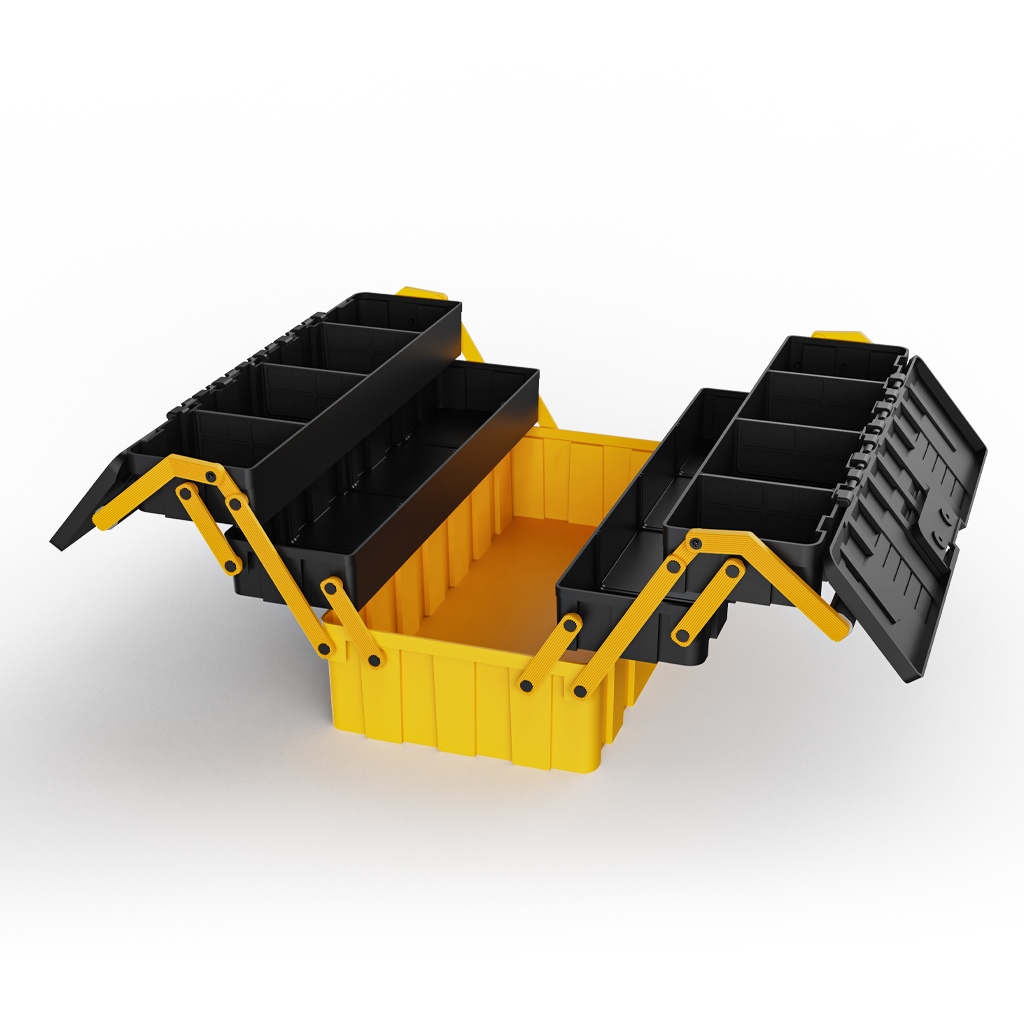
This principle is identical to how vertical layering adds usable storage to a cantilever toolbox without widening its external dimensions. For compact industrial equipment, this is the design philosophy that bridges the gap between specialized performance and everyday practicality.
1.Two Working Modes From One Shared Chassis
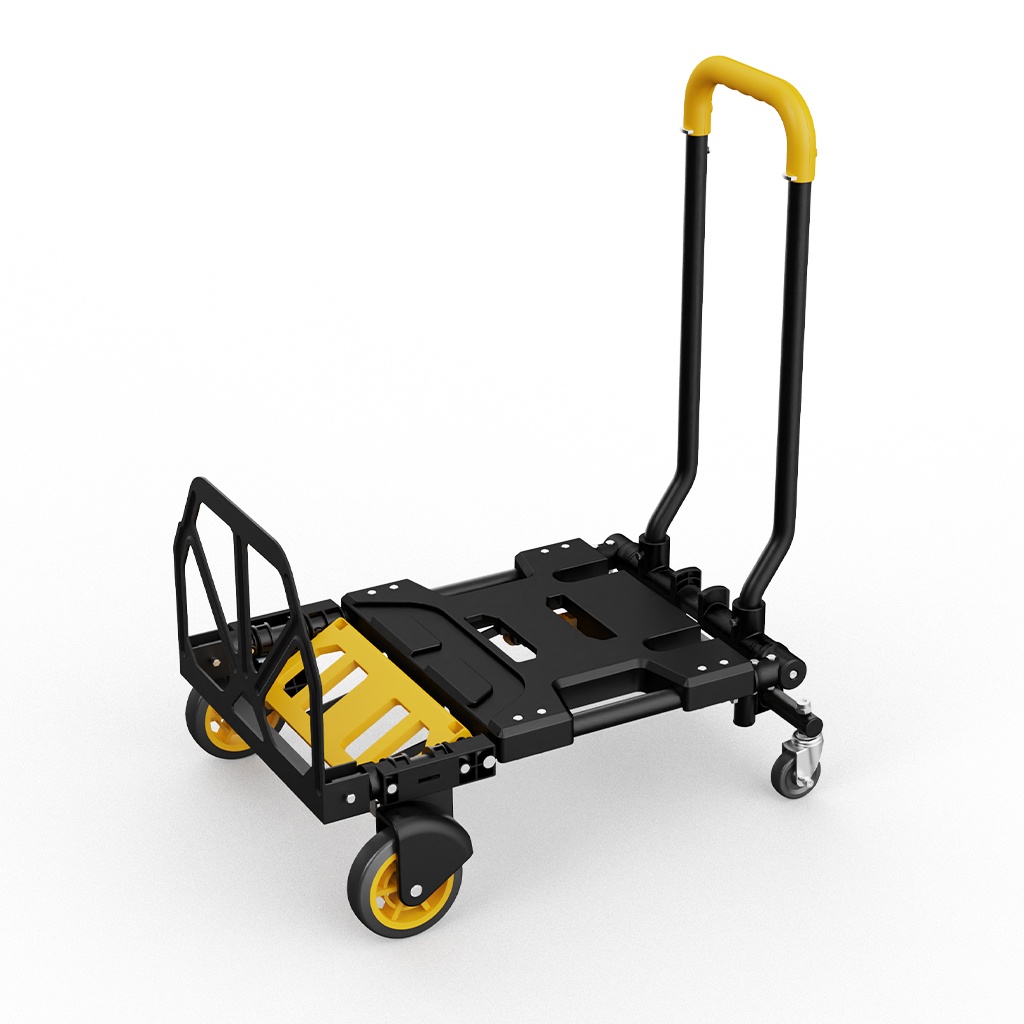
At its core, a convertible hand truck and cart delivers two distinct working configurations from a single frame, wheel set and handle assembly.
In 2-wheel upright mode, the frame stands vertically with an extended ergonomic handle, creating a traditional dolly profile optimized for pulling heavy individual items through doorways, elevators, narrow rack aisles and congested work zones. The tilted load position leverages mechanical advantage to reduce perceived weight on the operator, making it the preferred configuration for loading and unloading delivery vehicles and moving dense, heavy items.
In 4-wheel platform mode, the load bed rotates into a horizontal position supported by four wheels, creating a stable, flat surface for stacked cartons, bins, loose materials and multi-item loads. This mode distributes weight more evenly across the frame, reduces tipping risk, and allows operators to move larger volumes of goods across open warehouse floors, production lines and stock rooms in a single trip.
Crucially, there are no separate attachments, no loose parts and no additional hardware required. All functionality is built into the structure itself. This means no lost components, no assembly time and no need to store extra parts alongside the equipment.
2.The Third Mode: Folded Storage That Reduces Hidden Space Costs
Beyond the two active working modes, a well-engineered convertible trolley adds a third folded mode that addresses one of the most undercalculated costs of handling equipment: idle storage.
When not in use, the entire unit collapses into a slim, vertical rectangular profile that tucks into vehicle trunks, under workbenches, inside utility closets and between warehouse racking. For mobile service teams, delivery drivers and facilities maintenance crews, this means the equipment travels with the job rather than requiring dedicated storage space at every work site. For retail back rooms and small production workshops, where floor space directly impacts revenue capacity, the ability to stow equipment completely out of the way during peak operating hours delivers measurable operational and financial value.
To put this compactness in perspective, a standard 3-in-1 folding trolley measures roughly 37.5 cm × 13 cm × 81 cm when folded — narrow enough to fit alongside a standard interior door frame. This level of space efficiency is impossible to achieve with two separate dedicated carts.
Breaking Down Capacity, Build and Real-World Performance Specs

Specifications sheets only tell part of the story. What matters for industrial and commercial users is how those specs translate into real-world performance, durability and usability over thousands of work cycles. For convertible hand trucks, three categories of specifications define real value: load capacity, material construction, and dimensional accuracy across all modes.
1.Load Capacity: Rated vs. Peak — Why the Distinction Matters for B2B Buyers
Load capacity is the most referenced and most misunderstood specification. Product listings often advertise a “maximum load” figure, but this number typically describes a one-time static test peak, not a weight the unit can safely carry repeatedly across years of daily use.
For professional and industrial applications, rated load capacity is the meaningful benchmark. This is the weight the unit is engineered to carry continuously, cycle after cycle, without structural degradation or safety risk. A quality general-purpose convertible hand truck carries a 120 kg rated load capacity evenly distributed across both 2-wheel and 4-wheel modes. This rating is verified through fatigue testing — typically thousands of load cycles — rather than a single maximum-lift demonstration.
This distinction is especially important for B2B buyers because rated capacity directly impacts product liability, workplace safety and warranty exposure. Products sold on peak load figures rather than rated capacity create hidden risk for distributors, retailers and end users alike.
2.Material Construction: Hybrid Design for Optimal Strength-to-Weight Ratio
The material composition of a convertible hand truck determines its strength, durability, weight and corrosion resistance — all factors that shape total cost of ownership. Premium units use a hybrid construction that combines the best properties of multiple materials rather than relying on a single substance.
A reinforced PP+PA engineering polymer body combined with an internal iron support frame delivers the strongest overall balance of properties. The PP+PA composite provides excellent impact resistance, wear resistance and corrosion resistance, standing up to oils, grease, mild chemicals and rough handling common in industrial environments. The internal iron reinforcement frame delivers structural rigidity and load-bearing strength, preventing flexing, bending or warping even under maximum rated load.
This hybrid design is why a 120 kg rated convertible trolley can weigh as little as 7.1 kg — light enough for a single operator to lift into a vehicle or carry up stairs, while remaining robust enough for daily commercial use. All-metal designs by comparison are stronger but significantly heavier, increasing operator fatigue and transport difficulty. All-plastic designs are lighter but lack the structural rigidity for heavy loads.
3.Dimensional Accuracy Across All Three Modes
For a convertible product, dimensional consistency across each mode is a marker of manufacturing quality. A unit that fits through doorways in 2-wheel mode but sticks out awkwardly in 4-wheel mode, or that folds unevenly and fails to stack efficiently for shipping, creates operational problems that specifications alone do not reveal.
A precision-engineered 3-in-1 unit delivers consistent, purpose-built dimensions for each configuration:
- 4-wheel platform mode: 47.5 cm × 62 cm × 80.8 cm — optimized for standard euro-pallet half-widths and typical carton sizes
- 2-wheel hand truck mode: 47 cm × 40.5 cm × 121.5 cm — sized to clear standard doorways and service elevators
- folded storage mode: 37.5 cm × 13 cm × 81 cm — built for efficient vehicle storage and compact shelving
These dimensions are not arbitrary. They are calibrated around the most common real-world constraints found in warehouses, retail facilities, delivery vehicles and job sites.
Single-Use vs. Convertible: TCO Analysis for B2B Buyers

B2B procurement decisions should always be evaluated on total cost of ownership (TCO), not just upfront purchase price. For material handling equipment, TCO includes acquisition cost, storage cost, maintenance cost, replacement cycle length and productivity impact. When analyzed on this basis, convertible hand trucks consistently deliver better value than fleets of single-function carts for most general-purpose applications.
1.Acquisition and Storage Cost Comparison
Purchasing one convertible unit typically costs 30–40% less than buying two separate dedicated carts. But the acquisition cost gap is only the beginning.
Storage costs represent the largest hidden expense. In urban European and North American markets, warehouse storage costs range from €80 to €180 per square meter per year. A dedicated 2-wheel hand truck and a separate 4-wheel platform cart together occupy roughly twice the floor space of one folded convertible unit. Over a five-year service life, that space difference adds hundreds of euros per unit in indirect storage costs. For distributors holding inventory, the compact folded profile also reduces cube utilization in shipping containers and distribution centers, lowering per-unit logistics costs across the supply chain.
2.Maintenance, Durability and Replacement Cycles
It is often assumed that folding equipment is less durable than fixed designs, but this depends entirely on build quality. A well-engineered convertible with reinforced pivot points and quality materials can match the service life of a dedicated single-mode cart. Cheap folding trolleys with plastic hinges and thin frames do fail early — but this is a quality problem, not an inherent flaw of convertible design.
For B2B buyers, the more relevant comparison is replacement frequency. A fleet of two cheap single-function carts may need replacement every 2–3 years in heavy use. One industrial-grade convertible unit from a quality manufacturer typically delivers 5+ years of service life. This means fewer replacement purchases, less disposal cost and lower administrative overhead over time.
3.Productivity Impact: The Hidden Financial Upside
The largest TCO benefit comes from productivity gain. When workers do not have to transfer loads between carts or search for the right equipment for each task, they complete more handling cycles per shift. For a typical mid-sized warehouse operation, reducing equipment switching time by 15 minutes per worker per shift translates to roughly 5% higher material handling productivity — a gain that quickly pays for the equipment investment.
For distributors and retailers selling to end users, this productivity benefit is also one of the strongest selling points. It allows positioning the product as a cost-reduction and efficiency tool rather than a commodity equipment purchase.
Industry Use Cases Where One Unit Replaces Multiple Carts
The value of a convertible hand truck and cart is not uniform across all industries. It delivers the strongest return in environments where work tasks vary, spaces change shape and equipment must adapt to different conditions throughout the day.
Warehouse and distribution centers with mixed order profiles benefit enormously. Workers use 2-wheel mode to unload heavy cartons from delivery containers and navigate narrow pallet rack aisles, then switch to 4-wheel mode for order picking and stock replenishment across wider sorting zones. For facilities with a mix of full-case and piece-picking workflows, one convertible unit handles tasks that would otherwise require two different carts.
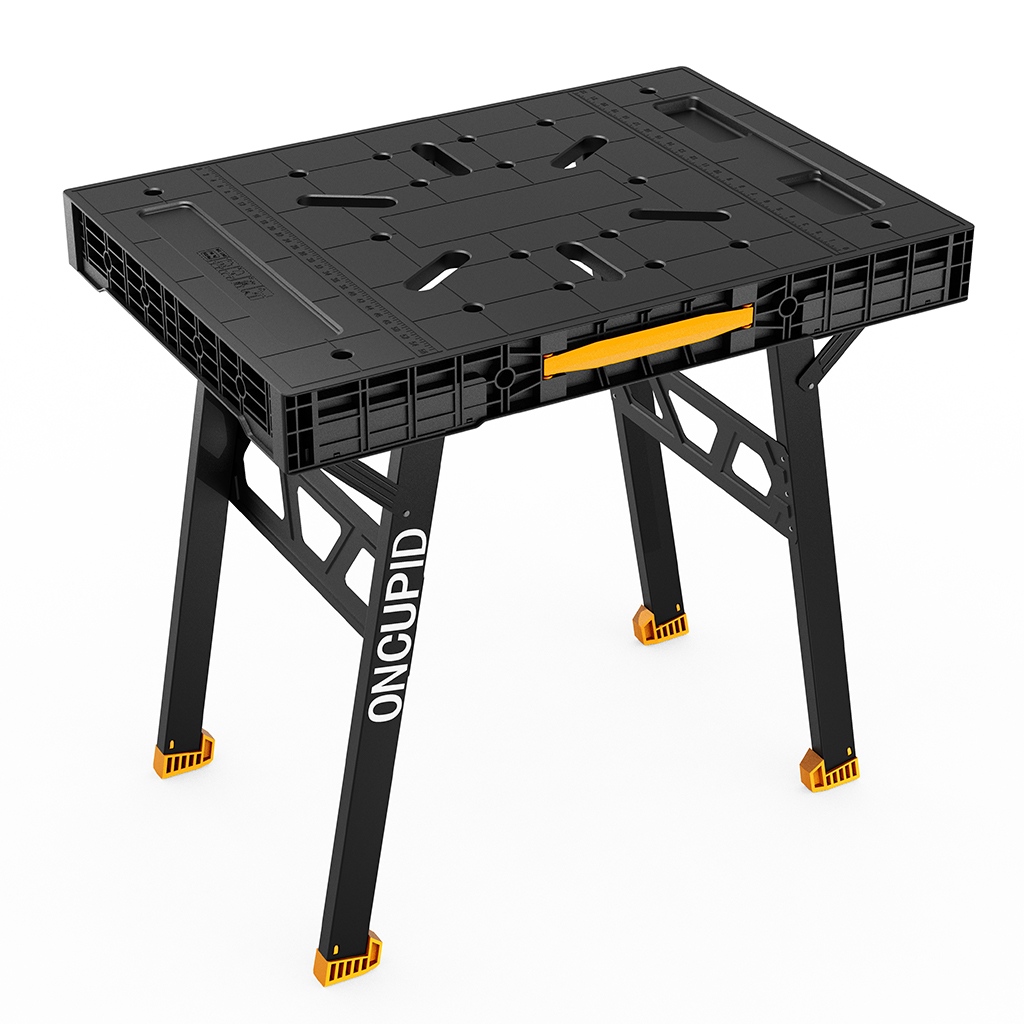
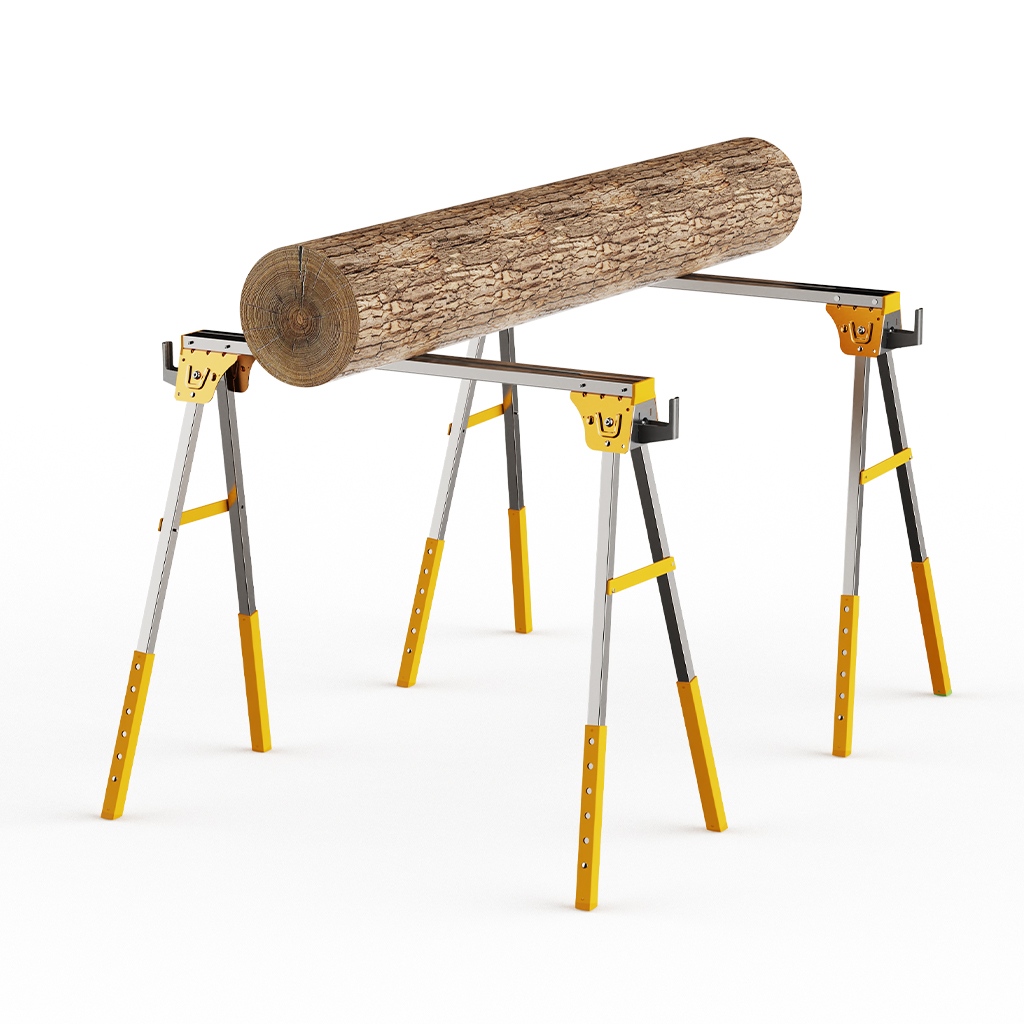
Manufacturing and industrial workshops deal with constant movement of raw materials, work-in-progress parts, finished goods and tools between storage and production lines. 4-wheel mode transports bins of small components and bulk supplies across workshop floors, while 2-wheel mode moves heavier individual items like motors, pumps and tooling. When paired with a height-adjustable workbench and foldable sawhorse stands, it also enables fully mobile workstations for on-site assembly, repair and maintenance work. The ability to fold and store the unit at workcells without blocking walkways is a major advantage in lean manufacturing environments.
Retail back-of-house operations are defined by extreme space constraints. Stock rooms are rarely designed for efficient material handling, and equipment must be completely out of sight during customer trading hours. A single convertible trolley handles receiving, stock movement, waste disposal and display setup tasks that would otherwise require multiple pieces of equipment. For multi-site retail chains, standardizing on one versatile model also simplifies procurement, staff training and replacement parts management across all locations.
Facilities maintenance and field service teams work across constantly changing environments — from tight mechanical rooms to open outdoor areas. A convertible unit travels in the service vehicle, then adapts to whatever the job requires: 2-wheel mode for pulling equipment down corridors, 4-wheel mode for carrying tools and parts across job sites, and folded mode for clean storage between calls. For service businesses, this versatility reduces the amount of equipment carried on each vehicle and expands the range of jobs each technician can handle.
Key Sourcing Criteria for Distributors and Industrial Buyers

Selecting the right convertible hand truck for a product range or equipment fleet requires evaluating more than just feature lists. For B2B buyers, supplier capability, manufacturing consistency, compliance certification and supply chain reliability are just as important as the product itself.
1.Manufacturing Consistency and Production Capability
Convertible designs have more moving parts than single-mode carts, which makes manufacturing precision and consistency critical. Pivot points, locking mechanisms, tray alignment and wheel mounting all require tight tolerances. Even small dimensional variations can cause binding, loose fits, uneven folding or premature wear.
This is why working with a manufacturer that controls full production in-house delivers significantly more consistent quality than sourcing through trading companies that aggregate products from multiple factories. Manufacturers with end-to-end capabilities — such as Ningbo Jingyan Tool Industrial Co., Ltd., founded in 2003 as a specialized B2B manufacturer — maintain complete control over quality at every production stage. With a 16,000㎡ self-owned production base, over 140 professionals across R&D, mold design, production, quality control and customer service, and more than 50 sets of precision production equipment including injection molding machines, CNC machining centers, stamping machines and a dedicated mold workshop, they have built a stable and scalable production system with standardized output of 300 workbenches per day and monthly volumes of 7,000 workbenches plus 100,000 accessories.
For B2B buyers, this level of vertical integration means consistent product quality across repeat orders, reliable production capacity and fewer supply chain surprises.
2.Compliance, Certification and Market Access
Products sold into global industrial and retail markets must meet a wide range of safety, quality and environmental regulations. Missing certifications can create border delays, market access barriers and product liability risk.
Reputable manufacturers establish full-process quality control systems with independent testing laboratories, and hold international certifications including ISO 9001, CE, ROHS, FDA, BSCI and CPC. These certifications are not just badges — they are market access requirements that allow distributors to sell into Europe, North America, Southeast Asia, the Middle East and Oceania without re-testing or re-certification.
As a designated supplier for leading global brands such as Stanley and Bosch with cooperation spanning over 11 years, and with products exported to more than 30 countries and regions, Jingyan Tools maintains full compliance with all major international standards. For B2B buyers, this means faster market entry, lower regulatory risk and stronger retail acceptance.
3.Supply Chain Reliability and Lead Time Predictability
For distributors and retailers, stock-outs kill sales and late orders damage customer relationships. Standard order lead times of 30 days with 20-day expedited options for urgent orders give buyers the flexibility to plan inventory and respond to market demand.
Equally important is scalability. A supplier that can handle both small trial orders and large bulk shipments allows distributors to test new products and scale up quickly when demand grows. This scalability is particularly valuable for convertible hand trucks, which often sell through multiple channels and customer segments.
How OEM/ODM Customization Extends Product Line Value
For distributors, retail chains and industrial brands, a standard product is only the starting point. Customization allows buyers to differentiate their offering, build brand recognition and command higher price points — but only if the manufacturer has the in-house capabilities to deliver it reliably.
1.Branding and Cosmetic Customization
Entry-level customization includes color matching and logo application. For convertible hand trucks, this typically means selecting from standard color options — yellow & black, red & black, orange, blue, yellow and green — or matching custom Pantone colors to align with brand identity. Logo application via printing, embossing or labeling on the handle, frame and retail packaging completes the private label look.
This level of customization is relatively simple but powerful for retail positioning. It allows distributors to create a branded product line without the cost and risk of full product development.
2.Structural and Functional ODM Development
For larger brands and industrial customers with specific requirements, full ODM customization goes deeper than cosmetics. It involves modifying dimensions, adjusting load capacities, adding features and developing entirely new product configurations based on customer concepts.
This requires the manufacturer to have in-house R&D and mold development capabilities. Manufacturers with dedicated design teams can take projects from initial concept and 3D modeling through mold fabrication, prototype testing and full mass production. This end-to-end capability allows customers to bring unique products to market that competitors cannot easily source.
Backed by a professional R&D team and in-house mold development capabilities, Jingyan Tools provides one-stop OEM/ODM customization services from concept design to mass production. This makes it possible for distributors and brands to build differentiated product lines around the convertible hand truck platform, rather than just selling the same generic product as every other competitor.
Frequently Asked Questions
1.Q: Can a convertible hand truck really replace both a 2-wheel dolly and a 4-wheel platform cart?
A: For general-purpose commercial, retail and light industrial use, yes. A quality industrial-grade convertible unit delivers equivalent core functionality to both a dedicated 2-wheel hand truck and a dedicated 4-wheel platform cart, with the added benefit of compact folding storage. For extremely heavy-duty applications above 150 kg or highly specialized use cases, dedicated equipment may still be preferable.
2.What is the actual rated load capacity of a standard convertible hand truck?
A: General-purpose convertible trolleys typically have a 120 kg rated load capacity for evenly distributed loads in both operating modes. This rating reflects continuous daily use across thousands of work cycles, not a one-time peak load test. Heavy-duty industrial models with higher rated capacities are available for more demanding applications.
3.Q: Does converting between modes require tools or extra parts?
No, premium convertible hand trucks are designed for tool-free conversion in seconds. The locking mechanism releases with a single simple motion, allowing the user to reconfigure the unit between 2-wheel and 4-wheel modes without additional hardware, attachments or loose parts.
4.Q: Are folding hand trucks less durable than fixed-frame hand trucks?
A: Not necessarily. A well-engineered folding design with reinforced metal pivot points, quality bearings and durable materials can match the service life of a fixed-frame cart. What matters is build quality, not whether it folds. Cheap folding trolleys with all-plastic hinges do fail early, but that is a quality issue, not an inherent flaw of convertible design.
5.Q: What certifications should I look for when sourcing convertible hand trucks for resale?
A: For global distribution, look for manufacturers with ISO 9001 quality management certification and product-level certifications including CE, ROHS, BSCI and CPC as applicable to your target markets. These certifications reduce market access barriers and demonstrate compliance with international safety and quality standards.
6.Q: What is the typical lead time for wholesale and OEM orders?
A: Standard production lead time for convertible hand trucks is typically 30 days from order confirmation, with 20-day expedited production available for urgent orders. Exact lead times vary by order size, customization level and current production schedule, so it is best to confirm with the supplier directly.
7.Q: Can I order small quantities to test the market before placing a large order?
A: Many professional OEM manufacturers offer flexible minimum order quantities to support market testing, especially for standard products. Custom OEM orders with unique colors, branding or structural modifications typically have higher MOQs based on the complexity of the customization.
Final Takeaway: Maximize Handling Coverage, Minimize Equipment Complexity
The challenge of material handling — for end users and B2B buyers alike — is not simply to move more goods with more equipment. It is to build equipment fleets and product assortments that use limited space, budget and labor as efficiently as possible.
Adding another specialized cart may solve an immediate handling gap, but it adds cost, consumes space and increases operational complexity. A well-engineered convertible hand truck and cart takes the opposite approach: it expands capability through smarter structural design, not bigger size or more units.
The three-mode principle — 2-wheel upright handling, 4-wheel platform transport and compact folded storage — demonstrates how design ingenuity can deliver more value than simply scaling equipment up. For end users, that means lower total cost of ownership, less wasted facility space and higher workforce productivity. For distributors and brands, that means a stronger product proposition, cleaner product segmentation and better margin potential.
The goal is not to choose the hand truck with the highest load number or the most features. The goal is to select the configuration that delivers the most useful coverage for the target user — without making the product unnecessarily bulky, heavy or expensive.
For distributors, importers, retail chains and industrial brands looking to source convertible material handling equipment, working with an experienced manufacturer ensures both design quality and production consistency. Jingyan Tools supports full OEM and ODM programs for convertible hand trucks, workbenches, sawhorses and tool storage solutions, with flexible order quantities, custom branding options and reliable bulk delivery capabilities. We sincerely welcome partners worldwide to explore long-term mutually beneficial cooperation.
Related products