How to Evaluate Portable Workbench Quality Before Buying

A portable workbench can look deceptively simple. A buyer may see a work surface, folding legs, locking points, and a compact design that can be carried or stored when not in use.
For professional buyers, however, appearance is only the starting point.
Two portable workbenches can have similar dimensions, similar materials, and even similar advertised load capacities, yet perform very differently after repeated use. One may remain stable and easy to operate, while another may develop looseness around its joints. One may feel rigid under working pressure, while another may flex or shift when force is applied near an edge.
For importers, distributors, retailers, and private label buyers, these differences can become much larger commercial problems. A product that looks acceptable in a catalog but performs poorly in the market can lead to returns, complaints, warranty claims, poor reviews, and additional inspection or service costs.
That is why portable workbench quality should not be judged by one specification or one visual inspection.
The more useful question is:
What evidence shows that the workbench is well designed, properly tested, and capable of delivering consistent performance in its intended application?
This guide explains how buyers can evaluate portable workbench quality before placing an order, from structural design and folding performance to load capacity, materials, sample testing, production consistency, and supplier quality controls.
- What Defines a High-Quality Portable Workbench?
- How to Evaluate the Structural Design
- How to Evaluate Folding Reliability
- How to Verify Workbench Load Capacity
- How to Evaluate Plastic and Metal Construction
- How to Evaluate Work Surface Quality and Usability
- How to Evaluate Height Adjustment
- Why Open and Folded Dimensions Both Matter
- How to Inspect a Portable Workbench Sample
- Why Mass-Production Consistency Matters
- What Evidence Should a Portable Workbench Manufacturer Provide?
- Portable Workbench Quality Checklist for Buyers
- Quality Should Be Evaluated Beyond the Product Sample
- How to Make the Final Purchasing Decision
- Final Takeaway
- Frequently Asked Questions
What Defines a High-Quality Portable Workbench?
A high-quality portable workbench is not simply a workbench that carries a large load or folds into a compact shape.
Quality comes from how multiple characteristics work together.
For most professional applications, the main areas to evaluate are:
- structural strength and stability;
- folding reliability;
- load performance;
- material selection;
- work-surface usability;
- height adjustment, where applicable;
- open and folded dimensions;
- ease of transport and storage;
- consistency between samples and production units.
These factors should be considered as a system.
For example, reducing product weight may improve portability, but it should not compromise structural rigidity. A large working surface may increase usability, but it should still remain stable under realistic loads. More adjustment positions may sound attractive, but they are only useful if the adjustment system remains secure and stable.
A useful quality evaluation therefore asks not only whether a feature exists, but whether it performs reliably in the way customers actually need it to.
How to Evaluate the Structural Design
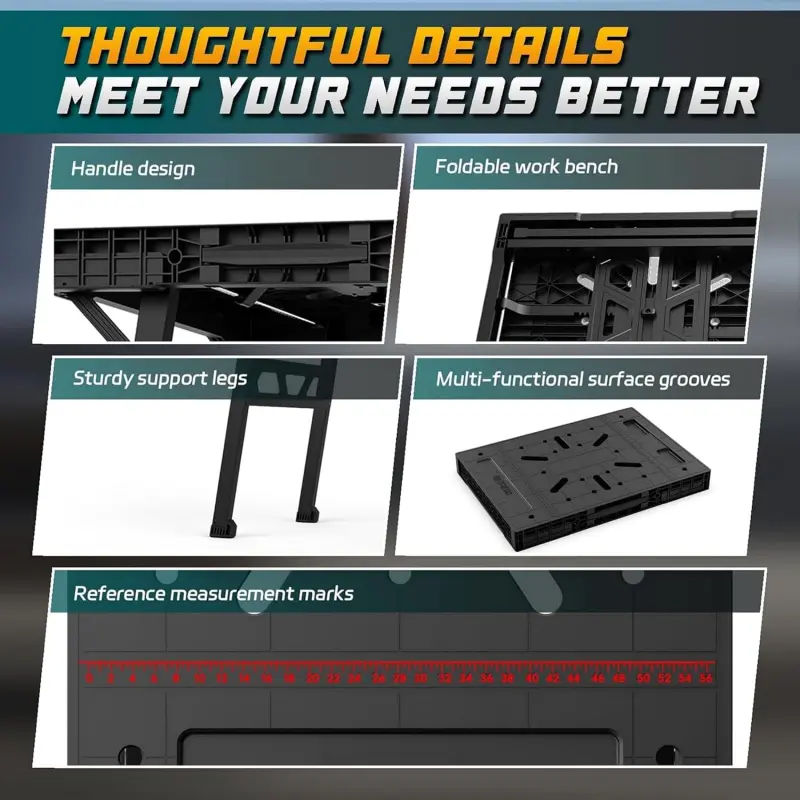
The structure is one of the first areas a professional buyer should inspect.
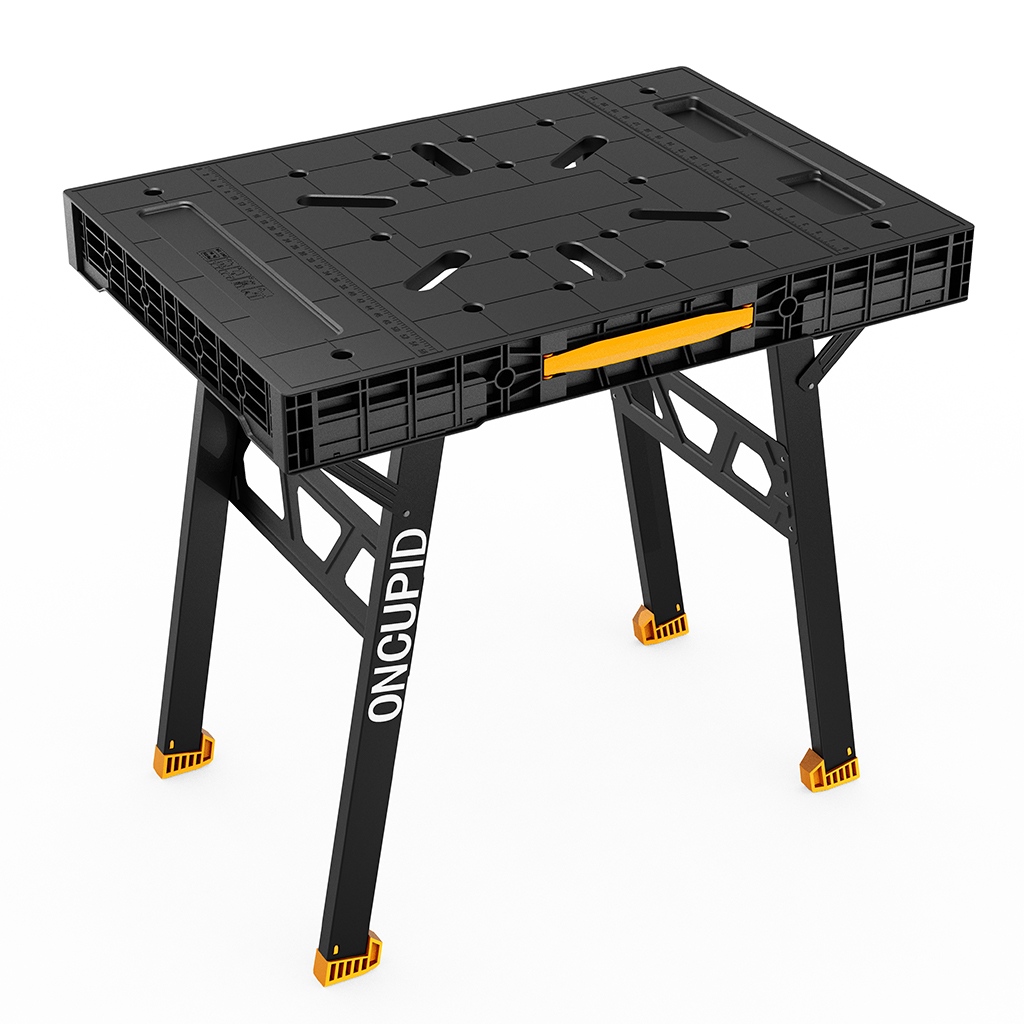
For a portable folding workbench, the work surface, frame, legs, joints, and locking points all contribute to the final working performance.
A strong component does not automatically create a strong product. The complete load path and connection design matter just as much.
1.Follow the Load Path
When a load is placed on the work surface, force moves through the structure and eventually reaches the floor.
Ask:
- Where are the primary load-bearing members?
- How are the legs connected to the frame?
- Where are the folding joints located?
- Which connection points experience the greatest stress?
- Does the frame remain aligned when loaded?
- Are the supporting members arranged to distribute forces effectively?
This is more useful than judging strength by the apparent thickness of one metal component.
A well-designed structure can achieve a practical balance between strength, rigidity, product weight, and portability.
2.Check Stability Across the Work Surface
Do not test only the center of the table.
Real users work close to edges and corners. Materials may be placed to one side, tools may be clamped near an edge, and users may apply force during cutting, drilling, assembly, or material handling.
During sample inspection, apply reasonable working pressure at several locations.
Observe:
- side-to-side movement;
- excessive flexing;
- frame twisting;
- leg movement;
- joint movement;
- changes in alignment.
The objective is not to perform an uncontrolled destructive test.
The objective is to determine whether the product behaves predictably under realistic working conditions.
How to Evaluate Folding Reliability
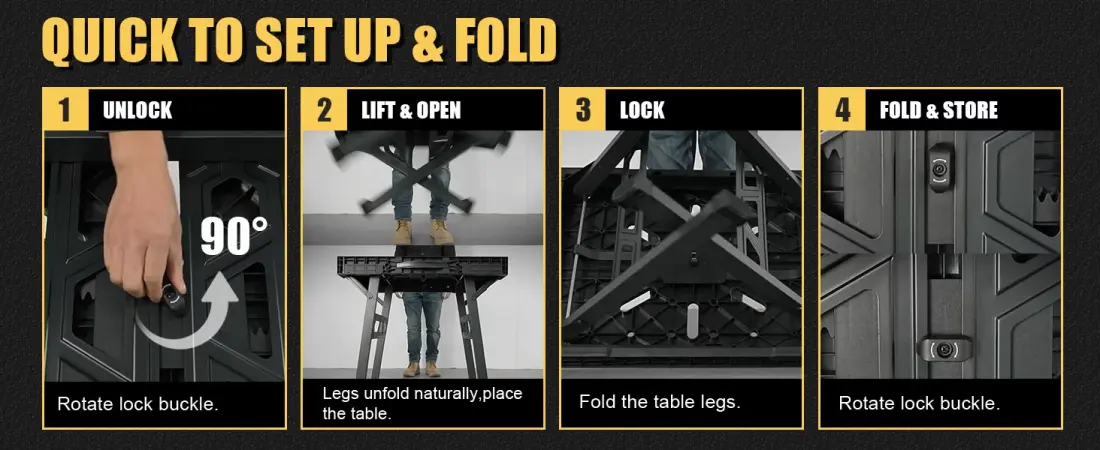
For a folding portable workbench, the folding system is part of the core product—not merely a convenience feature.
A reliable folding design should make the product easy to open and close while keeping the structure secure when fully deployed.
Current products in this category commonly emphasize quick setup and compact folding as part of their value proposition. For example, commercial listings for comparable portable folding worktables combine folding construction with portability, polypropylene components, metal support structures, and substantial load ratings.
1.Check Opening and Locking Performance
When inspecting a sample, open and close it several times.
Pay attention to:
- whether the legs move smoothly;
- whether the structure remains aligned;
- whether locking points engage completely;
- whether excessive force is needed;
- whether the mechanism feels controlled;
- whether movement or looseness appears after several cycles.
A mechanism that feels awkward or inconsistent during basic operation deserves closer inspection before approval.
2.Test Repeated Folding and Unfolding
A one-time demonstration only tells you that the mechanism works once.
For procurement, the more important question is:
Does the folding system continue to work properly after repeated use?
During repeated operation, monitor:
- joint play;
- locking consistency;
- frame alignment;
- operating force;
- unusual sounds;
- deformation;
- difficulty returning to the fully open position.
Repeated-use testing is particularly relevant because the folding mechanism is often one of the main reasons customers choose a portable workbench in the first place.
If the mechanism becomes difficult to operate or fails to lock securely, the product’s main functional advantage is compromised.
How to Verify Workbench Load Capacity
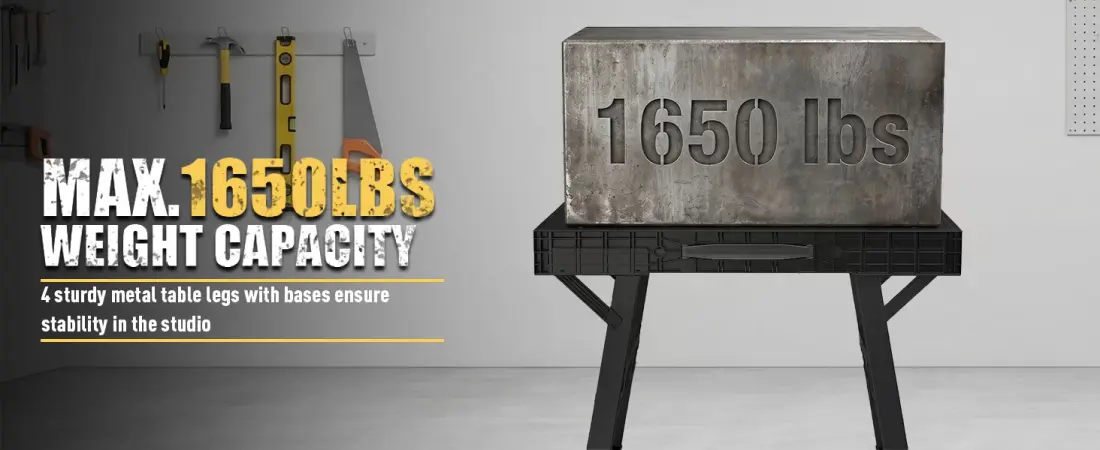
Load capacity is one of the most prominent specifications on a workbench listing.
It is also one of the specifications that should be investigated rather than accepted at face value.
A load rating is only meaningful when the buyer understands the conditions behind it.
1.Understand What the Rated Load Means
Ask the supplier:
- Is the rating based on static loading?
- Is the load evenly distributed?
- Was the workbench fully open and locked?
- Was the test performed at a specific height?
- Was the product placed on a level surface?
- Was the tested configuration identical to the production configuration?
These questions are important because two suppliers can publish similar load figures while using different test conditions.
The number itself is not enough.
2.Consider Real Working Forces
Users rarely place a perfectly centered, static load on a workbench.
They may press near an edge, clamp a workpiece, drill, cut, assemble components, or move materials across the surface.
These actions can create uneven or lateral forces.
Therefore, buyers should evaluate two separate but related questions:
How much load can the workbench support?
and
How stable does it remain while that load is being used?
A high load rating without corresponding stability does not automatically indicate better practical performance.
For buyers evaluating a 750kg-rated workbench, for example, understanding the testing conditions behind that figure is more useful than simply comparing “750kg” with another supplier’s headline number.
How to Evaluate Plastic and Metal Construction
A plastic or polypropylene workbench should not automatically be viewed as inferior to a traditional metal or wooden workbench.
For portable folding products, different materials can serve different functions.
Plastic or polypropylene components can contribute to:
- lower overall product weight;
- molded functional features;
- easier handling;
- integrated design details.
Metal structures can provide:
- structural support;
- rigidity;
- load-bearing capability.
The key question is not:
“Is plastic better than metal?”
The better question is:
“Is each material being used where it makes the most sense for the intended function?”
1.Evaluate Material Distribution
When reviewing a product sample, ask:
- Which components are plastic or polypropylene?
- Which components carry the primary structural load?
- Where are the metal supports located?
- Are high-stress areas reinforced?
- Are plastic components exposed to unnecessary structural stress?
- Are the folding areas suitable for repeated movement?
This functional approach is more meaningful than judging a product simply by its material label.
A portable folding workbench may achieve a useful balance between weight, structural support, handling, durability, and manufacturability when the material combination is properly designed.
How to Evaluate Work Surface Quality and Usability
The work surface is where the end user interacts with the product most directly.
A strong frame does not automatically compensate for a work surface that is awkward, unstable, or poorly designed.
When evaluating the work surface, consider:
- usable working area;
- flatness;
- rigidity;
- edge accessibility;
- surface durability;
- workpiece stability;
- ease of cleaning;
- compatibility with the intended work-holding method.
The advertised dimensions are only part of the picture.
A buyer should consider how much of the surface is actually practical for daily work.
This matters particularly in retail because customers judge the product through physical use. They can immediately feel whether the surface is stable, whether the bench shifts under pressure, and whether the available working area is useful.
Technical specifications should therefore support a positive physical experience rather than exist only on a catalog page.
How to Evaluate Height Adjustment
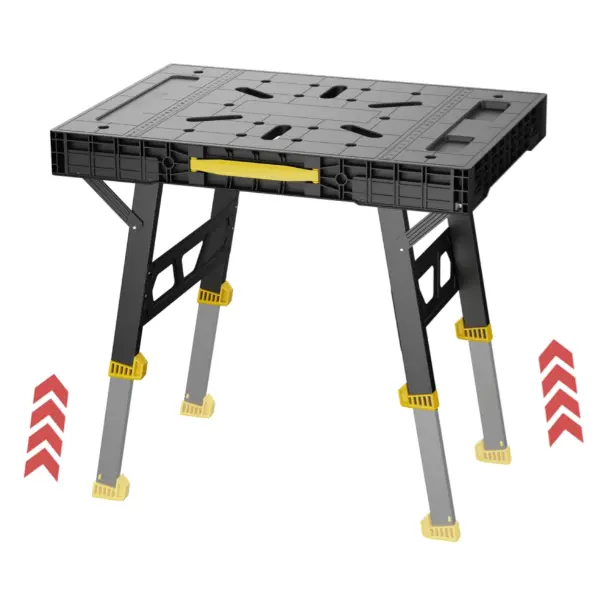
For a height-adjustable portable workbench, the adjustment system should be evaluated as a complete function rather than as a feature checkbox.
Important factors include:
- adjustment range;
- number of positions;
- ease of operation;
- locking security;
- leg alignment;
- stability at different heights.
1.Do Not Judge Height Adjustment by Range Alone
A larger range may look better on paper.
In practice, the useful range is the range in which the workbench remains stable and easy to operate.
Check:
- the lowest position;
- intermediate positions;
- the highest position.
Observe whether the structure remains stable at each level.
A product with fewer positions but reliable locking and consistent stability may be more useful than one with more positions that become difficult to use or less stable near the top of its range.
2.Check Adjustment Consistency
Repeatedly change the height and return it to the same position.
Look for:
- consistent engagement;
- proper alignment;
- secure locking;
- excessive movement after locking;
- changes in operating force.
For professional buyers, adjustment quality is therefore a combination of:
range + usability + locking + stability.
Why Open and Folded Dimensions Both Matter
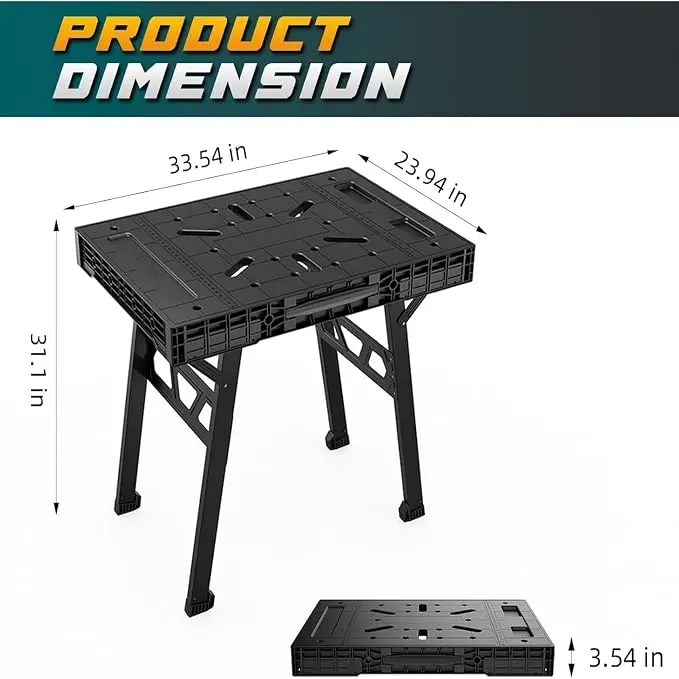
Portable folding products have two important physical states:
working configuration
and
folded configuration.
The open configuration determines how much space the user receives during work.
The folded configuration determines how practical the product is when it is being stored, transported, packaged, or handled.
For B2B buyers, folded dimensions can influence:
- warehouse storage;
- packaging size;
- pallet utilization;
- transport handling;
- vehicle loading;
- customer storage.
When comparing suppliers, record both open and folded dimensions.
Then also record:
- unit weight;
- carton dimensions;
- units per carton;
- carton gross weight;
- pallet configuration.
The goal is not to find the smallest folded product at any cost.
It is to determine whether the product achieves a useful balance between working area, folded size, structure, and portability.
How to Inspect a Portable Workbench Sample
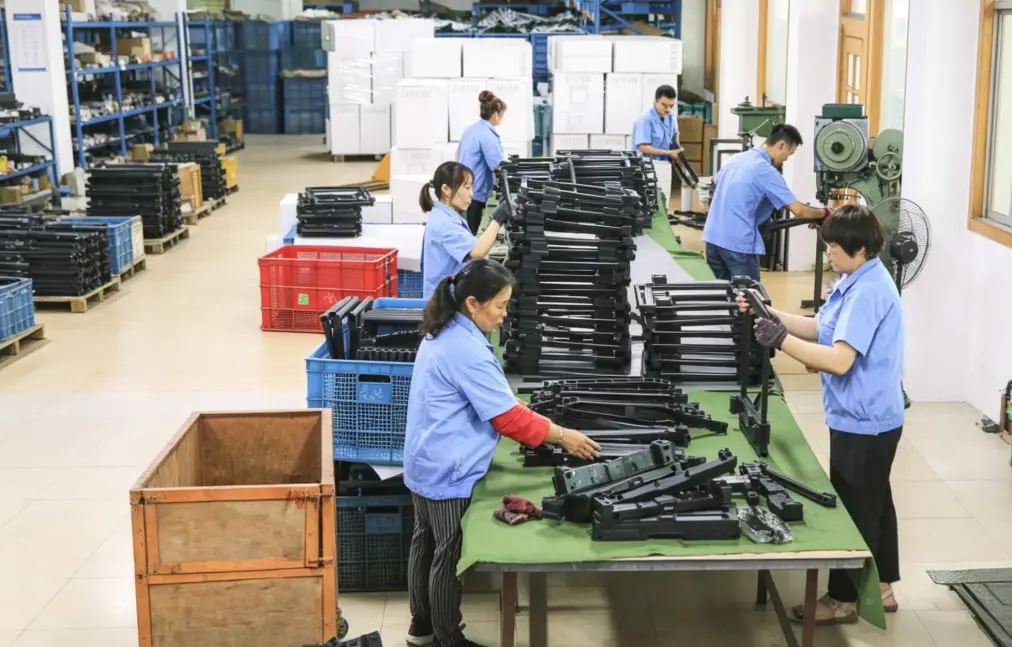
A supplier sample should be treated as a test unit rather than a showroom item.
The purpose of sample inspection is to discover whether the product behaves as described.
Step 1 — Physical Inspection
Check:
- overall dimensions;
- work-surface condition;
- frame alignment;
- fasteners;
- labels;
- visible deformation;
- packaging condition.
Where practical, record actual measurements.
Step 2 — Functional Inspection
Operate every major function.
Open the workbench.
Fold it.
Lock it.
Unlock it.
Adjust the height if applicable.
Move it.
Apply reasonable working pressure.
This is where problems that cannot be seen in photographs often become apparent.
Step 3 — Structural Inspection
Pay special attention to:
- folding joints;
- locking points;
- leg connections;
- frame joints;
- brackets;
- fasteners;
- reinforced plastic areas.
Look for movement, cracking, deformation, or inconsistent alignment.
Step 4 — Repeated-Use Inspection
Why Mass-Production Consistency Matters
A good sample is necessary, but it does not automatically guarantee a good production run.
For B2B buyers, one of the most important questions is:
Can the manufacturer reproduce the approved sample consistently?
Differences can arise from:
- raw materials;
- tooling;
- assembly;
- operator practices;
- inspection standards.
This is especially important for distributors and private label buyers because commercial orders involve many units rather than one sample.
A buyer should therefore ask how the supplier controls:
- incoming materials;
- critical dimensions;
- assembly accuracy;
- folding functionality;
- load-bearing components;
- finished-product inspection;
- packaging consistency;
- non-conforming products.
The approved sample should become a clear production reference.
Otherwise, the buyer may approve one product and receive a slightly different product after mass production begins.
What Evidence Should a Portable Workbench Manufacturer Provide?
A supplier’s claim that a product is “professional,” “durable,” or “heavy duty” is not enough by itself.
Professional procurement should move from descriptive words to evidence.
Ask:
How is this specification verified?
For example:
If the product has a stated load capacity, ask about the test conditions.
If the product is designed for repeated folding, ask how the folding function is evaluated.
If dimensions are critical, ask how they are controlled during production.
If quality consistency is claimed, ask how finished products are inspected.
If certifications or test documents are provided, confirm that they apply to the relevant product and configuration.
The strength of a manufacturer is therefore reflected not only in the finished product, but also in its ability to explain and control the process behind that product.
For OEM and private label buyers, this becomes particularly important because specifications, packaging, appearance, and functional details may all need to remain consistent across production batches.
Portable Workbench Quality Checklist for Buyers
Before approving a supplier, use a common checklist rather than making a decision based on one attractive feature.
| Quality Area | What to Check |
|---|---|
| Work surface | Material, usable area, flatness and rigidity |
| Frame | Structure, alignment and rigidity |
| Folding system | Smooth operation and secure locking |
| Repeated use | Looseness, deformation and alignment |
| Load capacity | Rating and test conditions |
| Stability | Center and off-center working pressure |
| Materials | Plastic/PP components and metal structure |
| Height adjustment | Range, locking and stability |
| Folded dimensions | Storage and transport practicality |
| Product weight | Portability versus structural performance |
| Packaging | Protection, dimensions and handling |
| Production control | Inspection and consistency |
| Documentation | Specifications and supporting records |
This checklist also makes supplier comparison more objective.
A lower unit price may not represent a lower total cost if the product later causes more returns, complaints, inspections, or service work.
Quality Should Be Evaluated Beyond the Product Sample
For a professional buyer, the physical sample is only one part of the decision.
The broader evaluation should also consider whether the manufacturer can support the product after the sample stage.
Relevant questions include:
- Are production standards documented?
- Are critical specifications controlled?
- Is the approved sample used as a production reference?
- Are finished products inspected before shipment?
- Can the supplier provide consistent technical documentation?
- Can the supplier support OEM or private label requirements when needed?
This is particularly important when the workbench is being developed as part of a long-term product line rather than purchased as a one-off item.
For retailers and distributors, consistency can affect customer satisfaction and return rates.
For private label buyers, manufacturing consistency can directly affect the credibility of the brand.
How to Make the Final Purchasing Decision
After completing the evaluation, avoid choosing a workbench based on one specification.
Instead, compare the product across four areas.
1.Product Performance
Does the workbench perform well under realistic working conditions?
2.Functional Reliability
3.Commercial Practicality
4.Manufacturing Confidence
Final Takeaway
Evaluating portable workbench quality requires more than checking photographs, comparing prices, or choosing the product with the highest advertised load capacity.
A stronger B2B evaluation combines:
structural design + folding reliability + load performance + stability + material selection + work-surface usability + height adjustment + folded dimensions + sample testing + production consistency.
Plastic or polypropylene does not automatically mean lower quality.
A metal frame does not automatically guarantee better performance.
A high load rating does not automatically prove that a product is better for real-world work.
What matters is whether the complete workbench has been properly designed, tested, manufactured, and controlled for its intended application.
For importers, distributors, retailers, and private label buyers, the safest approach is to move from marketing claims to verifiable evidence.
Check the structure.
Operate the folding system.
Test realistic working conditions.
Verify the load rating.
Inspect the sample.
Repeat the critical functions.
Review production controls.
And make sure the supplier can explain not only what the product claims to do, but also how those claims are supported.
That is the difference between simply buying a portable workbench and making a professional B2B sourcing decision.
Frequently Asked Questions
1.What should I check first when evaluating a portable workbench?
Start with structural design, stability, intended load, and folding performance. These factors establish whether the product is suitable for its intended application before cosmetic details become important.
2.Does a plastic workbench mean lower quality?
No. Plastic or polypropylene can be appropriate for portable folding workbenches when used in suitable components and combined with a properly designed supporting structure.
3.Is load capacity the most important specification?
No. Load capacity is important, but buyers should also consider testing conditions, stability, structural design, and how the product behaves under realistic working forces.
4.How can I test a folding workbench before placing an order?
Open and close the workbench repeatedly, test the locking mechanism, inspect joints and fasteners, check stability, and evaluate height adjustment where applicable. Record any changes in operation, alignment, or looseness.
5.Why do folded dimensions matter for B2B buyers?
Folded dimensions affect storage, packaging, transport, warehouse handling, and distribution efficiency, so they should be reviewed together with product weight and carton dimensions.
6.What should a private label buyer ask a workbench manufacturer?
Ask about materials, technical specifications, load testing, folding reliability, sample approval, quality-control procedures, production consistency, packaging, documentation, and how the manufacturer ensures that mass production matches the approved sample.
Related products