Metal vs Plastic Sawhorses: Which Is Better for Professional Buyers?
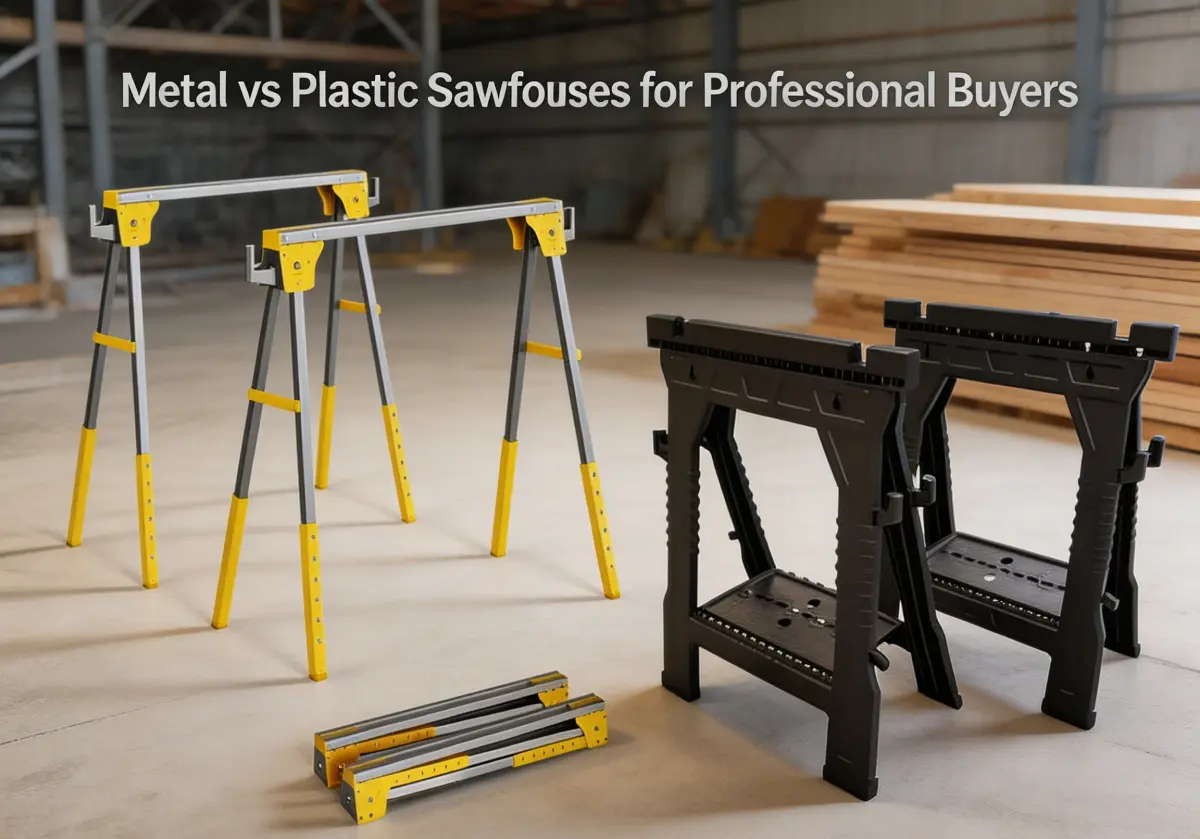
Choosing a sawhorse for a professional product line is very different from choosing one for occasional DIY use.
For a homeowner, the decision may come down to price, weight, or whether the sawhorse is easy to store. For an importer, distributor, retailer, or tool brand, the decision involves a much broader set of factors: load capacity, structural stability, durability, portability, storage efficiency, product positioning, quality consistency, packaging, and long-term supplier reliability.
This is why the question of metal vs plastic sawhorses deserves a more practical comparison.
Plastic sawhorses can offer advantages in weight, cost, corrosion resistance, and easy handling. Metal sawhorses, particularly those designed with reinforced frames, are often better suited to applications where structural strength and higher load performance are important.
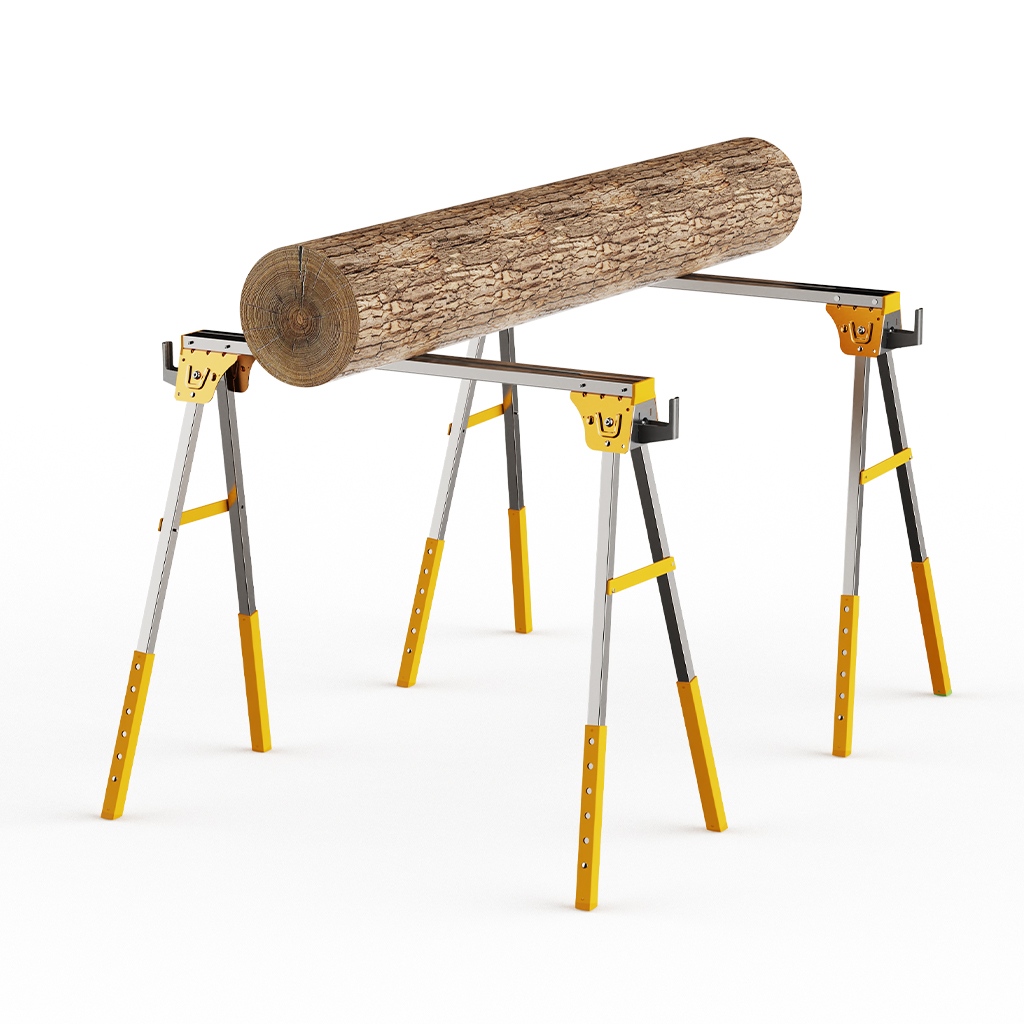
However, professional buyers should not evaluate material alone. The overall construction matters just as much. A modern professional folding sawhorse may combine a metal structural frame with engineered plastic components and non-slip materials to balance strength, weight, functionality, and manufacturing efficiency.
For buyers sourcing products for construction, woodworking, workshops, hardware distribution, or retail channels, understanding these differences can help avoid choosing a product that looks attractive on paper but does not fit the intended market.
Table of Contents
- Metal vs Plastic Sawhorses: Why Material Matters to Buyers
- Metal Sawhorses: Strength and Structural Performance
- Plastic Sawhorses: Where They Can Make Sense
- Key Differences Between Metal and Plastic Sawhorses
- Which Is Better for Professional Buyers: Metal or Plastic?
- Why a Metal + PP + TPR Sawhorse Can Be a Better B2B Product Solution
- What B2B Buyers Should Check Before Choosing a Sawhorse Supplier
- Metal vs Plastic Sawhorses for Different B2B Markets
- Final Verdict: Which Sawhorse Material Should Professional Buyers Choose?
- Frequently Asked Questions
Metal vs Plastic Sawhorses: Why Material Matters to Buyers
A sawhorse is a support product, so its material directly influences how the product behaves under load and during repeated use.
Metal and plastic are not simply two different manufacturing materials. They can lead to different product characteristics.
For professional buyers, the most important question is therefore not:
Which material is universally better?
A more useful question is:
Which material and construction approach best matches the intended application, customer expectations, and product positioning?
A professional construction-oriented product line may prioritize structural strength and load performance. A lightweight consumer-oriented range may put more emphasis on low weight, easy handling, and price.
The right choice depends on the market.
This is also why buyers should compare the entire structure rather than focusing on one material label. Frame geometry, connectors, feet, locking mechanisms, height adjustment, folding design, and quality control can all affect the final product.
Metal Sawhorses: Strength and Structural Performance
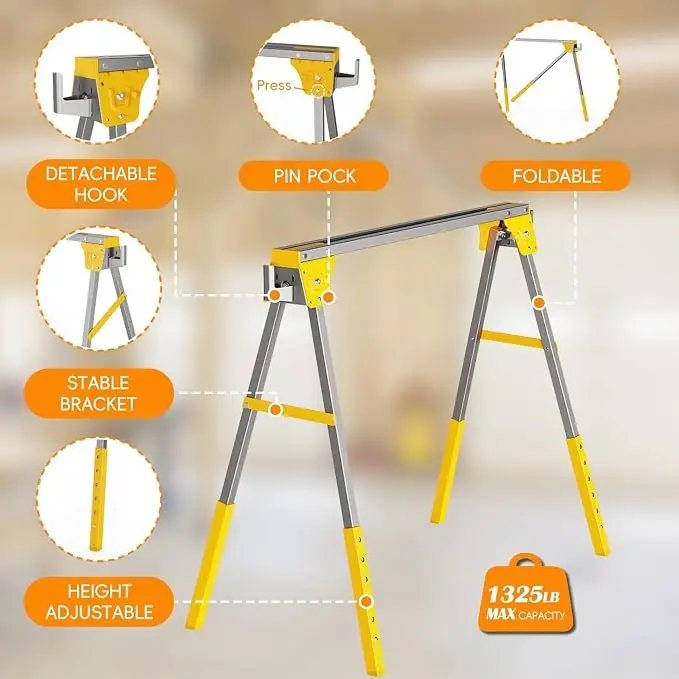
Metal is commonly selected for sawhorses when buyers need a strong structural frame.
A reinforced metal frame can provide the rigid support needed for lumber, panels, construction materials, and other heavy workpieces. This is especially relevant for professional users who may repeatedly place substantial loads on the same pair of sawhorses.
For B2B buyers, metal construction can also support a product positioning strategy centered on:
• Heavy-duty performance
• Professional use
• Higher load capacity
• Long-term durability
• Construction and workshop applications
• Commercial-grade positioning
However, saying that a sawhorse is “metal” is not enough to determine its quality.
The frame thickness, structural geometry, connection points, locking system, leg design, and foot construction all matter.
A poorly designed metal frame can still have stability problems. Conversely, a well-engineered structure can provide strong performance without making the product unnecessarily heavy.
That distinction is important when comparing suppliers.
For a deeper look at the characteristics that influence product quality, buyers can also review the guide on what makes a good sawhorse.
1.Where Metal Construction Has a Clear Advantage
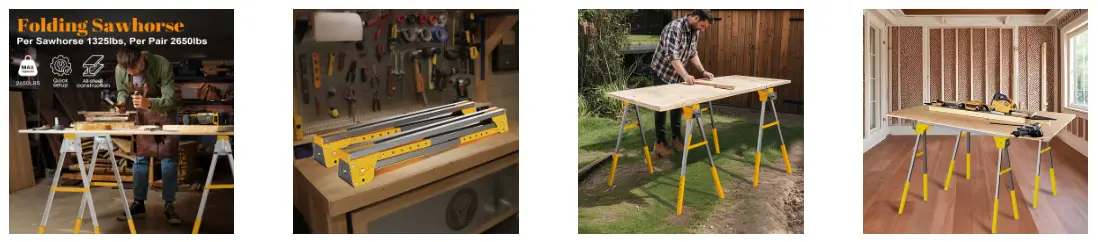
Woodworkers frequently need two support points rather than a single stand. A pair of properly positioned sawhorses can create a temporary working platform for boards, sheet materials, and other components.
The distance between the supports also matters. If the supports are too close together, long material may become unstable or flex excessively. If they are positioned too far apart, transportation and repositioning can become inconvenient.
A practical woodworking setup should therefore balance:
- Support stability
- Suitable working height
- Compatibility with long materials
- Ease of repositioning
- Folding and storage requirements
A folding design can be particularly useful for workshops where floor space is limited. Instead of permanently occupying valuable production or assembly space, the sawhorses can be folded when the task is finished.
Plastic Sawhorses: Where They Can Make Sense
Plastic should not automatically be treated as an inferior material.
Plastic sawhorses can be useful where low weight, easy handling, corrosion resistance, and cost efficiency are important.
For example, certain lightweight applications may benefit from a plastic structure because the product can be easier for users to carry and move.
Plastic can also offer design flexibility. Modern engineering plastics can be molded into complex shapes, allowing manufacturers to integrate functional features into the product.
For some retail segments, this can create an attractive combination of:
- Lower weight
- Easy handling
- Convenient storage
- Corrosion resistance
- Competitive pricing
- Consumer-friendly design
However, buyers need to look beyond the word “plastic.”
Not all plastics have the same mechanical properties, impact resistance, temperature performance, or long-term durability.
The quality of the material, the structural design, the connection system, and the intended load all need to be considered together.
1.Why “Metal vs Plastic” Is Not Always a Pure Either-Or Decision
One of the most important points for professional buyers is that modern sawhorse design does not always require choosing one material for every component.
A product can use different materials for different functions.
For example, a professional folding sawhorse may use:
- Metal for the main structural frame
- PP for connectors or molded components
- TPR for anti-slip feet or functional contact areas
This approach can combine the advantages of different materials.
The metal frame provides structural support.
The PP components can help create lightweight, impact-resistant connection areas and molded functional elements.
TPR feet can improve grip and help protect the working surface.
This is a fundamentally different approach from comparing a “100% metal” product with a “100% plastic” product.
For B2B buyers, the more useful question is therefore:
Is each material being used where it performs best?
That is often a better indicator of product engineering than the material name alone.
Key Differences Between Metal and Plastic Sawhorses
1. Load Capacity
Load capacity is one of the first specifications professional buyers should examine.
A heavy-duty sawhorse needs to support the intended workpiece safely and consistently. Buyers should therefore compare the stated load capacity, how it is measured, and whether the rating applies to one sawhorse or a pair.
This distinction is particularly important in B2B procurement because product listings do not always present capacity information in the same format.
For example:
• Capacity per unit
• Capacity per pair
• Evenly distributed load
• Static load
• Application-specific load
should not automatically be treated as equivalent.
When evaluating a supplier, ask for a clear specification sheet and confirm exactly how the load rating is defined.
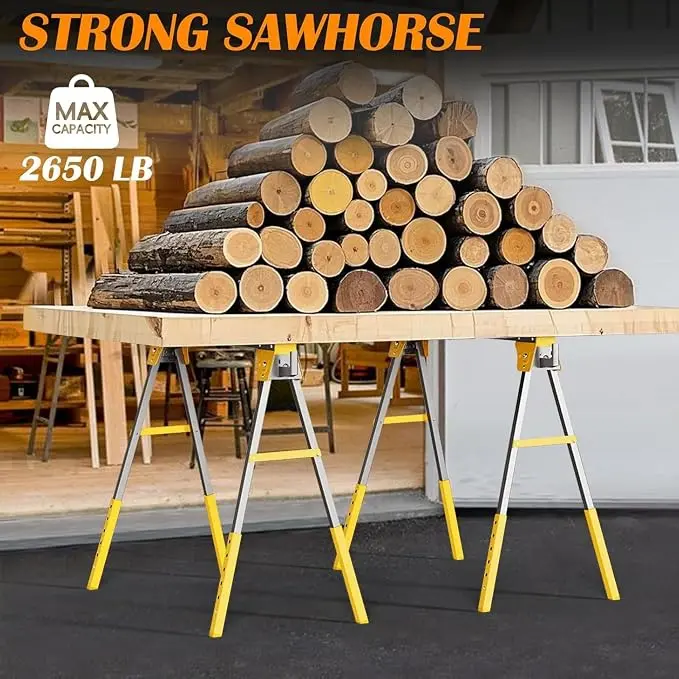
For buyers sourcing heavy-duty products, our heavy-duty folding sawhorse demonstrates one approach: the NH-SH001 platform uses a reinforced metal frame and is rated at 2,650 lbs per pair under evenly distributed load.
2. Stability
A strong frame is only part of a stable sawhorse.
Stability can also depend on:
- Leg geometry
- Foot design
- Connection points
- Locking mechanisms
- Height adjustment
- Weight distribution
- Floor contact
For professional users, stability becomes especially important when working with long or heavy materials.
A product that is easy to carry but unstable under load may create a poor user experience and ultimately lead to product complaints.
For procurement teams, stability should therefore be treated as a complete design characteristic rather than simply a material characteristic.
3. Durability
Professional users often open, close, transport, and reposition their equipment repeatedly. A folding sawhorse therefore needs to withstand not only working loads but also repeated handling.
Important areas include:
Folding joints
Locking points
Leg adjustment mechanisms
Frame connections
Feet
Plastic connectors
A durable product is not simply one made from metal. The interaction between different components determines how the complete product performs over time.
Buyers evaluating long-term product quality can also refer to our guide on long-lasting folding sawhorse design.
4. Portability
Portability is increasingly important for professional tools.
Contractors may transport equipment between job sites. Workshop users may need to clear floor space after completing a project. Retail customers may also prefer products that can be transported easily.
This is where folding design becomes particularly valuable.
A metal frame does not necessarily mean that a product must be extremely heavy or difficult to transport.
With an appropriate structural design, a metal folding sawhorse can balance strength and portability.
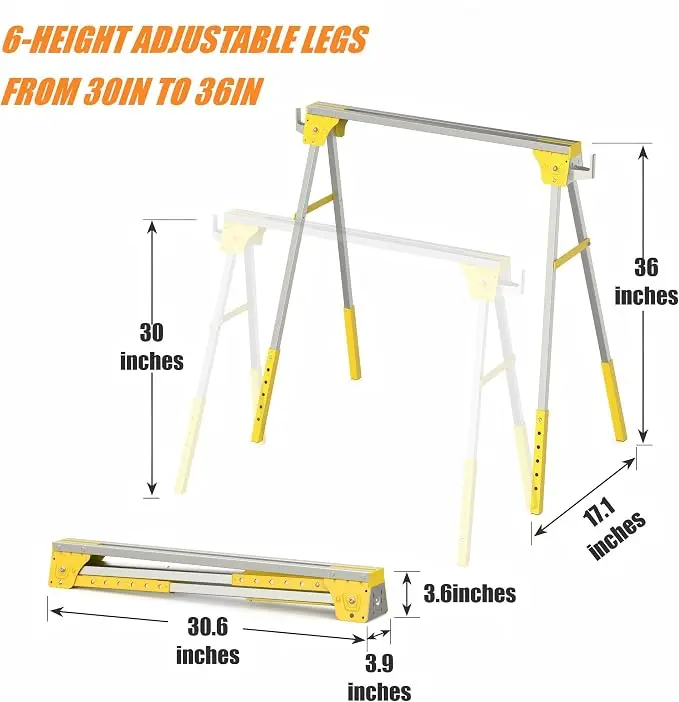
The NH-SH001, for example, weighs 4.5 kg per unit and folds to approximately 78 × 10.7 × 9.7 cm, allowing the product to occupy significantly less space when stored.
5. Storage Efficiency
Storage is often overlooked when buyers compare sawhorses.
For distributors and retailers, however, storage efficiency can directly affect warehouse utilization.
For professional users, a folding product can reduce the amount of floor or vehicle space required when the equipment is not being used.
This can be particularly useful for:
- Contractors
- Mobile workshops
- Construction crews
- Tool rental businesses
- Hardware retailers
- Professional tradespeople
A product that provides high working capacity but folds into a compact form can offer a stronger overall value proposition.
Which Is Better for Professional Buyers: Metal or Plastic?
There is no universal answer.
The better choice depends on the market and application.
1.Choose Metal When Strength Is a Priority
Metal is generally more attractive when the product is intended for:
- Heavy-duty work
- Construction
- Professional woodworking
- Frequent commercial use
- Higher-load applications
- Professional tool channels
For these markets, buyers often expect the product to communicate strength and durability.
2.Consider Plastic When Lightweight Handling Is the Main Priority
Plastic can be appropriate when:
- Low weight is critical
- Loads are relatively moderate
- Easy consumer handling is a priority
- Corrosion resistance is important
- The product needs to compete aggressively on cost
However, the final decision should still be based on the actual material specification and structural design.
Why a Metal + PP + TPR Sawhorse Can Be a Better B2B Product Solution
For professional buyers, the most interesting solution may not be a completely metal or completely plastic sawhorse.
A multi-material design can allocate each material to a specific function.
The NH-SH001 folding sawhorse uses:
- Metal for the main structural frame
- PP for high-impact connecting components
- TPR for non-slip foot elements
This combination is designed to balance structural strength, functional durability, weight, and usability.
The product supports up to 2,650 lbs per pair under evenly distributed load, while each unit weighs 4.5 kg.
It also provides height adjustment, two integrated utility hooks, and a folding mechanism that reduces the folded thickness to approximately 9.7 cm.
For buyers building a professional sawhorse product line, this type of construction can provide a more balanced proposition than simply choosing the cheapest plastic product or the heaviest metal product.
1.Height Adjustment Adds Product Differentiation
Adjustability can make a significant difference when a sawhorse is intended for professional users.
Different users may work with:
- Different material thicknesses
- Different working heights
- Uneven jobsite conditions
- Different cutting or assembly tasks
An adjustable structure allows the product to serve a wider range of applications.
For distributors, this can also make the product easier to position as a professional-grade solution rather than a basic support stand.
2.Folding Design Adds Value Beyond Convenience
For professional buyers, it can influence:
Transportation
Warehouse storage
Retail packaging
Vehicle storage
Jobsite mobility
Product differentiation
Our existing article on why folding sawhorses are essential for modern workspaces discusses these broader benefits, while our folding sawhorse buying guide focuses more specifically on procurement factors.
What B2B Buyers Should Check Before Choosing a Sawhorse Supplier
Material is only one part of the purchasing decision.
Before placing a bulk order, professional buyers should evaluate at least six areas.
1. Product Specifications
Confirm:
- Material
- Dimensions
- Folded dimensions
- Product weight
- Load capacity
- Height adjustment
- Accessories
- Color options
A supplier should be able to provide consistent and easy-to-understand specifications.
2. Quality Control
For a structural support product, quality control should not be limited to visual inspection.
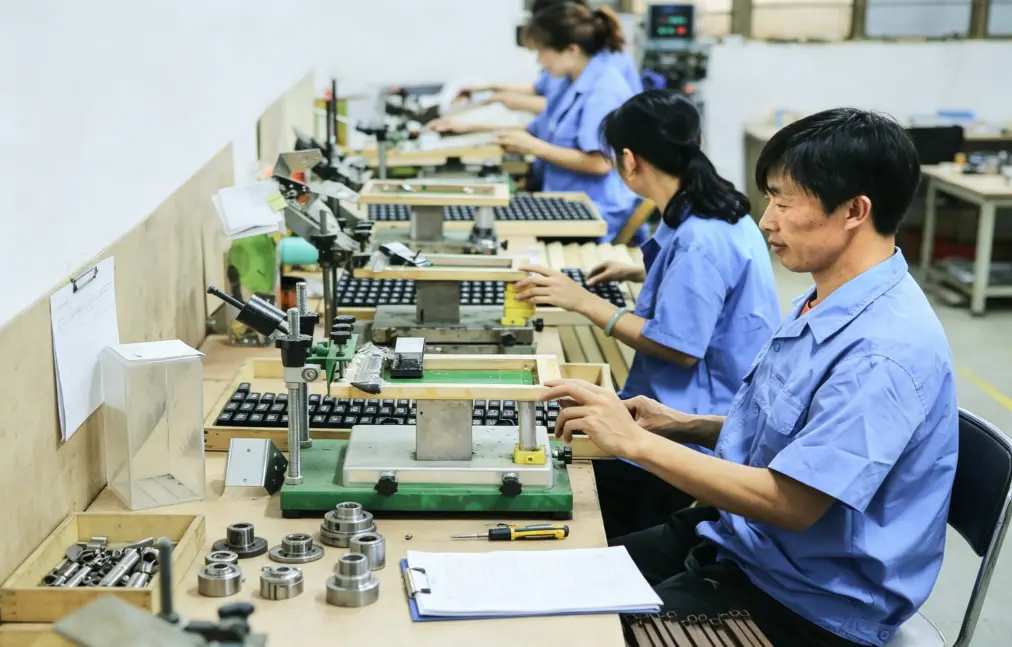
At Jingyan, the supplied NH-SH001 product specification includes strict load testing and quality inspection before shipment, with a stated defect rate below 0.1%.
For buyers, the key is not simply the percentage itself. It is whether the supplier has a repeatable quality-control process that can be applied consistently during mass production.
3. Sample Evaluation
Before moving to large-volume purchasing, buyers should evaluate samples for:
- Frame rigidity
- Folding operation
- Locking reliability
- Height adjustment
- Foot grip
- Component fit
- Surface finish
- Packaging
A sample should be evaluated as a complete product rather than simply inspected visually.
This is especially important when launching a new product line.
4. OEM and ODM Capability
For importers and brands, the ability to customize can be an important purchasing factor.
Depending on the supplier, customization may include:
Brand logo
Product color
Packaging
Labels
Product specifications
Selected structural details
A supplier that can handle both product development and mass production can simplify communication and reduce the number of external parties involved.
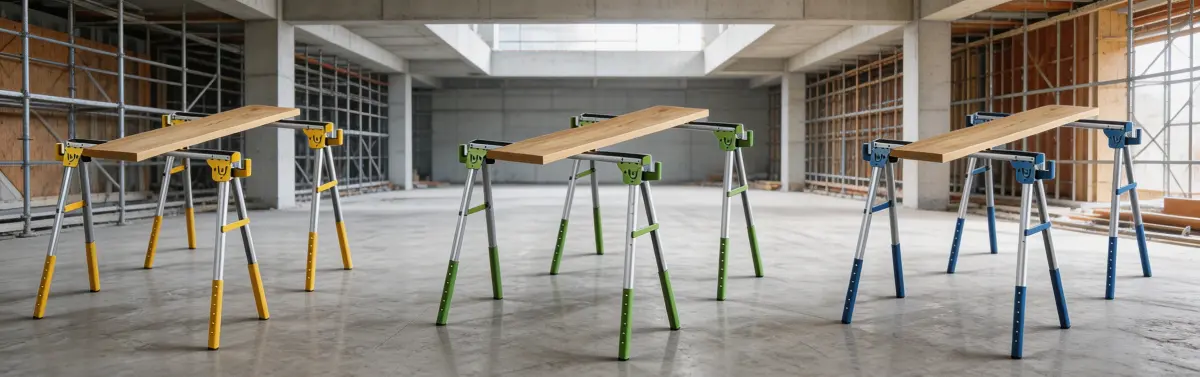
Jingyan provides OEM and ODM manufacturing solutions for global distributors and brands, including sawhorse products.
5. Production Capacity
A product may look excellent at the sample stage but still become difficult to manage during mass production.
Buyers should therefore ask:
- Can the supplier maintain consistent specifications?
- What is the production lead time?
- How is quality controlled during mass production?
- Can the supplier support trial orders?
- Can production scale with demand?
These questions become especially important when the product is intended for retail or private-label distribution.
6. Packaging and Shipping Efficiency
For international buyers, evaluate:
Folded dimensions
Carton dimensions
Units per carton
Gross weight
Packaging protection
Container utilization
A product with good performance but inefficient packaging can become unnecessarily expensive to transport and warehouse.
Metal vs Plastic Sawhorses for Different B2B Markets
| Target Market | Key Priority | More Suitable Direction |
|---|
| Professional tool distributors | Durability + functionality | Metal / reinforced design |
| Construction suppliers | Strength + stability | Heavy-duty metal |
| Woodworking retailers | Stability + adjustability | Adjustable folding design |
| General hardware retailers | Price + versatility | Depends on target segment |
| Professional tool brands | Differentiation + customization | Metal folding OEM/ODM |
| Private-label brands | Branding + specifications + packaging | Customizable folding design |
“Is this sawhorse metal or plastic?”
They should ask:
“Does the complete product meet the expectations of my target market?”
That shift leads to a much better purchasing decision.
For buyers serving several professional applications, our guide on sawhorse applications for woodworking and professional use provides additional context.
Final Verdict: Which Sawhorse Material Should Professional Buyers Choose?
For professional buyers, metal sawhorses generally have a strong advantage when structural strength, load performance, durability, and professional positioning are important.
Plastic sawhorses can still be useful for markets where lightweight handling, corrosion resistance, and cost efficiency are more important.
But the strongest product strategy is not always to choose one material and reject the other.
A well-designed professional sawhorse can combine materials according to their individual functions.
For example, a reinforced metal frame can provide structural support, while PP components and TPR feet can contribute to practical functionality and user handling.
That is why professional buyers should evaluate:
- Load capacity
- Frame structure
- Stability
- Durability
- Height adjustment
- Folding mechanism
- Folded dimensions
- Product weight
- Material quality
- Supplier quality control
- OEM/ODM capability
- Packaging and logistics
The best product is ultimately the one that provides the right balance between performance, cost, usability, and market positioning.
For distributors, importers, retailers, and brands looking for a professional folding sawhorse, a reinforced metal design with functional PP and TPR components can provide a strong combination of durability, portability, and product differentiation.
If you are evaluating folding sawhorses for wholesale, distribution, retail, or private-label development, you can review the NH-SH001 product specifications and contact Jingyan for OEM/ODM and bulk sourcing requirements.
Frequently Asked Questions
1.Are metal sawhorses stronger than plastic sawhorses?
Metal sawhorses can provide strong structural performance, particularly when the frame is properly engineered and reinforced. However, material alone does not determine strength. Frame design, connections, locking systems, and load distribution also matter.
2.Are plastic sawhorses suitable for professional use?
They can be suitable for some professional applications, especially where low weight, easy handling, and corrosion resistance are important. Buyers should match the product’s load capacity and construction to the intended application.
3.Are metal folding sawhorses difficult to transport?
4.What should distributors look for when buying metal sawhorses?
5.Can a metal sawhorse also use plastic components?
6.What makes a folding sawhorse attractive for B2B buyers?
7.Can Jingyan provide OEM or ODM sawhorse production?
Yes. Jingyan provides OEM and ODM manufacturing for sawhorse products and supports global distributors, wholesalers, and brands. Buyers can discuss product specifications, colors, packaging, branding, and other customization requirements with the manufacturer.
Related products