How to Evaluate Shelf Size, Clearance, and Load Capacity in a 3 Shelf Rolling Cart
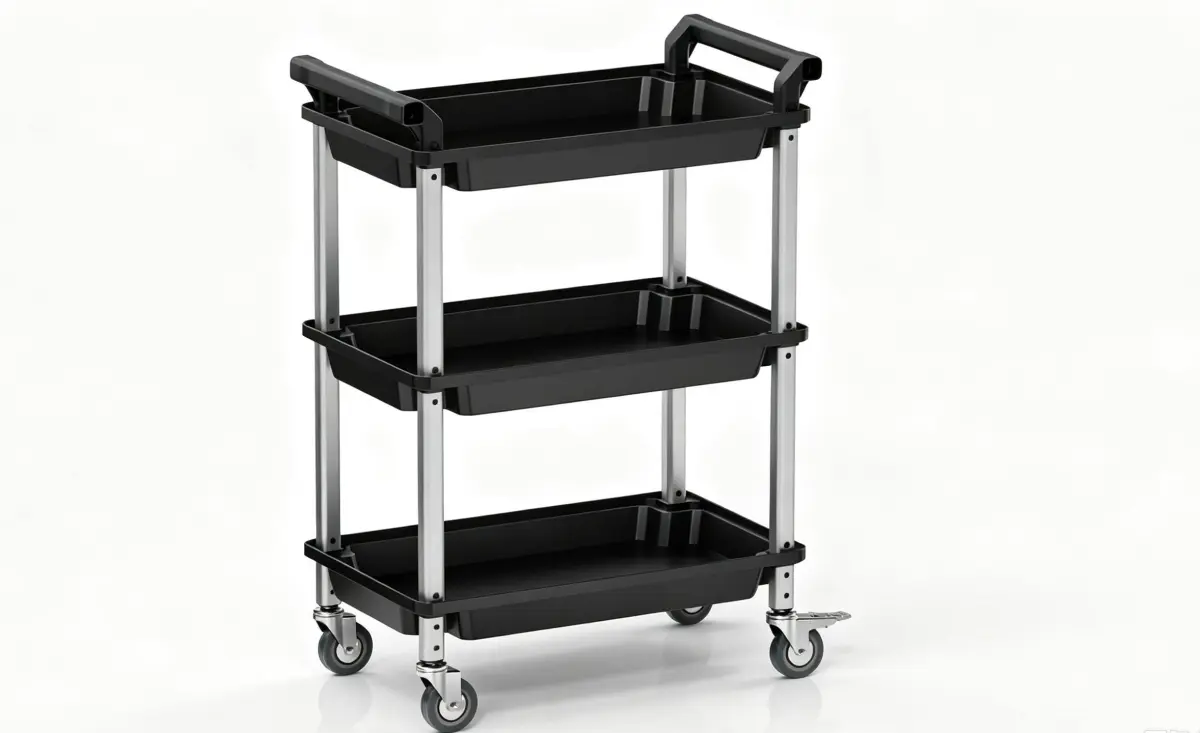
When sourcing a 3 shelf rolling cart for commercial or professional use, buyers often start by comparing overall dimensions and advertised load capacity.
That is a reasonable starting point, but it is not enough.
Two carts can both have three shelves, similar external dimensions, and a comparable load rating while providing very different practical value. One may offer enough usable shelf area for boxes, tools, or maintenance supplies, while another may have shelves that are too shallow or insufficient vertical clearance for the intended items. Likewise, two products may both claim high load capacity, but the way that capacity is distributed across the shelves can produce very different results in actual use.
For B2B buyers, the important question is therefore not simply:
“How large is the cart?”
or:
“How much weight can it hold?”
The better question is:
“Do the shelf dimensions, clearance, and load capacity work together for the actual products and tasks this cart needs to support?”
This distinction matters for B2B buyers evaluating a three-shelf cart, warehouse equipment suppliers, industrial product buyers, and private label brands.. A product can have attractive specifications on paper and still be a poor commercial choice if those specifications do not match the real requirements of the target market.
This guide explains how to evaluate a 3 shelf rolling cart by looking at three closely connected factors: usable shelf size, vertical clearance, and load capacity. It also explains how buyers can interpret these specifications together instead of evaluating each number in isolation.
- 1. Why Shelf Size, Clearance, and Load Capacity Should Be Evaluated Together
- 2. How to Evaluate Shelf Size in a 3 Shelf Rolling Cart
- 3. How Clearance Between Shelves Affects Usability
- 4. How to Evaluate Load Capacity on a Three-Shelf Cart
- 5. Match Shelf Clearance and Load Capacity to the Intended Application
- 6. Use a Simple Specification Method When Comparing Suppliers
- 7. Apply the Numbers to a Real Three-Shelf Cart Example
- 8. What B2B Buyers Should Ask Before Approving a 3 Shelf Rolling Cart
- FAQ About 3 Shelf Rolling Cart Dimensions and Capacity
- Final Takeaway
Why Shelf Size, Clearance, and Load Capacity Should Be Evaluated Together
A three-shelf cart is not useful simply because it has three levels.
The value of the design comes from how much usable material each level can accommodate, how easily users can access that material, and whether the structure can safely support the expected load.
These factors are closely related.
A large shelf with low clearance may work well for flat boxes but not for taller containers. A cart with generous clearance but limited shelf depth may accommodate tall items but provide less usable storage for wider packages. A cart with sufficient shelf space may still be unsuitable if the expected load is concentrated heavily on one level.
This is why B2B buyers should avoid evaluating specifications as isolated numbers.
Instead, think about the relationship between:
Shelf Size + Clearance + Load Capacity = Practical Storage Performance
1.Start With the Actual Items the Cart Needs to Hold
Before comparing product specifications, create a simple list of the typical items that the end user will place on the cart.
For example, a professional user might store:
- Hand tools
- Small components
- Maintenance supplies
- Boxes
- Bottles
- Spare parts
- Packaging materials
- Workshop consumables
The important question is not simply how much these items weigh.
You also need to know:
How large are they? How tall are they? How are they packaged? And how are they normally distributed across the shelves?
A cart specification becomes much more meaningful once it is connected to the actual contents.
For example, a buyer sourcing a cart for small parts may care more about usable shelf footprint and organization than maximum vertical clearance. Another buyer handling bottles or containers may need considerably more vertical space.
The same three-shelf structure can therefore produce very different results depending on the items being stored.
2.Avoid Choosing a Cart Based on Shelf Count Alone
“Three shelves” is a structural description, not a measure of storage efficiency.
A buyer should ask for the actual usable dimensions of each shelf.
A supplier that only provides overall cart dimensions may not be providing enough information for a serious product comparison.
For B2B purchasing, the more useful specification set is:
- Overall width
- Overall depth
- Overall height
- Shelf width
- Shelf depth
- Clearance between shelves
- Load capacity
- Product weight
These dimensions allow the purchasing team to determine whether the product is genuinely suitable rather than simply assuming that every three-tier design provides similar usable space.
How to Evaluate Shelf Size in a 3 Shelf Rolling Cart
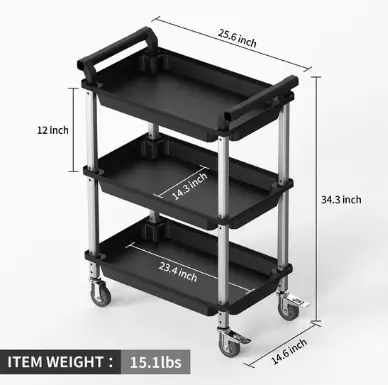
Shelf size is one of the most important specifications because it determines the actual floor area available for stored items.
However, buyers should distinguish between overall shelf dimensions and practical usable space.
A shelf may technically measure a certain width and depth, but the user may not be able to use every millimeter equally efficiently because of raised edges, structural supports, corners, handles, or the shape of the items being stored.
1.Look at Shelf Width and Depth Separately
Width determines how much horizontal space is available across the front of the shelf.
Depth determines how far the stored items can extend from front to back.
Both matter.
A wider shelf may allow the user to place multiple boxes side by side. A deeper shelf can provide more room for containers or larger parts.
Consider a shelf measuring approximately 23.6 inches wide × 19.5 inches deep, as used in Jingyan’s three-tier rolling utility cart.
The basic shelf footprint is approximately:
23.6 × 19.5 = 460.2 square inches
That calculation does not mean all 460.2 square inches will always be usable for every product.
It simply gives the buyer a much better basis for comparing the physical storage footprint of different models.
2.Compare Usable Shelf Area, Not Just Exterior Cart Size
Suppose Cart A and Cart B are both approximately the same overall width.
That does not mean they provide the same storage value.
One may use more of the available footprint for the shelf platform, while the other may lose space because of wider structural components or a different design.
For a commercial buyer, this difference becomes important when the cart is expected to replace repeated manual carrying or organize a large number of small supplies.
The buyer should therefore ask:
How much of the external footprint is actually available for storage?
This is a more useful question than simply comparing the width of the entire cart.
3.Consider the Shape of the Items Being Stored
Shelf area should also be evaluated against item geometry.
A large rectangular shelf may work well for:
- Boxes
- Tool cases
- Parts bins
- Containers
A smaller or irregularly shaped shelf may be less suitable for the same items.
Similarly, if stored products have handles, protrusions, or irregular packaging, the nominal shelf dimensions may not tell the whole story.
For B2B purchasing, it can be useful to place actual sample items on a prototype shelf before approving a larger order.
Real products are often a better test of usable space than dimensions viewed on a spreadsheet alone.
How Clearance Between Shelves Affects Usability
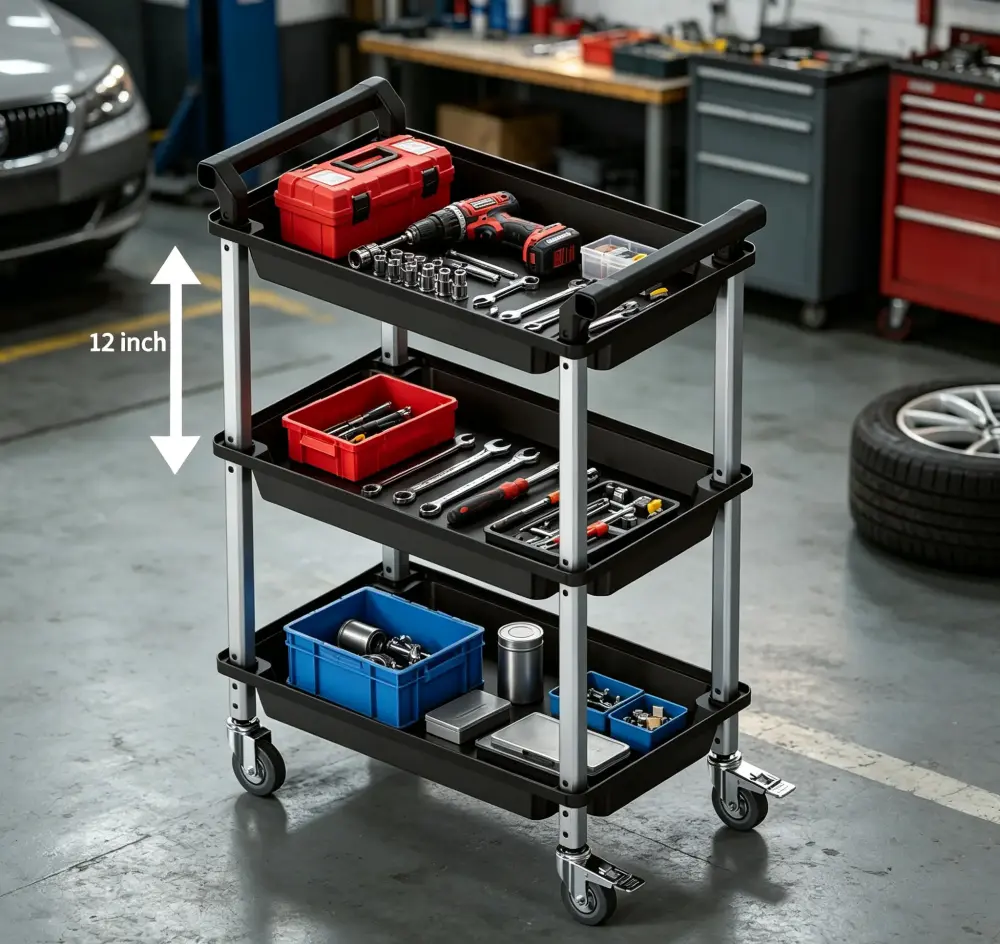
Shelf clearance is easy to overlook because it does not appear as important as overall width or load capacity.
In practice, however, clearance can determine whether a three-shelf cart is genuinely useful for the items it is intended to carry.
If the vertical space is too limited, the user may have to tilt containers, stack items horizontally, or leave valuable shelf area unused.
If the clearance is too large, the cart may use its overall height less efficiently.
The goal is not simply to maximize clearance.
The goal is to provide the right clearance for the intended contents.
1.Measure Clearance Based on the Actual Stored Item
A 12-inch clearance means something very different depending on what is being stored.
For example, a buyer may be handling:
- Short tool cases
- Bottles
- Small cartons
- Parts containers
- Maintenance supplies
- Taller packaged products
The correct clearance should leave enough room for the item to be placed and removed conveniently without wasting excessive vertical space.
Jingyan’s referenced three-tier model provides approximately 12 inches of clearance between shelves.
For a buyer, the important question is not whether 12 inches is universally ideal.
It is:
Is 12 inches sufficient for the objects that the target customer is expected to store?
That is the correct way to evaluate a specification.
2.Think About Access, Not Just Vertical Space
Clearance affects more than whether an item physically fits.
The user must also be able to place the item onto the shelf and remove it without unnecessary interference.
Imagine a container that technically fits into a 12-inch space but leaves almost no room for the user to grasp it.
The product may fit dimensionally but still be inconvenient operationally.
This is why clearance should be evaluated with both:
Fit + Access
in mind.
For products that will be handled frequently, the difference between “fits” and “fits comfortably” can matter.
3.Avoid Assuming More Clearance Is Always Better
More vertical space is not automatically more useful.
A very tall gap can reduce the efficiency of the overall three-tier configuration.
The buyer might then have a cart with plenty of empty air between shelves while still having limited overall storage area.
For this reason, the objective should be:
Match the vertical spacing to the typical item height.
The best three-shelf layout is the one that balances access and storage efficiency.
How to Evaluate Load Capacity on a Three-Shelf Cart
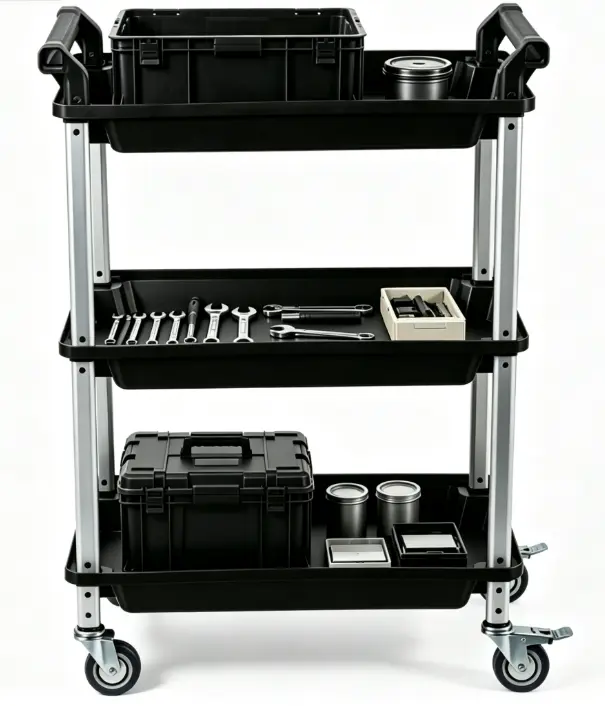
Load capacity is often treated as one simple number.
For example:
300 lbs
At first glance, this appears straightforward.
But B2B buyers should ask a more detailed question:
What exactly does the 300 lb rating mean?
This matters because total cart capacity and individual shelf capacity are related but not necessarily identical concepts.
A buyer may be comparing products where one supplier publishes a total capacity while another provides a capacity per shelf.
Those numbers should not be compared without understanding the measurement method.
1.Separate Total Capacity From Per-Shelf Capacity
Suppose a cart is rated for a total of 300 lbs.
That does not automatically mean a buyer should plan to place 300 lbs on one shelf.
For a three-shelf configuration, it may be more useful to think about how the total load is distributed.
The actual product design, testing method, and manufacturer specification should determine the permitted load arrangement.
This is why procurement teams should request clear answers to questions such as:
- Is the capacity a total cart rating?
- Is there a recommended maximum per shelf?
- Is the load expected to be evenly distributed?
- Does the rating assume the cart is stationary?
- Does the rating cover normal movement?
A clear answer allows the buyer to compare products fairly.
2.Think About Load Distribution
Two carts can carry the same total weight while experiencing very different loading conditions.
For example:
100 lbs + 100 lbs + 100 lbs
is structurally different from:
200 lbs + 50 lbs + 50 lbs
even though both total 300 lbs.
The location of the load matters.
A buyer should therefore consider:
- Which shelf receives the heaviest items?
- Are dense items likely to be concentrated on one level?
- Will the top shelf carry lighter items?
- Will users frequently rearrange the load?
For many professional applications, a balanced load is preferable because it makes the cart’s operating condition more predictable.
3.Consider the Center of Gravity
The vertical position of the load also matters.
Heavy items placed high on a cart can affect how the product behaves during movement and positioning.
Therefore, the buyer should not look at:
300 lbs
as a standalone marketing number.
The more useful evaluation is:
300 lbs under what loading arrangement and operating condition?
This is a much more professional way to compare three-shelf carts.
Match Shelf Clearance and Load Capacity to the Intended Application
The most useful specifications are not necessarily the largest specifications.
They are the ones that best fit the application.
A buyer should therefore connect shelf dimensions, clearance, and load capacity to an actual use case.
1.Match the Shelf Size to the Item Footprint
Consider a user storing small boxes, tools, or maintenance supplies.
The buyer may need:
- Enough width for multiple items
- Enough depth for stable placement
- Enough clearance to access each item
- Enough capacity for the expected combined load
The shelf size should therefore be evaluated as part of a complete storage configuration rather than as an isolated measurement.
For example, a 23.6 × 19.5-inch shelf can provide a substantial working footprint, but whether it is sufficient depends on what the target customer needs to place there.
2.Match Clearance to the Tallest Regular Item
Do not size the shelf spacing around the shortest product that will be stored.
Instead, consider the typical range of item heights.
A useful procurement process can divide expected contents into:
- Low-profile items
- Medium-height items
- Taller items
Then determine whether the available clearance works across the majority of normal usage conditions.
This is especially useful for buyers developing a product line for a defined customer segment.
3.Match Load Capacity to the Real Weight Profile
Likewise, do not choose capacity only because the number appears impressive.
Estimate the typical load for each shelf.
For example:
| Shelf | Typical Load | Typical Contents |
|---|---|---|
| Top | Light | Small tools, labels, light supplies |
| Middle | Medium | Parts, containers, maintenance items |
| Bottom | Heavier | Dense supplies or larger items |
This is only an example framework, not a universal loading rule.
The actual limits should always follow the manufacturer’s tested specification.
The important principle is:
The product specification should match the customer’s real load profile.
Use a Simple Specification Method When Comparing Suppliers
When multiple suppliers provide three-shelf carts, it can be difficult to compare them because each may present specifications differently.
One supplier may emphasize overall dimensions.
Another may emphasize capacity.
Another may provide detailed shelf measurements.
For B2B purchasing, it is better to standardize the comparison.
1.Build a Simple Comparison Table
A procurement team can collect at least these fields:
| Specification | Supplier A | Supplier B | Supplier C |
|---|---|---|---|
| Overall Width | |||
| Overall Depth | |||
| Overall Height | |||
| Shelf Width | |||
| Shelf Depth | |||
| Shelf Clearance | |||
| Total Load Capacity | |||
| Per-Shelf Rating | |||
| Product Weight | |||
| Carton Dimensions |
This makes it much easier to identify missing information.
A supplier with a high load rating but no explanation of the testing method should not automatically be ranked above a supplier that provides a clearer technical specification.
2.Separate “Measured” From “Claimed”
During sourcing, buyers should distinguish between information that has been physically measured or tested and information that is simply stated in marketing copy.
For example:
Product dimension: measured specification
Shelf clearance: measured specification
Load capacity: should have a defined test basis
This does not mean every marketing statement is unreliable.
It means the buyer should know which specifications can be directly compared and which require further technical clarification.
3.Confirm the Approved Specification Before Mass Production
Once the buyer has selected a product, the final specification should be confirmed before production.
This can include:
- Overall dimensions
- Shelf dimensions
- Shelf clearance
- Load capacity
- Product weight
- Material
- Color
- Components
The purpose is to make sure the production version matches the product that was actually evaluated.
For B2B buyers, this becomes particularly important when the product will be purchased repeatedly.
Apply the Numbers to a Real Three-Shelf Cart Example
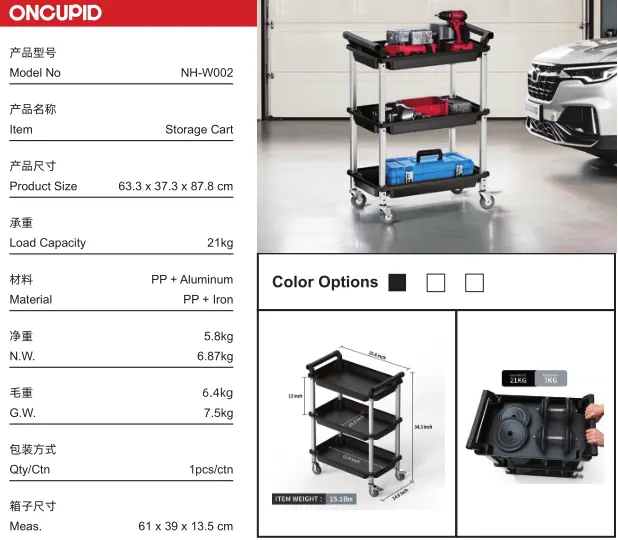
Product specifications become much easier to understand when applied to a real model.
Jingyan’s referenced 3-Tier Rolling Utility Cart provides a useful example:
- Overall size: 25.6″ W × 34.3″ H × 14.6″ D
- Shelf size: 23.6″ W × 19.5″ D
- Shelf clearance: 12″
- Stated load capacity: 300 lbs
- Shelf material: High-density polypropylene
- Frame material: Thickened aluminum tubing
These specifications should not be treated as a universal benchmark for every three-shelf cart.
Instead, they can be used to demonstrate how a buyer should read a product specification.
1.What the Shelf Dimensions Tell the Buyer
The approximately 23.6 × 19.5-inch shelf provides a defined storage footprint.
The width and depth can then be compared against the typical size of the boxes, tools, containers, or parts that the end customer will use.
That immediately creates a more meaningful purchasing question:
Will the customer’s normal items fit comfortably without wasting excessive shelf space?
2.What the 12-Inch Clearance Tells the Buyer
The 12-inch clearance provides information about vertical storage.
A buyer can compare this measurement against the height of typical stored items and determine whether they can be placed and removed comfortably.
The useful question is not:
Is 12 inches a large number?
It is:
Does 12 inches provide sufficient usable vertical space for the intended contents?
3.What the 300 lb Capacity Tells the Buyer
The stated 300 lb capacity provides a reference point for overall loading.
But the buyer should still verify how the capacity is tested and whether there are additional limits for individual shelves or specific load arrangements.
This is the difference between simply reading a specification and actually evaluating it.
What B2B Buyers Should Ask Before Approving a 3 Shelf Rolling Cart
A product specification sheet should make the basic questions easy to answer.
Before approval, the buyer should be able to confirm:
1.Shelf Specification Questions
- What are the exact shelf width and depth?
- What is the usable shelf area?
- What is the vertical clearance?
- Are the shelves identical in size?
- Are there raised edges or design elements that affect usable space?
2.Load Specification Questions
- What is the total rated capacity?
- Is there a per-shelf limit?
- How was the capacity tested?
- Was the load evenly distributed?
- Is the rating intended for static or moving use?
- Are there recommended loading conditions?
3.Product Fit Questions
- Does the cart fit the intended workspace?
- Can the typical items fit on the shelves?
- Can users access the contents comfortably?
- Does the loading pattern match the cart’s design?
- Does the specification provide enough practical margin?
The goal is to move from:
“The cart has three shelves and holds 300 lbs.”
to:
“The cart provides the shelf area, clearance, and load distribution required by the customer’s real application.”
That is a much stronger B2B purchasing standard.
FAQ About 3 Shelf Rolling Cart Dimensions and Capacity
1.What shelf dimensions should I look for in a 3 shelf rolling cart?
There is no single ideal shelf size for every application.
The correct dimensions depend on the size and shape of the products being stored. Buyers should compare actual shelf width and depth against the typical footprint of the end user’s items rather than selecting a cart based only on overall cart dimensions.
2.Is more shelf clearance always better?
No.
More clearance can help accommodate taller items, but excessive vertical space can reduce how efficiently the total cart height is used.
The better approach is to match clearance to the typical height of the products being stored.
3.How should I understand a 300 lb load rating?
First determine whether the rating refers to total cart capacity or another specific condition.
Then ask how the load was tested, whether it assumes even distribution, and whether there are limits for individual shelves.
4.Can each shelf carry the same amount of weight?
Not necessarily.
The actual allowable load arrangement depends on the manufacturer’s design and testing.
Buyers should request explicit information about total capacity and any per-shelf limitations rather than assuming the total rating can be divided automatically.
5.Why does load distribution matter?
Because two carts with the same total load can have different loading conditions.
A balanced distribution may create a different structural and operational condition from placing most of the weight on one shelf.
The buyer should therefore evaluate both total weight and where the weight will be positioned.
6.Should I compare three-tier carts using overall dimensions or shelf dimensions?
Both are important, but they answer different questions.
Overall dimensions determine whether the cart fits the intended environment.
Shelf dimensions determine how useful the storage space will be.
A serious B2B comparison should include both.
Final Takeaway
A 3 shelf rolling cart should not be evaluated by shelf count, overall dimensions, or load capacity alone.
The strongest purchasing decision comes from understanding how three core specifications work together:
Shelf Size + Shelf Clearance + Load Capacity
Shelf size tells you how much usable horizontal space is available.
Shelf clearance tells you what can fit vertically and how easily users can access it.
Load capacity tells you how much weight the structure is designed to support under the defined test conditions.
For B2B buyers, these numbers should always be connected to the actual customer application.
A shelf that is large enough for the target products, clearance that accommodates their typical height, and load capacity that matches the real weight profile will provide much more commercial value than a cart with impressive specifications that do not fit the intended use.
Jingyan‘s three-tier rolling utility cart provides one practical example, with approximately 23.6 × 19.5-inch shelves, 12 inches of clearance, and a stated 300 lb capacity. The value of these specifications is not simply the numbers themselves, but the ability to compare them against a buyer’s actual requirements.
For B2B sourcing, the best specification is not necessarily the largest one. It is the one that fits the real application with a clear and appropriate performance margin.
Need a Portable Work Bench with Fast, Tool-Free Setup?
Tell us your target market, required quantity, packaging requirements, and customization needs.
Related products