Heavy Duty Workbench Load Ratings: What 750kg and Other Weight Classes Really Mean

When a workbench is listed as a 750kg heavy duty workbench, the number looks straightforward. A buyer may naturally assume that the product can simply carry 750kg, regardless of how that weight is placed or how the workbench is configured.
That interpretation is often too broad.
For importers, distributors, and specification buyers, the more useful question is not just “How much weight can it hold?” but “What exactly does the stated load rating describe?”
A load rating is a technical specification tied to a particular product design and set of conditions. The meaning of the number can depend on the working configuration, load distribution, structural design, and the way the manufacturer defines and supports the capacity claim.
This becomes especially important when comparing several suppliers.
Two products may both be advertised as a heavy duty workbench with a 750kg rating, yet the numbers may not be directly comparable until the buyer knows what each manufacturer means by that rating.
A 500kg, 750kg, or 1,000kg figure is therefore more useful when treated as a defined specification, rather than as a standalone measure of product quality.
This article explains how to interpret workbench load ratings, what a 750kg rating actually tells a buyer, where common misunderstandings come from, and what specification buyers should confirm before using capacity figures in sourcing decisions or product marketing.
- What Does a Heavy Duty Workbench Load Rating Actually Tell You?
- How Should Buyers Interpret 500kg, 750kg, and 1,000kg Ratings?
- What Conditions Are Behind a Workbench Load Rating?
- Why Can Two 750kg Heavy Duty Workbenches Still Be Different?
- Does a Higher Load Rating Automatically Mean a Better Workbench?
- What Should a Specification Buyer Ask a Supplier About a 750kg Rating?
- Can a PP Tabletop Really Be Part of a 750kg Heavy Duty Workbench?
- How Should a Distributor Present a Load Rating in Product Information?
- What Role Does the Manufacturer Play in a Credible Load Rating?
- Load Rating and Certification Are Different Types of Information
- When Does a 750kg Rating Become Commercially Valuable?
- A Practical Framework for Comparing Load Ratings Across Suppliers
- FAQ About Heavy Duty Workbench Load Ratings
- The Real Meaning of a Heavy Duty Workbench Load Rating
What Does a Heavy Duty Workbench Load Rating Actually Tell You?
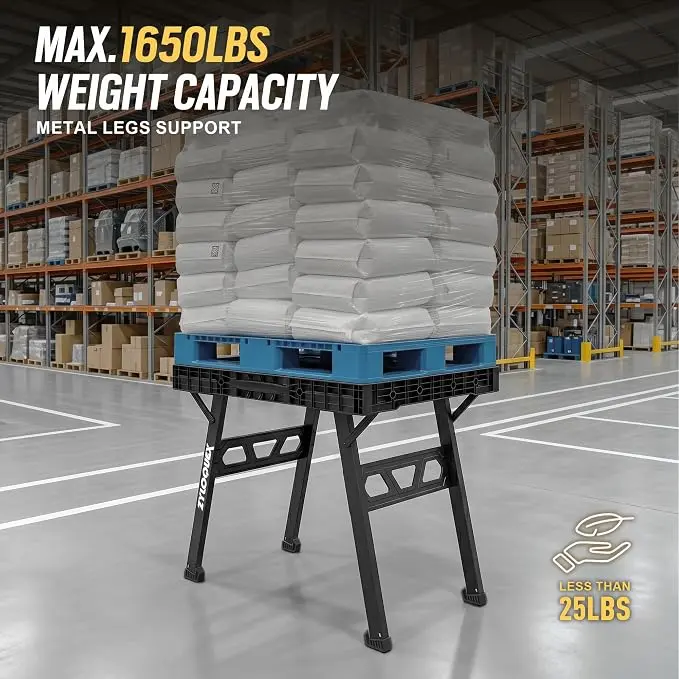
A load rating is a manufacturer’s stated indication of how much load the complete workbench is designed or evaluated to support under defined conditions.
The important word is defined.
A rating is not simply a statement about how thick the tabletop looks or how much metal is used in the frame. It relates to the assembled product as a structural system.
For example, a workbench specification may state:
Maximum Load Capacity: 750kg
A buyer should read this as a specific product claim rather than as an unrestricted statement that every possible 750kg loading situation is equivalent.
The practical meaning depends on information such as:
- the working configuration of the product;
- whether the product is fully deployed and locked;
- how the load is distributed;
- whether the stated figure represents a static condition or another defined condition;
- whether the rating applies to the complete assembled product.
That distinction is particularly important in B2B sourcing because the capacity specification may later appear in product listings, catalogs, packaging, sales sheets, or distributor documentation.
1.A load rating is not the same as the word “heavy duty”
The phrase heavy duty work bench is a product positioning term.
The number next to it is a technical specification.
These two ideas are related, but they are not interchangeable.
A manufacturer can describe a product as heavy duty without establishing a universal capacity threshold. Conversely, a high numerical capacity does not by itself explain every aspect of the product’s construction or intended use.
For a professional buyer, the better approach is:
Use “heavy duty” to understand positioning, and use the load rating to understand stated capacity.
That makes the specification easier to interpret and easier to communicate accurately downstream.
How Should Buyers Interpret 500kg, 750kg, and 1,000kg Ratings?
Capacity figures are often presented as though they form universal product classes.
They should not automatically be treated that way.
A 500kg workbench is numerically rated below a 750kg model, and a 1,000kg model has a higher stated capacity than both. But the difference between those numbers does not automatically tell you how the products compare in stability, structure, portability, configuration, or application suitability.
The number answers one specific question:
What capacity does the manufacturer state for the product under its defined rating conditions?
It does not answer every other product question.
For example:
| Stated Capacity | What the Number Tells You | What It Does Not Automatically Tell You |
|---|---|---|
| 500kg | A stated maximum capacity of 500kg | Whether another supplier’s 500kg rating uses identical conditions |
| 750kg | A stated maximum capacity of 750kg | Whether every type of loading is covered |
| 1,000kg | A stated maximum capacity of 1,000kg | Whether the higher number makes the product commercially better for every market |
This is why a specification buyer should avoid choosing a product simply because its headline number is larger.
A higher rating can be an advantage, but the value of that rating depends on whether it matches the intended product position and buyer requirement.
1.Why 750kg is a useful specification example
The 750kg figure is particularly useful because it demonstrates how easily a capacity number can be oversimplified.
Suppose one supplier states:
750kg Maximum Load
and another supplier also states:
750kg Maximum Load
At first glance, the specifications appear identical.
A professional comparison should go one step further.
The buyer should ask:
What configuration does the 750kg rating apply to?
How is the load applied?
Is the stated figure a static capacity?
Does the rating apply to the complete product?
What documentation or testing information supports the specification?
The answers determine how meaningful the comparison really is.
What Conditions Are Behind a Workbench Load Rating?
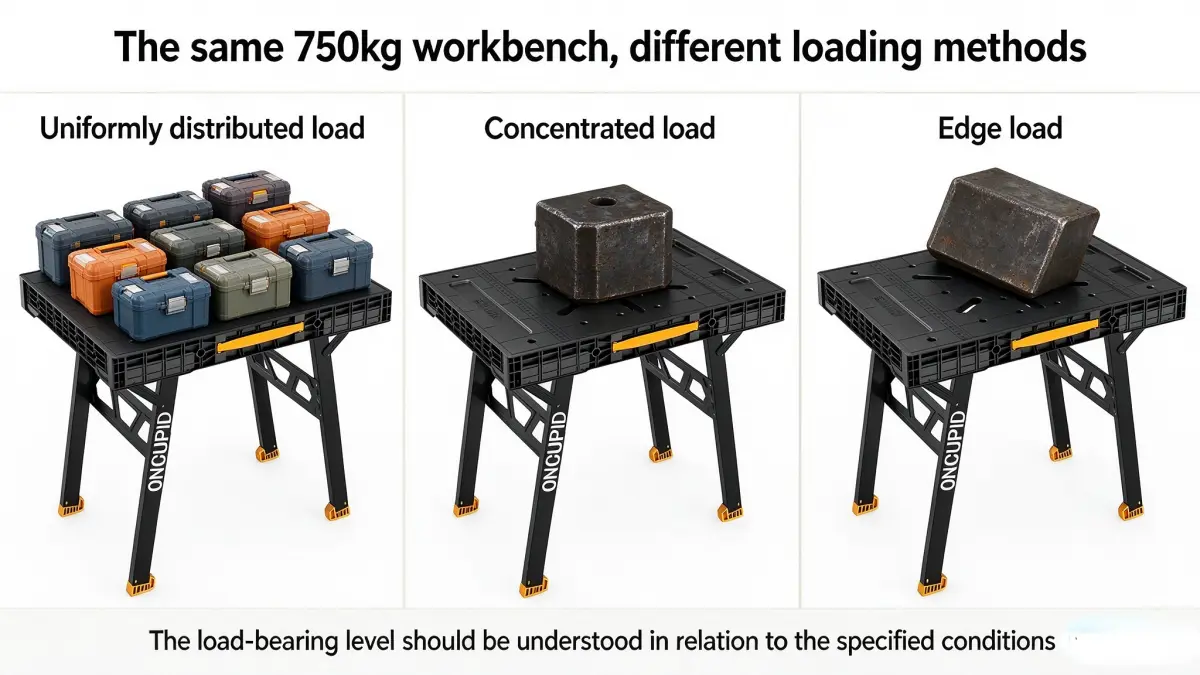
A load rating becomes much easier to understand when the conditions behind the number are made explicit.
The most important variables are usually the product configuration and loading condition.
1.Product configuration matters
A workbench may have more than one physical state.
A folding workbench, for example, may be:
- folded for storage;
- partly opened;
- fully deployed and locked for working.
The published working capacity should be understood in the configuration for which the manufacturer provides the rating.
For specification buyers, this means that a product sheet should make the working state clear rather than leaving the buyer to infer it.
A capacity figure without configuration information creates avoidable ambiguity.
2.Load distribution matters
The total mass is only part of the loading picture.
Consider two situations.
In the first, several loads are distributed across most of the tabletop.
In the second, a heavy component is supported over a relatively small contact area.
Both situations may involve the same total weight, but they do not necessarily create the same loading pattern.
This is why buyers should ask whether the stated capacity is based on a defined distributed load, concentrated load, centered load, or another specified condition.
The point is not that one loading arrangement is automatically unsafe.
The point is that a capacity figure should not be interpreted beyond the conditions attached to it.
3.Static capacity and other loading conditions should not be assumed to be identical
Some workbench ratings are presented as static capacity figures.
That does not automatically mean that every dynamic situation, impact, vibration, or moving load falls under exactly the same specification.
If the intended application involves unusual loading conditions, the supplier should be asked to clarify whether the published rating is appropriate for that application.
This question is especially useful when a distributor is sourcing for professional customers and needs the product specification to remain accurate after it passes through several stages of the supply chain.
Why Can Two 750kg Heavy Duty Workbenches Still Be Different?
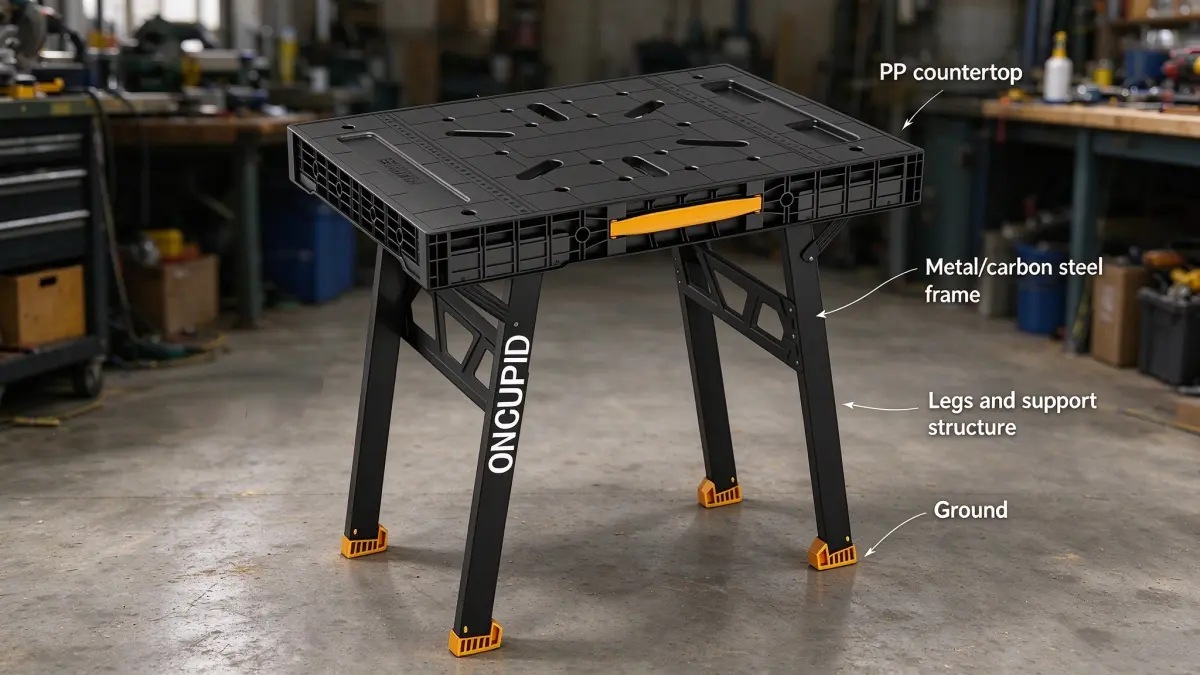
A capacity number belongs to a product structure.
That means two workbenches with the same headline rating can still use different engineering approaches.
1.The load path matters
When weight is placed on a workbench, the force does not stop at the tabletop.
It is transferred through a series of structural components:
Tabletop → Frame → Legs and supports → Floor
The load rating is therefore related to how the complete structure carries and distributes that force.
A strong-looking tabletop does not establish the final capacity by itself.
Neither does a steel frame automatically guarantee a particular rating.
The complete assembled design is what matters.
2.Tabletop material does not determine capacity by itself
Buyers sometimes assume that a heavy duty work table must have a solid metal tabletop.
That is not necessarily true.
A product can combine different materials so that each component serves a different structural or functional purpose.
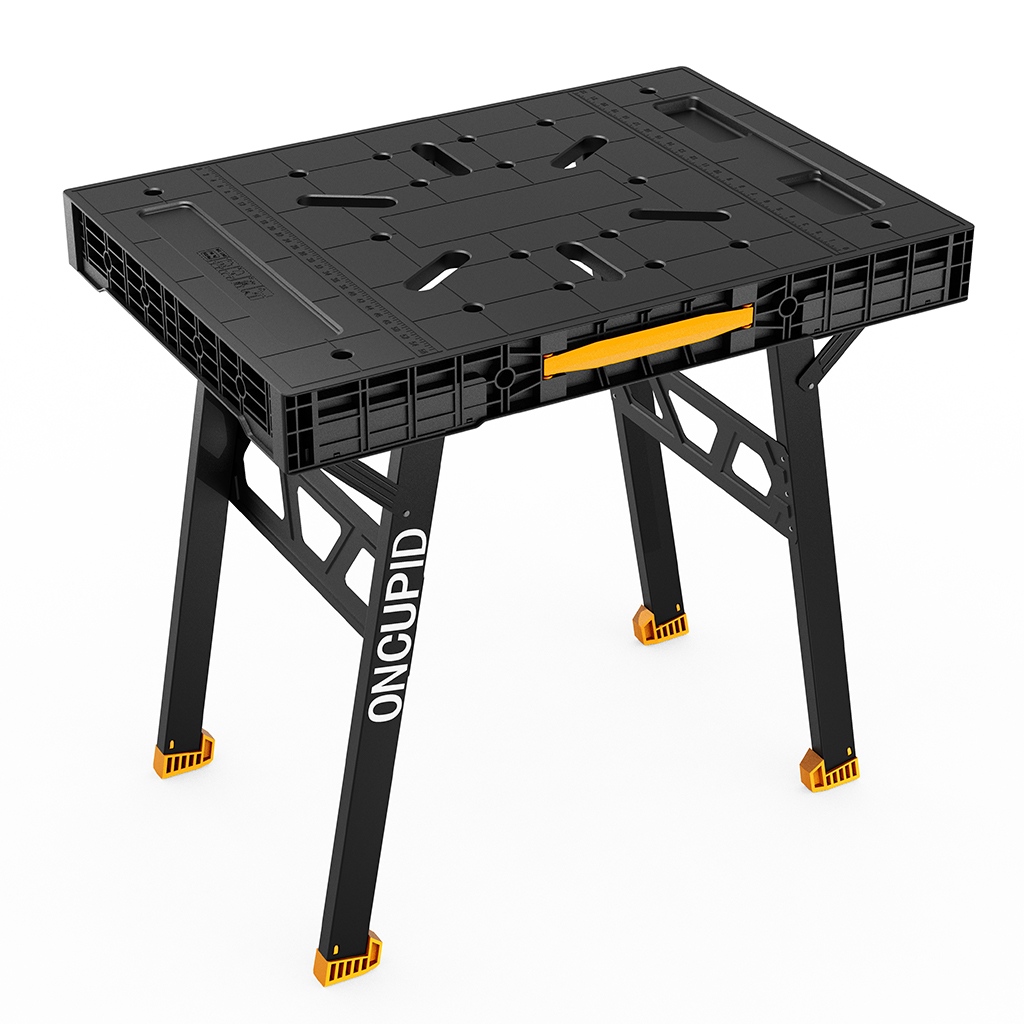
For example, a folding workbench can use a PP tabletop with a metal or carbon-steel frame.
The fact that the tabletop is PP does not automatically mean that the workbench has a low load rating.
At the same time, a PP tabletop alone cannot prove that a workbench can carry 750kg.
The rating belongs to the complete engineered product.
This is an important distinction for distributors because material descriptions and capacity claims are often presented next to each other in product catalogs.
3.Folding joints can become part of the structural question
A heavy duty folding workbench introduces additional structural elements such as hinges, locking points, pivot connections, and folding supports.
The key question is not whether the product folds.
It is whether the folding system forms the intended load-bearing structure when the workbench is deployed and secured.
This is one reason why the configuration attached to a capacity claim matters so much.
For buyers who want to understand folding structures from another angle, the existing folding worktable design article can provide supporting information about how folding architecture affects setup, transport, and daily use. Its subject is broader product design rather than interpretation of load ratings, so it should remain a supporting internal resource rather than a duplicate of this page.
Does a Higher Load Rating Automatically Mean a Better Workbench?
Not necessarily.
A higher load rating is a useful specification when the market actually values that additional capacity.
But product quality and commercial suitability cannot be reduced to a single number.
Imagine a distributor comparing two products:
- Product A: 750kg stated capacity
- Product B: 1,000kg stated capacity
Product B has the higher number.
That does not automatically mean Product B is the better product for the distributor.
The buyer may also need to consider whether the higher rating changes:
- the product’s weight;
- its dimensions;
- packaging requirements;
- logistics costs;
- product positioning;
- target customer;
- retail price;
- market demand.
The commercially stronger product may therefore be the one with the right capacity, not necessarily the maximum capacity available.
1.Capacity should support product positioning
For importers and distributors, load capacity can become a useful product-positioning tool.
A clear rating can help separate product models within a range.
For example:
standard capacity → higher capacity → high-capacity professional model
can be easier for customers to understand than a product range where every item is simply described as “heavy duty.”
The goal is not to make the number look impressive.
The goal is to make the specification clear, credible, and commercially meaningful.
What Should a Specification Buyer Ask a Supplier About a 750kg Rating?
This is where the load-rating discussion becomes directly useful for sourcing.
A buyer does not need a complicated engineering questionnaire.
A focused set of technical questions is usually enough to determine whether different suppliers are describing the same thing.
1.Ask what the rating applies to
The first question should be:
What exact product configuration does the 750kg rating apply to?
For a folding model, confirm the working configuration.
For an adjustable model, confirm whether the capacity applies across the relevant configuration range.
2.Ask how the load is defined
The next question should address the loading condition.
Ask whether the stated capacity refers to:
distributed load, concentrated load, static load, or another defined condition.
This prevents the buyer from making assumptions the supplier never intended.
3.Ask what supports the claim
A credible supplier should be able to explain how the capacity is established.
Depending on the product and project, supporting information may include:
test conditions, test records, product specifications, inspection procedures, or other technical documentation.
Not every product requires the same documentation package, so the buyer should evaluate the evidence according to the application and market.
The important point is that the capacity should not exist only as a marketing phrase.
4.Ask whether the specification is stable across production
For a one-time sample purchase, a capacity number may appear straightforward.
For a distribution or private-label program, the bigger question is whether mass-produced units continue to match the approved specification.
This is where manufacturing capability, material control, tooling, assembly, and quality control become relevant.
A good sample does not automatically guarantee a consistent production run.
Can a PP Tabletop Really Be Part of a 750kg Heavy Duty Workbench?
Yes, a PP tabletop and a high load rating are not inherently contradictory.
The key is to understand that material name and load capacity are different specifications.
The tabletop works together with the frame, supports, connections, and overall geometry.
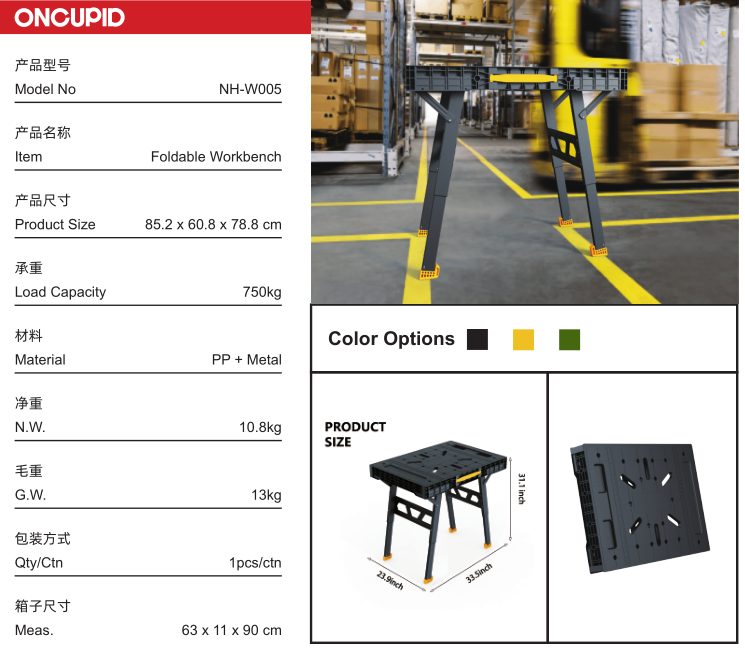
Jingyan Tools’ 750kg folding workbench is one example of this approach, using a PP tabletop with a metal/carbon-steel frame.
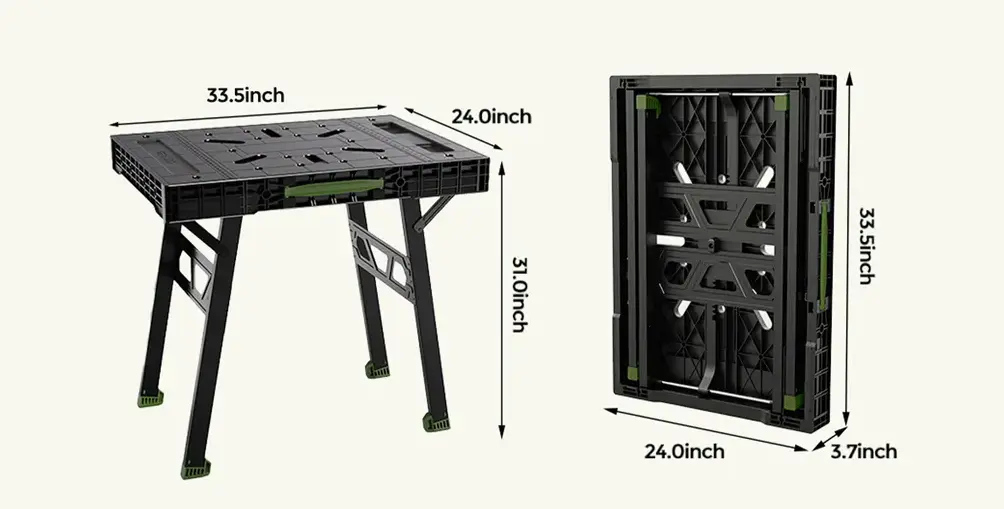
The published product dimensions are approximately 85.2 × 60.8 × 79cm, with a product weight of approximately 10.5kg, while the stated load capacity is 750kg.
These specifications illustrate an important point:
The workbench’s own weight does not define its rated load capacity.
A product can be relatively portable while still having a substantial stated load rating when its structure has been designed as a complete load-bearing system.
The product page is useful when buyers need the exact model specification, while the separate article on load capacity testing and real-world performance can be used when the buyer needs more information about how the 750kg performance was evaluated.
This separation is helpful for SEO as well as user experience: the current article explains the meaning of a rating, while the existing testing article addresses the evaluation of the rating.
How Should a Distributor Present a Load Rating in Product Information?
The way a distributor communicates a capacity rating can be just as important as the number itself.
A product page should avoid turning a conditional technical specification into an unrestricted promise.
Instead of using only:
Heavy Duty Workbench – 750kg
a clearer product description can communicate the number together with the relevant product type and configuration.
For example:
750kg Heavy Duty Folding Workbench
is more informative because it tells the customer:
- the product category;
- the positioning;
- the stated load capacity;
- the folding configuration.
The product page can then provide the supporting specifications underneath.
This approach is especially useful for B2B buyers because the information may later be copied into catalogs, quotations, distributor websites, packaging, or retail listings.
1.Avoid using “heavy duty” as a substitute for a specification
“Heavy duty,” “industrial-grade,” and similar expressions may support product positioning, but they should not replace a clear capacity specification.
When the actual rating is known, publish the number clearly and explain its conditions where needed.
This gives buyers something they can compare.
It also gives sales teams a more precise specification to communicate.
What Role Does the Manufacturer Play in a Credible Load Rating?
A load rating is ultimately connected to product engineering and manufacturing consistency.
This is why supplier selection still matters even when the article is focused specifically on capacity interpretation.
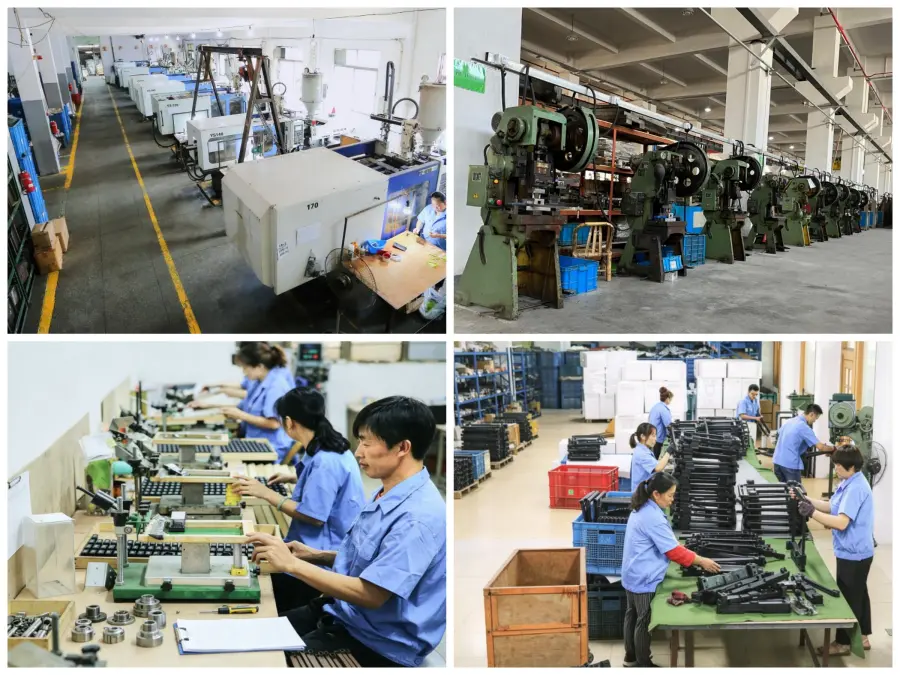
Jingyan Tools was established in 2003 and works across R&D, mold design, plastic products, metal stamping, production, quality control, and customer service.
The company supplies tool products for international markets and has long-term cooperation experience with brands including Stanley and Bosch.
These details do not prove a particular 750kg capacity by themselves.
Their value is different.
They help the buyer understand the manufacturing environment behind the product and evaluate whether the supplier has the capabilities needed to develop, produce, inspect, and maintain a specified product structure.
For buyers looking at OEM or ODM projects, that becomes especially important because a load-rating requirement may need to remain consistent through:
product development → tooling → sample approval → mass production → quality control → packaging and shipment
A manufacturer with integrated technical and production functions can therefore be easier to work with when capacity is an important part of the commercial specification.
Buyers who need broader supplier information can also review the company’s manufacturing capabilities as part of the sourcing process.
Load Rating and Certification Are Different Types of Information
Another common specification problem is treating certifications as if they prove a particular load capacity.
They do not necessarily answer the same question.
A certification or compliance document may address a regulatory, material, manufacturing, or management requirement.
A load rating addresses a product-capacity claim under defined conditions.
For that reason, a buyer should keep these categories separate:
Capacity specification
Testing information
Product construction
Certification and compliance
This makes the documentation easier to review and prevents one type of information from being used as a substitute for another.
For example, a manufacturer may hold certifications or compliance documentation for a product or management system, but that does not automatically establish that the workbench has a 750kg structural rating.
Likewise, a 750kg rating should not be presented as though it were itself a certification.
Clear separation between these specifications improves both technical communication and commercial accuracy.
When Does a 750kg Rating Become Commercially Valuable?
For a specification buyer, the value of a load rating is not limited to engineering.
It can also influence how a product is positioned in the market.
A distributor may use a 750kg rating to distinguish a professional model from lower-capacity alternatives.
A private-label brand may use the capacity as one part of its product proposition.
An importer may include the number in a specification table so buyers can compare products more easily.
The most useful approach is to connect the capacity figure with the rest of the product proposition.
For example:
750kg capacity + folding structure + practical dimensions + established manufacturing support
tells a more complete product story than:
750kg
by itself.
That does not mean every product must carry as many specifications as possible.
The principle is simply that the rating should be presented in context.
For distributors building a broader workbench portfolio, the workbench product range can also help compare different product configurations and capacity positions
A Practical Framework for Comparing Load Ratings Across Suppliers
When several suppliers offer similar heavy duty workbench models, a simple comparison framework can prevent misleading conclusions.
1.Compare the number
First record the stated maximum capacity.
2.Compare the configuration
Check which product state and configuration the rating applies to.
3.Compare the loading condition
Determine whether the suppliers are describing comparable loading conditions.
4.Compare the supporting information
Review available test conditions, technical documents, or specification records.
5.Compare the manufacturing basis
Consider whether the supplier has the engineering, tooling, production, and quality-control capability needed to maintain the specification consistently.
The result is a much stronger comparison than:
Supplier A = 750kg
versus
Supplier B = 750kg
The two numbers may look identical while the underlying specifications tell a different story.
FAQ About Heavy Duty Workbench Load Ratings
1.What does a 750kg load rating actually mean on a heavy duty workbench?
A 750kg rating means the manufacturer states a maximum load capacity of 750kg for the product under its defined rating conditions.
The number should be interpreted together with the working configuration, loading condition, and product structure. It should not automatically be treated as an unrestricted promise that every type of 750kg load can be applied in every position.
2.Can two heavy duty workbenches with the same 750kg rating be considered equivalent?
Not automatically.
Two suppliers may publish the same 750kg headline figure while defining the rating under different product configurations or loading conditions.
Before treating the products as equivalent, the buyer should compare the rated configuration, load application, testing information, and complete product structure.
This is one of the most important questions to ask when evaluating multiple factories.
3.Does a 750kg rating cover a concentrated load?
The answer depends on how the supplier defines the rating.
A published capacity may be based on a specific loading condition rather than every possible concentrated-load arrangement.
For a product that will regularly carry heavy components with small contact areas, the buyer should ask the supplier specifically whether that use condition is covered by the stated rating.
4.Does the load rating apply to every configuration of a folding or adjustable workbench?
It should not be assumed automatically.
For a folding workbench, the rating should be connected to its intended working configuration.
For an adjustable model, buyers should confirm whether the stated capacity applies throughout the specified adjustment range or only to a particular configuration.
The safest commercial approach is to use the manufacturer’s documented configuration when publishing the capacity.
5.What evidence should a supplier provide for a 750kg capacity claim?
The appropriate evidence depends on the product and the project, but buyers should expect the supplier to clearly explain what the rating represents and how it was established.
Supporting material may include test conditions, test records, technical specifications, inspection procedures, or other relevant documentation.
The key issue is not collecting paperwork for its own sake.
It is being able to connect the capacity claim to a defined product and a reproducible technical basis.
6.Can a workbench with a PP tabletop really have a 750kg load rating?
Yes.
Tabletop material alone does not determine the final load rating.
A workbench can combine a PP tabletop with a metal or carbon-steel frame and be designed as a complete load-bearing structure.
The correct question is therefore not “Is the tabletop plastic?”
but:
“What capacity has been established for the complete assembled workbench, and under what conditions?”
7.Should a distributor advertise “750kg capacity” without further explanation?
The capacity can be a strong selling specification, but it is better presented with enough context to prevent overstatement.
A distributor should identify the product configuration and avoid wording that implies the rating applies without conditions when the manufacturer’s specification is more limited.
For example, 750kg Heavy Duty Folding Workbench is more useful than simply saying Ultra Strong Workbench, because the former gives the customer an actual specification to evaluate.
8.Is a 1,000kg workbench automatically a better choice than a 750kg model?
No.
A higher rating can be beneficial when the target application requires it, but it does not automatically provide greater commercial value.
The better product is the one whose capacity, configuration, price, logistics, and market positioning match the intended customer requirement.
9.What is the most important question to ask a supplier about a load rating?
A very useful starting question is:
“What exactly does this load rating apply to?”
That single question usually leads to the information the buyer actually needs: product configuration, loading condition, testing basis, and supporting technical documentation.
The Real Meaning of a Heavy Duty Workbench Load Rating
A heavy duty workbench load rating is valuable because it gives buyers a concrete specification.
But the number becomes truly useful only when its meaning is understood.
A 750kg heavy duty workbench is not simply “a table that holds 750kg.”
The rating belongs to a particular product design, configuration, loading condition, and manufacturer specification.
That is why two products with the same 750kg headline may still require additional comparison before they can be treated as equivalent.
For specification buyers, the most useful approach is to look beyond the number without losing sight of the number.
Ask:
What is the rated capacity?
What configuration does it apply to?
How is the load defined?
What supports the claim?
Can the same specification be maintained in production?
Once these questions are answered, the load rating becomes far more useful for sourcing, product positioning, and downstream sales communication.
For importers and distributors evaluating a 750kg model, Jingyan Tools offers a concrete example of how a PP tabletop, metal/carbon-steel frame, folding configuration, and stated 750kg capacity can be brought together in one workbench design.
The most important lesson is simple:
Do not compare load numbers alone. Compare what those numbers actually mean.
That is how a 750kg rating becomes a meaningful specification rather than just a large number on a product page.
Need a Portable Work Bench with Fast, Tool-Free Setup?
Tell us your target market, required quantity, packaging requirements, and customization needs.
Related products