How Much Weight Can a Folding Hand Truck Carry? Capacity Explained
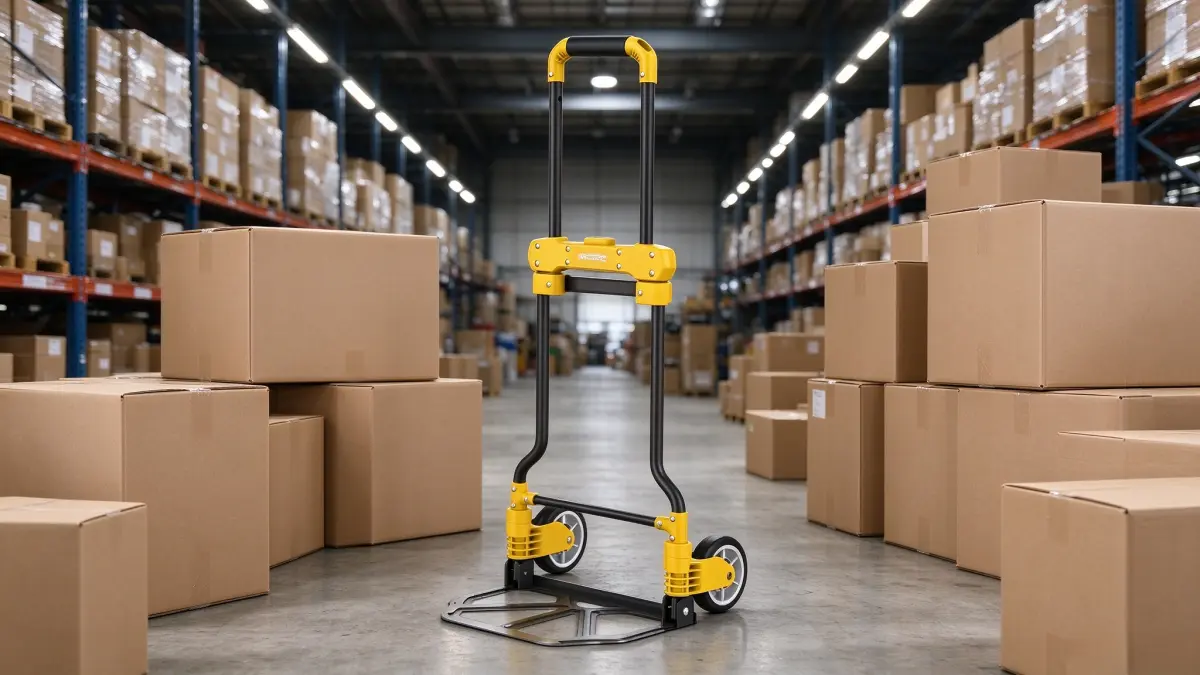
A folding hand truck’s load capacity is often one of the first specifications commercial buyers check. But the number on a product page does not tell the whole story. To understand whether a model is suitable for a particular load, buyers need to know what was tested, how the load was distributed, and which operating conditions the rating covers.
The answer to “how much weight can a folding hand truck carry?” depends on the specific model and its documented rating. A 100 kg capacity, for example, represents approximately 220.5 lb. Whether that figure is appropriate for a particular application depends on how the manufacturer defines the rating and how the hand truck will be used.
For importers, wholesalers, distributors, and tool brands, this distinction matters for more than product selection. It affects specification sheets, packaging claims, customer expectations, and the accuracy of product listings across different markets.
This article explains how to interpret a folding hand truck weight capacity, distinguish static test results from moving-load conditions, understand why load placement matters, and verify a manufacturer’s claim before purchasing.
Table of Contents
- What Does a Folding Hand Truck Load Rating Actually Mean?
- How to Interpret a 100 kg Folding Hand Truck Capacity
- Static Load Capacity vs. Moving Load Capacity
- What Can Affect Performance Under Real Working Conditions?
- How to Verify a Folding Hand Truck Weight Capacity Claim
- A Real Product Example: Jingyan Tools' 100 kg Folding Hand Truck
- Frequently Asked Questions About Folding Hand Truck Weight Capacity
- Conclusion: Verify the Rating, Not Just the Number
What Does a Folding Hand Truck Load Rating Actually Mean?
A load rating is a stated capacity associated with a particular product and its applicable test or operating conditions. It should be read as a defined specification, rather than as an unconditional promise that any load of the same weight can be carried in any situation.
Two products may both advertise a 100 kg capacity, yet the supporting information may differ. One manufacturer may describe a uniformly distributed static load; another may use a different test configuration or define a different working condition. The numbers appear identical, but the claims are not necessarily equivalent.
1.Why the Test Conditions Matter
A load rating only becomes useful when the buyer understands what the figure represents. Relevant details include the test method, load placement, support conditions, and the criteria used to determine whether the product passes.
For example, a product tested with a uniformly distributed load on a level surface has been evaluated under that defined arrangement. The result does not automatically establish that the same load is appropriate when concentrated on one small area, stacked high above the intended support surface, or moved across obstacles.
Buyers should also distinguish between a maximum test load, a manufacturer’s recommended working load, and a load rating specifically verified for moving operation. These terms should not be treated as interchangeable unless the supplier’s documentation supports that interpretation.
If a listing provides only a number without defining the test basis, ask the manufacturer to clarify it. A clear explanation is more useful than a stronger-sounding but ambiguous claim.
2.Uniformly Distributed Loads vs. Concentrated Loads
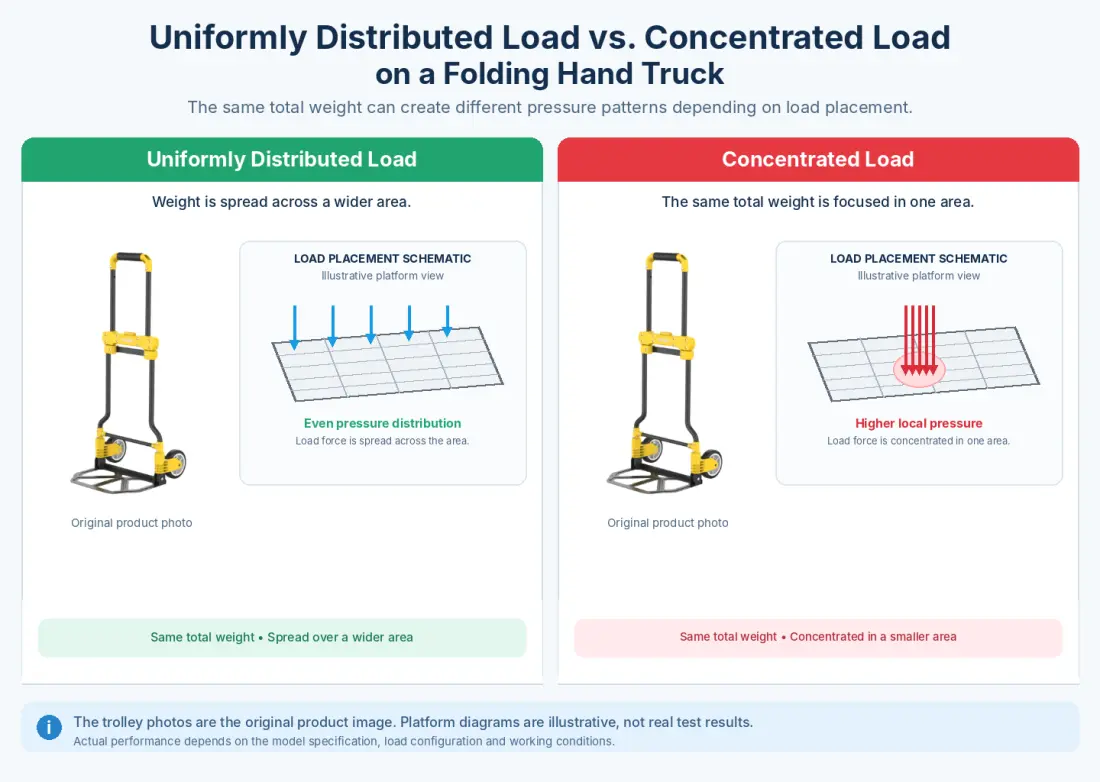
A uniformly distributed load spreads weight across the intended loading area. A concentrated load places a greater proportion of the weight in a smaller area.
This distinction is relevant because structural forces are not determined by total weight alone. The location of the force and the area over which it acts can influence local stress on the support plate, frame members, connections, and other load-bearing components.
Consider two shipments with the same total mass: one consists of several cartons arranged across the supporting area, while the other contains a dense machine component resting on a small section of the plate. The total weight is identical, but the loading pattern is different.
A uniform-load rating should not automatically be interpreted as a concentrated-load rating. When the intended cargo is unusually dense, narrow, or difficult to position, buyers should confirm whether the manufacturer’s rating applies to that configuration.
How to Interpret a 100 kg Folding Hand Truck Capacity
A stated 100 kg folding hand truck load capacity is approximately 220.5 lb. For international buyers, displaying both units can make the specification easier to understand in markets that use different measurement systems.
The more important task is to establish whether the intended load falls within the conditions attached to that rating.
Consider a distribution business that moves boxed products in several different configurations. A shipment could have a total mass below 100 kg but place most of its weight toward one edge. Another shipment could distribute the same mass more evenly. A third could have a tall stack that changes stability even though the combined weight is unchanged.
These examples lead to three separate checks:
-
Total payload: Does the combined cargo weight remain within the applicable stated limit?
-
Load distribution: Does the cargo arrangement match the manufacturer’s permitted loading configuration?
-
Operating conditions: Is the intended movement consistent with the conditions and restrictions covered by the product documentation?
All three checks matter. Passing only the first does not establish that the entire configuration is suitable.
For buyers comparing a product’s capacity with a real shipment, it is helpful to prepare a simple load profile before requesting technical confirmation.
|
Information to prepare |
Why it matters |
|---|---|
|
Total cargo weight |
Establishes the combined mass to be supported |
|
Number and dimensions of packages |
Helps identify overhanging, narrow, or awkwardly arranged cargo |
|
Weight distribution |
Shows whether the load is spread evenly or concentrated |
|
Intended transport route |
Identifies relevant thresholds, floor joints, slopes, or other obstacles |
|
Frequency of use |
Helps the supplier understand whether the requirement involves occasional handling or repeated commercial operation |
This information helps a manufacturer give a more useful answer than a question about maximum weight alone.
A 100 kg rating is not automatically a recommended target for every trip. Buyers planning repeated handling close to that limit should confirm the manufacturer’s approved operating conditions and ask whether any lower working-load recommendation applies.
Static Load Capacity vs. Moving Load Capacity
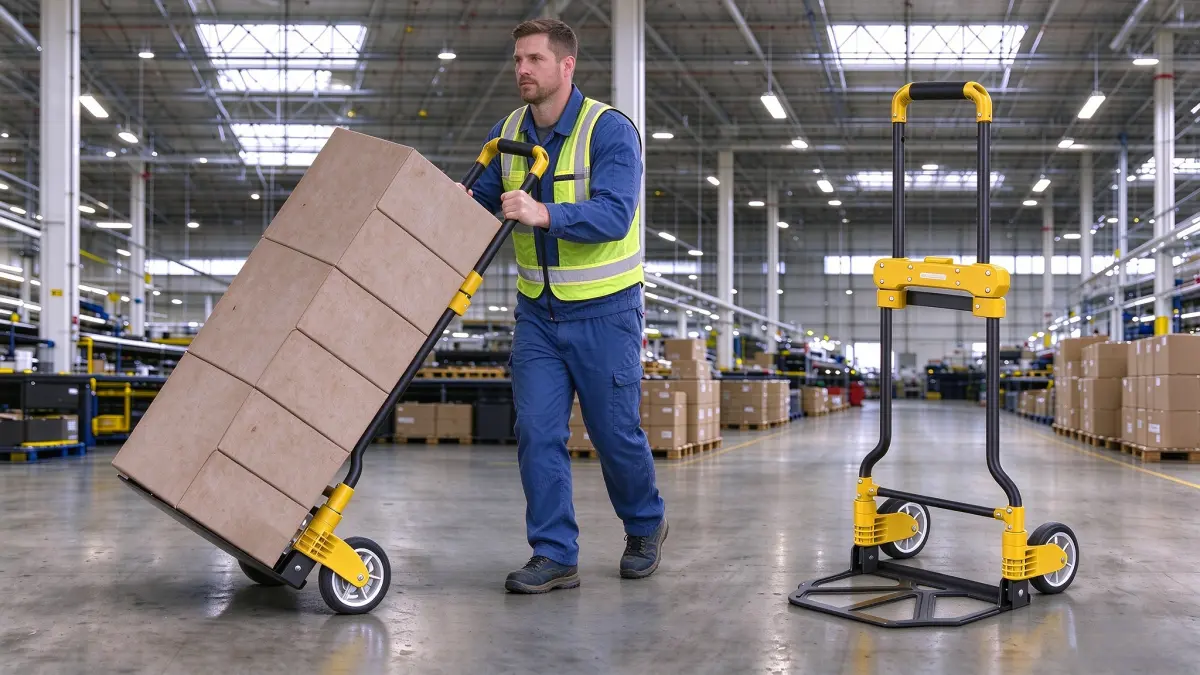
The difference between static and moving loads is one of the most important points when interpreting a folding hand truck weight limit.
1.What a Static Load Test Can Tell You
A static load test evaluates a product under a defined loading condition while the product is stationary. Depending on the manufacturer’s procedure, the test may be used to assess structural response to an applied load or determine whether the product meets specified acceptance criteria.
The result is useful, but its meaning is limited to the test and criteria documented. A static test does not, by itself, describe every condition that occurs during transportation.
For example, a hand truck may be stationary on a level surface during testing. While moving, its wheels may encounter a floor joint, its direction may change, or the cargo may shift. Those events create conditions different from the stationary test arrangement.
The correct interpretation is not that static tests have no value. It is that a static capacity result should be described as a static result unless separate evidence supports a broader claim.
2.What Changes During Movement?
During operation, the hand truck can experience changes in force as it starts, slows, turns, or crosses an obstacle. The cargo’s position relative to the wheels and support structure also affects how the system behaves.
A load that remains stable on a level surface may behave differently if the hand truck is tilted or the cargo shifts during movement. Abrupt changes in direction can affect control, while uneven surfaces may cause sudden changes in the forces acting through the wheels and frame.
These conditions do not automatically mean that a product with a static 100 kg rating is unsuitable for commercial use. They mean that the rating alone does not establish a universal moving-load capacity.
If an application involves repeated transport, thresholds, uneven flooring, slopes, or loads close to the published maximum, the buyer should ask the supplier which conditions have been evaluated and which restrictions apply.
3.How Buyers Should Compare Different Capacity Claims
When comparing hand trucks from different suppliers, avoid placing their capacity numbers side by side without checking the definitions.
Instead, compare the following information:
-
The stated load capacity and units.
-
The test method or standard, where specified.
-
Whether the load was uniform or concentrated.
-
Whether the stated value applies to stationary testing, movement, or another defined condition.
-
Any restrictions or recommended working limits.
-
The documentation available for the exact model.
If one supplier provides a detailed, model-specific test basis and another supplies only an unsupported maximum number, the buyer has different levels of evidence. A higher advertised figure should not automatically be treated as better performance.
What Can Affect Performance Under Real Working Conditions?
The actual load arrangement and working environment can influence how a folding hand truck behaves. These are not reasons to invent an arbitrary lower capacity; they are reasons to verify that the intended use matches the product’s documented conditions.
1.Load Position and Centre of Gravity
The centre of gravity describes where the combined mass of the load and the supported system effectively acts. Its position affects balance and the forces that must be controlled during handling.
Tall or unevenly stacked cargo can shift the combined centre of gravity. A load that projects substantially beyond the intended support area may also place different forces on the structure from those produced by a properly positioned load.
This is particularly relevant when carrying narrow, heavy, or irregularly shaped products. Even if the total mass is within the stated load rating, the arrangement may be unstable or unsuitable.
For commercial buyers, the practical step is to provide the manufacturer with the approximate package dimensions and loading arrangement when these differ significantly from ordinary, evenly arranged cartons.
2.Wheels, Obstacles, and Floor Conditions
The operating surface affects the forces transmitted through the wheels and frame. A smooth, level floor and a route with raised thresholds, gaps, slopes, or uneven sections are not equivalent working conditions.
When a wheel meets an obstacle, the force applied to the hand truck can change abruptly. The cargo may also shift, requiring the operator to correct the load’s position or movement.
Wheel condition matters as well. Damaged wheels, loose components, or worn load-bearing parts may affect control and operation. Buyers should follow the manufacturer’s inspection and maintenance instructions and remove visibly damaged equipment from service until it has been assessed.
None of these considerations changes the printed rating by itself. Instead, they help determine whether the use case is consistent with the conditions under which the rating was established.
3.Repeated Handling and Product Condition
A product used occasionally and one used repeatedly throughout a commercial shift may face different service demands. Frequent handling makes it particularly important to understand inspection requirements, maintenance procedures, and any operating limitations specified by the manufacturer.
For buyers sourcing hand trucks for distribution or resale, this information also helps set accurate customer expectations. A product should not be marketed as suitable for an application that has not been supported by its specifications or documented testing.
How to Verify a Folding Hand Truck Weight Capacity Claim
For importers and distributors, verifying the capacity is part of technical due diligence. It helps ensure that the specification advertised to customers matches the product being supplied.
1. Confirm the Exact Model
Begin by identifying the precise model, configuration, and version covered by the capacity claim.
Products in the same category can look similar while using different frames, support plates, joints, or wheel arrangements. A load rating associated with one model should not automatically be applied to another.
If an order involves customized components or a modified structure, ask whether the original capacity claim remains applicable to the final configuration.
2. Ask for the Test Basis
Ask the supplier to explain how the stated capacity was established. For a product advertised at 100 kg, useful questions include:
-
Is the 100 kg figure a maximum uniformly distributed static load?
-
Is a separate dynamic or recommended working-load rating available?
-
How was the test load positioned?
-
What test method and acceptance criteria were used?
-
Are there restrictions on cargo dimensions, placement, or operating conditions?
-
Can supporting test records or technical documentation be provided?
The purpose is not to demand that all suppliers use an identical procedure. It is to determine exactly what the specific supplier has verified.
3. Match the Claim to the Supporting Evidence
Compare the product page, technical specification, packaging information, user instructions, and relevant test documentation.
If one document describes a maximum static uniform load while another describes the same number as a general working capacity, request clarification before approving the claim.
A material list can help identify the product’s construction, but it does not independently demonstrate a capacity rating. Likewise, a general quality certification should not be presented as proof that a particular model has passed a particular load test unless the documentation actually supports that statement.
For private-label buyers, this step is especially useful because the information may need to be reused across catalogues, retailer listings, packaging, and translated product materials.
4. Record the Agreed Specification Before Ordering
Before approving a sample or production order, document the agreed capacity and its applicable conditions. Include any special requirements related to the cargo, transport route, or frequency of use.
If the product will be advertised with a specific load claim, confirm the wording with the supplier before printing packaging or publishing sales materials. This avoids a situation in which the marketing claim is broader than the available evidence.
For wider supplier checks and procurement documentation, buyers can also consult the separate guide to foldable hand truck dolly bulk purchasing. The key point here remains the load rating: establish what it means, what evidence supports it, and whether it matches the intended operation.
A Real Product Example: Jingyan Tools' 100 kg Folding Hand Truck
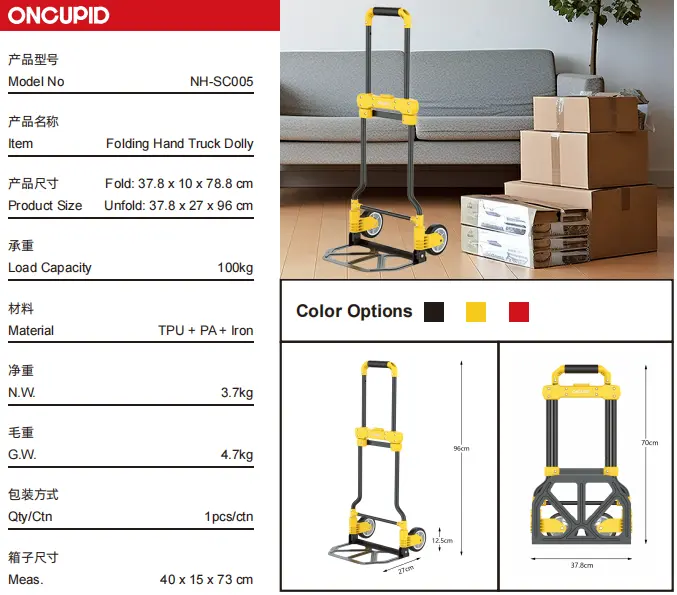
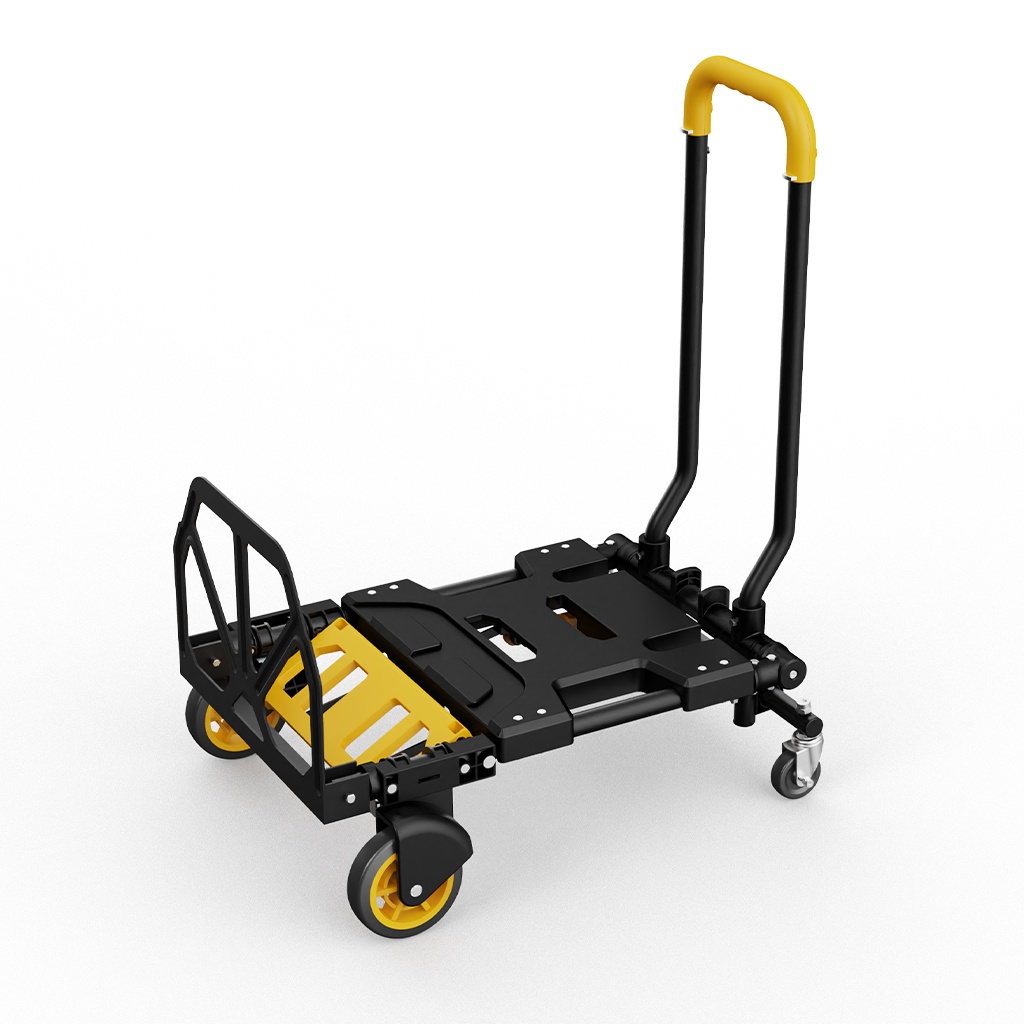
Jingyan Tools lists a yellow folding hand truck and dolly with a published load capacity of 100 kg (approximately 220.5 lb). The product page describes the capacity in connection with static load testing and a uniformly distributed load. Buyers should refer to the actual product documentation for the applicable test details and operating conditions.
The published specifications are:
|
Specification |
Product detail |
|---|---|
|
Product type |
Foldable hand truck and dolly |
|
Load capacity |
100 kg |
|
Material |
TPU + PA + Iron |
|
Product weight |
3.69 kg |
|
Open dimensions |
37.8 × 27 × 96 cm |
|
Folded dimensions |
37.8 × 10 × 70 cm |
|
Color |
Yellow |
For this article, the central detail is the 100 kg stated capacity and its described static, uniformly distributed load basis. The other specifications identify the model but should not be used as substitutes for load-test documentation.
A buyer planning to handle a particular product range should compare the load profile with the documented rating, especially if cargo is unusually dense, narrow, stacked high, or transported over challenging surfaces.
Ningbo Jingyan Tool Industrial Co., Ltd. was established in 2003 and provides manufacturing and OEM/ODM customization services. For importers and private-label buyers, confirming the exact model, agreed specification, and supporting technical information is a practical starting point for evaluating whether a product fits the intended application.
The important commercial question is not simply whether the hand truck carries a nominal 100 kg load. It is whether the documented capacity and test conditions correspond to the buyer’s actual requirements.
Frequently Asked Questions About Folding Hand Truck Weight Capacity
1.How much weight can a folding hand truck carry?
It depends on the model and its published rating. Check the load capacity, test basis, and applicable operating conditions. A 100 kg rating is approximately 220.5 lb, but it should not be assumed to cover every load configuration or working environment.
2.Does a 100 kg rating mean the hand truck can carry 100 kg while moving?
Not automatically. If the published claim relates to a static test, that result alone does not establish the same capacity under every moving condition. Ask whether dynamic performance or a recommended working load has been separately evaluated.
3.What is the difference between uniform and concentrated loads?
A uniform load distributes weight across the intended support area, while a concentrated load places more of the weight in a smaller area. The different force distribution may affect local stresses, so buyers should confirm whether the capacity rating applies to their planned cargo arrangement.
4.Can a hand truck carry an unevenly stacked load below its rated capacity?
The total weight may be within the stated limit, but an uneven or high stack can affect balance and control. Cargo dimensions, centre of gravity, position, and stability must also be considered in accordance with the manufacturer’s instructions.
5.How can importers verify a hand truck's load rating?
Confirm the exact model, ask for the test basis, and review the supporting documentation. Ensure the product page, technical sheet, packaging, and instructions use consistent capacity claims.
6.Is a higher advertised load capacity always better?
No. Capacity numbers are only directly comparable when the rating definitions and test conditions are sufficiently similar. A well-documented rating that matches the intended application may be more useful than a higher number with unclear supporting evidence.
Conclusion: Verify the Rating, Not Just the Number
A folding hand truck’s load capacity is meaningful only when it is understood in context. Buyers need to establish what the manufacturer tested, how the load was distributed, and whether the documented conditions match the intended use.
For a model advertised at 100 kg, start by verifying the stated capacity and its static or dynamic basis. Then examine the planned load distribution, cargo dimensions, and operating environment. Finally, confirm the exact model and supporting technical documentation before relying on the claim for a commercial application.
For importers, wholesalers, and distributors, this approach makes product specifications easier to evaluate and easier to communicate accurately to downstream customers.
Jingyan Tools’ 100 kg folding hand truck provides a concrete example of how to examine a capacity claim. The objective is not to treat a published number as a guarantee for every situation, but to establish whether the documented rating is suitable for the cargo and conditions involved.
Related products