How to Evaluate a Foldable Hand Truck Dolly for Bulk Purchasing
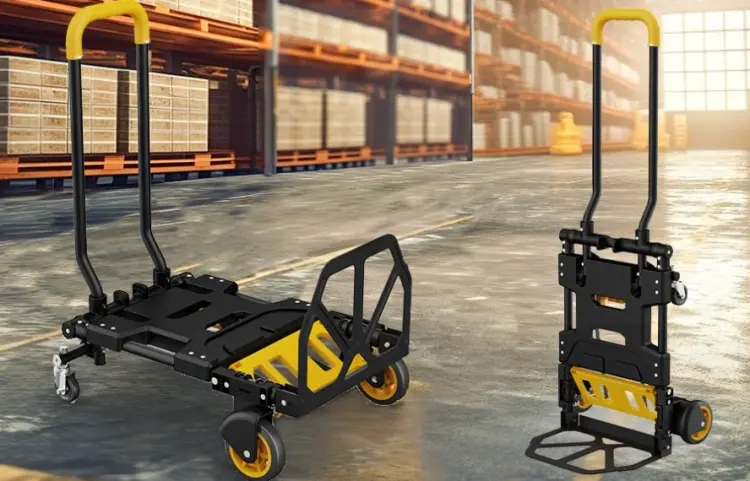
Buying a hand truck dolly foldable model for a business is very different from choosing one for occasional personal use.
For importers, distributors, wholesalers, and retail buyers, the purchasing decision rarely depends on a single specification. A commercially suitable trolley needs to match the intended application, operating conditions, storage requirements, packaging strategy, quality expectations, and long-term supply plan.
A product may look attractive in a catalog and have a competitive quotation, yet still become difficult to sell or manage after the order is placed. Inconsistent components, unclear load ratings, inefficient packaging, difficult operation, or unreliable replenishment can create significant costs when an order involves hundreds or thousands of units.
This is why a foldable hand truck dolly should be evaluated as a complete commercial product rather than simply as a cart with wheels.
The following framework explains what B2B buyers should review before approving a foldable trolley for bulk purchasing.
- 1. Define Your Application and Purchasing Requirements
- 2. Evaluate the Product Design and Specifications
- 3. Assess Foldability, Handling, and Everyday Usability
- 4. Verify Quality and Manufacturing Consistency
- 5. Evaluate OEM/ODM and Supplier Capability
- 6. Compare MOQ, Packaging, Lead Time, and Total Cost
- 7. A Practical Checklist for Choosing the Right Supplier
- FAQ About Buying a Foldable Hand Truck Dolly in Bulk
- Ready to Evaluate Your Next Bulk Order?
Define Your Application and Purchasing Requirements

The first step should be understanding what the product needs to accomplish and who will use it.
A trolley supplied to warehouse operators may need to handle frequent material movement, while a model sold through a hardware retailer may need to balance portability, compact storage, appearance, and packaging.
Defining the application first helps prevent a common purchasing mistake: selecting a product because its specifications look impressive without considering whether those specifications actually fit the target market.
1.Identify the Intended Use
Start with the main applications you expect your customers to have.
Typical commercial applications include warehouse material handling, stockroom transportation, workshop operations, retail replenishment, delivery work, maintenance, and moving cartons or general loads.
The goal is not to claim that one trolley is suitable for every situation. Instead, identify the applications most relevant to your business.
For example, a distributor serving warehouse customers may give more weight to stability and load handling. A retailer may care more about folded dimensions, packaging, color options, and ease of use. A company supplying service vehicles may prioritize portability and storage efficiency.
This application-based approach also helps the buyer choose which specifications deserve the most attention.
2.Set the Key Product Requirements
Before requesting quotations, define the requirements that every supplier should quote against.
These may include:
- Intended operating modes
- Required load capacity
- Product weight
- Open dimensions
- Folded dimensions
- Wheel configuration
- Material construction
- Color requirements
- Branding requirements
- Packaging requirements
- Target order quantity
- Expected delivery schedule
Using the same requirements for different suppliers makes quotations easier to compare and reduces the risk of evaluating products based on different assumptions.Buyers who are still defining their basic product requirements may also benefit from a folding hand truck selection guide before moving into bulk procurement evaluation.
Evaluate the Product Design and Specifications
Once the purchasing requirement is clear, examine the actual product.
A folding hand truck dolly should not be evaluated only by its headline specifications. The product needs to make sense as a complete structure, with the frame, joints, wheels, platform, handle, and operating mechanism working together.
1.Frame and Material Construction
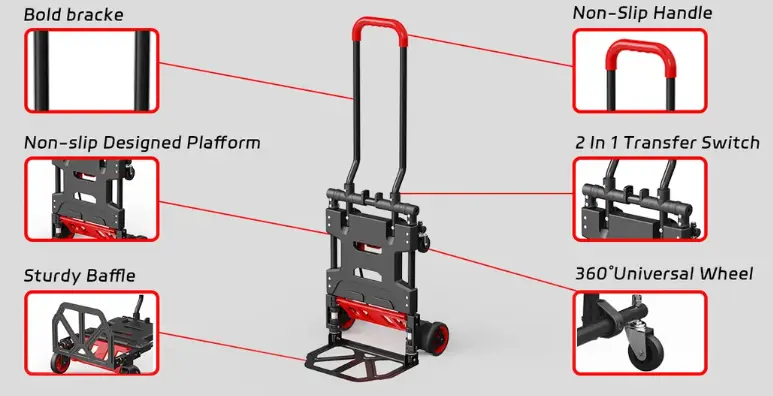
The frame is one of the most important structural elements, so buyers should look beyond general marketing descriptions such as “heavy duty.”
Examine the main frame sections, handle connection points, folding joints, wheel mounting areas, platform supports, and other areas where working forces are transferred.
Material selection should also be considered in relation to function.
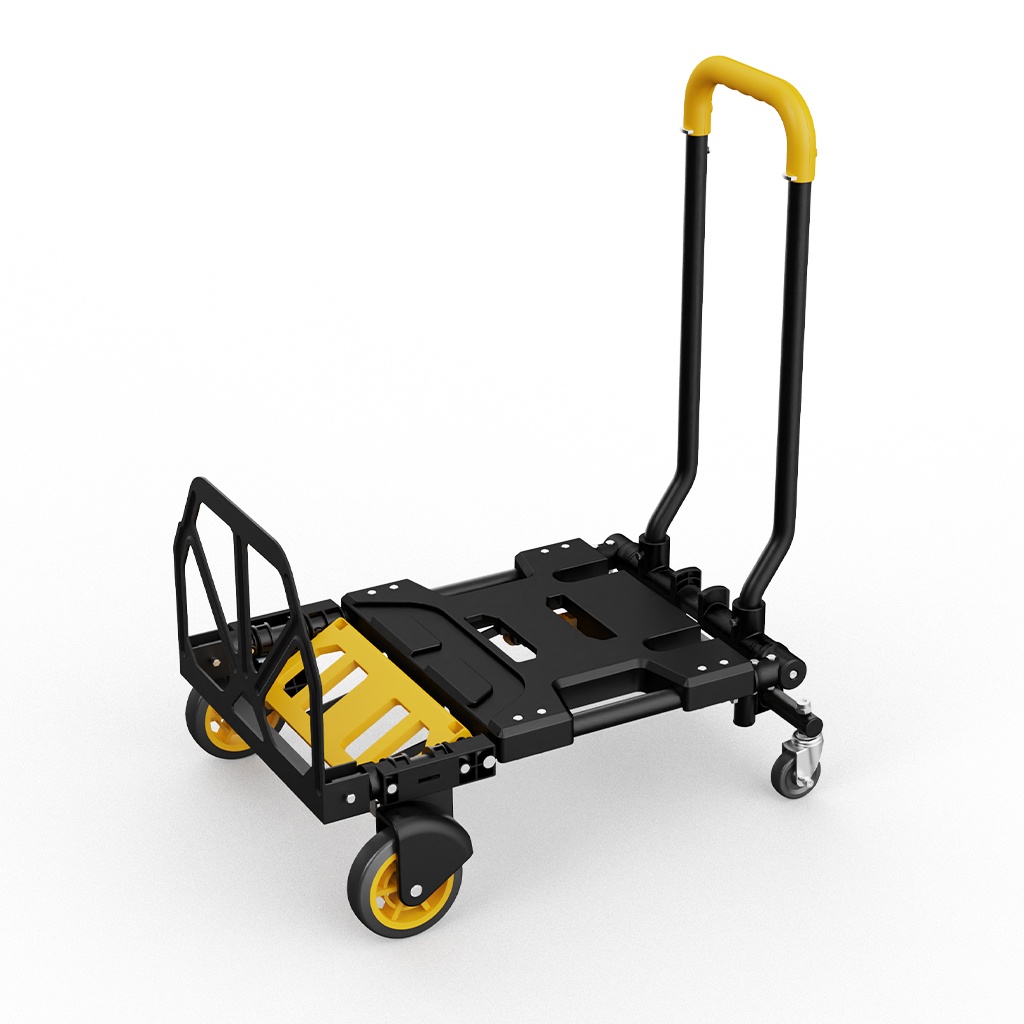
The product described in this article uses PP + PA + Iron construction. The combination is designed to balance molded components with a metal structural frame while keeping the overall product weight manageable.
For procurement purposes, it is useful to ask how the materials are distributed throughout the product. Which components carry the primary load? Which parts move repeatedly? Which components are exposed to the greatest wear?
These questions provide more useful information than simply comparing the names of materials.
2.2-Wheel and 4-Wheel Configurations
A convertible trolley can provide more flexibility than a single-function product, but only when both configurations have a clear purpose.
A two-wheel mode can support upright handling, while a four-wheel platform mode creates a different method of transporting loads.
When reviewing a convertible design, consider:
- How easily the product changes configuration
- Whether each mode locks securely
- Stability in both configurations
- Ease of operation
- Tool requirements
- Practicality with typical loads
The second function should provide genuine value rather than simply increasing the feature count.
3.Load Capacity, Product Weight, and Dimensions
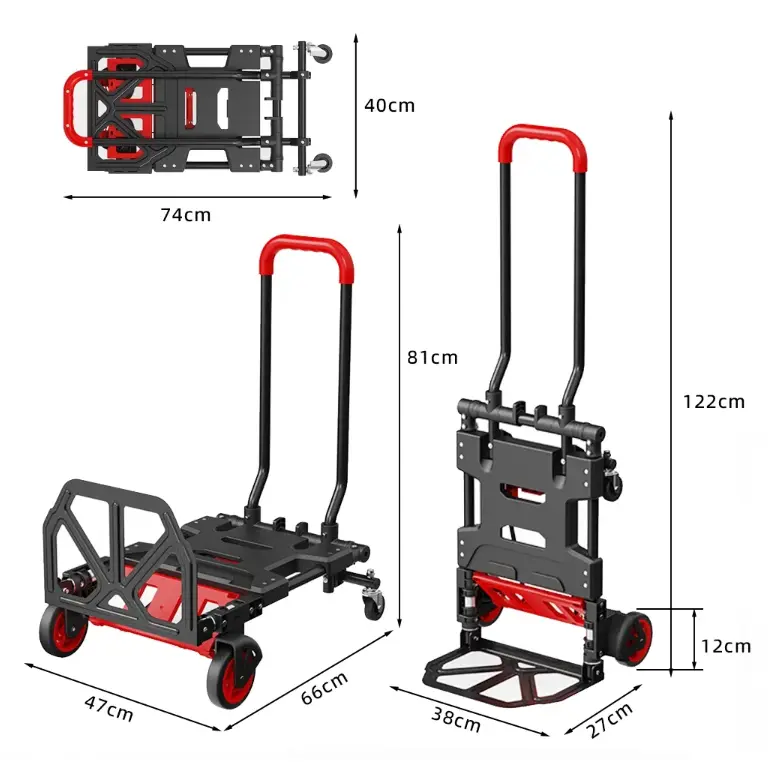
The supplied specifications for this trolley are:
| Specification | Value |
|---|---|
| Material | PP + PA + Iron |
| 4-Wheel Open Dimensions | 47.5 × 62 × 80.8 cm |
| 2-Wheel Open Dimensions | 47 × 40.5 × 121.5 cm |
| Folded Dimensions | 37.5 × 13 × 81 cm |
| Product Weight | 7.1 kg |
| Load Capacity | 120 kg |
These figures should be evaluated together rather than independently.
A stated 120 kg capacity may be commercially attractive, but a buyer should confirm how that rating was established and under which operating conditions.
Questions may include whether the load rating applies to two-wheel mode, four-wheel mode, static loading, moving loads, a specific surface, or a defined load distribution.
Product weight should also be considered with capacity. A lighter trolley may be easier to store, move between locations, and handle during everyday operation, while a heavier construction may be positioned differently in the market.
The correct specification is therefore the one that fits the intended application rather than the one with the largest number.
Assess Foldability, Handling, and Everyday Usability
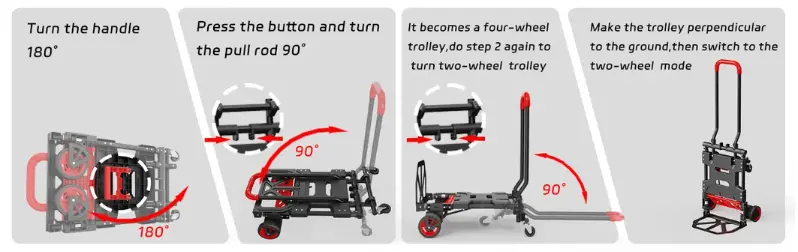
Foldability is one of the main commercial features of this type of product, but the word “foldable” alone does not tell a buyer whether the design is useful.
The important question is what the folding mechanism contributes to everyday operation, storage, and transportation.
1.Folding and Conversion Mechanism
A folding mechanism should be intuitive enough for different users to operate consistently.
When reviewing a sample, examine:
- Number of steps required
- Ease of folding and unfolding
- Locking points
- Hinge movement
- Stability after conversion
- Tool requirements
- Clearance between moving components
Repeated use matters as much as the first operation.
A mechanism that works smoothly once but becomes difficult or loose after repeated use can eventually lead to complaints, returns, or additional service costs.
For commercial procurement, the buyer should therefore consider the mechanism as a working component rather than as a visual feature.
2.Wheel and Platform Design
Wheel configuration influences maneuverability and the overall user experience.
Review wheel size, wheel material, construction, bearing arrangement, and compatibility with the surfaces expected in the target market.
A trolley used in a warehouse may encounter different floor conditions from one used in a workshop or retail environment.
The platform also deserves attention in four-wheel mode.
Consider its dimensions, support structure, surface design, edge treatment, and suitability for the types of cartons or materials commonly handled by your customers.
The most useful platform is not automatically the largest one. It is the one that works well with the loads and applications the product is designed to serve.
3.Storage and Transportation Efficiency
Foldability becomes especially valuable when it reduces the amount of space needed between uses.
For distributors and end users, this can affect:
- Warehouse storage
- Vehicle storage
- Back-room space
- Product handling
- Inventory density
The supplied folded dimensions are 37.5 × 13 × 81 cm, but buyers should also obtain the complete packaging dimensions.
Product compactness and shipping efficiency are not the same thing. Carton dimensions, units per carton, pallet arrangement, and shipping configuration can all influence the actual logistics result.
Verify Quality and Manufacturing Consistency
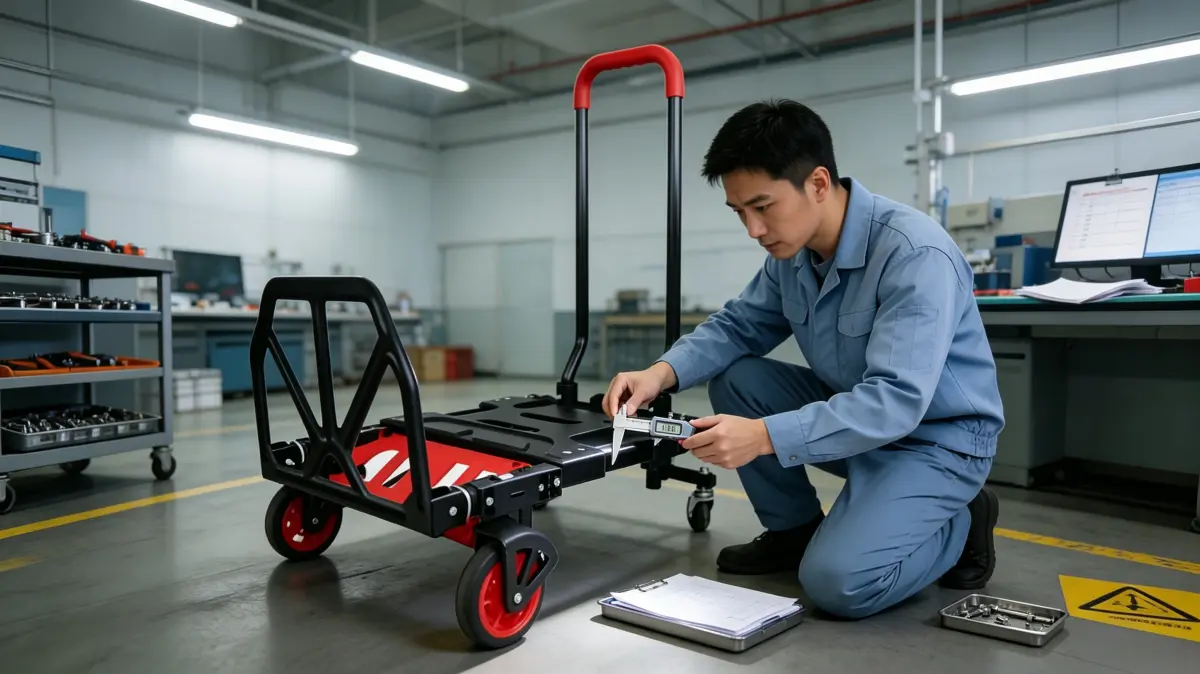
A strong sample does not automatically prove that a supplier can produce a consistent bulk order.
When the order quantity increases, manufacturing repeatability becomes one of the most important factors.
1.What to Check in a Product Sample
The sample should be tested as a working product rather than evaluated only by appearance.
Check:
- Folding and unfolding
- Conversion between operating modes
- Handle movement
- Wheel movement
- Platform stability
- Fastener condition
- Surface finish
- Plastic components
- Metal components
Then compare what you physically receive with the agreed specification.
If the sample uses a different material, dimension, color, or component from the quotation, clarify the difference before placing the order.
It is also useful to document the final approved configuration so that the supplier has a clear reference for mass production.
2.Quality Control Before Mass Production
Quality requirements should be discussed before production begins.
Depending on the product and market, inspection may cover raw materials, molded components, metal parts, assembly, folding mechanisms, wheels, appearance, functionality, and packaging.
The exact process will vary between suppliers, but the principle is important:
Quality should be controlled throughout production rather than discovered only after delivery.
For larger orders, buyers may also establish inspection standards, sample approval procedures, packaging requirements, and procedures for handling non-conforming units.
3.Consistency Across Repeat Orders
For a distributor, consistency between shipments is especially important.
The first order may be excellent, but the second and third orders need to remain aligned with the original specification if the product is going to become a reliable part of the product range.
Ask how the supplier manages:
- Material consistency
- Component dimensions
- Color variation
- Assembly standards
- Production changes
- Final inspection
A supplier that can maintain reasonable consistency across repeat orders provides greater value than one that simply produces a good initial sample.
Evaluate OEM/ODM and Supplier Capability

Standard catalog products may be sufficient for some wholesale programs, but long-term brand and private-label projects often require more flexibility.
For this reason, buyers should evaluate not only the product but also the capabilities of the manufacturer behind it.For distributors, multi-function products can also help address different customer segments without requiring a completely separate product for every application.
1.Customization Options
Possible customization areas may include:
- Product color
- Brand logo
- Product labels
- Packaging
- Printed instructions
- Carton artwork
- Selected components
- Product-specific modifications
Not all customization has the same production impact.
A logo change may be straightforward, while changing a molded component or structural part can affect tooling, testing, assembly, cost, and lead time.
The more clearly these requirements are defined at the quotation stage, the easier it is to manage production later.
2.Manufacturing and Engineering Support
OEM and ODM projects usually involve more technical communication than a standard catalog order.
A capable manufacturer should be able to discuss the relationship between product requirements, component design, sample development, production, and packaging.
Engineering support can become especially important when a buyer wants to modify a product for a particular market.
For example, changing one component can affect how another part is assembled or how the product is packaged.
This is why buyers should consider whether the supplier can support the product beyond basic order processing.
3.Long-Term Supply Capability
Supplier evaluation should also include what happens after the first shipment.
A long-term partner should be able to support future orders without unnecessary changes to the approved product.
Questions worth asking include:
- Can the supplier reproduce the approved specification?
- Can standard colors be maintained?
- Can packaging remain consistent?
- Can repeat orders be scheduled efficiently?
- How are production changes communicated?
- Can future product development be supported?
For distributors and wholesalers, these factors can have a direct effect on inventory planning and customer satisfaction.Reviewing the manufacturer’s capabilities can also help buyers assess whether the supplier is prepared to support long-term production and product development.
Compare MOQ, Packaging, Lead Time, and Total Cost
Once the product and manufacturer appear suitable, commercial terms become the next stage of the evaluation.
However, a bulk purchase should not be judged only by the quoted unit price.
1.Minimum Order Quantity and Replenishment
MOQ should be considered alongside your sales cycle.
A business testing a new category may prefer a manageable initial order, while an established distributor may be more concerned with long-term replenishment.
Confirm whether the MOQ applies to:
- Each model
- Each color
- Each packaging design
- Each order
- A combined product program
Also ask how repeat orders are handled.
A supplier that can support one large order but struggles with later replenishment may create inventory problems even if the first purchase looks attractive.
2.Packaging and Logistics
Packaging can affect the entire economics of a bulk order.
Review:
- Individual package dimensions
- Units per carton
- Carton dimensions
- Gross weight
- Product protection
- Pallet configuration
- Shipping arrangement
- Labeling requirements
A smaller folded product does not necessarily guarantee lower logistics costs.
The final result depends on how efficiently the product is packaged, stacked, stored, and transported.
3.H3: Price Versus Total Procurement Value
Unit price is important, but it should be compared with the potential cost of quality and supply problems.
Additional costs may come from:
- Product returns
- Replacement shipments
- Customer complaints
- Delayed replenishment
- Damaged packaging
- Additional inspection
- Lost sales
This is why a supplier with a slightly higher quoted price can sometimes provide better overall procurement value when quality, delivery, and repeat-order stability are stronger.
A Practical Checklist for Choosing the Right Supplier
1.Product Checklist
Before approving the trolley, confirm that:
- The application is clearly defined
- The operating modes are genuinely useful
- The load capacity matches the intended use
- The product weight is acceptable
- Open dimensions are practical
- Folded dimensions provide a useful storage advantage
- Wheels match the target environment
- The platform is appropriate for typical loads
- The folding mechanism is easy to understand
- The sample matches the agreed specification
2.Supplier Checklist
Review the supplier’s ability to provide:
- Stable manufacturing
- Consistent quality
- Sample development
- OEM/ODM support
- Engineering communication
- Packaging customization
- Suitable MOQ
- Acceptable lead time
- Repeat-order support
A supplier should be evaluated as a long-term manufacturing resource rather than simply as the company offering the lowest first quotation.
3.Final Questions Before Ordering
Before placing the order, ask:
Does this product solve a real customer problem?
Are the specifications clear and measurable?
Does the sample accurately represent the expected production version?
Are quality-control requirements agreed in advance?
Are packaging and logistics requirements understood?
Does the supplier have the capability to support repeat orders?
Are OEM or ODM requirements clearly defined?
Does the overall procurement value justify the purchase price?
If the answers are clear, the purchasing decision becomes much more structured and much less dependent on price alone.
FAQ About Buying a Foldable Hand Truck Dolly in Bulk
1.H3: Is a foldable hand truck dolly suitable for wholesale distribution?
2.What specifications should I compare before placing a bulk order?
3.Is a 3-in-1 trolley better than a single-function model?
4.What should I ask a supplier before placing a bulk order?
5.How can I reduce procurement risk when choosing a supplier?
Ready to Evaluate Your Next Bulk Order?
Before requesting a quotation, prepare your target quantity, intended applications, preferred product configuration, packaging requirements, and customization needs.
This gives manufacturers a clearer basis for quotation and allows both sides to establish the expected product standard before production begins.
For importers, distributors, wholesalers, and private-label buyers, the goal is not simply to locate the lowest-priced trolley.
The better objective is to select a product and supplier combination that can support consistent quality, practical functionality, efficient logistics, and future demand.
Related products