How to Organize Tools and Small Parts with a 3 Tier Cart Organizer
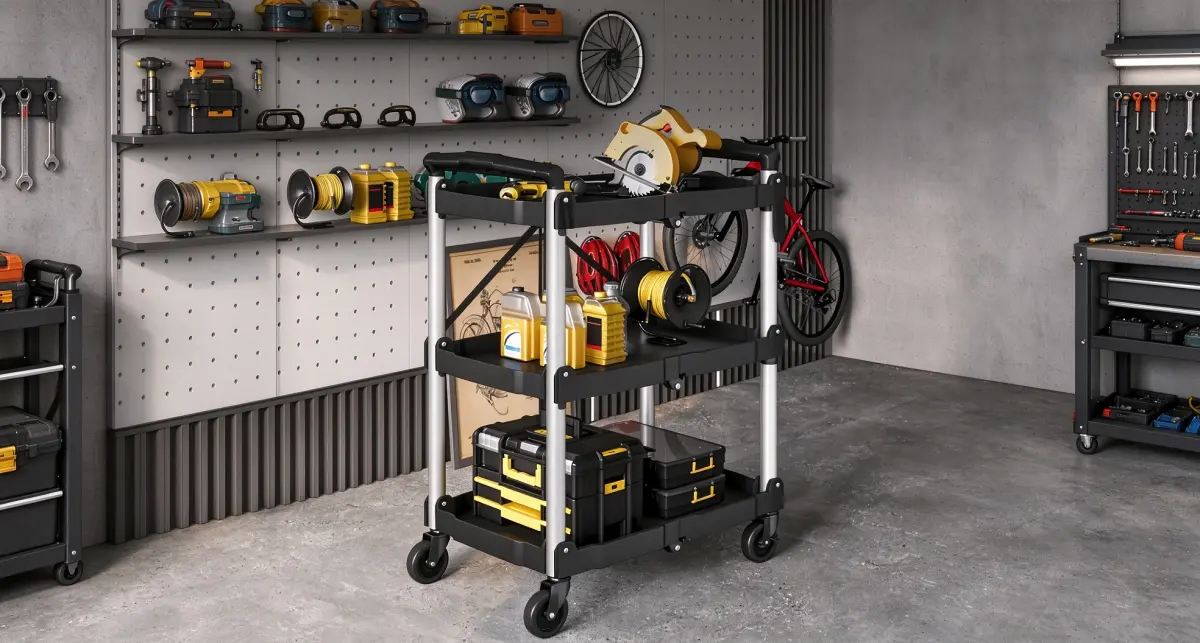
Tools and small parts are easy to misplace when they are stored together without a clear system. A screwdriver may end up beneath a box of fasteners, replacement fittings may be mixed with used components, and frequently needed items may be scattered across several workstations. Over time, these small problems can interrupt routine maintenance, slow down repairs, and make it harder for teams to keep track of consumable supplies.
A 3 tier cart organizer offers a practical way to create separate storage zones on a mobile cart. Instead of treating all three shelves as general-purpose storage, a team can assign each level a specific role based on tool type, part category, usage frequency, or work sequence.
The key is not simply to place more items on a cart. It is to make each item easier to identify, retrieve, return, and replenish.
For maintenance teams, production facilities, repair centers, and organized work areas, a consistent three-tier arrangement can turn a collection of loose tools and components into a repeatable storage routine. The same principle can also help distributors and retailers explain the practical value of a three-shelf rolling organizer to professional customers.
- Why a 3 Tier Cart Organizer Needs a Clear Classification System
- How to Assign Three Shelves to Tools and Small Parts
- How to Sort Small Parts Without Creating More Confusion
- Organize the Cart Around a Repeatable Work Sequence
- Manage Replenishment and Prevent Small-Parts Shortages
- Choosing a 3 Tier Rolling Organizer for Practical Tool Management
- How Jingyan Tools' Three-Tier Cart Can Support Tool Organization
- A Simple Routine for Keeping a Three-Tier Cart Organized
- Frequently Asked Questions
- Conclusion: Build a System, Not Just a Storage Cart
Why a 3 Tier Cart Organizer Needs a Clear Classification System
A cart with three shelves creates physical separation, but separation alone does not guarantee good organization. If every shelf contains a mixture of unrelated tools, loose screws, replacement parts, and used components, users still have to search through the contents before finding what they need.
A useful organization system should answer three questions:
-
Where does each item belong?
-
How can someone identify it quickly?
-
What should happen when an item is used, returned, or running low?
When these questions have clear answers, the cart becomes easier to use consistently, including when several people share the same equipment.
1.Reduce Searching and Unnecessary Handling
Imagine a maintenance technician preparing to replace a small component. The technician needs a hand tool, several fasteners, a replacement fitting, and a cleaning cloth. If these items are mixed together, the technician may need to open several containers, move unrelated materials, and return to another storage point.
A classified cart can bring frequently used items into one working area. Tools can occupy one designated zone, small parts can be grouped in labeled containers, and supporting supplies can have their own location.
The objective is to reduce unnecessary searching and handling, not to promise a fixed percentage of time savings. Actual results depend on the task, the initial storage arrangement, and how consistently employees follow the system.
2.Make Shared Storage Easier to Understand
A cart may be used by different technicians, shifts, or departments. Without a common arrangement, one person may place spare fittings on the top shelf while another expects them to be stored below.
A simple, documented layout reduces this uncertainty. Every shelf should have a defined purpose, and every regularly used container should have an identifiable home.
The system should be understandable to a new employee without requiring a long explanation. If a person cannot identify where a common item belongs after looking at the labels, the classification system may be too complicated.
How to Assign Three Shelves to Tools and Small Parts
There is no single arrangement that suits every workplace. A repair center handling many small components may need a different layout from a production team that repeatedly uses a limited set of hand tools.
A practical starting point is to organize the cart according to access frequency, item category, and the sequence of work. The three levels should work together rather than becoming three unrelated storage spaces.
1.Top Shelf — Frequently Used Tools and Active Items
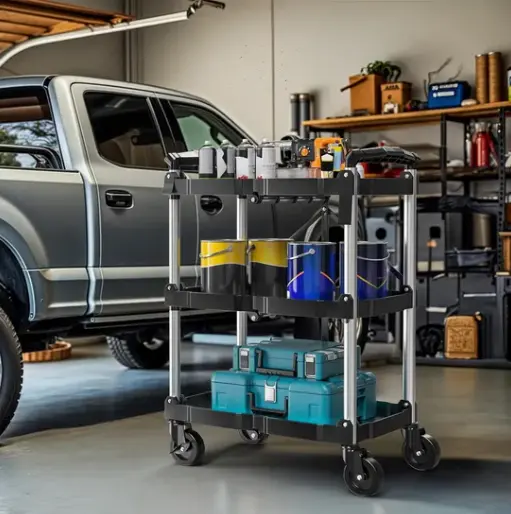
The top shelf can be reserved for tools and materials that workers need repeatedly during the current task.
Depending on the operation, this may include:
-
Common hand tools used during routine maintenance.
-
A small container of fasteners required for the current job.
-
Measuring or inspection tools used regularly.
-
A clearly identified tray for items currently being worked on.
Keeping active items together helps users see what is immediately available without searching through backup supplies.
However, the top shelf should not automatically become a dumping area. Items that are no longer needed for the current task should be returned to their designated locations or removed from the cart.
Loose screws, washers, clips, and similar components should be placed in suitable containers rather than left scattered across the shelf. Small parts are easier to count, identify, and retrieve when they are separated into defined groups.
2.Middle Shelf — Small Parts, Fittings, and Accessories
The middle shelf can serve as a dedicated area for small parts and accessories that support routine repairs or assembly work.
Examples include:
-
Screws, nuts, bolts, and washers.
-
Replacement connectors and fittings.
-
Clips, brackets, and small mounting components.
-
Electrical or mechanical accessories, where appropriate for the task.
-
Labeled containers holding related spare parts.
The most important rule is to avoid mixing components that look similar but serve different purposes. Two fasteners may appear almost identical while differing in length, thread, material, or application.
Use separate containers when these differences matter. Labels should identify the part clearly enough for the intended user to distinguish one group from another.
For example, a useful label might state “M6 bolts — 20 mm” rather than simply “Bolts.” If a component has a part number, the label can include that number as well.
A middle shelf can also be divided by task or equipment type. A technician maintaining two different machines may find it easier to use separate, labeled containers for each machine instead of mixing all spare parts into one general box.
3.Bottom Shelf — Backup Supplies and Less Frequently Used Items
The bottom shelf can hold backup consumables, reserve parts, or supporting materials that are not needed for every step of the current task.
Possible items include:
-
Refill containers for commonly used fasteners.
-
Replacement accessories for scheduled maintenance.
-
Additional cleaning materials.
-
Clearly separated containers for less frequently used components.
This arrangement helps distinguish the items needed immediately from those that support future work.
Backup supplies should remain visible and accessible enough for users to check stock levels. A reserve container hidden behind unrelated materials may be difficult to monitor, even if it technically fits on the shelf.
The bottom shelf should not be used automatically for every heavy item. Weight distribution, the cart’s rated capacity, container stability, and the manufacturer’s instructions must still be considered. Heavy or unstable items should be positioned according to the cart’s operating guidance, not simply according to a universal shelf rule.
4.Adapt the Layout to the Actual Workflow
The top-middle-bottom arrangement is a starting point, not a rigid formula.
A team that uses the cart for a specific repair procedure may prefer to arrange the shelves in the order that materials are needed. Another team may classify items by machine, maintenance zone, or department.
For example, a small-parts assembly task could use the top shelf for active hand tools, the middle shelf for components required during assembly, and the bottom shelf for replenishment stock.
A facility inspection task might instead place inspection instruments and checklists at the top, frequently used replacement items in the middle, and reserve consumables below.
The best arrangement is the one that matches actual work. Test the proposed layout with the people who will use it, then revise it when repeated searching or unnecessary handling reveals a problem.
How to Sort Small Parts Without Creating More Confusion
Small parts require more precise organization than larger tools because many components are similar in appearance and easy to mix together.
The goal is to create groups that are meaningful to the people who select, use, and replenish them.
1.Separate Parts by Function Before Size
Start by grouping components according to what they do. For example, fasteners, connectors, mounting brackets, and replacement fittings should generally have separate groups.
After grouping by function, divide the categories further where necessary. Fasteners might be separated by diameter, length, thread type, or material. Connectors might be grouped by compatible equipment or application.
This two-step approach is usually easier to understand than creating one large collection of tiny containers without a clear classification logic.
Avoid excessive subdivision. If every minor variation receives its own container but users cannot distinguish the labels easily, the system may create more work than it removes.
2.Use Containers That Match the Parts
A labeled container helps keep small components together during movement and routine use. Choose a container size that suits the quantity and physical dimensions of the parts.
Very large containers can encourage unrelated items to be mixed together. Containers that are too small may overflow or require frequent refilling.
Where several part types are used in the same task, separate compartments can help prevent accidental mixing. If parts are removed in batches, containers should also allow users to take the required quantity without spilling the remaining stock.
The cart’s open shelves can hold suitable organizers, trays, or boxes, provided they fit securely and do not create an unstable load. The cart itself does not need to provide a separate molded compartment for every component.
3.Label for Identification, Not Decoration
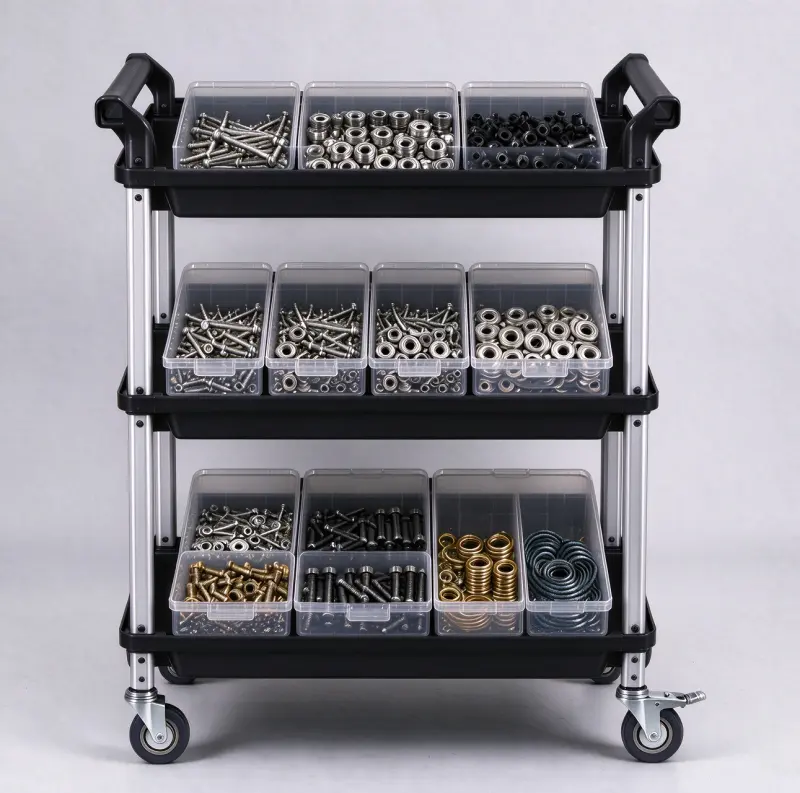
A label should help someone identify the contents without having to open every container.
Depending on the operation, include some or all of the following:
-
Common part name.
-
Part number or internal reference.
-
Size or specification.
-
Compatible machine or task.
-
Minimum stock level, where useful.
For example, a label reading “Replacement Clips — Line A” is more useful than “Small Parts” when the clips are specific to one production line.
Color coding can provide an additional visual cue, but it should not replace written labels. Color conventions may vary between organizations, and a color alone does not communicate an exact part number or specification.
Use consistent label placement and wording throughout the cart. If a label changes, update the relevant stock list or work instruction as well.
Organize the Cart Around a Repeatable Work Sequence
1.Prepare the Cart Before Starting a Task
Before a scheduled repair or assembly job, identify the tools, components, and consumables that will be required.
Check that the necessary items are present and that the containers hold the correct parts. Remove unrelated items that could cause confusion or occupy space needed for the job.
For repeated tasks, a standard preparation checklist can help different employees assemble the cart in the same way. This is particularly useful when a cart is shared across shifts or used for recurring maintenance work.
The checklist does not need to be complicated. It can simply list the required tools, part containers, supporting materials, and any items that must be checked before work begins.
2.Keep Active Parts Separate From Used or Unverified Components
During maintenance, removed components should not automatically be returned to the same container as unused replacement parts.
Depending on the process, used, damaged, or unverified items may need a separate, clearly marked container or designated holding area. This helps prevent an employee from accidentally selecting an item that has not been inspected or approved for reuse.
Follow the workplace’s maintenance, quality, and disposal procedures when handling used components. A general-purpose cart is a storage aid; it does not replace required inspection or material-control procedures.
3.Return Items to Their Assigned Locations
A classification system works only when users follow it after the task is complete.
At the end of a job, return reusable tools to their designated locations, close or secure small-parts containers, and remove waste or unrelated materials. Check whether any containers have been moved to the wrong shelf.
This short reset makes the cart easier for the next user to understand. It also helps prevent a gradual buildup of miscellaneous objects that undermines the original organization plan.
For teams with frequent shift changes, including a simple cart-reset step in the handover routine can help maintain consistency.
Manage Replenishment and Prevent Small-Parts Shortages
A well-organized cart should help users recognize when supplies are running low. Classification alone does not guarantee that the right items will always be available, so a simple replenishment rule is also needed.
1.Set a Practical Reorder Point
For frequently used parts, define a minimum quantity that should remain available before replenishment is requested.
The appropriate level depends on consumption, delivery lead time, the importance of the component, and how often the cart is used. A commonly used screw may require a different reserve quantity from a specialized replacement fitting that is rarely needed.
The reorder point should be based on actual use rather than an arbitrary number copied across every container.
For example, a maintenance team could mark a minimum fill line on a suitable container or record the minimum quantity on its label. When stock reaches that point, the assigned person initiates replenishment.
2.Assign Responsibility for Stock Checks
When everyone assumes that someone else will refill a container, shortages can remain unnoticed until a part is needed.
Assign responsibility to a role, shift, or named team member. The responsible person should check designated consumables, confirm that the correct parts are being replenished, and remove outdated or unidentified stock according to workplace procedures.
For frequently used carts, a brief check at the beginning or end of a shift may be sufficient. Less frequently used carts may need a check before each scheduled task.
The right frequency depends on the operating environment. The purpose is to make replenishment predictable without creating unnecessary administrative work.
3.Keep Inventory Records Proportionate to the Task
Not every maintenance cart needs a complex inventory system.
A small team may only need labeled containers and a short checklist. A larger operation with many part numbers may benefit from a shared spreadsheet, barcode labels, or a formal inventory system.
Whatever method is chosen, the record should reflect the physical contents of the cart. If a part has been removed permanently or a container has been reassigned, update the relevant record.
A simple, accurate system is more useful than a detailed record that nobody maintains.
Choosing a 3 Tier Rolling Organizer for Practical Tool Management
Once the classification plan is clear, the next step is to determine whether the cart can support the intended arrangement.
This is where a 3 tier rolling cart organizer becomes relevant to maintenance teams and to B2B buyers evaluating products for their customers. The aim is to match the cart’s structure and materials to the proposed storage routine, rather than selecting a product based on appearance alone.
1.Check Whether the Shelves Fit the Organizers
Before assigning containers to the three levels, compare their footprints with the available shelf area.
A container that extends beyond the shelf may be knocked or displaced during movement. Containers placed too closely together may make labels difficult to read or prevent users from removing the intended item easily.
The layout should leave enough practical access for the people using it. A cart that technically holds all the containers may still be inconvenient if users must remove several boxes to reach one part.
2.Match Shelf Clearance to Container Height
The shelf material and frame construction should be suitable for the intended working conditions and the expected maintenance routine.
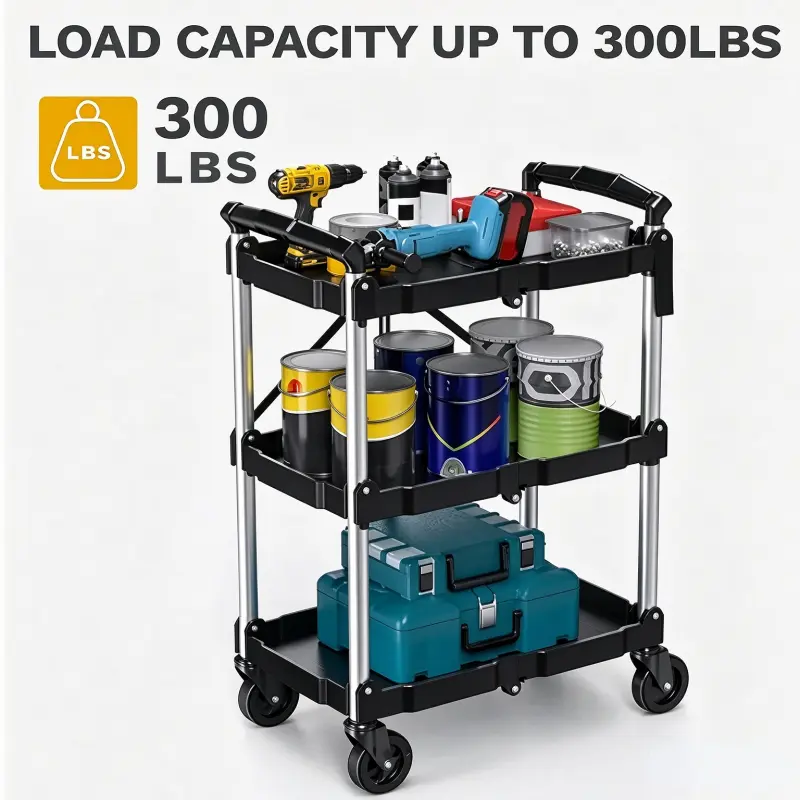
Jingyan Tools’ black 3-Tier Rolling Utility Cart uses high-density polypropylene shelves and thickened aluminum tubing. Its published specifications list overall dimensions of 25.6 inches wide, 34.3 inches high, and 14.6 inches deep, with shelf dimensions of 23.6 inches wide by 19.5 inches deep and a stated total load capacity of 300 lbs.
These details help buyers assess whether the cart’s available space and construction suit a proposed organization plan. The 300 lb rating should not be interpreted as permission to exceed the manufacturer’s load-distribution or operating instructions.
Before purchase, confirm the exact product configuration, applicable load guidance, and any requirements that are important for the intended application.For a broader sourcing checklist, read our guide on what B2B buyers should look for in a 3 tier cart with wheels.
3.Evaluate the Cart as Part of a Complete Storage System
A rolling cart is most useful when it works alongside the rest of the storage arrangement.
For example, a cart may carry the tools and parts needed for active maintenance, while a separate toolbox holds equipment that should remain protected or be transported independently. A fixed storage area can hold reserve stock that is replenished onto the cart when necessary.
This division prevents the mobile cart from becoming an overloaded substitute for every storage location in the facility.
For distributors and retailers, explaining how the cart fits into a broader tool-organization system can also make the product easier for professional customers to evaluate. The focus remains on the customer’s workflow, not simply the number of shelves.
How Jingyan Tools' Three-Tier Cart Can Support Tool Organization
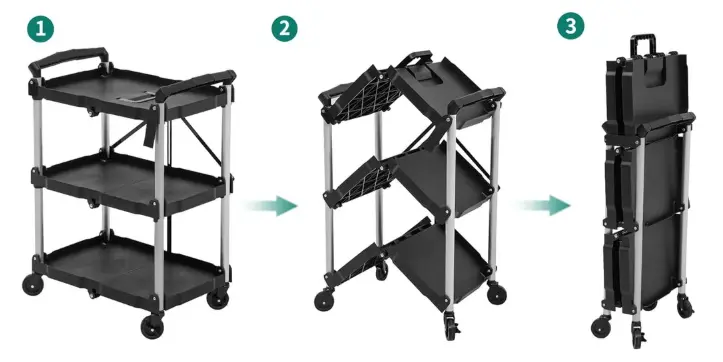
Jingyan Tools offers a black 3-Tier Rolling Utility Cart with an open three-shelf configuration. Its published specifications include high-density polypropylene shelves, thickened aluminum tubing, 12-inch shelf clearance, and a stated 300 lb load capacity.
For a team that needs a mobile location for frequently used tools, grouped small parts, and reserve consumables, this configuration provides three distinct levels that can be assigned different organizational roles.
The actual layout should be determined by the user’s tools, containers, task sequence, and stock-control requirements. The product specifications provide a starting point, but they do not establish a universal arrangement for every workshop or maintenance operation.
Jingyan Tools, also known as ONCUPID, is a tool manufacturer that provides OEM and ODM services for business customers. For importers, distributors, retailers, and private-label brands evaluating rolling storage products, the company can be contacted to discuss product specifications, bulk purchasing requirements, and potential cooperation.
When assessing a product for a professional range, buyers should clearly communicate the intended application, expected order quantity, required packaging, and any market-specific requirements. These details help both parties establish whether the proposed product is suitable for the target customer.
A useful cart is not defined solely by its physical structure. Its value also depends on whether users can maintain an understandable classification system and whether the product fits the customer’s real working conditions.
A Simple Routine for Keeping a Three-Tier Cart Organized
Even a well-designed classification plan can deteriorate if the cart is not checked regularly. A short routine is usually more sustainable than occasional, time-consuming reorganizations.
1.Daily or Before-Task Checks
Before starting work, confirm that commonly used tools are present, small-parts containers are correctly labeled, and the required supplies are available.
After the task, return tools to their designated positions, separate used or unverified parts where required, and remove unrelated items.
2.Periodic Organization Reviews
At a suitable interval, review which items are frequently used, which containers are difficult to access, and which supplies repeatedly run out.
If the same item is regularly placed in the wrong location, consider whether the label is unclear or the assigned shelf is inconvenient. If a container is consistently overfilled, review the quantity stored or the replenishment frequency.
Changes should be based on actual use rather than reorganizing the cart simply to make it look different.
3.Update the System When Work Changes
A cart organized for one repair procedure may no longer suit a different task. When tools, machines, or work responsibilities change, review the shelf assignments and labels.
Keep the classification rules simple enough that the updated arrangement can be explained and followed by every relevant user.
The objective is not to create a perfect-looking cart. It is to maintain a reliable system that makes tools and small parts easier to locate, use, return, and replenish.
Frequently Asked Questions
1.What should go on each shelf of a 3 tier cart organizer?
A practical starting point is to place frequently used tools and active items on the top shelf, grouped small parts and accessories on the middle shelf, and backup consumables on the bottom shelf. The exact arrangement should reflect the task, the container sizes, the load guidance, and the user’s workflow.
2.How should small parts be organized on a rolling cart?
Group parts by function first, then separate them by relevant characteristics such as size, specification, part number, or compatible equipment. Use suitable containers and clear labels so users can identify the contents without opening every box.
3.Should tools and spare parts be stored together?
They can be carried on the same cart if they have clearly assigned locations. However, loose small parts should be kept in suitable containers, and used, damaged, or unverified components should be separated according to workplace procedures.
4.How can a team prevent tools from being misplaced?
Assign each tool and container a consistent location, label storage zones clearly, and include a return-and-reset step after each task. For shared carts, use the same arrangement across shifts and make the layout easy for new users to understand.
5.How often should a three-tier cart be checked?
Check the cart before a task or at the start of a shift when the equipment is used frequently. Review stock and organization at an interval that reflects actual consumption and workflow. High-use carts may need more frequent checks than carts used occasionally.
6.Can a 3 tier rolling cart organizer be used for different maintenance tasks?
Yes, provided the cart and its arrangement are suitable for the intended items and operating conditions. The shelf assignments can be adapted to different tasks, but the classification rules and labels should be updated whenever the layout changes.
7.What should B2B buyers check when sourcing a three-tier cart for tool organization?
Buyers should assess the usable shelf dimensions, vertical clearance, stated load capacity, materials, container compatibility, and suitability for the intended working environment. They should also confirm product configuration, packaging, order requirements, and any applicable market requirements with the supplier.
Conclusion: Build a System, Not Just a Storage Cart
A 3 tier cart organizer works best when each shelf has a clear purpose and every frequently used item has an identifiable location.
Start by separating active tools, small parts, and backup supplies. Use containers and informative labels to prevent similar components from being mixed together. Connect the arrangement to the actual work sequence, establish a simple replenishment rule, and reset the cart after each task.
For maintenance teams, these practices make shared storage easier to understand and maintain. For importers, distributors, and retailers, they also provide a practical way to explain the value of a three-tier rolling organizer to professional customers.
Jingyan Tools’ three-tier rolling utility cart is one option to evaluate when the required shelf space, clearance, materials, and stated load capacity fit the intended application. Business buyers can contact Jingyan Tools to discuss the product configuration and bulk supply requirements for their market.
The most effective organization system is not necessarily the most complicated one. It is the one that users can follow consistently every day.
Related products