Folding Hand Truck and Cart: When One SKU Can Serve Two Use Modes
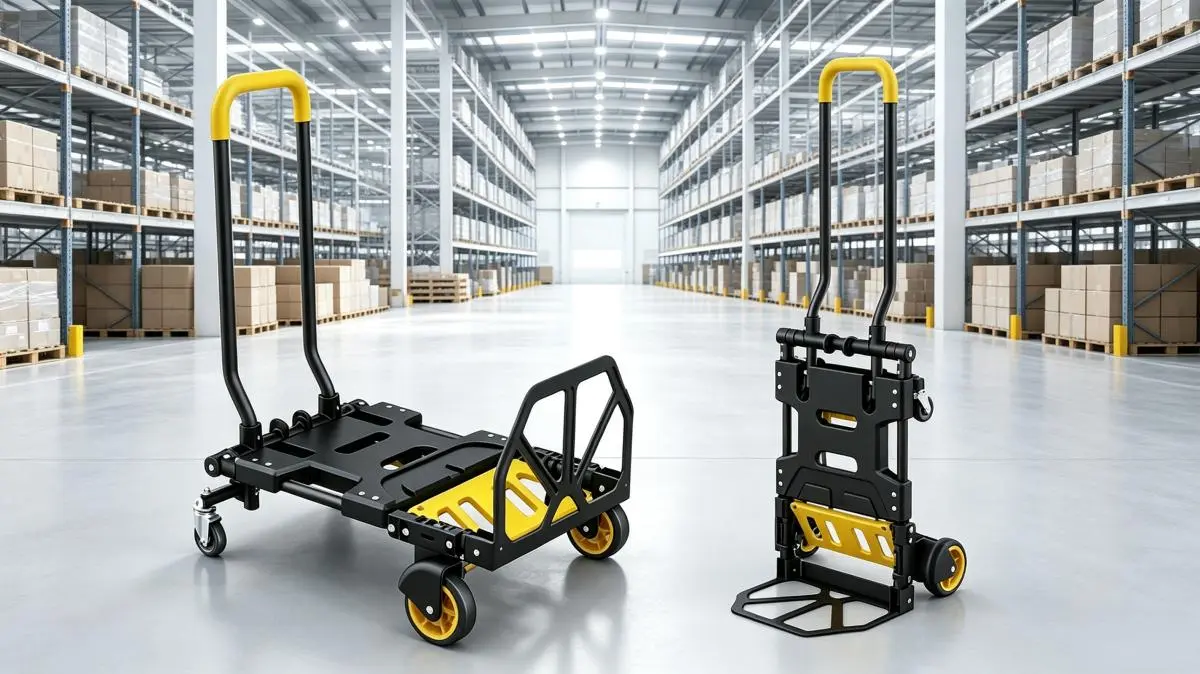
A folding hand truck and cart can look like a single material-handling product, but its value becomes clearer when the same SKU can support two different ways of moving goods.
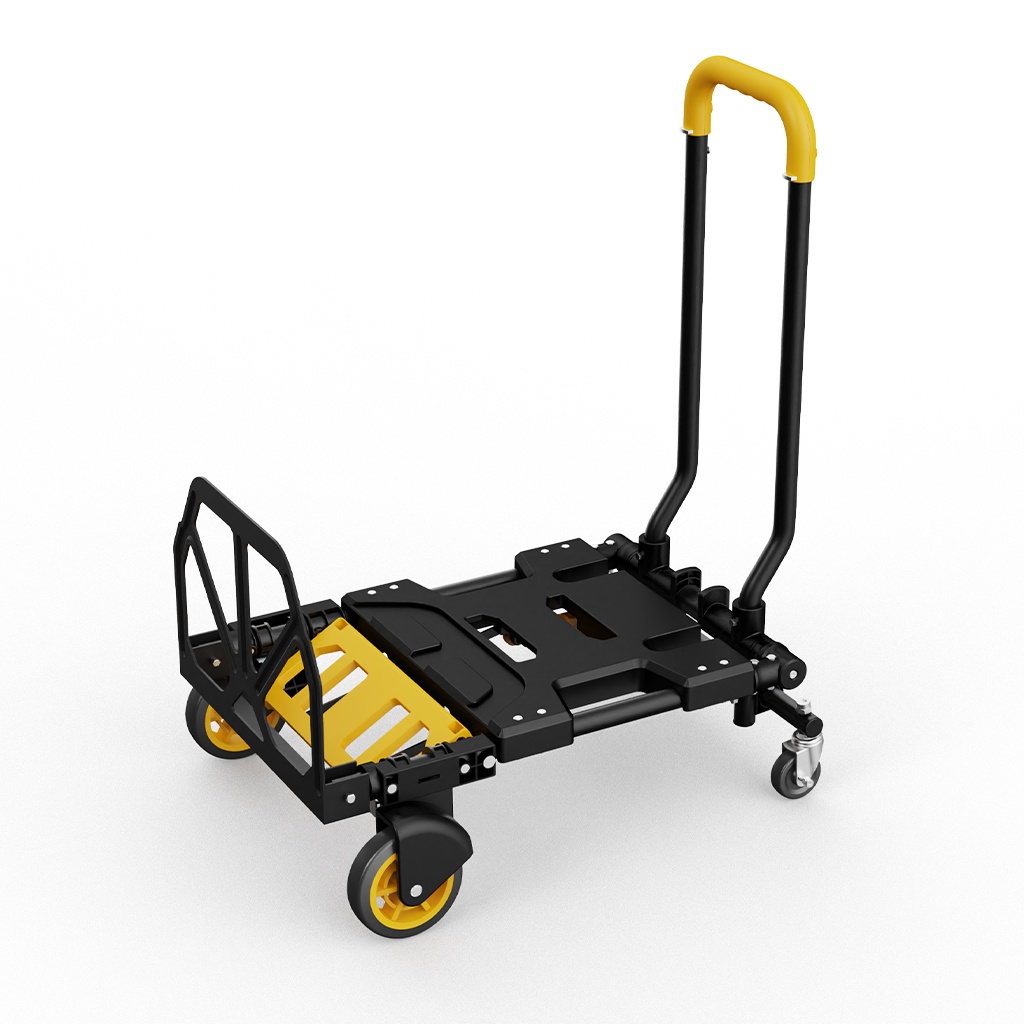
In one mode, the product works as a two-wheel hand truck, allowing an operator to pull or push a vertically positioned load through relatively narrow spaces. In another mode, the frame and load platform are opened into a four-wheel cart configuration, creating a horizontal base for moving boxes, supplies, components, or other loads.
For distributors, retailers, and tool brands, this raises a practical product-line question: when can one folding hand truck and cart genuinely serve both use modes without requiring customers to buy two separate products?
The answer depends less on the number of advertised functions and more on how naturally the product transitions between its modes, how each configuration fits a different workflow, and whether the physical design supports both modes consistently.
A well-designed dual-mode product does not simply add another function to a hand truck. It creates a product architecture in which the same frame, wheels, platform, and folding structure can support two distinct handling tasks.
This article examines that relationship and explains when a single
- What Makes a Folding Hand Truck and Cart a Two-Mode Product?
- Why the Two Modes Can Complement Each Other
- The Key Difference Between the Two Use Modes
- When One SKU Can Serve Both Use Modes
- When One SKU May Not Be Enough
- How the Folding Mechanism Supports the Two-Mode Concept
- A Real Product Example: One Folding Trolley, Two Core Modes
- How the Two Modes Fit Different Commercial Workflows
- What B2B Buyers Should Verify Before Adding the SKU
- Why Mode Clarity Matters More Than Function Count
- How One SKU Can Cover Two Customer Needs Without Becoming Too Broad
- What This Means for Distributors, Retailers, and Tool Brands
- Using One Product Platform for Multiple Handling Environments
- A Practical Way to Explain the Product to Customers
- Why This Dual-Mode Structure Can Be Relevant for B2B Product Selection
- FAQ About Folding Hand Truck and Cart Two-Mode Use
- Conclusion
What Makes a Folding Hand Truck and Cart a Two-Mode Product?
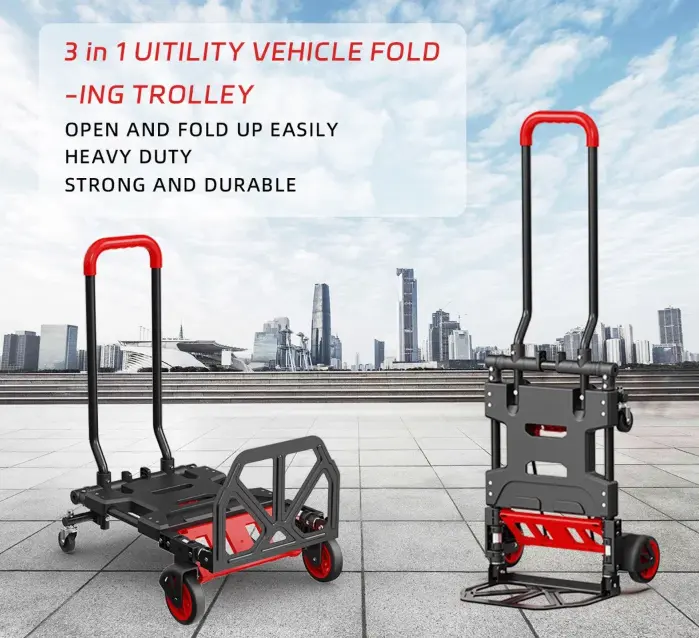
The defining characteristic of a folding hand truck and cart is not simply that it folds.
The important distinction is that the product can be configured for two different load orientations and movement patterns.
Mode 1 — Two-Wheel Hand Truck Operation
In the hand-truck configuration, the load is positioned vertically against the supporting frame.
This arrangement is useful when the operator needs to:
- Move cartons through narrower paths
- Keep a load relatively close to the operator
- Maneuver through doors or aisles
- Tilt and move vertically oriented packages
- Transport goods that are easier to support against a frame than on a flat platform
The hand-truck mode therefore emphasizes controlled movement of vertically positioned loads.
For a distributor or retailer, For a distributor or retailer, this mode represents the traditional hand truck product use case. Customers may use it for cartons, equipment boxes, packaged goods, spare parts, and other loads that can be secured against the frame.
Mode 2 — Four-Wheel Cart Operation
The second configuration changes the way the load is supported.
Instead of carrying the load vertically against the frame, the product becomes a four-wheel cart with a horizontal load surface.
This can be useful when:
- Several smaller cartons need to be moved together
- The load is more stable when placed horizontally
- Operators need to push rather than tilt a load
- Goods have a wider footprint
- Materials need to remain level during movement
- A workstation requires repeated short-distance transfers
The cart mode therefore emphasizes horizontal load support and rolling movement.
This difference is the central reason why one SKU can serve two use modes. The two configurations are not simply cosmetic variations. They solve different handling problems.
Why the Two Modes Can Complement Each Other
A hand truck and a cart do not always compete with each other.
In many working environments, the same operator may encounter both types of handling tasks during the same day.
For example, a warehouse employee may first move a tall carton from a storage area using the two-wheel configuration. Later, the same employee may need to transfer several smaller boxes between workstations. A horizontal cart configuration may be more practical for that second task.
This is where the dual-mode concept becomes commercially relevant.
The objective is not to replace every specialized handling product with one SKU. The objective is to cover two recurring handling patterns with one practical product design.
That distinction is important for B2B buyers.
A folding hand truck and cart is most relevant when the two modes correspond to real, recurring differences in the customer’s workflow.
If customers only need one configuration, the second mode may have limited value. But when both vertical and horizontal handling occur regularly, a dual-mode SKU can provide a more flexible product proposition.
The Key Difference Between the Two Use Modes
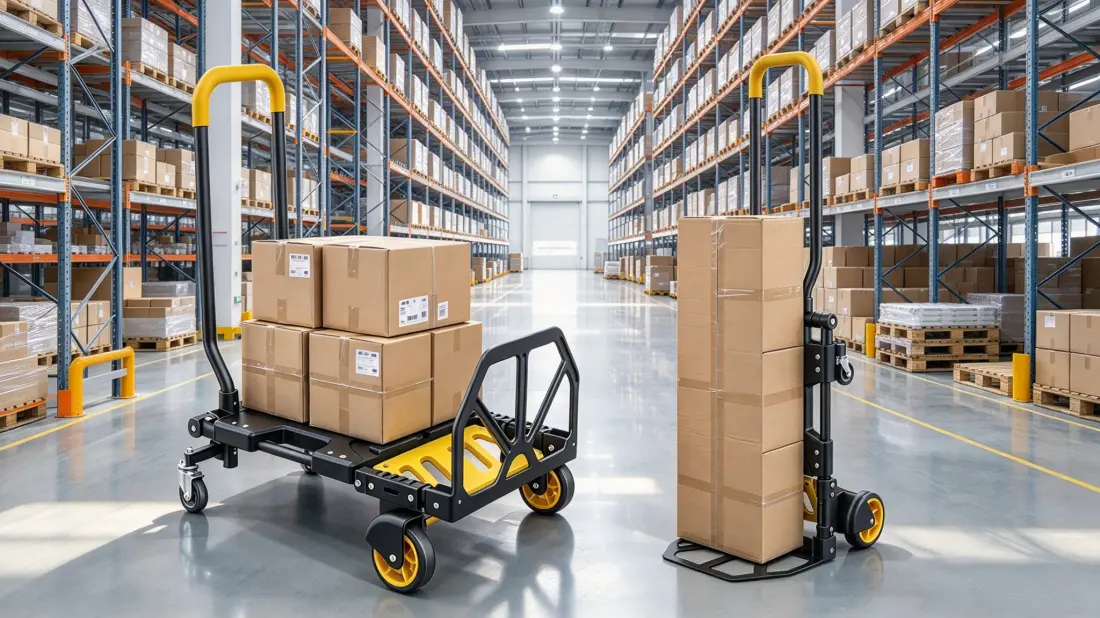
The easiest way to understand the concept is to compare what changes when the product changes configuration.
| Factor | Two-Wheel Hand Truck | Four-Wheel Cart |
|---|---|---|
| Load orientation | Mainly vertical | Mainly horizontal |
| Primary movement | Tilted rolling | Horizontal pushing |
| Typical load shape | Taller or boxed loads | Multiple or wider items |
| Operator interaction | Pull/push with tilted load | Push from a more stable platform |
| Space requirement | More compact during movement | Wider support footprint |
| Typical workflow | Point-to-point transport | Short-distance transfer |
| Main advantage | Maneuverability with vertical loads | Stable horizontal load support |
The important point is that neither configuration needs to be treated as universally better.
They are designed around different movement patterns.
For commercial buyers, this makes the product easier to evaluate: instead of asking whether the product has multiple functions in theory, the buyer can ask whether the two configurations correspond to actual customer tasks.
When One SKU Can Serve Both Use Modes
Not every convertible product automatically makes sense as a two-mode SKU.
A single folding hand truck and cart is more likely to serve both roles effectively when several conditions are present.
1.The Customer Handles Different Load Types
A business may handle both individual cartons and groups of smaller items.
A two-wheel configuration can be suitable for a larger upright carton, while a four-wheel configuration can provide a broader base for several smaller packages.
The product therefore adapts to load organization, rather than simply changing its appearance.
This is especially relevant to distributors whose customers work across warehouses, workshops, retail stockrooms, and delivery environments.
2.The Workflow Changes During the Day
Some workplaces do not have one fixed material-handling task.
A worker may move goods from storage to a workstation, transfer materials between production areas, and then move finished packages toward another location.
The ideal configuration can change according to the task.
A dual-mode product is particularly relevant when the same operator repeatedly switches between these handling patterns.
3.Space Conditions Vary
A narrow aisle, doorway, vehicle interior, or crowded stockroom may favor the hand-truck configuration.
An open workshop floor or stockroom may provide enough space for the four-wheel cart configuration.
The product’s usefulness therefore comes partly from its ability to adapt to different physical environments without requiring another SKU.
4.Customers Value Compact Storage
The folding structure also matters when the product is not being used.
A dual-mode product can be folded into a relatively compact form for storage or transport.
This does not mean folded size should become the central topic of the product proposition. Rather, it supports the broader idea that one product can transition between different handling roles and then return to a compact storage state.
When One SKU May Not Be Enough
The two-mode concept has practical limits.
A folding hand truck and cart should not be positioned as a universal replacement for every type of material-handling equipment.
A buyer should consider whether the intended customers genuinely need both configurations.
For example, if the target market handles only very large, specialized loads, a lightweight convertible product may not match the application.
Likewise, if customers exclusively use a cart configuration and never need vertical hand-truck operation, the additional configuration may not create meaningful value.
The commercial question is therefore not:
“Does the product have two modes?”
It is:
“Do the target customers have two recurring handling tasks that the two modes can realistically address?”
That question helps prevent over-positioning.
How the Folding Mechanism Supports the Two-Mode Concept
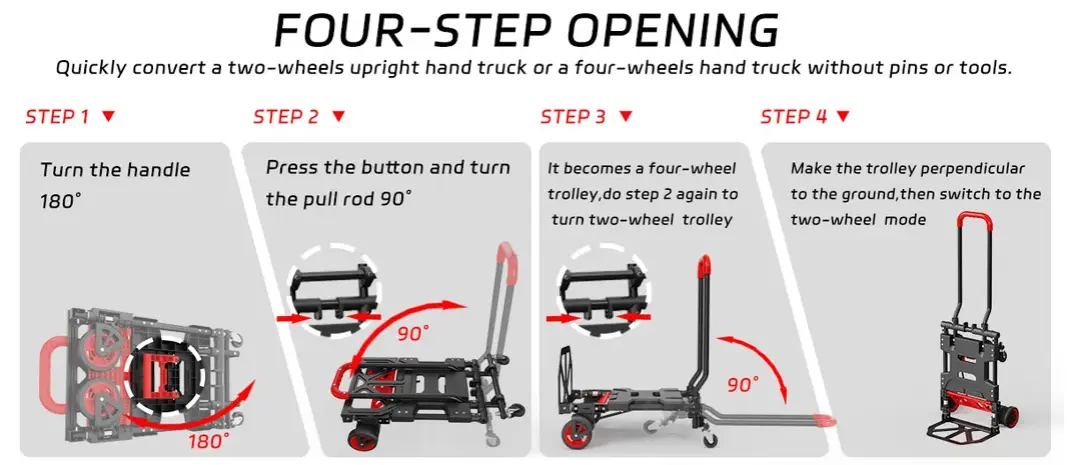
A dual-mode product depends heavily on its conversion mechanism.
The mechanism needs to allow the user to change the product’s configuration without turning the process into a complicated setup procedure.
For professional users, a practical transition should be:
- Easy to understand
- Repeatable
- Stable after conversion
- Suitable for routine use
- Integrated into the product structure rather than dependent on loose accessories
The conversion process is important because a product with two theoretical configurations may have limited practical value if customers avoid changing between them.
The easier the transition is to understand and repeat, the more believable the two-mode product proposition becomes.
For B2B buyers evaluating a potential SKU, this is an important point to verify during product sampling.
The buyer should not only inspect the finished appearance. The buyer should also observe how the product changes from hand-truck mode to cart mode and back again.
A Real Product Example: One Folding Trolley, Two Core Modes
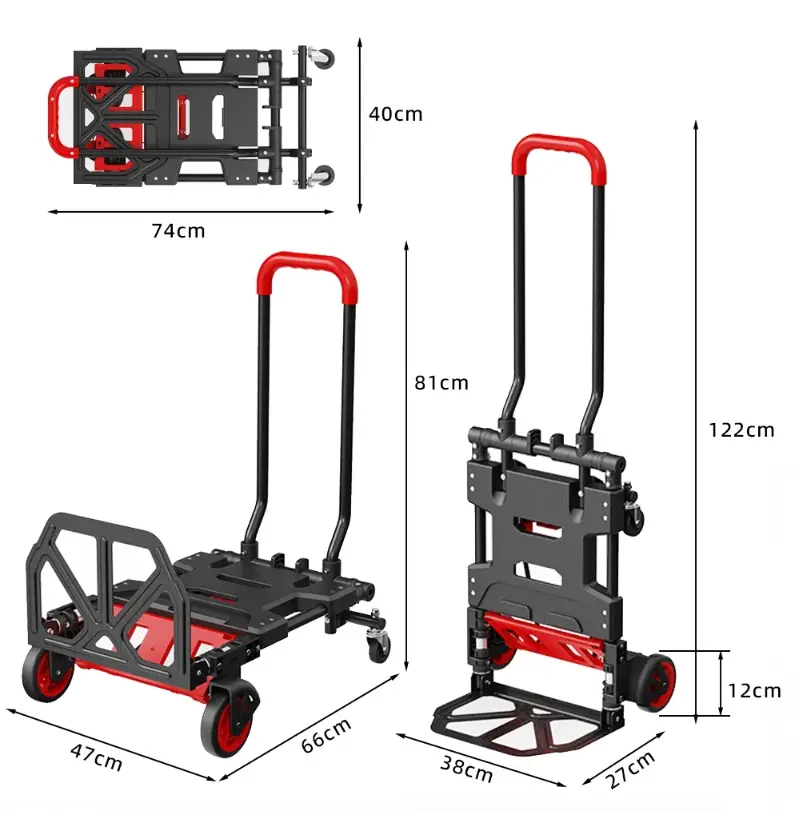
A practical example helps illustrate how this concept can be implemented.
A folding trolley developed for multiple professional and daily handling environments can use a PP + PA + iron construction, combining a polymer-based structural component system with an iron frame.
One configuration provides a two-wheel opening dimension of approximately 47 × 40.5 × 121.5 cm.
When opened into the four-wheel configuration, the dimensions become approximately 47.5 × 62 × 80.8 cm.
The difference is meaningful because the product is not simply becoming larger or smaller. Its geometry changes according to the intended movement mode.
The product has a listed 200 kg load capacity and a product weight of approximately 7.1 kg.
Its folded dimensions are approximately 37.5 × 13 × 81 cm, allowing the product to return to a compact configuration when the handling task is complete.
The product is available in multiple color combinations, including yellow and black, red and black, orange, blue, yellow, and green.
For B2B buyers who also need to verify the manufacturer behind the product, you can review our manufacturing background and production capabilities.
For B2B buyers, these specifications are useful not because they make the product suitable for every application, but because they demonstrate how a single physical platform can be configured around two different handling patterns.
How the Two Modes Fit Different Commercial Workflows
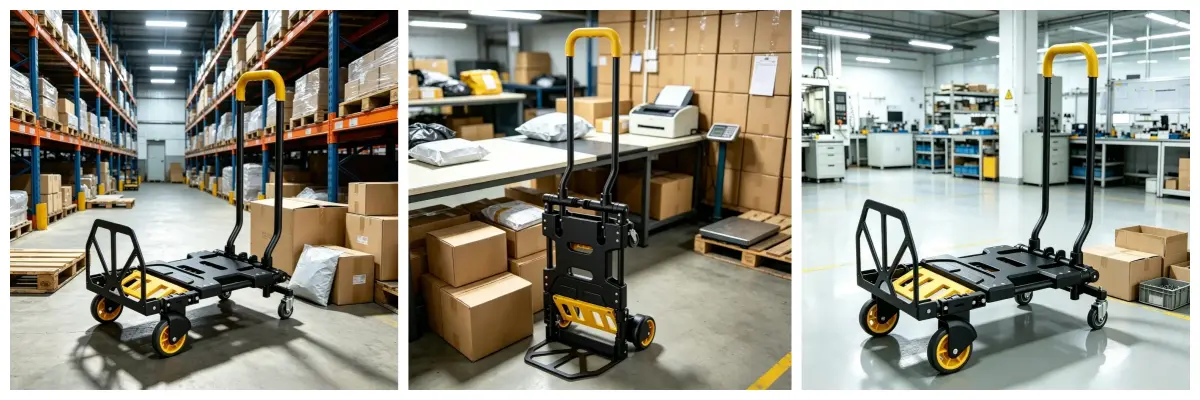
The dual-mode concept becomes more useful when connected to actual workflows.
1.Warehouse Transfer
In a warehouse, an operator may need to move a single carton from one location to another.
The two-wheel hand-truck configuration can provide a direct way to position and move that carton.
When several smaller cartons need to be transferred together, the four-wheel configuration can provide a horizontal platform.
The same SKU can therefore support both individual-load and grouped-load movement within the same general working environment.
2.Workshop Material Transfer
Workshops often have different material-transfer requirements from one station to another.
A component may need to be moved vertically or individually between locations, while multiple small parts or supplies may be easier to place on a horizontal platform.
A dual-mode trolley allows the operator to adjust the configuration according to the immediate task.
The important point is that the product is supporting workflow changes, rather than simply offering more functions for marketing purposes.
3.Retail Stockroom and Restocking
Retail environments can involve both back-room movement and shelf-replenishment tasks.
A hand-truck configuration may be useful for transporting packaged goods from a storage area, while the cart configuration can support grouped items during short-distance movement.
For retailers building a convertible hand truck product line, this can make the product relevant to multiple operational moments without requiring a completely separate handling tool for every task.
4.Logistics and Delivery Operations
A folding structure can also be relevant when handling equipment needs to be transported in a delivery vehicle.
The product can be folded for storage and opened when goods need to be moved.
During delivery operations, the appropriate configuration can depend on whether the operator is moving a single larger package or several smaller parcels.
Again, the value lies in using the same product platform for different movement patterns.
What B2B Buyers Should Verify Before Adding the SKU
A distributor, retailer, or tool brand should evaluate the two-mode concept at the product level rather than relying only on a feature list.
1.Verify Both Modes With Physical Samples
A sample should be tested in both configurations.
The buyer should check whether the product feels like a complete handling tool in each mode rather than a primary configuration plus a secondary feature.
2.Compare the Intended Customer Workflows
Ask whether the target customers actually move:
- Loads that are better supported vertically
- Loads that are better supported horizontally
If the answer is yes to both, the dual-mode structure has a stronger application case.
3.Check the Transition Between Configurations
The conversion should make sense for ordinary users.
If switching modes requires excessive steps, complicated adjustments, or separate components, customers may simply remain in one configuration.
The practical frequency of mode changes matters more than the number of configurations listed in a catalogue.
4.Evaluate the Product as One SKU
The central commercial question is whether the same SKU can be presented clearly to customers as:
one folding product with two useful handling modes.
That message should be easy for sales teams, product pages, catalogues, and packaging to communicate.
If customers need a long explanation to understand why the two modes matter, the product proposition may not be sufficiently clear.
Once the product passes this evaluation stage, the next consideration is bulk purchasing, including how the product should be assessed before moving from sampling to an actual order.
Why Mode Clarity Matters More Than Function Count
Multi-function products are sometimes described by counting how many configurations they offer.
For this type of product, however, function count is not the most useful way to communicate value.
A product that has several theoretical positions but only one commonly used configuration may not be more useful than a simpler product.
By contrast, a product with two clearly differentiated and regularly used modes can have a much easier commercial story.
The two-mode structure can be communicated simply:
Use it as a hand truck when the load needs vertical support.
Use it as a cart when the load needs a horizontal platform.
That explanation connects the product configuration directly to the customer’s task.
For distributors and retailers, this can also make product education easier because the difference is based on use rather than technical terminology.
How One SKU Can Cover Two Customer Needs Without Becoming Too Broad
The strongest positioning for a folding hand truck and cart is not “one product for everything.”
That message is too broad and can create unrealistic expectations.
A clearer proposition is:
One folding SKU for two recurring material-handling modes.
This keeps the product proposition focused.
The hand-truck mode addresses vertically supported loads and maneuverability.
The cart mode addresses horizontal load support and grouped movement.
The folding structure connects the two.
This creates a logical product story:
same product → different configuration → different load orientation → different handling task.
That is the central relationship buyers should understand.
What This Means for Distributors, Retailers, and Tool Brands
For a distributor, the product can be evaluated according to whether its customer base regularly encounters both types of handling tasks.
For a retailer, the key question is whether shoppers or professional users can understand the two-mode benefit quickly from product photography, packaging, and demonstrations.
For a tool brand, the product architecture can provide a basis for developing a private-label SKU through an OEM/ODM program around a clear functional proposition.
In all three cases, the value should be demonstrated through real use cases rather than an oversized list of features.
This can also support a broader hand truck and cart product line strategy when the same customer base needs more than one handling format.
The product should show how the two configurations solve two different problems.
Using One Product Platform for Multiple Handling Environments
The same dual-mode structure can be relevant across several environments because the underlying requirement is similar: goods need to be moved, but the preferred method can change.
A warehouse may require carton transfer.
A workshop may require material distribution between workstations.
A retail stockroom may require replenishment movement.
A delivery operation may involve moving individual parcels and grouped packages.
These environments are different, but the common requirement is flexible movement between locations.
That is why the dual-mode concept can have broader commercial relevance without turning the article or product positioning into a generic “multi-purpose tool” message.
The focus remains on the relationship between the two configurations.
A Practical Way to Explain the Product to Customers
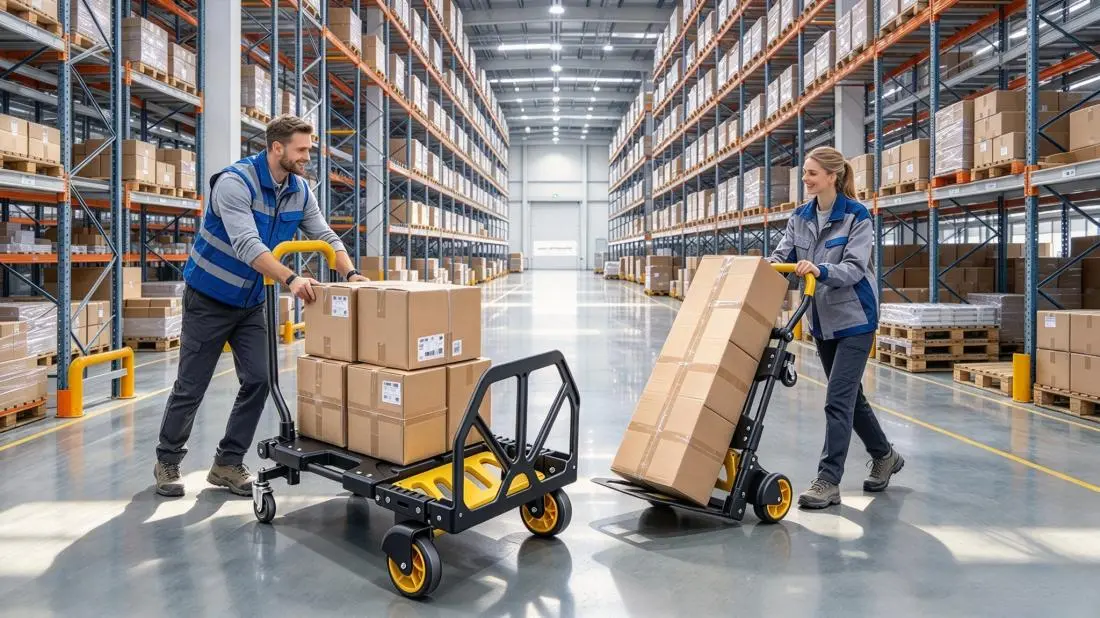
For sales teams and product pages, the product can be explained through a simple sequence.
1.Start With the Handling Task
Ask what the customer is moving.
Is it a tall carton or individual package?
Or is it a group of smaller items?
2.Match the Load to the Mode
If the load benefits from vertical support, the hand-truck configuration may be appropriate.
If the load benefits from a horizontal platform, the cart configuration may be more suitable.
3.Explain the Conversion
The customer can then understand that the same folding product can be reconfigured for the other task.
This approach is more useful than simply saying the product is “multi-functional.”
It tells the buyer why the second mode exists.
Why This Dual-Mode Structure Can Be Relevant for B2B Product Selection
For B2B buyers, a product’s value is closely connected to how clearly it fits the intended customer base.
A folding hand truck and cart can be a logical SKU when the target market includes customers who move different types of loads in the same working environment.
The product is particularly relevant when:
- The customer handles both individual and grouped loads
- Working areas vary in available space
- Operators switch between different handling tasks
- Storage space matters
- A folding product is practical for transportation and storage
- Both hand-truck and cart functions are regularly used
The concept becomes less relevant when the target application requires a highly specialized handling platform outside the product’s intended operating range.
This boundary is important.
Good product positioning does not claim that one SKU can replace every other handling product. It explains exactly where the two-mode design creates practical value.
FAQ About Folding Hand Truck and Cart Two-Mode Use
1.What is a folding hand truck and cart?
A folding hand truck and cart is a convertible material-handling product that can operate in both a two-wheel hand-truck configuration and a four-wheel cart configuration. The two configurations support different load orientations and movement patterns.
2.What is the main benefit of using one SKU for two modes?
The main benefit is that the same product can address two recurring handling tasks without requiring customers to use a completely separate product for each task.
3.When should a folding hand truck be used as a cart?
The cart configuration can be useful when the load is better supported on a horizontal platform, particularly when moving multiple smaller items or goods that benefit from a broader support surface.
4.When is the hand-truck configuration more suitable?
The two-wheel configuration can be more appropriate when the load is better positioned vertically against the frame or when maneuverability through tighter areas is important.
5.Is a two-mode product suitable for every warehouse?
No. Suitability depends on the loads, workflow, space, and operating requirements of the intended users. A dual-mode product should be matched to applications where both configurations have a practical purpose.
6.Can one folding trolley serve warehouse and workshop applications?
Yes, where the handling requirements overlap. Warehouse carton transfer and workshop material movement can both involve situations where vertical and horizontal load handling are useful.
7.What should distributors check before buying a dual-mode SKU?
Distributors should evaluate both configurations with physical samples, verify the transition mechanism, review the intended customer workflows, and confirm that both modes provide genuine application value.
8.What should tool brands consider for private-label projects?
Tool brands should focus on whether the two-mode concept is clear enough to communicate through product demonstrations, packaging, product photography, and sales materials. The product proposition should explain why each mode exists, rather than simply listing multiple functions.
Conclusion
The strongest reason to consider a folding hand truck and cart is not that one product can be described as multi-functional.
It is that one SKU can provide two genuinely different ways to handle goods.
When customers need vertical support for some loads and horizontal support for others, the two configurations can work together as part of the same workflow.
For B2B buyers, that makes the product worth evaluating as a dual-mode SKU: not because it promises to replace every handling tool, but because it can address two practical movement patterns through one folding product platform.
For manufacturers and brands developing this type of product, the same principle should guide product development and communication:
make both modes useful, make the transition practical, and make the reason for each mode easy for customers to understand.
That is what turns a folding hand truck and cart from a product with multiple configurations into a genuinely useful two-mode handling solution.
Related products