Why Convertible Hand Trucks Can Add More Value to a Retail Product Line

For retailers, distributors, and private label buyers, adding another material handling product to a catalog is not simply a question of whether the product works. The more important question is whether the product can create enough commercial value to justify its position in the product line.
A conventional hand truck may serve one primary handling purpose. A platform cart may serve another. A folding trolley may solve storage and transportation problems. A convertible hand truck combines several of these functions in one product format, which can make it particularly interesting for businesses that need to balance assortment breadth, SKU efficiency, customer demand, storage space, and product differentiation.
That does not mean every convertible hand truck is automatically a better retail product. Buyers still need to evaluate load capacity, materials, folding dimensions, usability, packaging, target applications, quality consistency, and supplier capabilities.
The real advantage is strategic: one well-positioned convertible product can potentially address several customer needs without requiring a retailer to develop completely separate products for every handling scenario.
For distributors and private label brands, that creates an opportunity to build a more flexible product portfolio while keeping the product proposition easy to understand.
- What Makes a Convertible Hand Truck Different from a Standard Product?
- Why Retailers May Benefit from Adding Convertible Products
- How Convertible Hand Trucks Can Fit Different Retail Strategies
- What Retail Buyers Should Evaluate Before Adding a Convertible Hand Truck
- Why Product-Line Value Matters More Than Feature Count
- How Convertible Design Can Support Private Label Positioning
- Why Supplier Capability Matters When Sourcing Convertible Hand Trucks
- A Practical Buyer Checklist for Convertible Hand Trucks
- Example: A 3-in-1 Convertible Folding Trolley for Retail Programs
- Convertible Hand Truck vs. Basic Hand Truck: A Retail Perspective
- When a Convertible Hand Truck May Not Be the Best Choice
- How to Decide Whether a Convertible Hand Truck Deserves a SKU
- Conclusion: Convertible Design Can Be a Product-Line Strategy
- Frequently Asked Questions About Convertible Hand Trucks
What Makes a Convertible Hand Truck Different from a Standard Product?
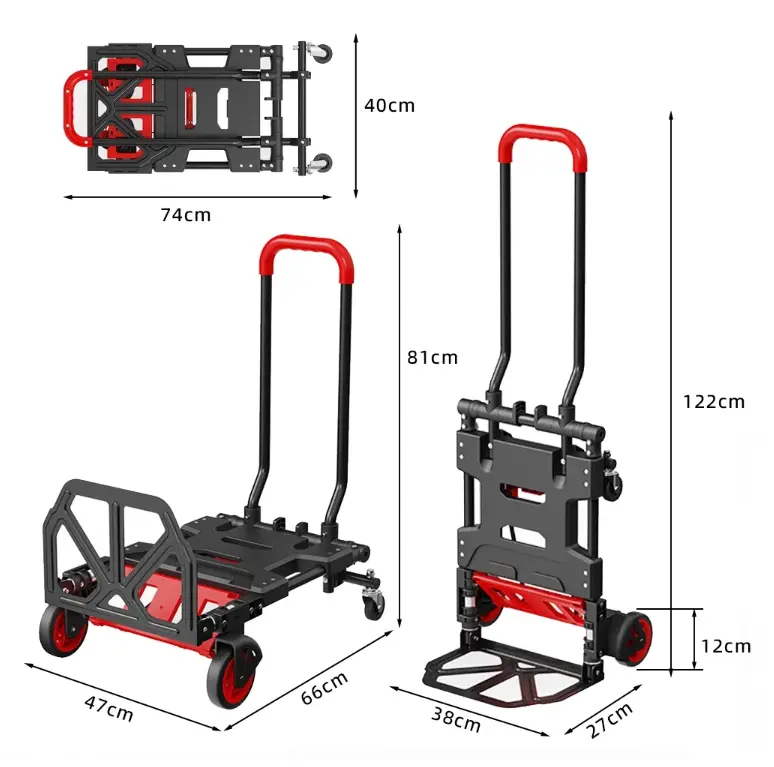
A convertible hand truck is designed to change between different handling configurations rather than serving only one fixed purpose.
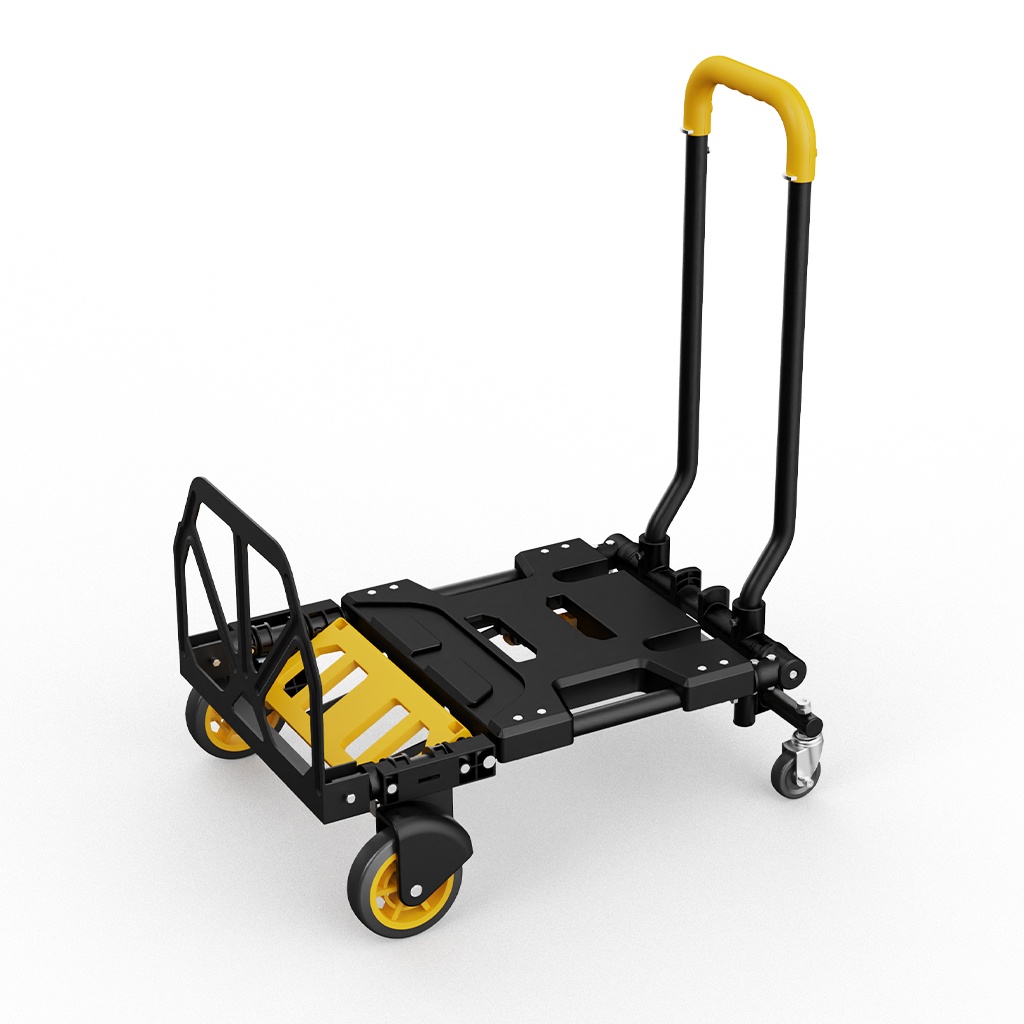
For example, a product may work in a two-wheel upright configuration when users need to move tall or vertically positioned loads. It can then be converted into a four-wheel platform configuration when the user needs a more stable base for larger or wider items.
This configuration change is more than a mechanical feature. From a retail perspective, it can become a product-positioning advantage.
A standard hand truck may communicate one straightforward benefit: moving loads on two wheels.
A convertible hand cart or trolley can communicate a broader value proposition:
- multiple handling configurations
- better adaptation to different load shapes
- easier storage through a foldable design
- wider application coverage
- potentially stronger differentiation from basic hand trucks
For consumers, these advantages may translate into convenience. For B2B buyers, they can translate into better product-line efficiency and broader customer coverage.
1.One Product Can Address More Than One Handling Scenario
Retail customers rarely handle identical loads every day.
A customer may transport cartons vertically in one situation and move several boxes on a platform in another. A workshop may require a compact trolley for short-distance movement but prefer a four-wheel base when carrying wider materials.
The value of a convertible design is therefore not simply that it has multiple positions. Its value comes from how those positions match real customer problems.
For a retailer, this can make the product easier to position as a versatile solution instead of another generic hand truck.
2.Convertible Design Creates a Stronger Product Story
In retail, product differentiation matters because buyers often compare similar products with similar-looking specifications.
A product described only as a “folding hand truck” may compete primarily on capacity, size, material, price, and appearance.
A product positioned as a convertible hand truck gives the merchandising team another story to communicate:
one product, multiple handling modes, compact storage, and broader everyday utility.
That story can support packaging, product images, online listings, catalogs, distributor presentations, and sales conversations.
Why Retailers May Benefit from Adding Convertible Products
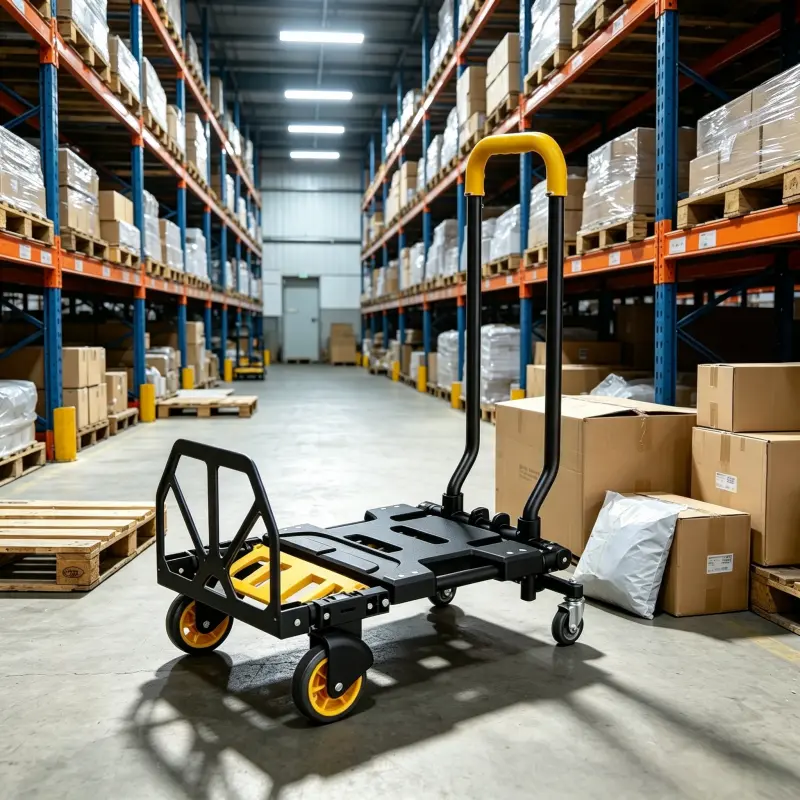
Retail product lines are built around more than individual product performance. Buyers must think about how products work together inside the assortment.
A product may be technically strong but commercially weak if it has limited appeal, is difficult to explain, requires too much shelf space, or overlaps too heavily with existing SKUs.
Convertible hand trucks can potentially address several of these concerns at the same time.
1.Broader Customer Coverage
A single handling product can appeal to multiple user groups when its different configurations correspond to different tasks.
Potential end users can include:
- homeowners and moving users
- workshop users
- warehouse staff
- delivery and logistics personnel
- contractors
- maintenance teams
- small businesses
- retail customers handling cartons and equipment
For B2B retailers and distributors, broader application coverage can make a SKU more useful across different customer segments.
The key is not to claim that one product replaces every other material handling tool. Instead, the product should be positioned around multiple related use cases that genuinely fit its design.
2.Better SKU Efficiency
SKU efficiency is an important commercial consideration for retailers.
When a product serves only a narrow application, its sales potential depends heavily on one customer need. A convertible product may have a wider application range, allowing one SKU to speak to several related use cases.
This can be especially relevant for distributors that operate with limited inventory budgets or warehouse space.
Instead of evaluating only how many products can be added to the catalog, buyers can ask:
How many customer problems can each SKU reasonably address?
That is where convertible products can become attractive.
3.More Opportunities for Product Differentiation
Generic material handling products can be difficult to differentiate when competing suppliers offer similar capacities and basic structures.
A convertible structure provides another dimension for differentiation.
The competitive story can focus on:
- configuration flexibility
- compact folding
- multi-purpose use
- ease of transportation
- storage efficiency
- product appearance
- customized color options
- private label branding
This can help distributors avoid competing exclusively on unit price.
How Convertible Hand Trucks Can Fit Different Retail Strategies
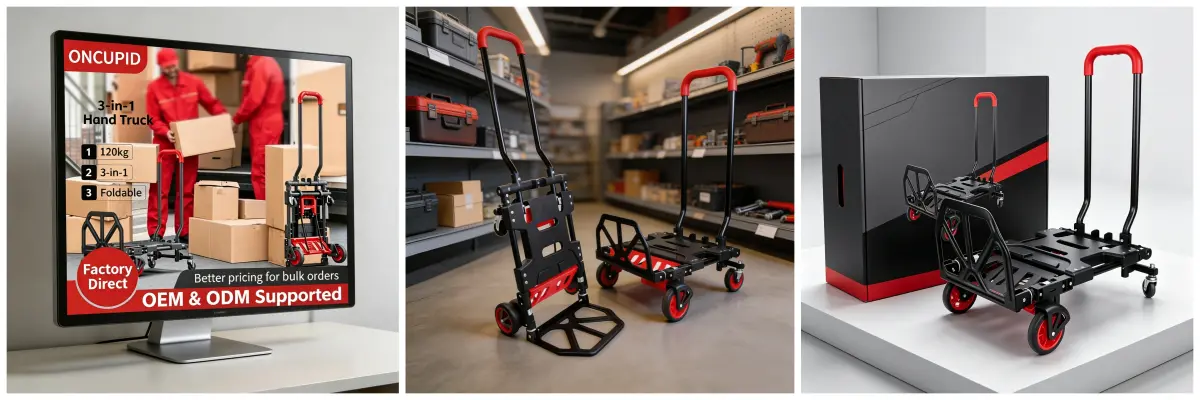
Not every retailer has the same product strategy. The commercial value of a convertible hand truck depends on how the retailer plans to sell it.
1.For Hardware and Tool Retailers
Hardware stores often need products that can serve a variety of practical applications without requiring extensive explanation.
A convertible hand truck can fit into categories related to:
- material handling
- moving equipment
- warehouse tools
- workshop equipment
- delivery accessories
- utility carts
Its versatility can make it easier to cross-position the product across related categories.
2.For E-Commerce Retailers
Online retailers have a different challenge: they need to communicate the value of a product quickly through images, specifications, and concise selling points.
Convertible products can work well in visual merchandising because the change between configurations can be demonstrated clearly.
A listing can show:
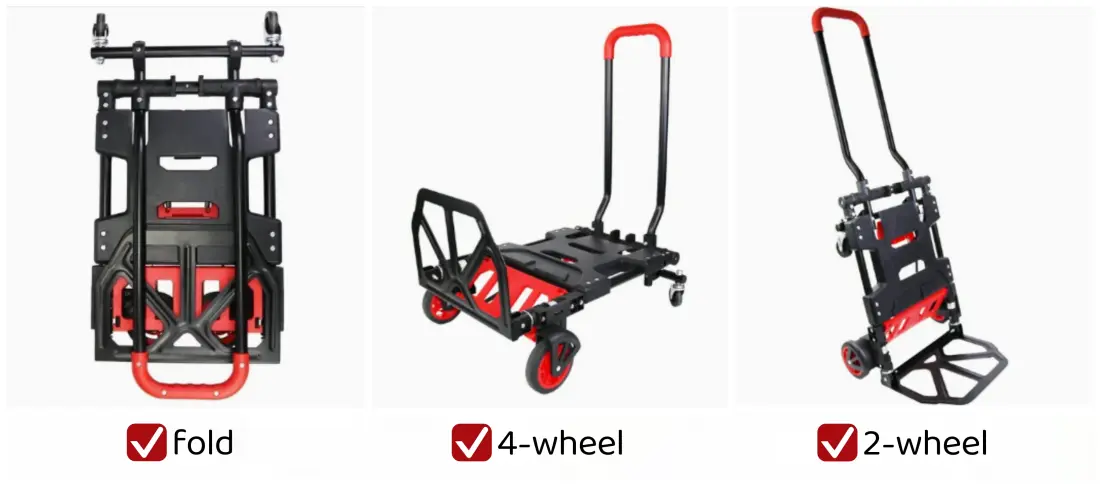
2-wheel mode → 4-wheel platform mode → folded storage mode
This creates a straightforward visual explanation of the product.
For e-commerce teams, this can help turn a technical product feature into a more understandable customer benefit.
3.For Distributors
Distributors often need products that can be sold to multiple downstream channels.
A convertible hand truck may therefore have value beyond direct retail sales. It can be supplied to hardware stores, industrial distributors, online sellers, moving-equipment suppliers, workshop-equipment businesses, and other specialized channels, depending on the exact product design and compliance requirements.
The broader the appropriate application range, the more opportunities a distributor may have to place the same product into different customer accounts.
4.For Private Label Buyers
Private label buyers usually need more than a technically functional product.
They need a product that can be given a distinct market identity through:
- branding
- packaging
- color selection
- product naming
- specification positioning
- photography
- retail presentation
Convertible products can offer more storytelling opportunities than conventional one-function products.
A private label brand, for example, can position the same core product around “compact storage,” “multi-mode handling,” “workshop flexibility,” or “delivery convenience,” depending on the target market.
What Retail Buyers Should Evaluate Before Adding a Convertible Hand Truck
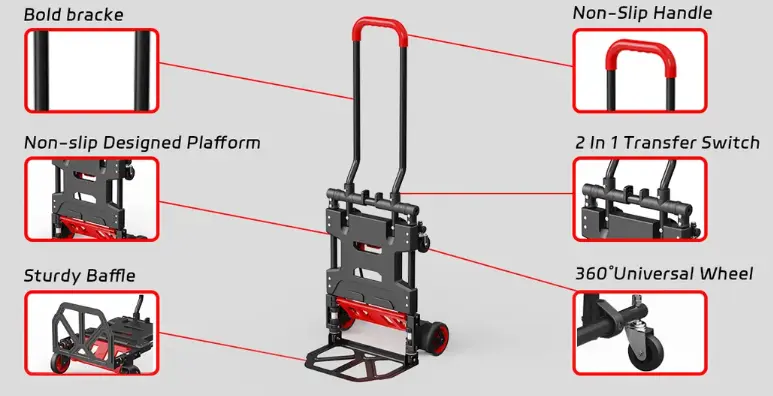
The strongest commercial opportunity can disappear if the underlying product is poorly designed.
Retail buyers therefore need to look beyond the number of configurations and evaluate the complete product.
1. Conversion Mechanism
The first question is simple:
Can the product be converted easily and consistently?
A multi-function design has little commercial value if changing modes is complicated, slow, or confusing.
Buyers should evaluate the mechanism from an end-user perspective:
- Is the conversion intuitive?
- Does it require tools?
- Can one person operate it?
- Does the structure feel stable in each mode?
- Are locking points secure?
- Is the process easy to demonstrate?
The simpler the conversion process, the easier it can be to communicate the product advantage in retail channels.
2. Load Capacity
Capacity must be considered according to the intended use rather than used as a standalone marketing number.
A product rated for 120 kg may be suitable for many commercial and everyday material handling applications, but buyers should still verify how the rating was determined and how the load should be distributed.
Capacity communication should be clear across:
- packaging
- product pages
- catalogs
- manuals
- technical documentation
This reduces the risk of creating unrealistic customer expectations.
3. Materials and Structural Construction
Material selection affects weight, durability, manufacturing consistency, and perceived quality.
A convertible folding trolley can combine materials such as PP, PA, and iron to balance structural support with weight and usability.
However, material names alone do not determine product quality.
Retail buyers should also examine:
- frame construction
- joints
- load-bearing points
- wheel design
- fasteners
- folding components
- wear areas
- surface finishing
A strong product specification should therefore be supported by actual manufacturing and quality-control capability.
4. Folded Size and Storage Efficiency
For retailers, storage is a commercial issue.
For end users, compact storage is often part of the product’s value proposition.
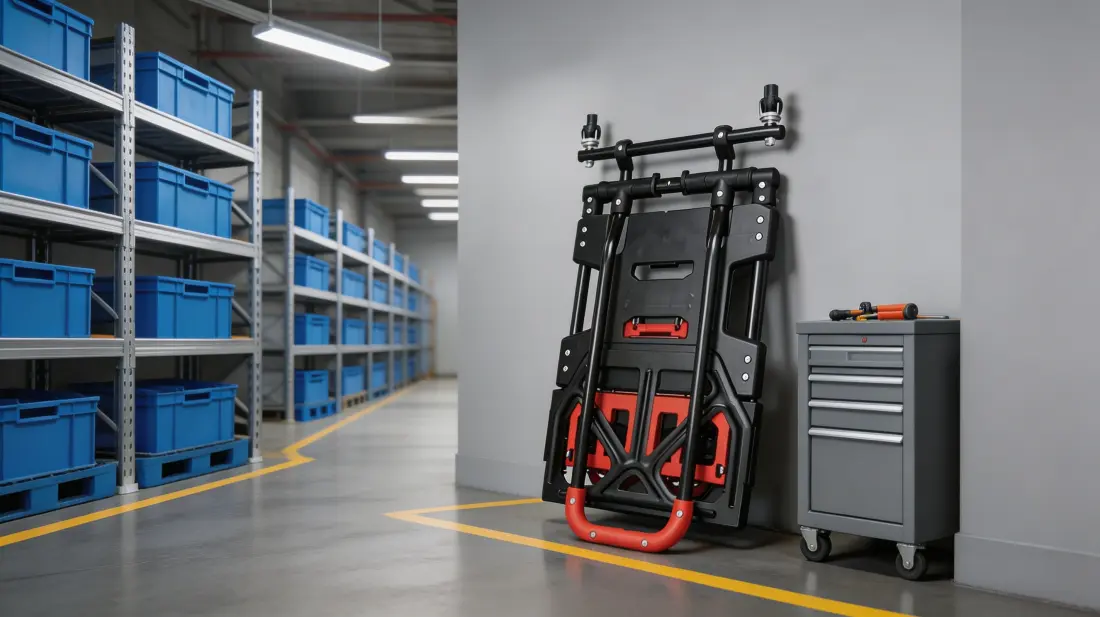
A foldable convertible trolley can provide a particularly useful combination: multiple operating modes when needed and a compact footprint when the product is not being used.
For example, a 3-in-1 convertible folding trolley can be designed around:
4-wheel open size: 47.5 × 62 × 80.8 cm
2-wheel open size: 47 × 40.5 × 121.5 cm
Folded size: 37.5 × 13 × 81 cm
The significance of these measurements is not the numbers themselves. Buyers should assess whether the folded dimensions are practical for:
- warehouse storage
- transportation
- retail packaging
- home storage
- e-commerce fulfillment
5. Product Weight
Product weight is another important balance point.
A lighter trolley may be easier to carry, store, and reposition, while adequate structural reinforcement is still required for the intended load.
The example 3-in-1 convertible trolley weighs 7.1 kg, combining a relatively manageable product weight with a stated 120 kg load capacity.
For buyers, the important question is whether the overall weight-to-capacity relationship creates a compelling customer proposition without compromising usability or structural reliability.
6. Wheel and Mobility Performance
Different configurations change how loads interact with the floor.
A buyer should consider:
- wheel size
- wheel material
- turning behavior
- rolling resistance
- stability
- floor compatibility
- noise expectations
- performance under realistic loads
A product that looks flexible in the specification sheet still needs to feel predictable in actual use.
Why Product-Line Value Matters More Than Feature Count
One of the most common mistakes in product sourcing is treating additional functions as automatically equal to additional value.One of the most common mistakes in product sourcing is treating additional functions as automatically equal to additional value. For buyers considering a broader multi-function product strategy, it is also important to understand how functional flexibility can create new commercial opportunities rather than simply adding features.
They are not.
A product with more functions is only commercially attractive when those functions are useful, understandable, and reliable.
For example, a retailer may not need a trolley that claims to do everything. What the retailer needs is a product whose functions solve several related customer problems without making the product difficult to use.
This distinction is particularly important for B2B buyers.
How Convertible Design Can Support Private Label Positioning
Private label programs often require products to stand apart from competing generic listings.
A convertible hand truck can provide several opportunities for brand differentiation.
1.Color and Visual Identity
A product offered in several color combinations can be adapted to different brand strategies.
For example, a supplier may support combinations such as:
- Yellow & Black
- Red & Black
- Orange
- Blue
- Yellow
- Green
Color selection can contribute to packaging consistency, catalog identity, and product-family recognition.
However, color should support the product proposition rather than become the only point of differentiation.
2.Packaging and Merchandising
A convertible trolley is particularly suitable for visual communication.
Packaging can use sequential images to demonstrate:
Convert → Load → Move → Fold → Store
Retailers and private label buyers can also use the same visual sequence on:
- online product pages
- brochures
- distributor catalogs
- trade show displays
- social media content
- sales presentations
This makes the product feature easier to understand without requiring long technical explanations.
3.Customized Brand Presentation
Private label buyers may also need:
- custom logo
- custom colors
- customized packaging
- product photography
- market-specific specifications
Whether these options are available depends on the supplier’s actual manufacturing capabilities and order requirements.
This is why supplier evaluation should happen at the same time as product evaluation.
Why Supplier Capability Matters When Sourcing Convertible Hand Trucks
A good product concept is not enough.
For retailers and distributors, the supplier must also be capable of producing the product consistently at commercial scale.
A supplier should be evaluated across several areas.
1.Manufacturing Capability
Look for evidence of:
- dedicated production capability
- engineering support
- tooling and mold capability
- quality-control processes
- assembly consistency
- packaging capability
- export experience
For buyers comparing potential manufacturing partners, reviewing the supplier’s production capabilities, engineering resources and quality-control structure can provide a clearer picture of long-term supply reliability.A supplier with integrated manufacturing resources can be better positioned to handle product revisions and customization than a trading company that sources every component externally.
2.OEM and ODM Support
OEM and ODM capabilities can become particularly important for private label buyers.
The buyer may want to adjust:
- brand identity
- colors
- packaging
- product configuration
- accessories
- labeling
A supplier that already supports OEM/ODM programs can make this process easier to manage.
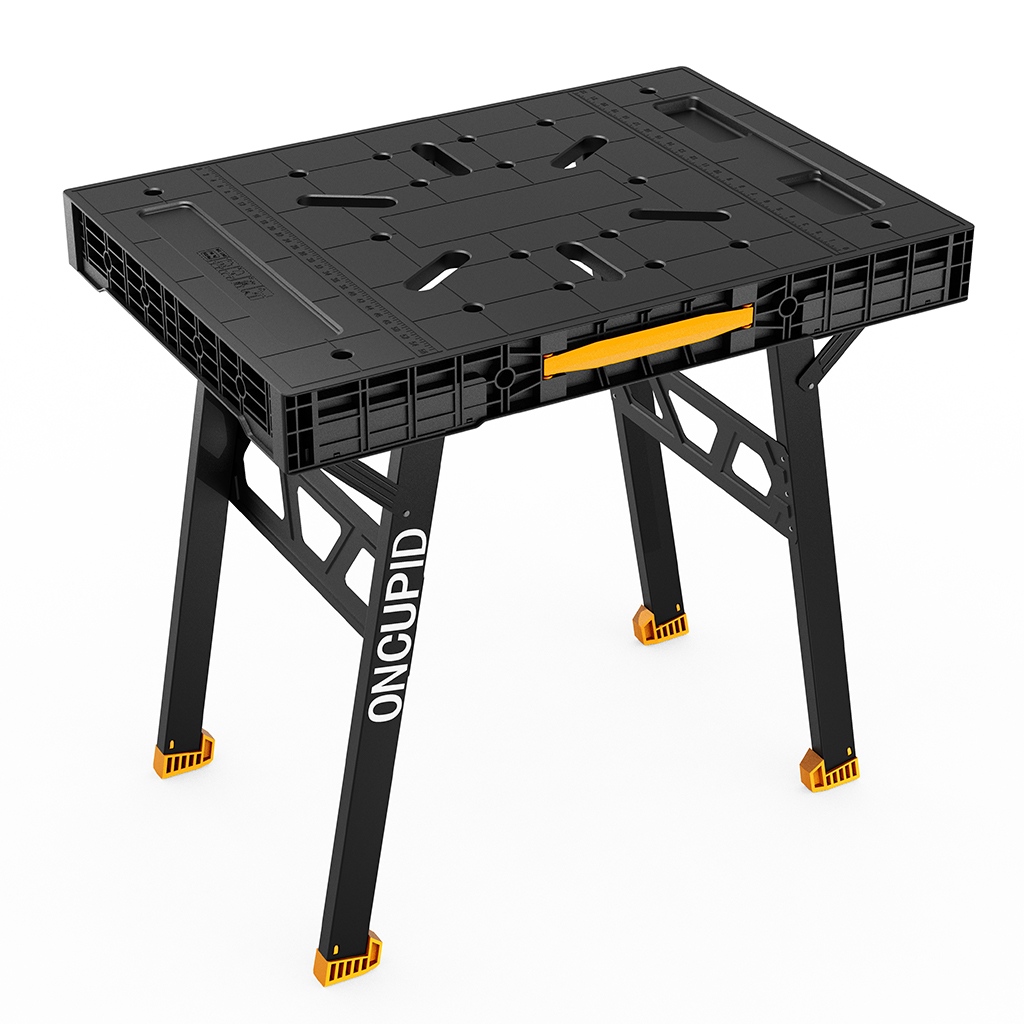
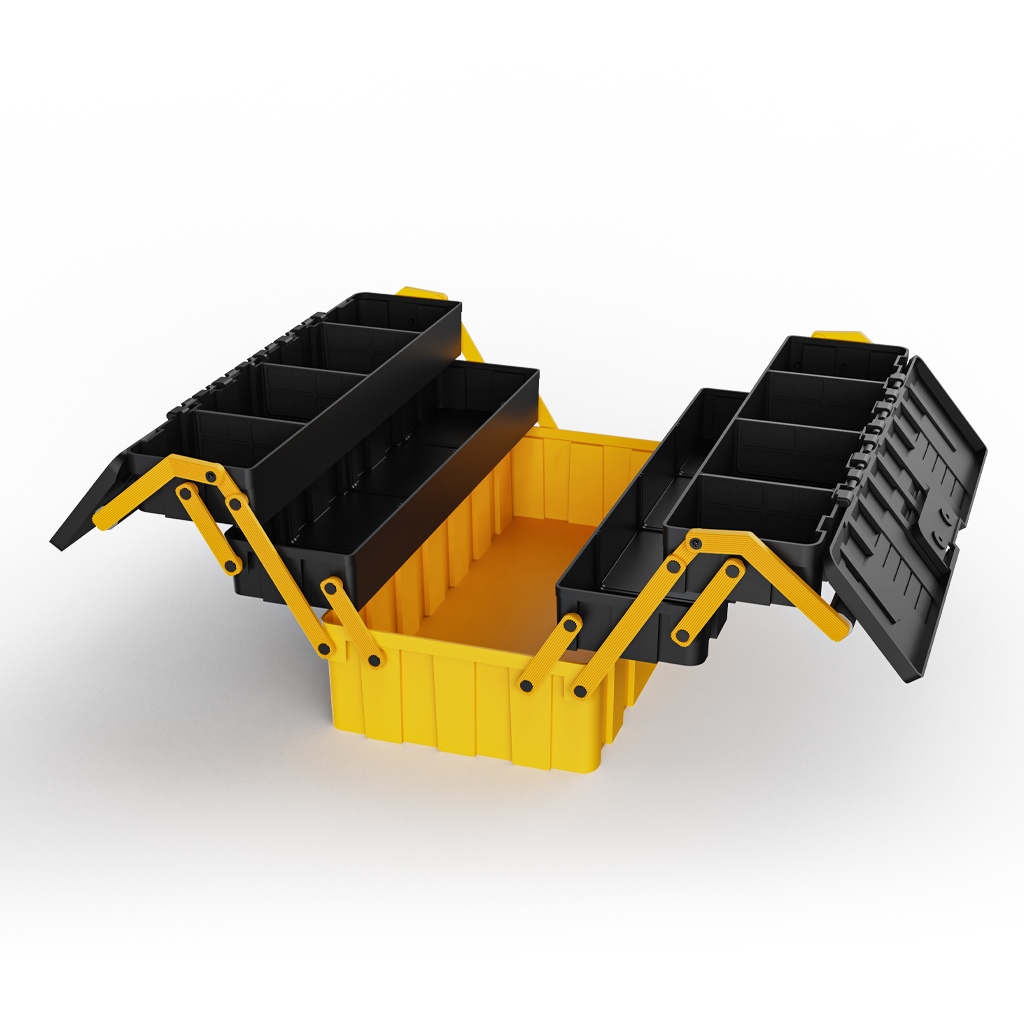
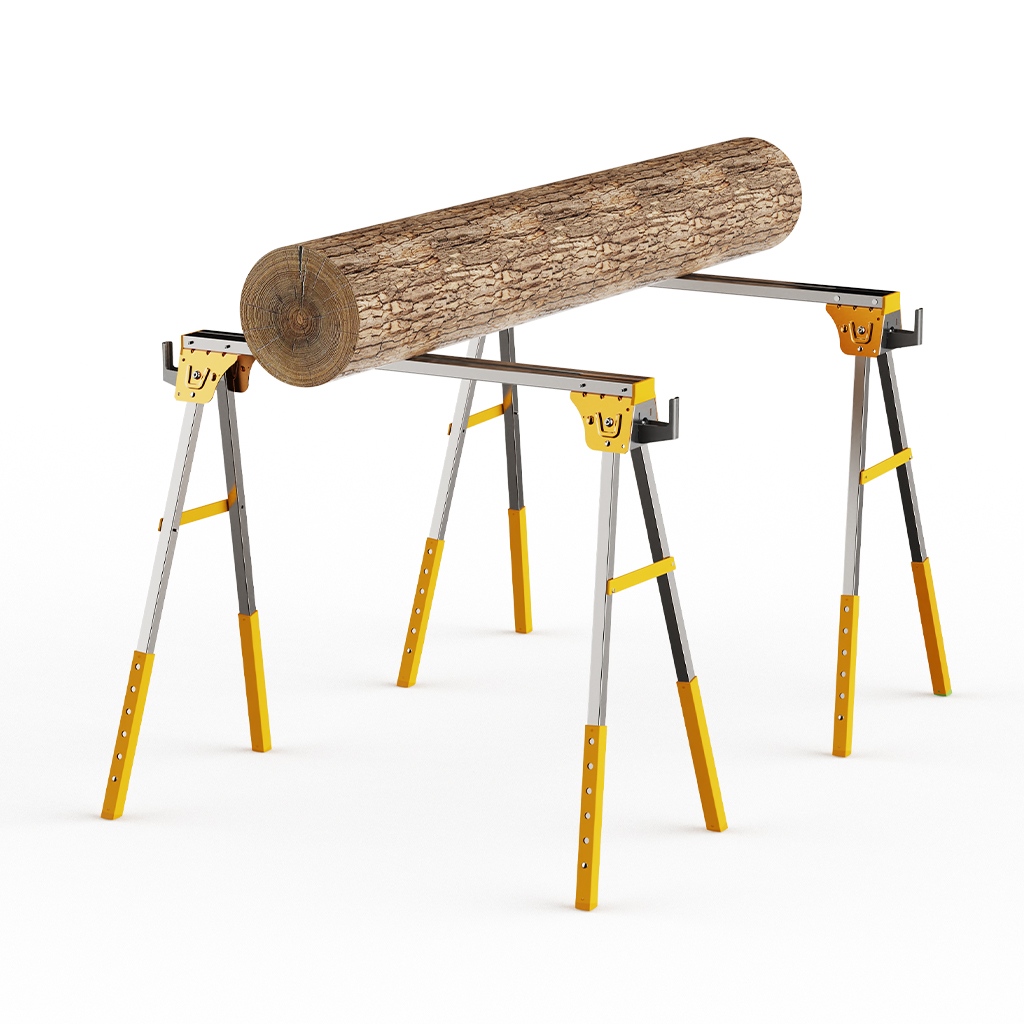
Jingyan Tools currently positions itself as an OEM/ODM manufacturer for industrial tools and lists workbench, sawhorse, toolbox and hand truck product categories. Its website also presents manufacturing, R&D, mold, production and QC capabilities for global B2B customers.
3.Quality and Compliance
For export-oriented buyers, compliance requirements should be confirmed for the target market and specific product.
Depending on the market and product category, buyers may need documentation related to material requirements, product safety, testing, packaging, labeling, or other regulatory obligations.
Retailers should not assume that a supplier’s general certifications automatically cover every product or every market.
The best practice is to ask for product-specific documentation and test evidence where applicable.
A Practical Buyer Checklist for Convertible Hand Trucks
Before adding a convertible hand truck to a retail product line, buyers can use the following checklist.Before adding a convertible hand truck to a retail product line, buyers can use the following checklist. Once the product appears to fit the assortment, the next step is to evaluate the details that matter when preparing for a bulk purchasing decision.
1.Product Fit
Ask:
- Does the product solve more than one relevant customer problem?
- Are the conversion modes genuinely useful?
- Is the product easy to explain visually?
- Does the folded format improve storage?
- Does the load capacity match the intended customer segment?
2.Commercial Fit
Ask:
- Does the product fill a gap in the current assortment?
- Does it overlap too heavily with an existing SKU?
- Can it be sold through more than one channel?
- Can the product support a differentiated retail story?
- Is the expected margin strong enough after logistics and packaging costs?
3.Supplier Fit
Ask:
- Can the supplier maintain consistent quality?
- Can it support the expected order volume?
- Are OEM/ODM options available?
- Can the supplier provide customized colors and branding?
- Can documentation and packaging meet the target market’s requirements?
This three-layer evaluation is more useful than comparing product specifications alone.
Example: A 3-in-1 Convertible Folding Trolley for Retail Programs
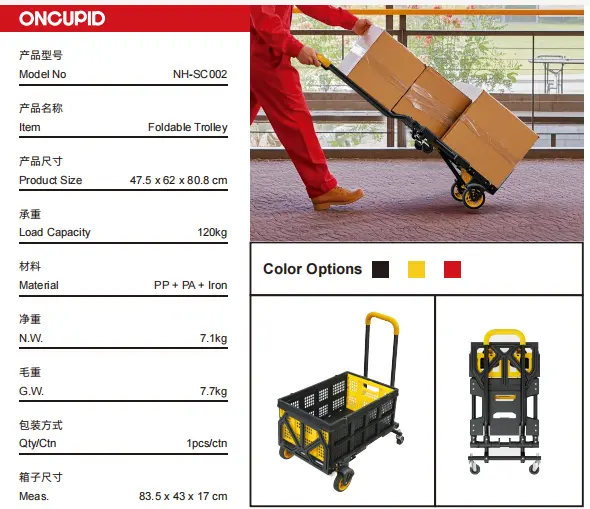
One example of a retail-oriented product concept is a 3-in-1 convertible folding trolley designed for material handling and compact storage.
The product combines a PP + PA + iron construction with a folding structure and multiple handling configurations.
Its listed specifications include:
| Specification | Value |
|---|---|
| Material | PP + PA + Iron |
| 4-Wheel Open Dimensions | 47.5 × 62 × 80.8 cm |
| 2-Wheel Open Dimensions | 47 × 40.5 × 121.5 cm |
| Folded Dimensions | 37.5 × 13 × 81 cm |
| Weight | 7.1 kg |
| Load Capacity | 120 kg |
From a product-line perspective, these specifications create several selling points at once:
multi-mode handling, foldable storage, manageable weight, and a clearly defined load capacity.
The commercial question, however, remains whether these features match the target market.
For one retailer, the strongest positioning may be compact storage.
For another, it may be warehouse utility.
For a private label brand, it may be multi-purpose product differentiation.
That is why product-line strategy should come before simply choosing a specification sheet.
Convertible Hand Truck vs. Basic Hand Truck: A Retail Perspective
A basic hand truck can remain the right choice in many situations.
If the target customer only needs a simple two-wheel solution, adding additional configurations may not create enough value to justify a higher selling price or more complex product structure.
A convertible product becomes more compelling when the customer base includes users with multiple related handling requirements.
| Retail Consideration | Basic Hand Truck | Convertible Hand Truck |
|---|---|---|
| Primary function | Usually one main configuration | Multiple configurations |
| Product story | Simple and direct | More versatile |
| Application coverage | More focused | Potentially broader |
| Visual merchandising | Straightforward | Strong demonstration opportunity |
| Storage | Depends on design | Often enhanced by folding design |
| Differentiation | Often specification-led | Function + flexibility |
| Private label storytelling | Moderate | Potentially stronger |
The goal should not be to replace every basic hand truck with a convertible product.
Instead, retailers can use convertible products strategically where versatility itself is part of the buying proposition.
When a Convertible Hand Truck May Not Be the Best Choice
Balanced product evaluation also requires understanding its limitations.
A convertible hand truck may not be ideal when:
- the target customer needs only one specific configuration
- the extra mechanism creates unnecessary complexity
- the selling price becomes too high for the target category
- the product is difficult to demonstrate
- the application does not justify multi-function capability
- a simpler product already dominates the target market
Retailers should therefore treat convertible design as a strategic option rather than a universal upgrade.
This is particularly important for professional buyers who are responsible for assortment profitability.
How to Decide Whether a Convertible Hand Truck Deserves a SKU
A practical decision can be based on five questions.
Question 1: Does It Solve Multiple Related Problems?
If yes, the product may have stronger assortment value.
Question 2: Is the Difference Easy for Customers to Understand?
If a customer can understand the benefit in a few seconds through images and a simple explanation, the product is easier to merchandise.
Question 3: Does It Create Product-Line Differentiation?
A product that looks and functions exactly like everything else may struggle to justify a new SKU.
Question 4: Can the Supplier Support Your Brand Strategy?
OEM, ODM, color, packaging and specification flexibility may determine whether the product can become a branded product rather than another generic item.
Question 5: Does the Commercial Model Work?
The final decision should consider:
product cost + packaging + freight + duties + warehouse cost + expected selling price + channel margin
A product with excellent features can still be a poor SKU if the economics do not work.
Conclusion: Convertible Design Can Be a Product-Line Strategy
A convertible hand truck is more than a hand truck with multiple configurations.
For retailers, distributors, and private label buyers, its greatest potential value lies in how the product fits into the broader assortment.
A well-designed convertible product can offer:
- broader application coverage
- stronger visual differentiation
- better storage efficiency
- more flexible retail positioning
- additional private label storytelling opportunities
- potentially better SKU efficiency
The key is to evaluate the product from the perspective of the entire commercial system rather than judging the product only by its number of functions.
The right convertible hand truck should be easy to use, easy to explain, easy to store, commercially differentiated, and supported by a supplier capable of consistent production and customization.
For B2B buyers, that makes convertible design worth considering not simply as a product feature, but as a potential product-line strategy.
If you are evaluating a convertible hand truck for wholesale, distribution, or private label use, the next step is to compare the product specification, customization options, packaging requirements, MOQ, and target-market requirements with your current assortment.
Frequently Asked Questions About Convertible Hand Trucks
1.What is a convertible hand truck?
A convertible hand truck is a material handling product designed to operate in more than one configuration. Depending on the design, it may switch between a two-wheel hand truck mode and a four-wheel platform or cart mode.
2.Why would a retailer choose a convertible hand truck?
Retailers may choose a convertible hand truck because it can address multiple related handling needs while offering a more differentiated product story than a basic one-function hand truck.
3.Is a convertible hand cart suitable for private label brands?
Yes, when the supplier supports the required customization. Private label buyers may look for options such as logo branding, product colors, packaging, product photography and other market-specific requirements.
4.What should distributors check before placing a bulk order?
Distributors should evaluate product specifications, conversion mechanism, load capacity, materials, folded dimensions, packaging, MOQ, production consistency, quality control, customization options and export documentation.
5.How much load can a convertible hand trolley carry?
Load capacity depends on the model and manufacturer. For the example 3-in-1 convertible folding trolley discussed in this article, the listed load capacity is 120 kg. Buyers should confirm the applicable load rating and test conditions with the supplier before commercial use.
6.Is a convertible hand truck better than a standard hand truck?
Not automatically. A standard hand truck may be more suitable when customers need one simple function. A convertible model can be more attractive when flexibility, broader application coverage, and product differentiation are important parts of the buying decision.
7.Can convertible hand trucks be customized?
Customization depends on the supplier and program. Typical options may include logo, color, packaging and product presentation. Buyers should confirm MOQ, tooling requirements, lead time and customization costs before placing an order.
8.What makes a convertible hand truck valuable for a retail product line?
Its value comes from combining functional flexibility with commercial differentiation. The strongest products are those that genuinely solve multiple related customer problems while remaining easy to use, explain, store, and sell.
Related products