750kg Folding Workbench: Load Capacity Testing and Real-World Performance Analysis
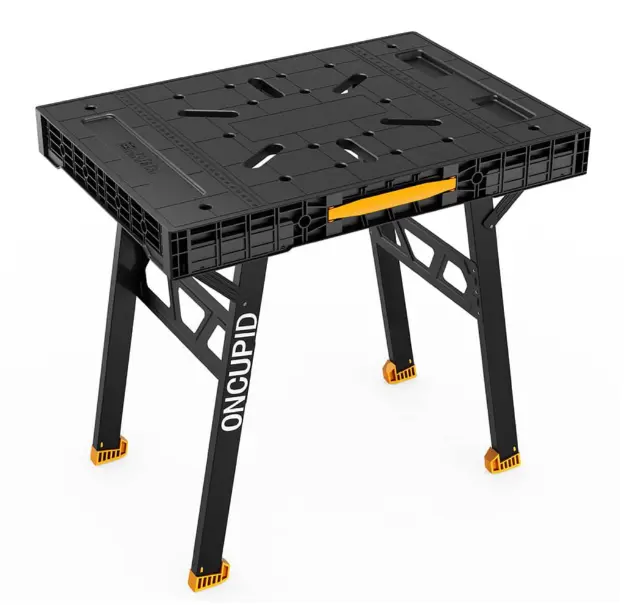
A 750kg load capacity is one of the most important specifications buyers may see when evaluating a heavy duty folding workbench. However, the number itself does not tell the whole story.
For importers, distributors, private-label brands, and industrial tool buyers, the more useful question is not simply whether a workbench is rated at 750kg. Buyers also need to understand how the load is tested, what type of load the rating represents, how the frame responds under pressure, and whether the product remains stable after the load is removed.
This matters because a static load rating and real-world working conditions are not always identical. A controlled test may use a defined load distribution, while an actual workbench may experience uneven materials, localized pressure, repeated handling, movement, and other forces.
A proper evaluation therefore needs to connect the 750kg figure with the structure behind it.
This guide focuses specifically on 750kg load testing and real-world performance. It explains how to interpret a heavy duty folding workbench load rating, what to observe during testing, and what professional buyers should verify before approving a product for commercial sourcing.
- 1. What Does a 750kg Load Capacity Actually Mean?
- 2. How Should a 750kg Folding Workbench Be Load Tested?
- 3. Which Structural Areas Should Be Observed During Testing?
- 4. What Happens After the Load Is Removed?
- 5. Why Repeated Testing and Production Consistency Matter
- 6. Real-World Performance: How Actual Use Differs From a Controlled Test
- 7. A Practical Example: Jingyan's 750kg Folding Workbench
- 8. How Professional Buyers Should Verify a 750kg Workbench Claim
- 9. What a 750kg Rating Does Not Mean
- 10. A Practical 750kg Folding Workbench Testing Checklist for Buyers
- 11. Frequently Asked Questions About 750kg Folding Workbenches
- 12. Final Takeaway: Look Beyond the 750kg Number
What Does a 750kg Load Capacity Actually Mean?
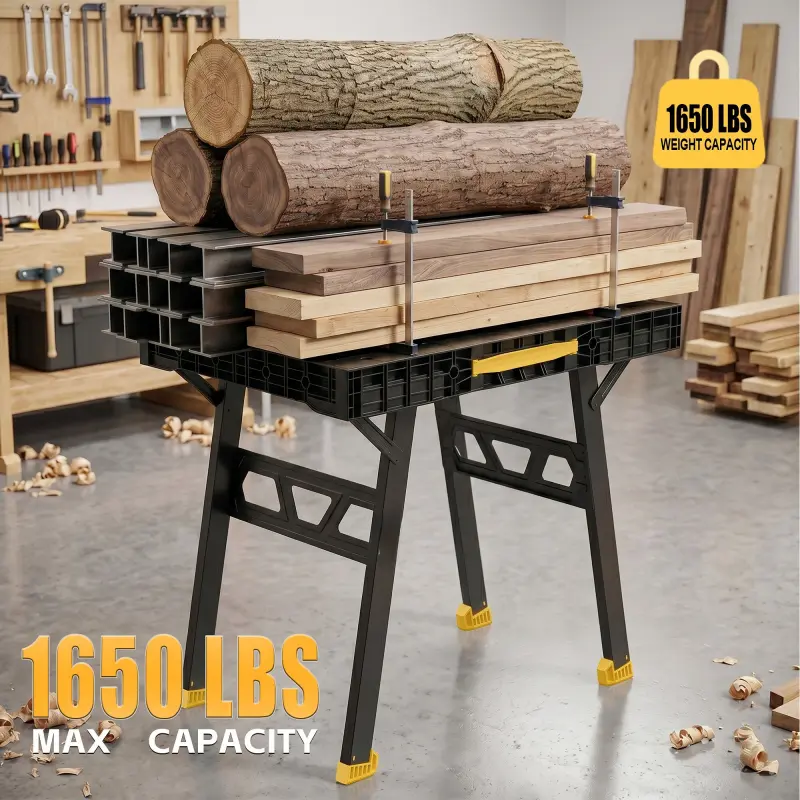
When a folding workbench is rated at 750kg, the first question should be: what exactly does that number represent?
A load-capacity figure should always be connected to a defined testing or operating condition. In many product specifications, a stated capacity refers to the load that the workbench can support in a specified working configuration under static conditions.
That is different from saying that the workbench can safely absorb every type of 750kg load in every possible situation.
1.Static Load Capacity vs. Dynamic Load
A static load is applied in a relatively stable and controlled condition.
For example, a predetermined weight may be placed on the tabletop while the workbench is fully opened and correctly positioned. The product is then observed while the load remains in place.
Real-world use can be more complicated.
A workshop table may experience:
- unevenly distributed materials;
- tools placed at different positions;
- localized pressure;
- equipment being moved across the surface;
- users leaning or pushing against the tabletop;
- vibration or temporary impact.
These forces are different from a simple static weight.
For that reason, a 750kg static load rating should not automatically be interpreted as a universal 750kg dynamic working limit.
The distinction is particularly important for commercial buyers because inaccurate interpretation of a load rating can create unrealistic expectations further down the distribution chain.
2.Rated Capacity and Test Conditions
A professional buyer should also ask how the rated capacity was established.
Important test information may include:
- the exact product model;
- the fully deployed configuration;
- the loading method;
- the weight distribution;
- the test duration;
- the condition of the workbench before testing;
- the condition of the structure after unloading.
The more clearly these conditions are defined, the easier it is to compare suppliers.
A number without test conditions is difficult to interpret consistently.
How Should a 750kg Folding Workbench Be Load Tested?
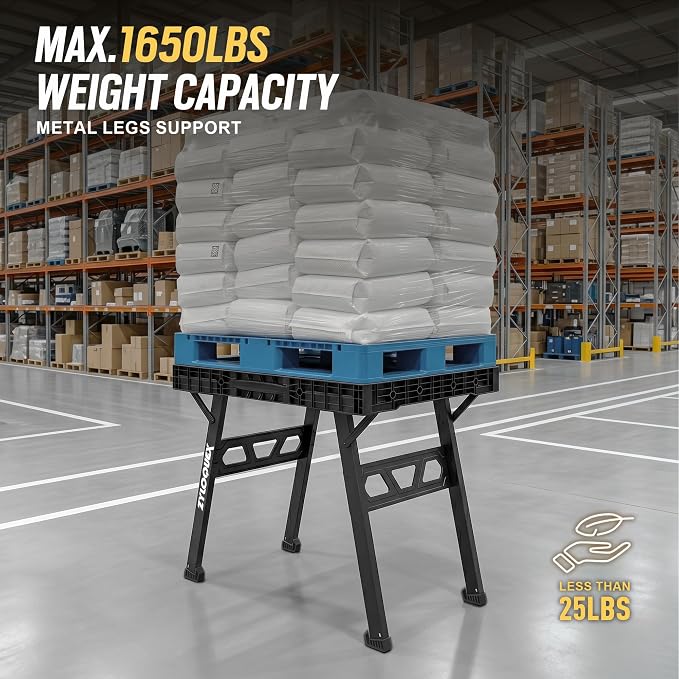
A meaningful load test should use a controlled and repeatable procedure.
The exact testing method may vary depending on the manufacturer’s internal quality system, customer requirements, or applicable testing procedures. However, several basic principles should remain consistent.
Step 1 — Prepare the Workbench in Its Working Position
A folding workbench should first be placed in the configuration in which it is intended to operate.
This means the tabletop should be fully opened and the support structure should be correctly positioned.
For a folding product, this step is particularly important because the structural system includes moving and locking components.
Before loading, inspectors should confirm:
- the tabletop is fully deployed;
- support points are correctly positioned;
- locking components are engaged;
- the legs are properly seated;
- the product is placed on a stable test surface.
Testing an incompletely deployed workbench would not provide a representative result for normal use.
Step 2 — Apply the Load in Controlled Stages
The load should be applied in a controlled manner rather than introduced through sudden impact.
Gradual loading makes it possible to observe structural changes before the final test load is reached.
During incremental loading, inspectors can observe:
- tabletop movement;
- frame displacement;
- joint behavior;
- leg stability;
- locking performance;
- visible deformation;
- unusual movement or noise.
The purpose of this process is not simply to reach the target number.
The behavior of the structure as the load increases can provide valuable information about how the workbench manages stress.
Step 3 — Control Load Distribution
Load distribution is one of the most important variables in any workbench test.
A uniformly distributed 750kg load creates a different loading condition from a heavy object concentrated in a small area.
For this reason, the test setup should clearly define where the load is positioned.
A distributed load can help evaluate the overall structure.
A localized load can reveal different information about the tabletop and support points.
Neither condition should automatically be treated as representative of every possible application.
Professional buyers should therefore ask suppliers whether the published capacity is based on distributed loading, central loading, or another defined test condition.
Which Structural Areas Should Be Observed During Testing?
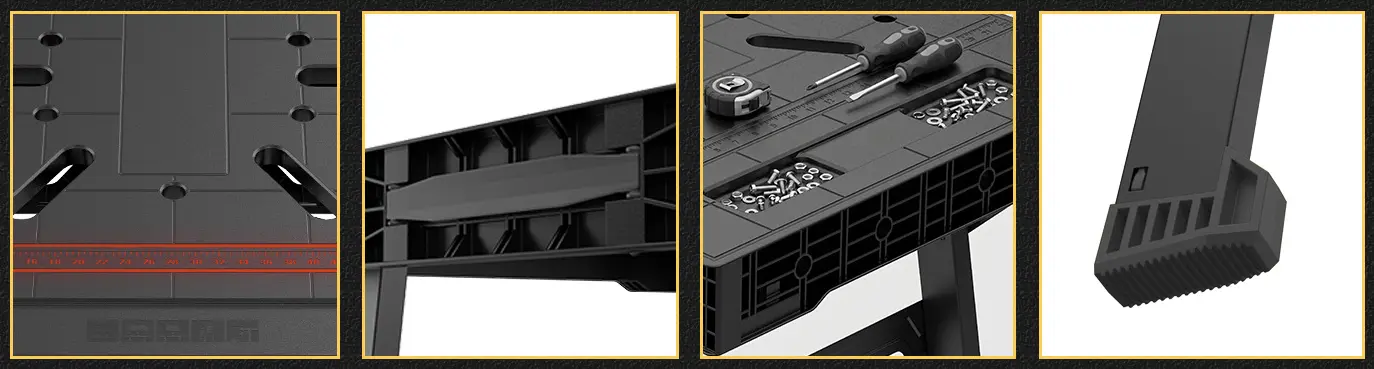
A useful load test does not focus only on the maximum weight.
It should also examine what happens to the individual parts of the structure while the load is being applied.
1.Tabletop Response
The tabletop is the first structural component that receives the applied load.
A thickened high-impact PP tabletop can provide a combination of low product weight, impact resistance, practical durability, and manufacturing flexibility. However, material selection is only one part of evaluating overall portable workbench quality.
During a test, inspectors should look for:
- excessive deflection;
- visible cracking;
- permanent deformation;
- movement around connection areas;
- changes in alignment;
- unusual stress near support points.
One important distinction is between temporary deflection and permanent deformation.
A structure may move slightly while under load and still return to its expected shape after unloading. A permanent change in geometry represents a different structural condition.
2.Frame Response
The supporting frame transfers the tabletop load toward the legs and the floor.
For a heavy duty folding workbench, this load path is critical.
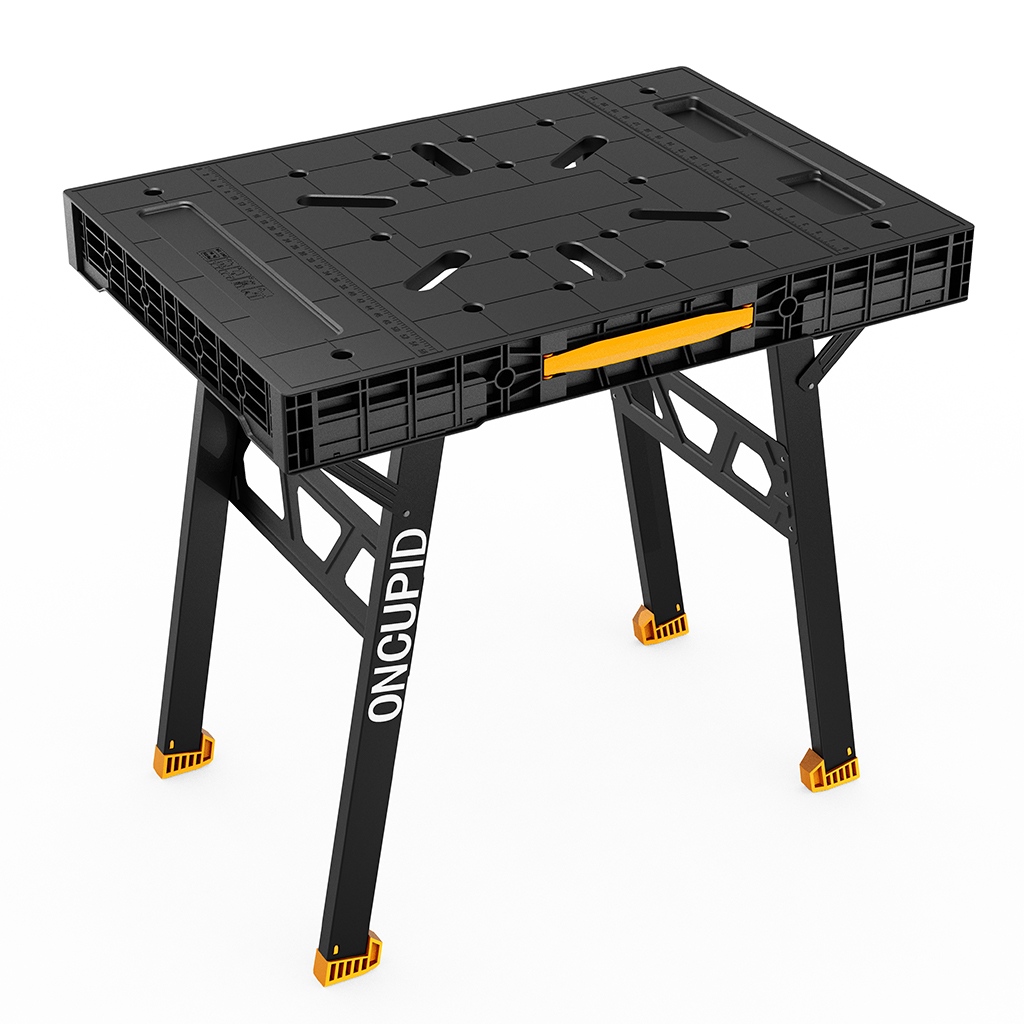
Jingyan’s 750kg folding workbench uses a reinforced carbon steel support frame beneath the tabletop. The combination is designed to keep the product portable while providing substantial structural support.
During testing, the frame should be checked for:
- bending;
- twisting;
- movement at joints;
- deformation near connection points;
- changes in leg alignment;
- instability during loading.
This is why a load rating should never be evaluated only by looking at the nominal material specification.
The overall structure matters more than one component considered in isolation.
3.Folding and Locking Points
A folding workbench must perform two different jobs.
It must fold efficiently for storage and transportation, and it must create a stable working platform after deployment.
The locking structure therefore becomes an important part of the load path.
A well-controlled test should confirm that the folding components remain correctly engaged throughout the loading period.
A high load rating is much more meaningful when the entire deployed structure remains stable rather than when only the tabletop itself carries the load.
4.Legs and Floor Contact
The legs transfer the load from the frame to the supporting surface.
Inspectors should therefore pay attention to:
- leg movement;
- uneven floor contact;
- lateral displacement;
- changes in support geometry;
- rocking during loading.
A strong tabletop cannot compensate for an unstable support structure.
What Happens After the Load Is Removed?
Post-load inspection is one of the most useful parts of a structured load test.
The workbench should be considered in three stages:
before loading → during loading → after unloading
This sequence provides more information than observing only the maximum load.
1.Temporary Deflection
A loaded structure can show temporary movement.
This is not automatically the same as structural failure or permanent damage.
What matters is whether the movement remains within the expected range for the intended application and whether the product returns to its normal condition after unloading.
2.Permanent Deformation
Permanent deformation is different.
If the tabletop, frame, legs, or connections remain visibly displaced after the load is removed, the test has revealed a lasting structural change.
For commercial product evaluation, this is important because repeated exposure to loads may need to be considered alongside one-time performance.
3.Alignment and Locking Condition
After unloading, inspectors should also check whether:
- the tabletop remains aligned;
- the frame remains symmetrical;
- the folding mechanism still operates correctly;
- the locking components engage normally;
- the legs return to their intended positions.
This creates a more complete picture of the product’s structural response.
Why Repeated Testing and Production Consistency Matter
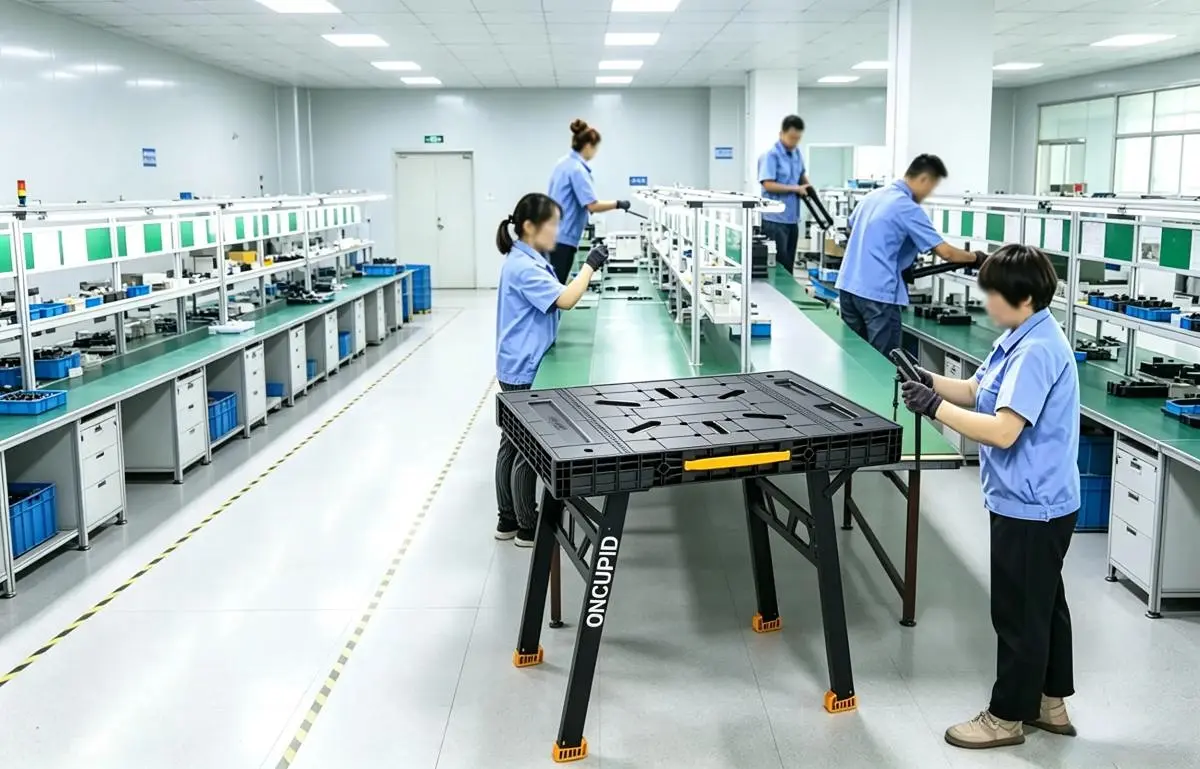
A single sample can demonstrate that a design is capable of supporting a defined load.
For a commercial buyer, however, another question is equally important:
Can the manufacturer consistently reproduce the same product performance in production?
This becomes particularly important when buyers move from samples to wholesale or private-label orders.
1.Prototype Performance Is Not the Same as Production Consistency
A prototype and a production unit may not perform identically if manufacturing variables change.
Potential variables include:
- material batches;
- component dimensions;
- molding conditions;
- metal-processing tolerances;
- assembly methods;
- fastening;
- inspection procedures.
This is why a load-capacity claim should be connected to production quality control.
For buyers assessing a portable workbench beyond a single load rating, weight, strength, and durability should also be considered together rather than as isolated specifications.
2.Quality Inspection Supports Consistency
Jingyan states that its folding workbenches undergo a triple inspection process before shipment.
For a buyer, this should be understood as a quality-control measure rather than as a replacement for structural testing.
The two processes answer different questions.
A load test asks:
How does the structure respond to a defined load?
Quality inspection asks:
Does the finished product conform to the required specifications and production requirements?
A commercial sourcing program benefits from both.
3.Why Consistency Matters for Private-Label Buyers
For a private-label buyer, a product may be sold under the same model name across multiple production batches.
Small differences that are insignificant in a single sample can become important when multiplied across hundreds or thousands of units.
Therefore, buyers should consider:
- sample approval;
- material consistency;
- dimensional consistency;
- production inspection;
- finished-product inspection;
- packaging quality.
A supplier’s ability to maintain consistency is part of the practical value of a load-capacity specification.
Real-World Performance: How Actual Use Differs From a Controlled Test
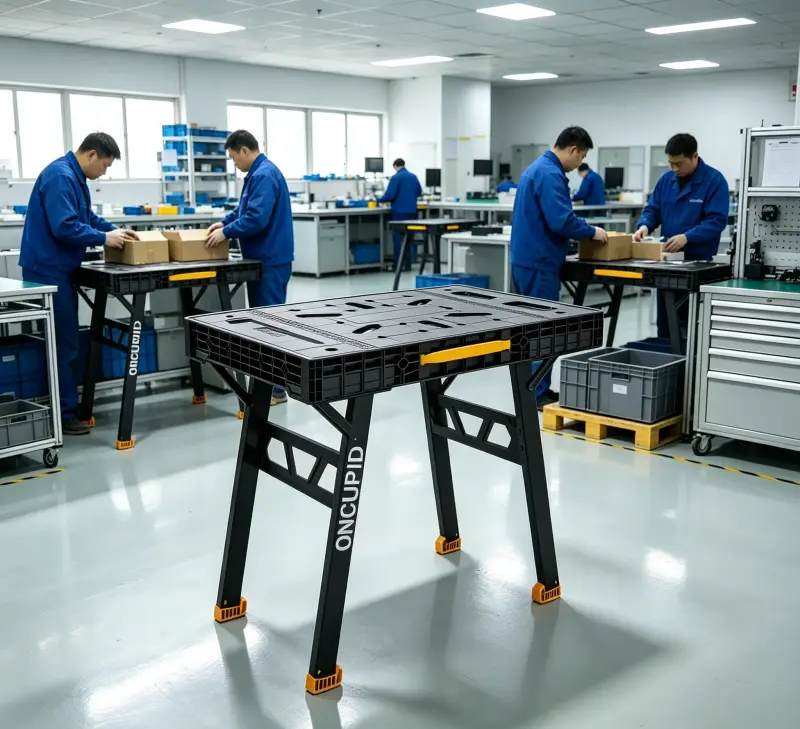
A controlled static test creates a defined measurement condition.
A real working environment is less predictable.
That does not make static load testing less useful. Instead, it means the test result needs to be interpreted within its intended scope.
1.Uneven Load Distribution
In practical use, heavy items are rarely distributed perfectly across the entire tabletop.
For example, several dense components may be placed close together, or a heavy object may sit closer to one side.
The total weight may remain well below 750kg, yet the local stress distribution can be different from the test condition.
This is why buyers should understand not only the maximum capacity but also the loading arrangement used during testing.
2.Point Loads
A concentrated load creates a different stress condition from a distributed load.
An industrial component with a small contact area may produce relatively high local pressure even when its total weight is much lower than the rated capacity.
For applications involving dense components, equipment, molds, or machinery, buyers should confirm whether the supplier has evaluated the intended loading condition.
3.Human Interaction
Actual work also creates forces beyond simple downward weight.
Workers may:
- push materials;
- pull components;
- operate clamps;
- lean against the tabletop;
- move tools;
- reposition heavy parts.
These actions create horizontal or dynamic forces.
Therefore, a 750kg workbench should not be presented as being capable of unlimited impact or dynamic loading simply because its static rating is 750kg.
Clear specifications protect both the buyer and the end user.
4.Floor Conditions
The supporting surface also affects practical performance.
A stable and reasonably level surface helps distribute forces through the legs.
An uneven surface may increase movement or shift more load toward particular support points.
For professional applications, correct deployment and stable positioning are therefore part of responsible product use.
A Practical Example: Jingyan's 750kg Folding Workbench
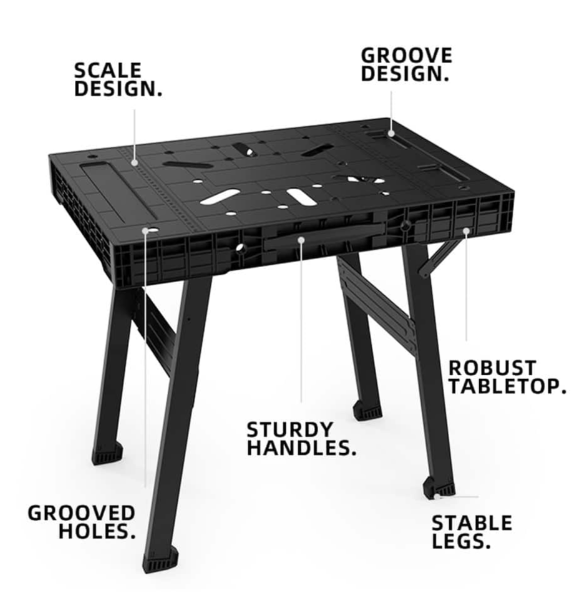
Jingyan’s 750kg folding workbench provides a useful example of how a product specification can be interpreted through structural testing.
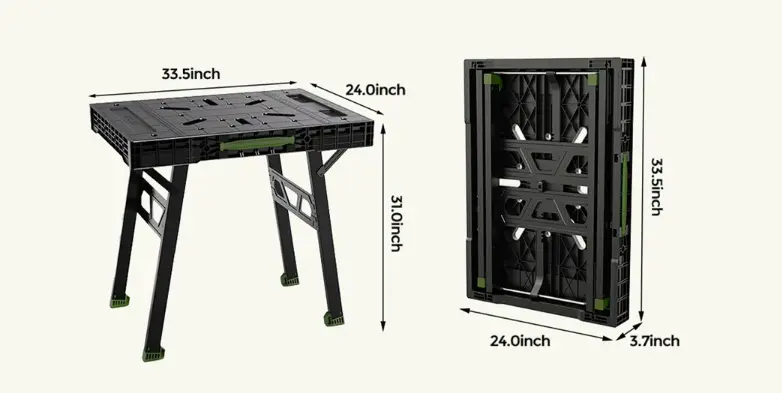
The workbench combines a thickened high-impact PP tabletop with a reinforced carbon steel frame. It weighs approximately 10.5kg (23.3 lb) and has a listed 750kg static load capacity.
The working dimensions are approximately 33.5 inches deep × 24 inches wide × 31 inches high.
The product is available in black, black/green, and black/yellow configurations within the listed WORKBENCH01, WORKBENCH02, and WORKBENCH03 series.
1.Why the Weight-to-Capacity Relationship Matters
A product weighing approximately 10.5kg while carrying a listed 750kg static load represents a substantial difference between product weight and rated capacity.
That does not mean the product should be exposed to unlimited dynamic force.
Instead, it highlights the importance of structural load paths.
The tabletop, frame, connections, and legs must work together to transfer the applied load.
2.Interpreting the 750kg Specification
The product is marketed with a 3x static load testing claim.
For professional buyers, the useful follow-up is to understand the test basis behind that claim.
Questions may include:
- What was the test load?
- How was the load distributed?
- How long was the load maintained?
- What structural changes were observed?
- Was the product inspected after unloading?
These details make a load-capacity claim more useful than a number viewed in isolation.
3.Portability and Heavy-Duty Performance
A folding workbench needs to balance portability with structural support.
Jingyan’s design uses a tool-free folding mechanism intended to make deployment and storage practical while maintaining a substantial load-bearing structure when fully opened.
The key point for buyers is that foldability should be evaluated in the deployed working configuration.
The product’s ability to become compact during storage does not itself determine its load capacity. The performance of the structure after it is fully opened and locked is what matters during operation.
How Professional Buyers Should Verify a 750kg Workbench Claim
For an importer or private-label buyer, reviewing a product page is only the first step.
A better supplier evaluation process connects the load rating with specific evidence.
For a broader framework covering load capacity, materials, supplier checks and OEM considerations, buyers can also refer to our heavy duty workbench buying guide.
1.Ask What the 750kg Rating Represents
Questions can include:
- Is the rating static or dynamic?
- Is the load uniformly distributed?
- Where is the load positioned?
- How long is the load maintained?
- What is considered a pass or fail?
- Is the product inspected after unloading?
These questions help buyers avoid comparing different load ratings as if they represented identical test conditions.
2.Confirm That the Tested Version Matches the Production Version
This is especially important for OEM and ODM projects.
Changes to:
- material;
- color formulation;
- structure;
- hardware;
- component dimensions;
- tooling;
may affect the final product.
If the design changes, the buyer should confirm whether additional testing is required.
3.Review the Supplier's Manufacturing Capabilities
For structural products, manufacturing capability can directly influence consistency.
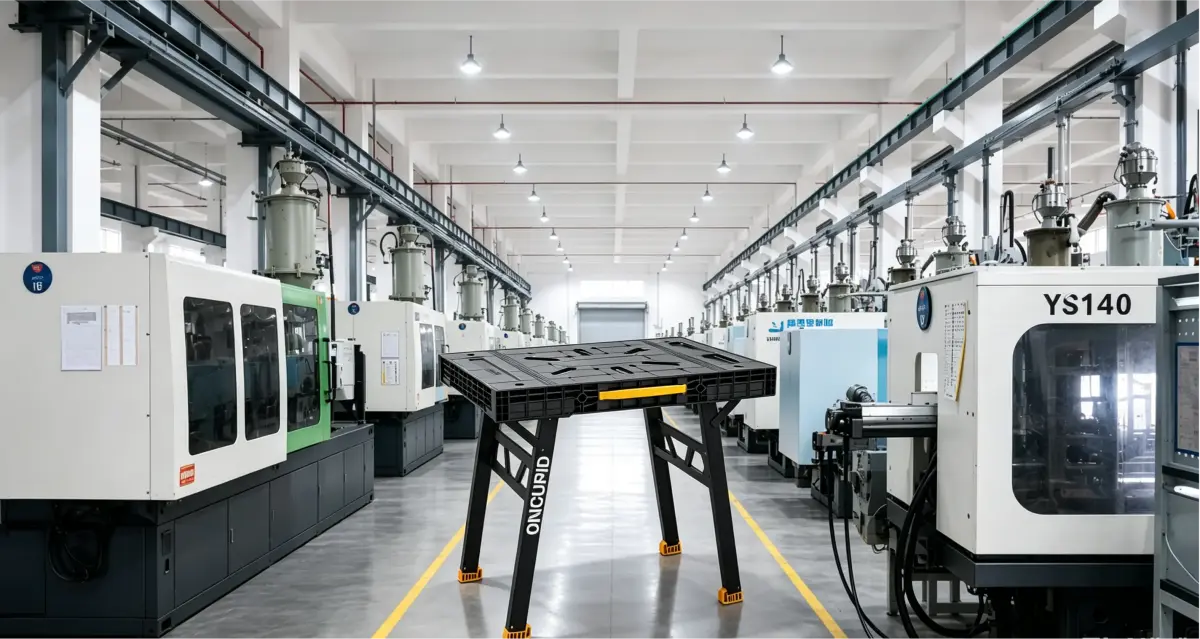
Ningbo Jingyan Tool Industrial Co., Ltd. has operated since 2003 and provides OEM/ODM manufacturing for workbenches and other industrial tools. The company’s current website describes a 16,000㎡ self-owned production base, more than 140 professionals, and integrated functions covering R&D, mold development, production, quality control, and customer service.
Its manufacturing system includes equipment for injection molding, CNC machining, stamping, and mold development.
For a buyer sourcing a folding workbench, these capabilities are relevant because changes to the plastic or metal structure can involve multiple production stages.
4.Evaluate Production Capacity Alongside Quality
A supplier must be able to move from sample development to repeat production without losing consistency.
Jingyan states a standardized production capacity of approximately 300 workbenches per day and around 7,000 workbenches per month, in addition to accessory production.
For commercial buyers, production scale is therefore worth evaluating alongside testing and quality control.
What a 750kg Rating Does Not Mean
A clear load specification should also define its limits.
A 750kg load capacity does not automatically mean:
1.Unlimited Impact Loading
Dropping a heavy object onto the tabletop can generate impact forces that are different from a controlled static load.
2.Unlimited Concentrated Loading
3.Safe Operation in a Partially Folded Position
4.Identical Performance on Every Floor Surface
5.A Replacement for Application-Specific Engineering
These limitations do not make a 750kg rating less useful.
They define the conditions under which the rating should be understood.
A Practical 750kg Folding Workbench Testing Checklist for Buyers
Before approving a workbench for commercial sourcing, buyers can review the following areas.
1.Product Configuration
Confirm:
- exact model;
- dimensions;
- product weight;
- tabletop material;
- frame material;
- folding configuration;
- locking configuration.
2.Load Test Conditions
Confirm:
- rated load;
- actual test load;
- static or dynamic condition;
- load distribution;
- test duration;
- test configuration;
- post-test inspection.
3.Structural Response
Observe:
- tabletop deflection;
- frame bending;
- joint movement;
- leg stability;
- locking behavior;
- recovery after unloading.
4.Production Quality
Review:
- material consistency;
- dimensional consistency;
- assembly inspection;
- finished-product inspection;
- packaging protection.
5.Commercial Supply Capability
For importers and private-label buyers, also review:
- OEM/ODM support;
- customization;
- packaging options;
- production capacity;
- lead time;
- quality-control procedures.
This produces a much clearer supplier evaluation than simply comparing one manufacturer’s “750kg” figure with another supplier’s headline specification.
Frequently Asked Questions About 750kg Folding Workbenches
1.Is a 750kg folding workbench suitable for heavy-duty applications?
A workbench with a listed 750kg static load capacity is designed around a high-load application, but buyers should still evaluate the testing conditions and intended working environment.
The 750kg figure should not automatically be interpreted as unlimited impact, vibration, or uneven dynamic loading.
2.Is the 750kg rating static or dynamic?
For the Jingyan workbench discussed here, the listed 750kg capacity is presented as a static load capacity.
Buyers should still confirm the detailed test conditions when evaluating the product for a specific application.
3.How should a 750kg folding workbench be tested?
A typical controlled evaluation starts with the workbench fully deployed on an appropriate surface. A defined load is then applied according to the test condition, while the tabletop, frame, joints, legs, and locking points are observed.
The workbench should also be inspected after unloading.
4.Does a higher load rating automatically mean better performance?
Not necessarily.
Load capacity is one performance metric.
A commercial buyer may also need to consider stability, folding reliability, portability, dimensional consistency, manufacturing quality, and application conditions.
5.Can a folding workbench support 750kg while partially folded?
The rated capacity should be understood in the intended fully deployed working configuration.
A folding workbench should be properly opened, positioned, and locked before use.
6.What should an importer ask the manufacturer?
Useful questions include:
- What does the load rating represent?
- What test configuration was used?
- How was the load distributed?
- Was the product inspected after unloading?
- Does the tested version match the production version?
- What quality-control procedures are used for mass production?
7.Can this type of 750kg workbench be customized for private-label projects?
Yes. Jingyan provides OEM/ODM options including logo printing, Pantone color matching, custom packaging, and structural modification.
For structural modifications, buyers should confirm whether the revised configuration requires additional performance verification.
Final Takeaway: Look Beyond the 750kg Number
A 750kg folding workbench should not be evaluated by its maximum load figure alone.
The real value of the specification comes from the conditions behind it.
A meaningful evaluation should connect:
test configuration → load distribution → structural response → post-load condition → production consistency → real-world use
For professional buyers, this creates a much clearer way to compare suppliers and evaluate a product for wholesale or private-label sourcing.
The most useful question is not simply:
“Can this folding workbench hold 750kg?”
A more useful question is:
“Under what conditions was the 750kg capacity established, how did the structure respond during testing, and can the manufacturer consistently reproduce that performance in production?”
That approach turns a headline specification into a more practical purchasing decision.
For a heavy duty folding workbench, credible performance evaluation should connect structural design, controlled testing, quality control, and application conditions.
For buyers considering the Jingyan 750kg folding workbench for wholesale, OEM, ODM, or private-label programs, the next step is to confirm the exact configuration, testing basis, customization requirements, packaging, and production specifications with the manufacturer.
Related products