How Much Weight Can a Sawhorse Hold? A Buyer’s Guide to Load Capacity
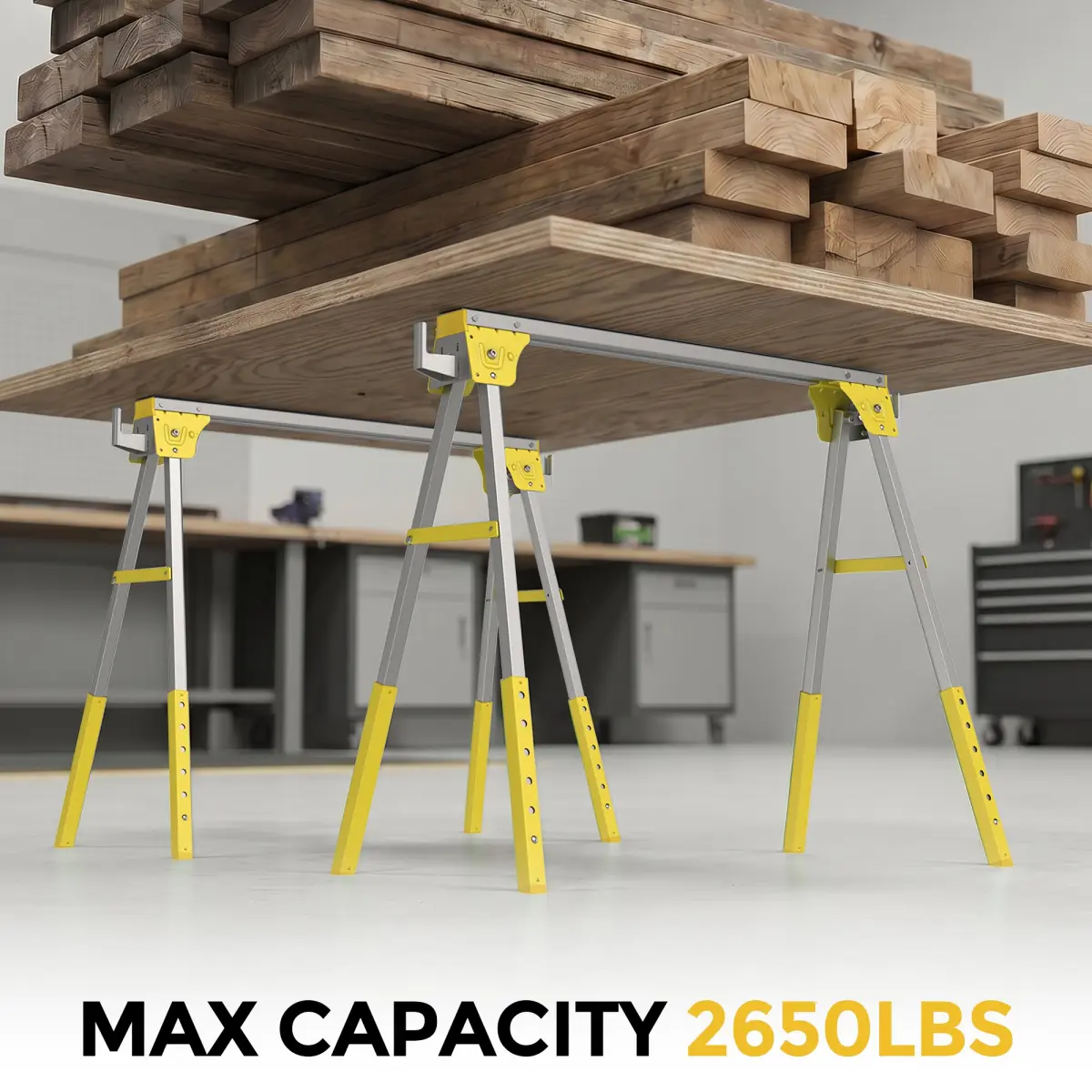
A sawhorse may look like a simple support stand, but its load capacity is one of the most important specifications to understand before purchasing or sourcing one.
For professional users, a sawhorse may support timber, plywood, panels, construction materials, tools, or temporary work surfaces. The amount of weight it can safely support depends not only on the number printed on a product specification sheet, but also on how that number was established, how the load is distributed, how the sawhorse is positioned, and how the structure performs under working conditions.
This is especially important when evaluating a heavy duty sawhorse for construction, woodworking, maintenance, material preparation, or professional workshop applications.
For B2B buyers, load capacity also has a commercial dimension. Importers and distributors need specifications that can be communicated clearly to their customers. Tool brands need reliable performance data when developing their product ranges. Retailers need product information that is easy to understand without creating misleading expectations.
A useful load-capacity evaluation therefore starts with a simple question:
What does the stated weight capacity actually mean?
This guide explains how professional buyers can evaluate sawhorse load capacity, understand the difference between a single-unit rating and a pair rating, assess structural factors, and determine whether a heavy duty folding sawhorse is appropriate for a particular market.
- What Does Sawhorse Load Capacity Actually Mean?
- Why Load Capacity Matters to Professional Buyers
- Single Sawhorse Capacity vs. Pair Capacity
- How Load Distribution Affects Sawhorse Performance
- What Makes a Sawhorse “Heavy Duty”?
- How Frame Construction Influences Load Capacity
- Why Stability Is Just as Important as Weight Rating
- Does Folding Design Reduce Load Capacity?
- How the NH-SH001 Handles Heavy-Duty Support
- How Product Weight Relates to Heavy-Duty Performance
- Why Testing Matters When Evaluating Load Capacity
- Static Load vs. Real-World Working Conditions
- How Load Capacity Should Be Evaluated for Different Applications
- Common Mistakes Buyers Make When Comparing Sawhorse Capacity
- What B2B Buyers Should Ask a Sawhorse Manufacturer
- Why Manufacturing Capability Matters for Heavy-Duty Sawhorses
- How Load Capacity Influences Product Positioning
- How Buyers Can Compare Heavy Duty Sawhorses More Accurately
- Frequently Asked Questions About Sawhorse Load Capacity
- Final Takeaway: Load Capacity Is More Than a Number
What Does Sawhorse Load Capacity Actually Mean?
Load capacity is the maximum weight a product is designed or rated to support under specified conditions.
However, a load rating should not automatically be interpreted as a universal guarantee for every possible working situation.
For example, a product rated at 2,650 lbs per pair does not necessarily mean that users should place any 2,650-lb object on the sawhorses in any position and under any circumstances.
Professional buyers should first determine:
- Whether the rating applies to one sawhorse or a pair
- Whether the load is evenly distributed
- Whether the rating refers to static loading
- What working conditions were used during testing
- Whether the product was fully opened and locked
- Whether the manufacturer specifies particular usage conditions
- Whether the load rating applies to the complete product assembly
This distinction is particularly important when comparing heavy duty saw horses from different manufacturers.
A higher number is not automatically a better product if the rating is calculated or presented differently.
The first step is therefore to understand exactly what the manufacturer’s specification represents.
Why Load Capacity Matters to Professional Buyers
For an occasional user, load capacity may seem like a simple product specification.
For a professional buyer, however, it can influence product positioning, customer expectations, product safety, and long-term brand reputation.
A contractor may use a sawhorse to support construction materials throughout the day. A woodworking customer may use a pair to support long boards or panels. A distributor may sell the same product to several different customer groups.
In each case, the buyer needs confidence that the product specification accurately represents its intended application.
Load capacity can also influence how a product is positioned in a catalogue.
A basic support stand may be marketed toward light-duty household applications, while a heavy duty sawhorse can be positioned toward construction, woodworking, workshop, and professional markets.
For this reason, load capacity is not simply a technical number.
It is part of the product’s value proposition.
Single Sawhorse Capacity vs. Pair Capacity
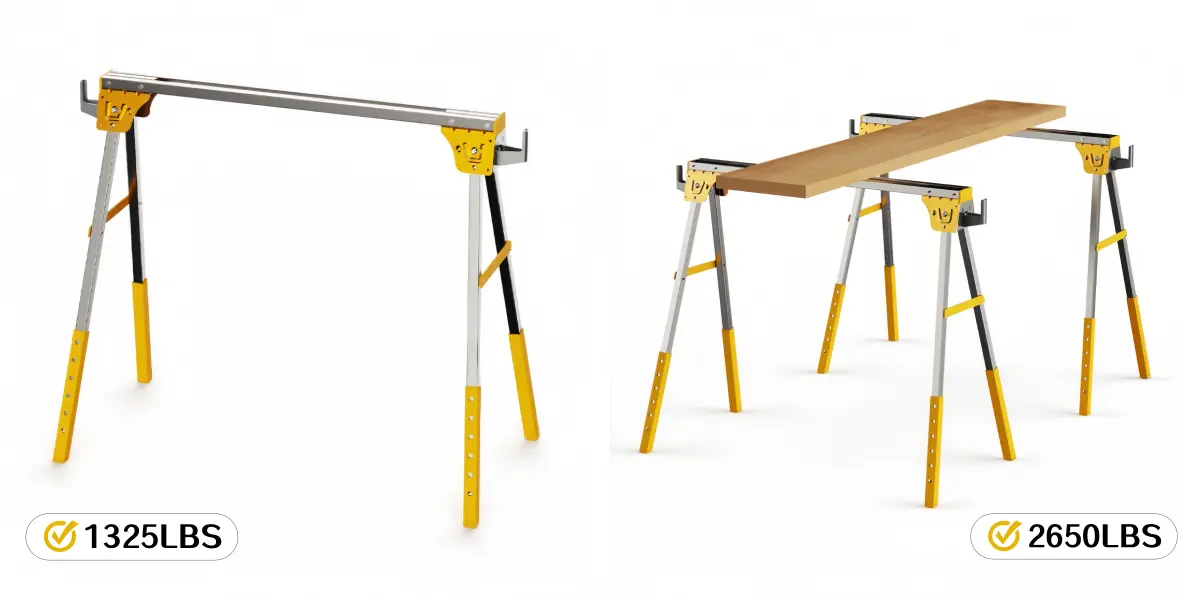
One of the most common points of confusion is whether the advertised load capacity applies to one sawhorse or a pair.
This distinction should always be checked before comparing products.
A pair of sawhorses is frequently used to support long materials because two support points provide a more practical working arrangement.
For example, the Jingyan NH-SH001 is specified with a 2,650 lbs load capacity per pair.
That wording matters.
The figure should be communicated as:
2,650 lbs per pair
rather than simply:
2,650 lbs
because the second version can easily be misunderstood as the capacity of one individual unit.
For distributors and retailers, accurate wording is particularly important.
Product pages, packaging, catalogues, advertising materials, and sales documentation should use the same capacity definition so that customers receive consistent information throughout the purchasing process.
1.Why Two Sawhorses Are Often Used Together
Long materials behave differently from compact objects.
A long timber board, plywood sheet, or construction component can extend significantly beyond the support points. Using two sawhorses allows the material to be supported at two locations rather than resting on a single central point.
This can improve the overall working arrangement.
However, using two sawhorses does not mean that the capacity can automatically be doubled under every condition.
The manufacturer’s stated rating should always be followed as written.
If a product is rated at 2,650 lbs per pair, the buyer should treat that as the specified pair capacity rather than independently calculating a new rating.
How Load Distribution Affects Sawhorse Performance
The total weight of a load is only one part of the equation.
How the weight is distributed also matters.
Consider two situations.
In the first situation, a long board distributes its weight relatively evenly across two properly positioned supports.
In the second situation, a concentrated load is placed close to one edge of a support.
The total weight could be identical, but the structural loading conditions are different.
For this reason, professional users should consider:
- Load distribution
- Position of the material
- Distance between support points
- Center of gravity
- Contact area
- Stability of the floor
- Orientation of the sawhorse
This is why a load rating should not be interpreted as permission to place any object anywhere on the product.
The rating describes a specified performance condition.
Actual working conditions still need to follow the manufacturer’s instructions and appropriate safety practices.
What Makes a Sawhorse “Heavy Duty”?
The phrase heavy duty sawhorse is commonly associated with higher load capacity, but load rating alone does not define heavy-duty construction.
A professional heavy-duty product normally needs a combination of structural and functional characteristics.
These may include:
- Strong structural frame
- Reinforced support points
- Reliable joints
- Stable leg geometry
- Secure locking mechanisms
- Durable materials
- Appropriate contact surfaces
- Consistent manufacturing quality
A sawhorse with a large advertised capacity but weak connections would not provide the same overall value as a product whose entire structure has been designed around the intended workload.
This is why buyers should evaluate the complete load-bearing system rather than looking only at the headline number.
How Frame Construction Influences Load Capacity
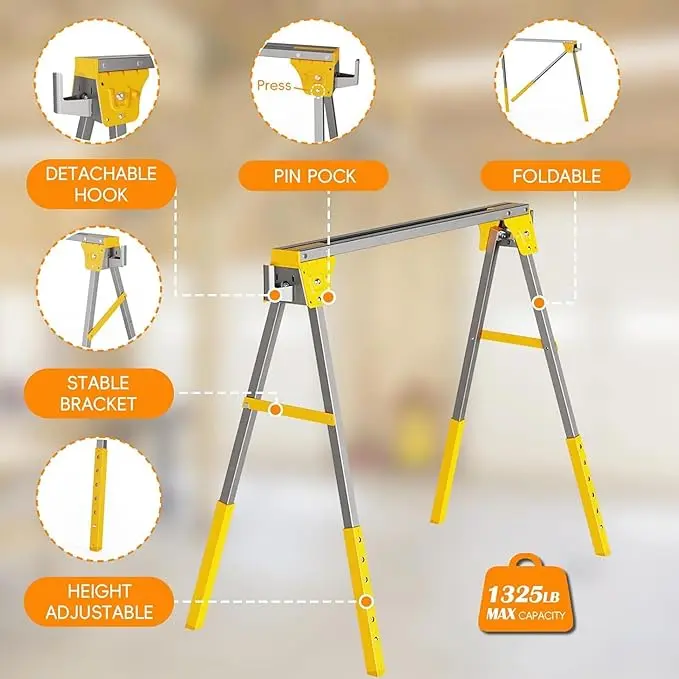
The frame is the primary structural component of most metal sawhorses.
Its geometry determines how loads are transferred through the legs and supporting members toward the ground.
For a professional heavy duty folding sawhorse, the frame must perform two different functions.
First, it needs to provide sufficient support when the product is open.
Second, it needs to accommodate folding without compromising the working structure.
The Jingyan NH-SH001 uses a metal + PP + TPR construction, with the metal component forming the primary structural framework.
This multi-material construction illustrates an important point about product engineering.
Not every component needs to be made from the same material.
Structural components can be optimized for strength, while polymer components can be used where other functional requirements are important.
For B2B buyers, understanding this distinction is more useful than simply asking whether a product is “metal” or “plastic.”
Why Stability Is Just as Important as Weight Rating
A high load rating has limited practical value if the product is unstable during use.
Stability depends on multiple factors, including:
- Leg geometry
- Ground contact
- Frame structure
- Locking points
- Working height
- Material position
- Floor conditions
- Load distribution
A sawhorse needs to remain appropriately positioned while supporting the intended material.
This is especially important when the product is used for cutting or handling long materials.
For example, a long board can create movement if its weight extends significantly beyond the support points.
Professional buyers should therefore evaluate load capacity and stability together.
A useful procurement question is not simply:
“How much weight can this sawhorse hold?”
It is:
“How does the structure maintain stable support under the intended load?”
That question provides a much more meaningful basis for supplier comparison.
Does Folding Design Reduce Load Capacity?
Not necessarily.
A folding mechanism introduces additional structural components, but a well-engineered folding sawhorse can still provide substantial load-bearing performance.
The important issue is how the folding structure is engineered.
Buyers should examine:
- Locking mechanisms
- Hinge or connection points
- Leg structure
- Frame thickness
- Contact points
- Opening position
- Locking reliability
The product needs to transition from a compact transport configuration into a stable working configuration.
Once fully opened and secured, the structure should provide the intended support performance according to the manufacturer’s specifications.
This is one reason a heavy duty folding sawhorse should not be evaluated only by its folded appearance.
The working configuration is what ultimately determines whether the product is suitable for professional use.
How the NH-SH001 Handles Heavy-Duty Support
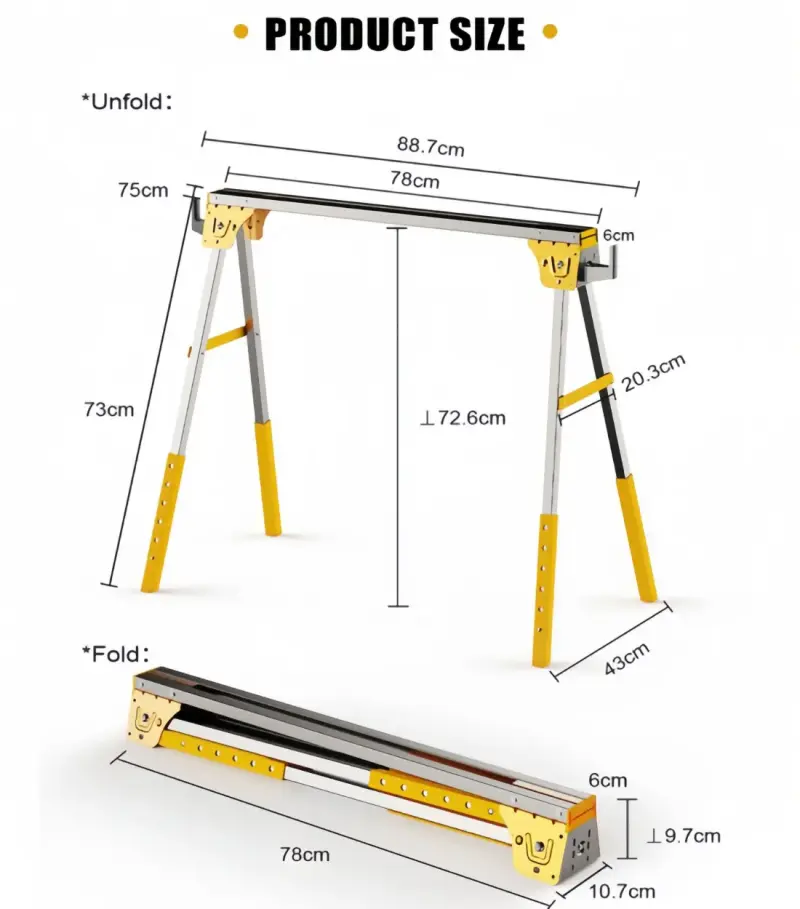
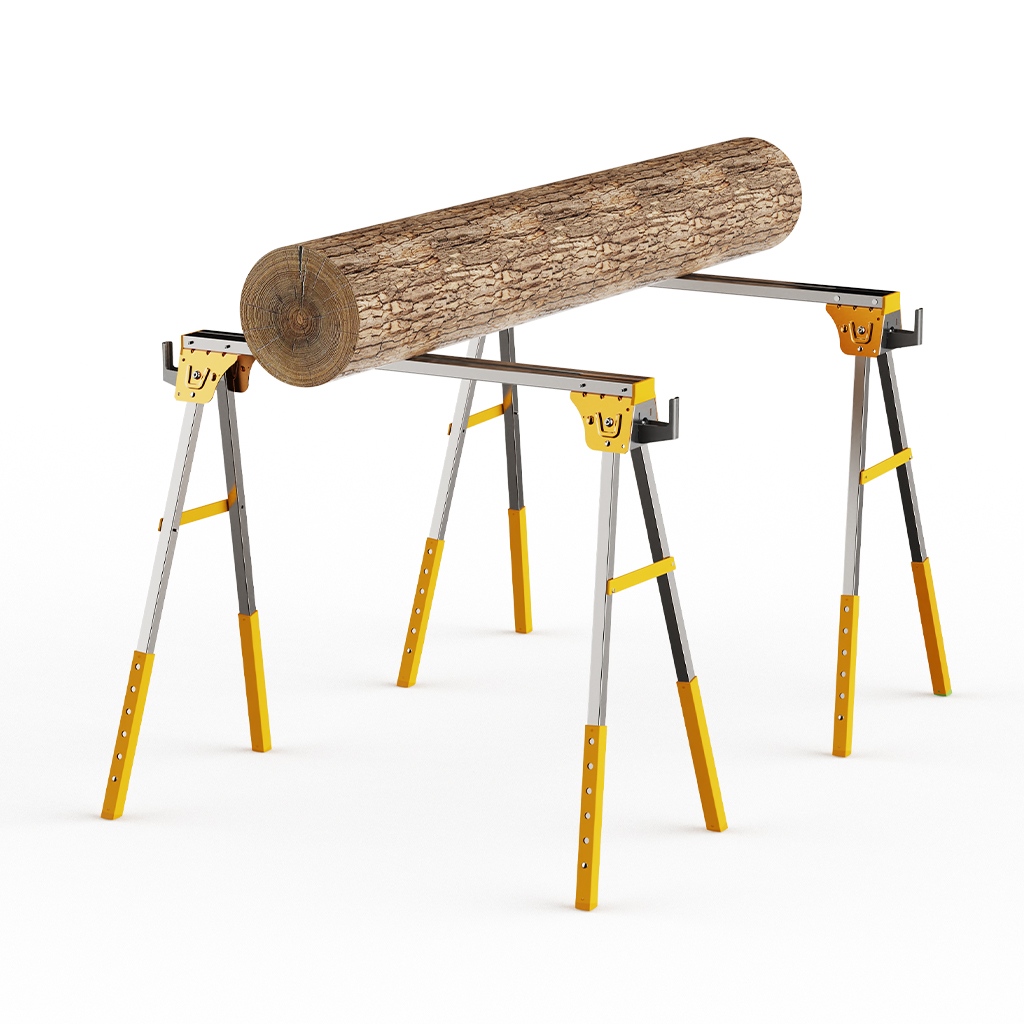
The Jingyan NH-SH001 is an example of a folding sawhorse designed around professional support requirements.
Its published specifications include:
| Specification | NH-SH001 |
|---|---|
| Material | Metal + PP + TPR |
| Load Capacity | 2,650 lbs/pair |
| Unfolded Dimensions | 88.7 × 43 × 72.6 cm |
| Folded Dimensions | 78 × 10.7 × 9.7 cm |
| Product Weight | Approximately 4.5 kg |
| Height Adjustment | Available |
| Color Options | Green, Yellow, Blue |
The combination is important.
The product is not simply designed to carry a high load. It also needs to remain practical to move, store, and deploy.
At approximately 4.5 kg, the product provides a relatively portable format for professional users who may need to move equipment between different working areas.
Its folded dimensions also make storage and transportation more practical.
This combination of load performance and portability is particularly relevant for distributors targeting contractors, woodworking users, construction markets, and mobile professional applications.
How Product Weight Relates to Heavy-Duty Performance
A common misconception is that a heavier sawhorse must always be stronger.
That is not necessarily true.
Product weight is influenced by:
- Material selection
- Frame geometry
- Component thickness
- Product dimensions
- Folding structure
- Polymer components
- Manufacturing methods
A heavier product may use more material, but additional weight does not automatically translate into better structural performance.
For professional buyers, a better question is:
Does the product achieve the required load performance without creating unnecessary transportation and handling problems?
This is particularly important for folding equipment.
A contractor may need to carry a pair of sawhorses from a vehicle to a jobsite. A distributor may need to consider shipping efficiency. A retailer may need to store multiple units.
In these situations, a balance between structural performance and practical weight can be more valuable than simply maximizing product mass.
Why Testing Matters When Evaluating Load Capacity
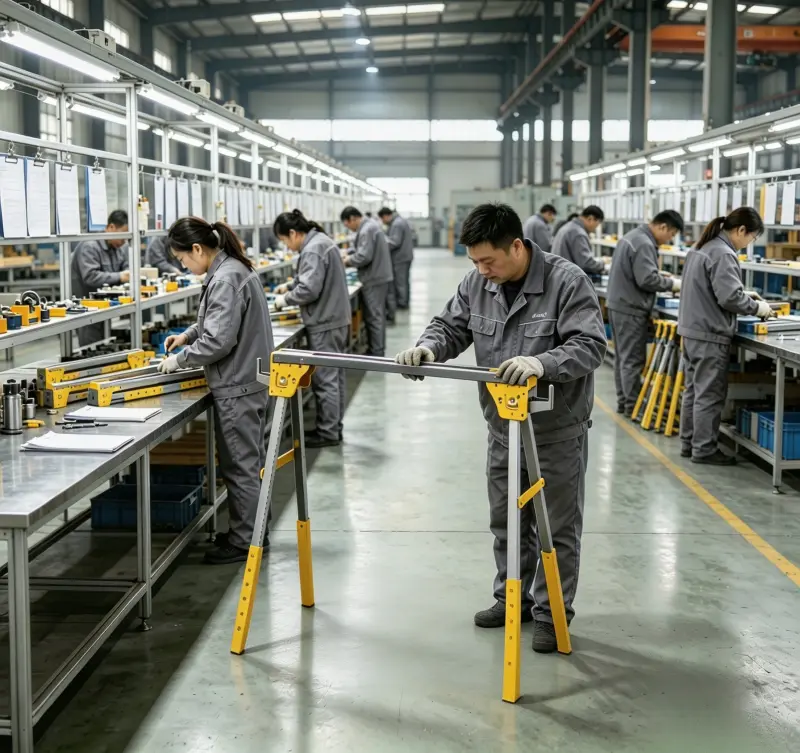
A load rating should ideally be supported by a repeatable testing and quality-control process.
For B2B buyers, useful questions include:
- How is load capacity tested?
- Is testing performed during product development?
- Are finished products inspected?
- Is the same testing method used across production batches?
- Are structural components checked?
- Are folding mechanisms inspected?
- Are defective products separated before shipment?
This is where factory capability becomes relevant.
A product specification has greater commercial value when the manufacturer has the production and quality-control systems required to reproduce that specification consistently.
Jingyan Tools states that its manufacturing system includes R&D, mold development, production, quality control, and an independent testing laboratory, together with more than 50 sets of production equipment. These capabilities support the broader quality-control and manufacturing side of its B2B product development.
For buyers, the important point is not simply that a factory owns equipment.
The more useful question is whether those capabilities are integrated into a repeatable manufacturing process.
Static Load vs. Real-World Working Conditions
Another important distinction is the difference between a controlled load test and real-world use.
A static load test generally evaluates how a product responds to a defined load under controlled conditions.
Real work can involve additional variables.
For example:
- The material may be unevenly distributed.
- The user may reposition the material.
- The floor may not be perfectly level.
- The product may be moved between locations.
- The sawhorse may be repeatedly opened and folded.
- Materials may extend beyond the support points.
This does not make the rated load capacity meaningless.
Instead, it means that professional users should understand what the specification represents.
A load rating should be used as part of a broader product evaluation rather than as the only factor determining whether a product is suitable for a specific application.
How Load Capacity Should Be Evaluated for Different Applications
Different applications place different demands on a sawhorse.
How to Choose the Right Folding Sawhorse for Different Workloads?
1.Woodworking
Woodworking users may need to support:
- Timber
- Plywood
- Panels
- Doors
- Trim
- Long boards
For these applications, buyers should consider load capacity together with stability, working height, support spacing, and portability.
2.Construction
Construction users may place greater emphasis on:
- Higher load requirements
- Repeated setup
- Jobsite transportation
- Structural durability
- Stable support
- Folding convenience
For this market, a heavy duty folding sawhorse can provide a useful combination of support capability and mobility.
3.Maintenance and Workshops
Workshop users may need the same sawhorse for several different tasks.
Here, versatility can become more important than maximizing a single specification.
The product may need to be moved frequently, stored after use, and adapted to different working areas.
4.Material Preparation
For cutting and material preparation, buyers should pay close attention to how long materials are supported.
The load capacity should be considered alongside the number and position of support points.
Common Mistakes Buyers Make When Comparing Sawhorse Capacity
Professional buyers can avoid several common mistakes by looking beyond the headline number.
Mistake 1: Comparing Numbers Without Checking the Unit
Mistake 2: Assuming Higher Capacity Always Means Better
A higher capacity may come with greater weight, larger dimensions, higher cost, or lower portability.
The correct product depends on the target application.
Mistake 3: Ignoring Load Distribution
A total weight figure does not describe every possible loading condition.
The location and distribution of the load matter.
Mistake 4: Ignoring the Folding Structure
For a folding product, hinges, locking components, and connection points deserve attention.
Mistake 5: Looking Only at the Sample
What B2B Buyers Should Ask a Sawhorse Manufacturer
Before placing a wholesale or OEM order, professional buyers can ask a manufacturer several practical questions.
1. What is the rated load capacity?
2. How is the capacity tested?
3. What materials are used?
4. What are the working and folded dimensions?
5. What is the product weight?
6. Is the product suitable for repeated folding?
7. Can the product be customized?
8. Can the supplier maintain consistent production?
Why Manufacturing Capability Matters for Heavy-Duty Sawhorses
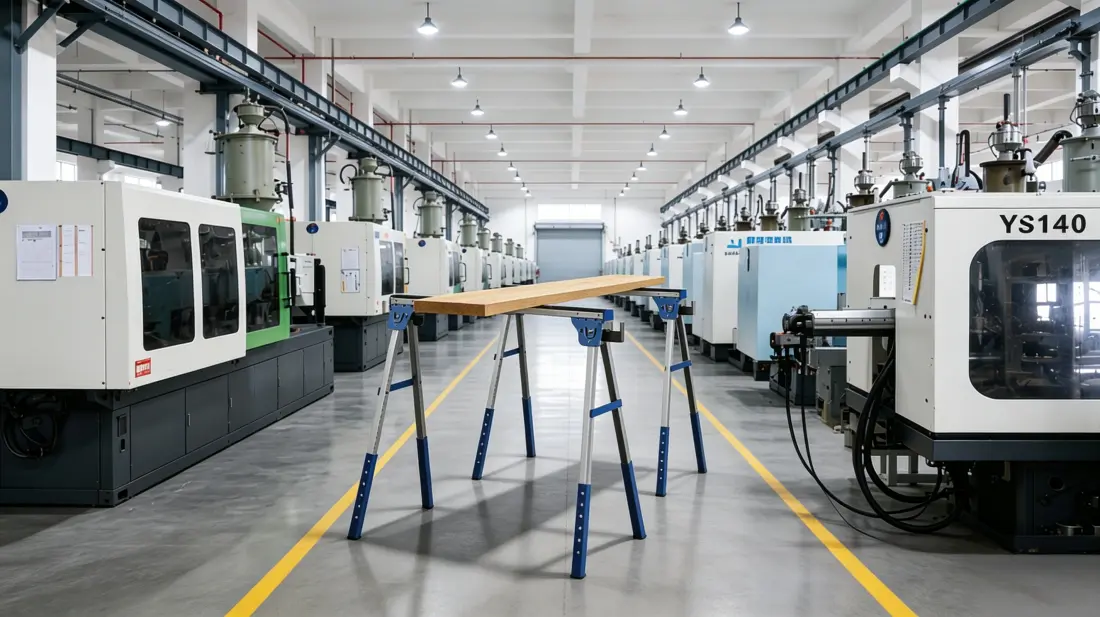
For B2B buyers, the product and the factory cannot be separated completely.
A heavy-duty product requires consistent materials, controlled assembly, appropriate quality inspection, and stable production processes.
Ningbo Jingyan Tool Industrial Co., Ltd. was founded in 2003 and operates a self-owned production base of more than 16,000㎡ with more than 140 professionals. The company focuses on workbenches, plastic products, metal stamping parts, tool storage solutions, and related industrial tool products.
Its manufacturing system includes R&D, mold development, production, quality control, and customer service. The company also reports more than 50 sets of production equipment and a production capacity of approximately 300 workbenches per day.
For B2B buyers, these factory attributes matter because a successful product program requires more than producing one sample.
It requires the ability to reproduce the required specifications across commercial production.
Jingyan Tools also provides OEM and ODM services for buyers developing customized products, branding, colors, packaging, or other product requirements.
How Load Capacity Influences Product Positioning
Load capacity can also influence how a distributor positions a product.
A lower-capacity product may be suitable for occasional household or light workshop use.
A heavy duty sawhorse, by contrast, can be positioned toward:
- Professional contractors
- Construction suppliers
- Woodworking retailers
- Hardware distributors
- Workshop equipment suppliers
- Tool brands
The key is to match the product specification with the market promise.
A distributor should not promote a product as suitable for applications that exceed the manufacturer’s stated specifications.
Instead, the load rating should support a clear and credible product position.
This approach helps create better alignment between product engineering, marketing communication, and customer expectations.
How Buyers Can Compare Heavy Duty Sawhorses More Accurately
When comparing several heavy duty saw horses, create a specification table rather than comparing only one number.
Consider:
| Evaluation Factor | Why It Matters |
|---|---|
| Load capacity | Indicates rated support capability |
| Capacity basis | Shows whether rating is per unit or pair |
| Frame material | Indicates structural approach |
| Folding structure | Affects portability and storage |
| Stability | Influences practical working performance |
| Product weight | Affects handling and transport |
| Folded dimensions | Affects storage and logistics |
| Working dimensions | Determines usable support area |
| Testing | Provides evidence behind specifications |
| Quality control | Supports batch consistency |
| OEM/ODM | Supports private-label and customized programs |
This method gives professional buyers a much clearer picture of overall product value.
A product with slightly lower capacity but better portability may be more suitable for one market.
A product with higher capacity and heavier construction may be more suitable for another.
The objective is not to find the largest number.
The objective is to find the product whose complete specification matches the intended customer and application.
Frequently Asked Questions About Sawhorse Load Capacity
1.How much weight can a heavy duty sawhorse hold?
The answer depends on the specific model and its rated capacity. For the Jingyan NH-SH001, the stated load capacity is 2,650 lbs per pair. Users should follow the manufacturer’s specifications and instructions rather than applying the number to conditions outside the rated use.
2.Is 2,650 lbs the capacity of one sawhorse?
For the NH-SH001, the stated rating is 2,650 lbs per pair, not 2,650 lbs for a single unit. This distinction should be clearly communicated in product listings and purchasing documents.
3.Are heavy duty folding sawhorses strong enough for construction?
A properly engineered folding sawhorse can be suitable for professional construction applications when its rated capacity, structural design, and intended use match the requirements of the job.
4.Does a heavier sawhorse always have a higher load capacity?
No. Product weight alone does not determine structural performance. Frame geometry, materials, connections, load paths, and manufacturing quality all contribute to the final result.
5.What should I check when comparing heavy duty saw horses?
Check the rated capacity, whether it applies to one unit or a pair, materials, frame construction, stability, folding mechanism, product weight, folded dimensions, testing, and quality-control process.
6.Can a heavy duty folding sawhorse be used for woodworking?
Yes. Folding sawhorses can be useful for woodworking when their working dimensions, stability, load capacity, and support arrangement match the materials and tasks involved.
7.Can B2B buyers customize a heavy duty sawhorse?
Final Takeaway: Load Capacity Is More Than a Number
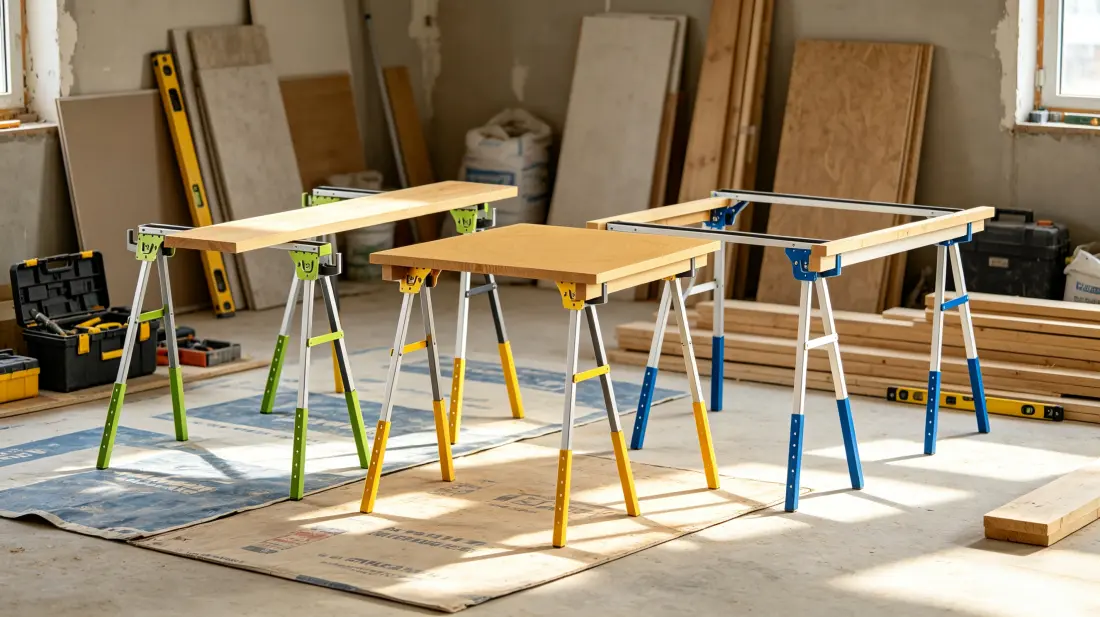
When evaluating a heavy duty sawhorse, the first specification most buyers notice is often the load capacity.
But the number alone does not tell the whole story.
Professional buyers should also understand:
- Whether the capacity applies to one unit or a pair
- How the load is distributed
- How the frame transfers the load
- How stable the product is
- How the folding structure is locked
- What materials are used
- How the product is tested
- Whether production quality remains consistent
- Whether the supplier can support repeat orders
The Jingyan NH-SH001 demonstrates how these factors can be combined into one professional folding sawhorse. It uses a Metal + PP + TPR construction, has a stated 2,650 lbs per-pair load capacity, weighs approximately 4.5 kg, and folds to approximately 78 × 10.7 × 9.7 cm.
For distributors, importers, contractors, and tool brands, the right question is therefore not simply:
“How much weight can this sawhorse hold?”
A better procurement question is:
“Does the complete structure, load rating, stability, portability, testing process, and manufacturing capability match the market I intend to serve?”
That is the more useful way to evaluate a heavy-duty sawhorse for long-term professional and commercial use.
Related products