What Makes a Plastic Toolbox Suitable for Portable Tool Storage?

When a toolbox needs to move with its user, the material of the toolbox becomes more important than it may first appear.
A portable storage product has to perform two jobs at the same time. It must protect and organize tools, but it must also remain practical to carry from one working location to another. That creates a design challenge: the toolbox needs enough structural integrity to protect its contents without becoming unnecessarily difficult to transport.
This is where plastic can be a practical material for portable tool storage.
A well-designed plastic tool box is not useful simply because it is made from plastic. Its suitability comes from how the material works with the shell, storage structure, dimensions, carrying system, and intended load. In other words, the question is not whether plastic is inherently “better” than every other material. The more useful question is whether plastic can provide the combination of properties required by a portable storage product.
For importers, distributors, and private label buyers, this distinction matters. A toolbox intended for mobile maintenance, workshop service, automotive repair, electrical work, or construction needs to be considered as a complete product. Material selection is the starting point, but the final portability of the product depends on what that material allows the manufacturer to achieve.
This article looks specifically at why plastic can work well for portable tool storage, how material characteristics influence weight and structural design, how those characteristics affect real-world carrying, and what buyers can learn from an actual 3-layer and 5-layer plastic toolbox product range.
- 1. Why Is Plastic a Practical Material for Portable Tool Storage?
- 2. How Does Plastic Toolbox Weight Affect Portability?
- 3. How Does Plastic Construction Help Protect Tools During Transport?
- 4. How Does Plastic Design Influence Toolbox Size and Configuration?
- 5. Why Does Plastic Suit Portable Storage Better in Some Professional Applications?
- 6. What Are the Limitations of Plastic for Portable Tool Storage?
- 7. What Does a Real Plastic Toolbox Example Tell B2B Buyers?
- 8. What Does Plastic Toolbox Material Choice Mean for Private Label Buyers?
- 9. What Makes a Plastic Toolbox a Suitable Portable Storage Solution?
- 10. Frequently Asked Questions About Plastic Tool Boxes for Portable Storage
- 11. Ready to Develop a Plastic Toolbox for Portable Storage?
Why Is Plastic a Practical Material for Portable Tool Storage?

The main reason plastic can be suitable for portable tool storage is not simply that plastic products can be made lightweight.
The more important point is that plastic gives manufacturers considerable freedom to balance several product requirements within the same structure. The more important point is that plastic gives manufacturers considerable freedom to balance several product requirements within the same structure. For buyers comparing plastic and metal toolboxes, these trade-offs can affect product weight, structural requirements, durability expectations, and the intended working environment.
A portable toolbox generally needs:
- A body with sufficient rigidity
- A controlled overall weight
- Defined dimensions that are practical to carry
- Structural areas capable of handling repeated opening and closing
- Storage sections that remain accessible after transportation
- Protection for tools during ordinary handling
- A design that can be manufactured consistently at commercial scale
These requirements interact with one another.
Adding more material can increase structural stiffness, but may also increase product weight. Increasing storage capacity can make the toolbox more useful, but can also increase the amount of weight the user eventually has to carry. A larger body can hold more tools, yet become more difficult to place in a vehicle or move through a crowded workshop.
Plastic is useful in this context because it allows these elements to be considered as parts of one molded product rather than as separate design problems.
1.Plastic Can Help Balance Structural Rigidity and Product Weight
A portable toolbox must have enough structural stability to keep its basic shape during handling.
The shell should not simply collapse around the tools. It needs to support the storage structure, connections, opening system, and carrying load.
At the same time, a portable product should not become unnecessarily heavy before a single tool is placed inside it.
This is where the balance between structural rigidity and product weight becomes important.
Plastic materials can be engineered into rigid molded shells while keeping the product weight within a practical range for its intended use. The exact result depends on material formulation, wall structure, reinforcement, manufacturing process, and product geometry.
For example, the plastic toolbox configurations discussed later in this article use ABS+PA construction. The significance of that specification is not that ABS+PA automatically guarantees a certain performance level. Rather, it shows how material selection becomes part of a larger product architecture.
The same material could perform differently in different designs.
That is why B2B buyers should evaluate the finished toolbox, not just the raw material name.
2.Plastic Supports Controlled Product Geometry
Portable storage requires more than strength.
The product also needs a useful shape.
A toolbox may need to fit:
- Inside a service vehicle
- On a workshop bench
- Beside production equipment
- On warehouse shelving
- Into temporary work areas
- Within export packaging
The ability to develop the shell through molding can help manufacturers control the external shape while integrating structural and storage features into a single product.
This can be particularly useful when the product needs a defined footprint rather than simply the largest possible internal volume.
For portable tool storage, dimensions should be viewed as part of the material-and-structure relationship.
A wider body may create room for more tools, while a taller structure can increase storage without changing the basic footprint as much. The final design needs to reflect how the product will actually be transported.
3.Plastic Allows Storage Features to Be Integrated Into the Product Structure
Another practical characteristic of plastic is its compatibility with molded product design.
A toolbox is not merely an empty shell. It may include:
- Raised sections
- Dividers
- Trays
- Hinged elements
- Handle connection areas
- Reinforced corners
- Latching points
- Internal support structures
Integrating these features into a manufactured product can create a more coherent portable storage system.
This matters because every additional component has the potential to affect the product’s weight, assembly, cost, and long-term consistency.
For a B2B product, the goal is not to add as many features as possible. It is to create a structure in which the material and product geometry support the way users carry and use the toolbox.
How Does Plastic Toolbox Weight Affect Portability?

Weight is often the first characteristic associated with portability, but it is also one of the easiest to oversimplify.
A plastic toolbox does not need to be the lightest product in its category.
What matters is whether the total carrying load remains reasonable for the intended application.
1.Empty Toolbox Weight Is Only One Part of the Equation
Consider a simple relationship:
Total carrying weight = toolbox weight + contents weight
The second part of that equation can be much more important than the first.
A toolbox that weighs 9 kg when empty may become a 20 kg or 25 kg load after professional tools are added. A toolbox weighing slightly more may therefore still be the more practical option if it allows the user to carry the right tools in one organized unit.
This is especially important when evaluating professional applications.
The product should be judged based on its working weight, not only its catalog weight.
2.Product Weight Needs to Be Considered Alongside Capacity
This is where material selection becomes commercially relevant.
A product with higher structural requirements may need additional material or reinforcement. A product with more storage layers may require a taller structure and more components.
Therefore:
Portability is not a competition to reduce product weight as far as possible.
It is a matter of achieving a useful relationship between:
product weight + usable capacity + structural performance + carrying frequency.
For a B2B buyer, this relationship can also help distinguish products that appear similar in a catalog but perform differently in real use.
3.Portability Changes With the Frequency of Carrying
A toolbox moved once a week has different practical requirements from a toolbox carried throughout every working shift.
Frequent movement makes seemingly small design choices more important.
Handle position, balance, shell dimensions, opening resistance, and the way the storage structure moves can all affect the user’s experience.
This is why a product should be evaluated under realistic conditions instead of being judged only from an empty toolbox photographed on a table.
How Does Plastic Construction Help Protect Tools During Transport?

Portable tool storage creates a second requirement beyond carrying convenience: the tools need to arrive at the next work area in usable condition.
Tools are moved around workshops, production areas, service vehicles, warehouses, construction sites, and maintenance zones. During that movement, a toolbox may be lifted, placed down, repositioned, opened, and closed repeatedly.
A suitable outer structure can help create a controlled environment around the tools.
1.A Defined Shell Can Separate Tools From the Outside Environment
The toolbox body creates a physical boundary between the contents and normal handling conditions.
That does not automatically make every plastic toolbox waterproof, dustproof, shockproof, or suitable for extreme environments. Such claims require product-specific evidence.
The more limited and defensible point is that a rigid toolbox shell provides physical containment and separation.
For portable storage, that alone is valuable.
It reduces the need to transport every tool as a separate loose item and can help keep a defined set of tools together during movement.
2.Structure Matters More Than the Material Name Alone
A plastic toolbox can only provide useful protection if its structure is appropriate.
Areas that deserve attention include:
- Corners
- Hinges
- Handle connections
- Latches
- Tray connections
- Shell edges
- Load-bearing sections
A material specification such as ABS+PA provides useful information, but it does not explain the whole product.
B2B buyers should therefore connect the material to the structural design.
This is another reason a physical sample can be more informative than a specification sheet alone.
3.Portable Storage Should Protect Without Becoming Overbuilt
There is also a balance on the protection side.
A toolbox could theoretically be made increasingly thick or heavily reinforced, but excessive construction can create more weight and bulk.
For portable storage, the better objective is usually:
sufficient protection for the intended application without unnecessary mass.
This is one of the areas where a plastic structure can be useful when the product is engineered around a specific use case rather than built as a generic container.
How Does Plastic Design Influence Toolbox Size and Configuration?

The suitability of a plastic toolbox for portable storage is also connected to the way the storage structure is arranged.
This is not primarily about whether three layers are better than five layers. Your intended customer and working environment determine that.
The more relevant question is:
How can the available product structure support the amount of equipment that needs to move with the user?
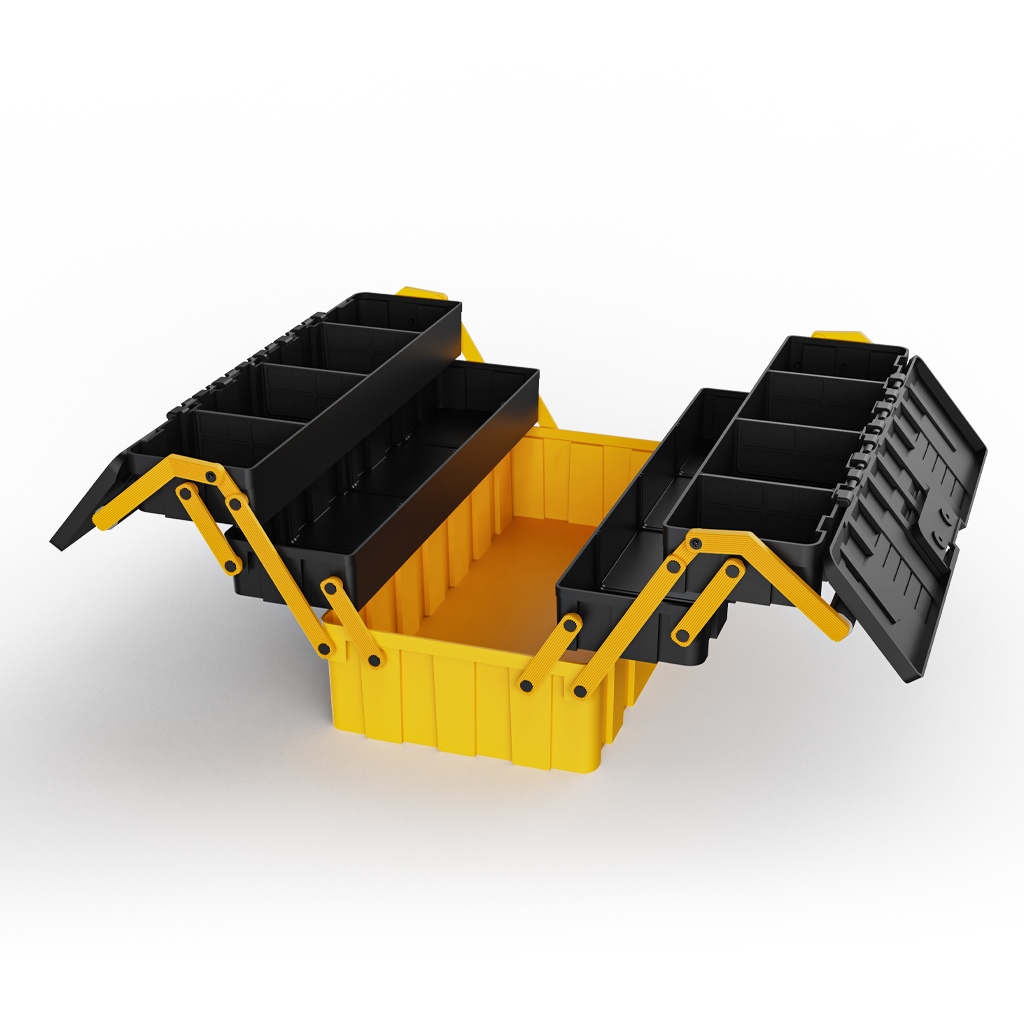
1.A 3-Layer Design Can Support a More Focused Mobile Tool Set
A three-layer configuration can be appropriate when users need a meaningful range of tools but do not need extensive storage separation.
For example, a technician may need:
- General hand tools
- Measuring equipment
- Small maintenance parts
- Common accessories
within one portable unit.
A 3-layer plastic toolbox can provide multiple storage levels while maintaining a relatively controlled overall height.
One actual configuration uses:
- ABS+PA construction
- 46 × 26.5 × 15.8 cm dimensions
- 9.5 kg product weight
- 30 kg stated load capacity
- Green, yellow, and red options
These specifications provide an example of the design trade-off.
The toolbox has enough physical structure to create a multi-level storage system, but the overall height remains lower than the corresponding 5-layer version.
The significance is not that this makes the 3-layer product universally better.
It demonstrates how material, size, capacity, and weight have to be considered together when portability is part of the product’s purpose.
2.A 5-Layer Design Can Carry a Broader Range of Equipment
A five-layer configuration can make sense when users need more storage separation within one portable unit.
The additional storage level may allow different categories of tools and components to remain separated during movement.
A corresponding product configuration uses:
- ABS+PA construction
- 46 × 26.5 × 21 cm dimensions
- 12.5 kg product weight
- 30 kg stated load capacity
- Green, yellow, and red options
The difference is useful because it shows a practical design principle.
The 5-layer version weighs more than the 3-layer version and is taller, but it also gives the user additional storage structure.
That may be worthwhile when transporting a broader tool assortment in a single unit.
3.More Storage Does Not Automatically Mean Better Portability
the goal of the design should not be:
Maximum storage at any cost.
Instead, the goal should be:
The appropriate amount of storage for the load and movement pattern of the intended user.
That is a product-design question, not simply a storage-capacity question.
Why Does Plastic Suit Portable Storage Better in Some Professional Applications?
The material advantages of plastic become clearer when the toolbox is considered as a mobile product rather than a stationary container.
1.Factory Equipment Maintenance
Factory maintenance teams often move tools between equipment stations.
A toolbox can provide a defined mobile tool set without requiring every item to be carried independently.
The plastic shell, controlled dimensions, and layered configuration can work together to make that movement more practical.
The key advantage is not simply that the box contains tools.
It is that the storage structure travels with the maintenance task.
2.Workshop Service
Workshops may have fixed tool cabinets, but not every repair happens beside the cabinet.
A technician may need to take a selected collection of tools to another bench, machine, or work area.
A portable plastic toolbox provides a mobile extension of the workshop’s existing storage system.
3.Automotive Repair
Vehicle service work often requires technicians to change their physical position around the vehicle.
The toolbox therefore needs to move with the repair task.
A contained toolbox can keep frequently used tools together while the technician moves from one part of the vehicle to another.
4.Electrical and Construction Work
Electrical installation and construction work often involve changing work locations.
Tools may need to move from a vehicle into a building and then between several installation points.
A portable toolbox provides a structured way to transport those tools as a group rather than carrying loose items separately.
5.Warehouse and Outdoor Maintenance
Warehouse inspections and outdoor equipment maintenance can also involve considerable movement.
A maintenance worker may need tools at several locations during one task.
A plastic toolbox can serve as a mobile storage container for that work, provided the product’s environmental limits match the application.
Again, the important point is not to make unsupported claims such as “weatherproof” or “impact-proof” simply because the product is plastic. Environmental suitability should be based on the actual material specification, construction, testing, and intended operating conditions.
What Are the Limitations of Plastic for Portable Tool Storage?
A balanced explanation also needs to recognize where plastic may not be the ideal solution.
The fact that plastic can work well for portable storage does not mean it is automatically suitable for every possible toolbox application.
1.Extremely Heavy-Duty Loads May Require a Different Design
If the intended application involves exceptionally high loads, severe mechanical abuse, or specialized industrial conditions, a plastic toolbox may require substantial reinforcement or a different structural approach.
The correct solution depends on the actual operating requirements.
2.Environmental Conditions Matter
Temperature, chemical exposure, sunlight, oils, impact frequency, and moisture can all affect material selection and product design.
A supplier should therefore be able to explain whether the selected material and construction have been developed for the intended environment.
This is particularly important when products are exported into markets with different climate and application requirements.
3.Plastic Should Not Be Marketed With Unsupported Claims
For B2B buyers, careful product language is important.
A responsible product specification should distinguish between:
- What the material can generally support
- What the finished product has been tested for
- What is specifically guaranteed by the manufacturer
This approach protects both the buyer and the supplier from overly broad product claims.
What Does a Real Plastic Toolbox Example Tell B2B Buyers?

Real product specifications can make the material discussion more meaningful because they show how different design choices affect the finished product.
Consider the following 3-layer and 5-layer toolbox configurations:
| Specification | 3-Layer Toolbox | 5-Layer Toolbox |
|---|---|---|
| Material | ABS+PA | ABS+PA |
| Dimensions | 46 × 26.5 × 15.8 cm | 46 × 26.5 × 21 cm |
| Product Weight | 9.5 kg | 12.5 kg |
| Stated Load Capacity | 30 kg | 30 kg |
| Color Options | Green / Yellow / Red | Green / Yellow / Red |
These specifications demonstrate several useful points.
First, both configurations use the same general ABS+PA material approach, but the finished products have different dimensions and weights.
Second, the increase from 3 layers to 5 layers does not simply increase the length or width. The additional storage is achieved through greater height.
Third, the 5-layer model is heavier, which means additional storage capability should be considered against the carrying requirements of the end user.
This is exactly why plastic material should not be discussed independently from product design.
The real commercial question is not:
“Is ABS+PA good?”
It is:
“What product characteristics does this material allow the manufacturer to combine, and does that combination suit the intended portable application?”
That is a much more useful question for a product manager or sourcing team.
What Does Plastic Toolbox Material Choice Mean for Private Label Buyers?

For private label buyers, the importance of plastic construction extends beyond the physical toolbox.
A product line also needs to be manufactured consistently.
Color selection, brand identification, packaging, configuration changes, and other product details may become part of a private label program.
This can be especially relevant for plastic products because the appearance and physical configuration are closely connected to the manufacturing process.
1.Product Development Can Be Part of the Sourcing Decision
A private label buyer may not want to sell exactly the same configuration as every other distributor.
They may want:
- A specific color
- Custom branding
- Different packaging
- Adjusted product configuration
- Market-specific positioning
Those requirements make manufacturer capability relevant to the discussion.
Jingyan Tools manufactures toolbox and related workshop products and provides OEM/ODM production support. For a buyer developing a branded portable toolbox range, this capability can help connect product specifications with manufacturing, customization, and commercial production requirements.
The important point is not that an OEM supplier automatically makes one product better than another.
The important point is that material selection, product structure, customization, and manufacturing consistency need to work together when a toolbox is developed as a commercial product line.
What Makes a Plastic Toolbox a Suitable Portable Storage Solution?
The answer is more specific than simply saying that plastic is lightweight.
A plastic toolbox can be well suited to portable tool storage because the material can be incorporated into a product structure that balances several competing requirements.
It can support:
Controlled product weight
A portable toolbox needs to keep its own mass within a practical range before tools are loaded.
Structural rigidity
The shell and connected components need sufficient stability for the intended working conditions.
Controlled dimensions
Portable storage needs a usable footprint and height rather than unlimited volume.
Integrated storage design
Molded and assembled components can be combined into trays, shells, connection points, and other features that support mobile use.
Tool containment
A defined shell provides physical separation and allows tools to move as a group rather than as unrelated loose items.
Commercial customization
For B2B and private label products, color, branding, packaging, and configuration can become part of a broader product development program.
The important conclusion is therefore not:
Plastic is always better.
It is:
Plastic can be a particularly practical material when a toolbox needs to combine protection, manageable weight, structured storage, controlled dimensions, and scalable product manufacturing.
That is why a plastic toolbox can work well for portable tool storage in professional environments.
The material is not the entire solution.
It is the foundation that enables the manufacturer to build the solution around the user’s movement, tools, working environment, and commercial requirements.
Frequently Asked Questions About Plastic Tool Boxes for Portable Storage
1.Why is plastic suitable for a portable tool box?
Plastic can be suitable because it allows manufacturers to develop a toolbox structure that balances product weight, rigidity, dimensions, storage configuration, and handling requirements. The actual result depends on material formulation and product design.
2.Does a plastic tool box need to be lightweight to be portable?
3.Is ABS suitable for portable tool storage?
ABS-based construction can be suitable for many portable toolbox applications. However, performance should be evaluated based on the complete finished product rather than the material name alone.
4.What is the role of ABS+PA in a plastic toolbox?
ABS+PA can be used as a material system for toolbox construction, but the final performance depends on the material formulation, product geometry, structural reinforcement, assembly, and manufacturing quality.
5.Can a small plastic tool box be suitable for professional use?
Yes. A small plastic tool box can be useful when the customer needs a focused collection of tools in a compact mobile format. The appropriate size depends on the actual tool set and working conditions.
6.Is a 5-layer plastic toolbox too heavy for portable use?
Not necessarily. The 5-layer Plastic toolbox discussed here weighs 12.5 kg before loading. Whether that is practical depends on how much additional equipment the user needs to carry and how frequently the toolbox is moved.
7.Does a higher load capacity make a plastic toolbox more portable?
No. Load capacity and portability are related but different characteristics. A higher capacity can allow more tools to be carried, but product weight, dimensions, balance, and handling still determine the actual carrying experience.
8.Can plastic toolboxes be used in factory maintenance?
9.Can plastic toolboxes be customized for private label?
Depending on the manufacturer’s capabilities, customization can include color, branding, packaging, and product configuration. MOQ, tooling, sample approval, and production requirements should be confirmed before a bulk order.
10.What should buyers test before ordering a portable plastic toolbox?
Use a physical sample loaded with realistic tools. Check the carrying experience, balance, opening and closing, structural connections, storage access, and packaging before approving mass production.
Ready to Develop a Plastic Toolbox for Portable Storage?
For importers, distributors, and private label buyers, the most useful way to assess a plastic toolbox is to look at the relationship between the material and the finished product.
Review the material construction.
Check the actual product weight.
Compare dimensions with the intended working environment.
Evaluate the load capacity and its test conditions.
Then test the toolbox with real tools rather than judging the product only from photographs.
When plastic material, structural design, storage configuration, and manufacturing requirements are aligned, a toolbox can become more than a container.
It can become a practical portable storage system for workshop maintenance, factory servicing, automotive repair, electrical installation, construction work, warehouse maintenance, and other mobile applications.
For a commercial product line, the same principle applies at another level: the material needs to support not only the end user’s working needs, but also the consistency, customization, and manufacturing requirements expected by distributors, importers, and private label brands.
That is the real reason a plastic toolbox can be a strong option for portable tool storage: the material gives manufacturers room to balance the physical and commercial requirements of a product that has to move with its user.
Related products