How to Compare Sawhorses From Different Suppliers
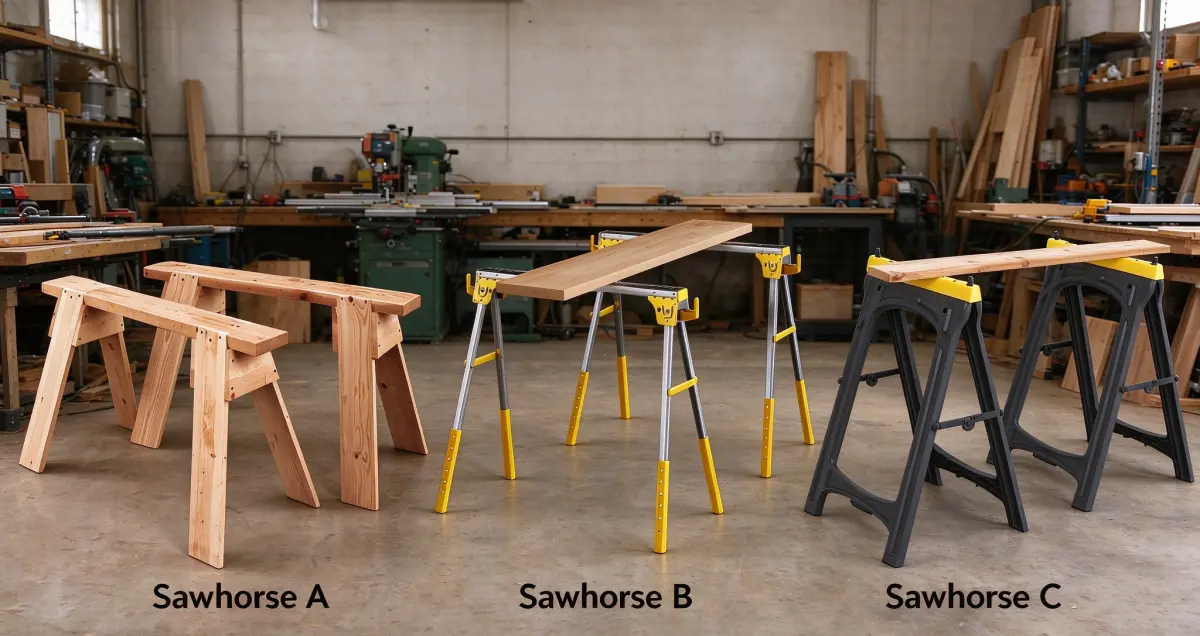
Choosing between different sawhorse suppliers is more complicated than comparing unit prices on several quotations. Two suppliers may appear to offer almost identical folding sawhorses, yet their products can differ substantially in specifications, component quality, manufacturing consistency, packaging, customization capability, lead time, and after-sales support.
For importers, distributors, tool brands, hardware chains, and other B2B buyers, the goal is therefore not simply to find the lowest quotation. The more useful approach is to compare suppliers using the same product requirements, the same evidence standards, and the same commercial assumptions.
This is particularly important when sourcing folding sawhorses. A product that looks similar in a catalogue may use a different frame construction, different plastic components, different connection methods, or a different production process. Even when the headline load capacity is similar, the overall commercial value can be different.
A practical supplier comparison should answer five questions:
- Are the products genuinely comparable?
- Can the supplier substantiate its specifications and quality claims?
- Can the supplier maintain consistent production?
- Can the commercial terms support the buyer’s business model?
- Can the supplier support the product after the first order?
This article explains how to compare sawhorse suppliers systematically, with a focus on product specifications, manufacturing capability, quality evidence, supply terms, customization, and long-term cooperation.
- Why Comparing Sawhorse Suppliers Requires More Than Comparing Prices
- Start With the Same Buying Specification for Every Supplier
- Compare Sawhorse Specifications on an Apples-to-Apples Basis
- Evaluate Quality Claims by Looking at the Manufacturing Process
- Compare Production Consistency, Not Just One Approved Sample
- Compare MOQ, Lead Time, Packaging, and Commercial Terms
- Examine OEM, ODM, and Private-Label Capability
- Use a Supplier Comparison Matrix Instead of Relying on Memory
- A Practical Example: Comparing Folding Sawhorse Suppliers
- How Jingyan Tools Fits a B2B Supplier Evaluation
- What Questions Should Buyers Ask a Sawhorse Supplier?
- FAQ: Comparing Sawhorse Suppliers
- Final Takeaway: Compare Suppliers by Evidence, Not Price Alone
Why Comparing Sawhorse Suppliers Requires More Than Comparing Prices
The first mistake buyers make is often comparing the unit price before confirming what is actually included in each quotation.
Suppose three suppliers quote for a folding sawhorse. Supplier A offers the lowest price, Supplier B is slightly higher, and Supplier C is higher again. At first glance, A appears more competitive.
However, the three quotations may not represent the same product.
One supplier may quote for one sawhorse while another quotes based on a pair. One may include retail packaging while another uses bulk cartons. One may include a hook, adjustable-height mechanism, or additional accessory while another supplies a simpler configuration.
The same problem can occur with material descriptions.
“Metal frame” does not necessarily describe the same construction across suppliers. The frame thickness, component design, joining method, protective treatment, plastic parts, foot pads, and hardware may all be different.
For B2B procurement, the supplier comparison should therefore start by normalizing the quotation, rather than immediately selecting the lowest number.
A fair comparison asks:
- What exact model is being quoted?
- What is the unit of sale?
- What materials are included?
- What accessories are included?
- What is the stated load capacity?
- Does that capacity apply to one unit or a pair?
- What are the folded and unfolded dimensions?
- What packaging is included?
- What is the MOQ?
- What is the production lead time?
- What customization is included?
- What quality inspection is performed before shipment?
Only when these variables are aligned does the price comparison become meaningful.
Start With the Same Buying Specification for Every Supplier
Before contacting several sawhorse suppliers, prepare a common specification sheet.
This simple step can make supplier comparison much more accurate because every supplier is responding to the same requirements.
1.Define the Product Configuration
The specification should identify the product category and configuration clearly.
For example, a buyer sourcing folding sawhorses may specify:
- Folding or fixed construction
- Metal, plastic, or hybrid construction
- Required working dimensions
- Folded dimensions
- Adjustable or fixed height
- Required accessories
- Hook configuration
- Color requirements
- Packaging format
- Private-label requirements
The more precisely the configuration is defined, the less likely the buyer is to compare different products under the same product name.
A catalogue photograph is not enough.
Two products can both be described as a “folding sawhorse” while having different dimensions, different structural layouts, different accessories, and different target markets.
2.Define the Required Performance Level
Performance requirements should also be standardized before requesting quotations.
Instead of asking suppliers to offer “a strong sawhorse,” specify the required performance range.
For example:
- Required load capacity
- Intended type of material support
- Frequency of folding and transportation
- Required working height
- Stability expectations
- Required testing documentation
This prevents each supplier from interpreting “heavy duty” according to its own marketing language.
A buyer does not need to tell every supplier exactly how to manufacture the product. The purpose is to define the commercial and functional outcome that all suppliers must meet.
3.Define the Commercial Requirements
Supplier comparison should include commercial requirements from the beginning.
These may include:
- MOQ
- Sample availability
- Sample lead time
- Bulk production lead time
- Packaging requirements
- Shipping carton specifications
- Private-label requirements
- Logo printing
- Color matching
- Inspection requirements
- Payment terms
This matters because a quotation that looks cheaper at the product level may become less competitive once additional packaging, customization, or production requirements are added.
Compare Sawhorse Specifications on an Apples-to-Apples Basis
Once the common specification is prepared, compare each supplier using the same fields.
A useful comparison should separate visible specifications from the evidence supporting those specifications.
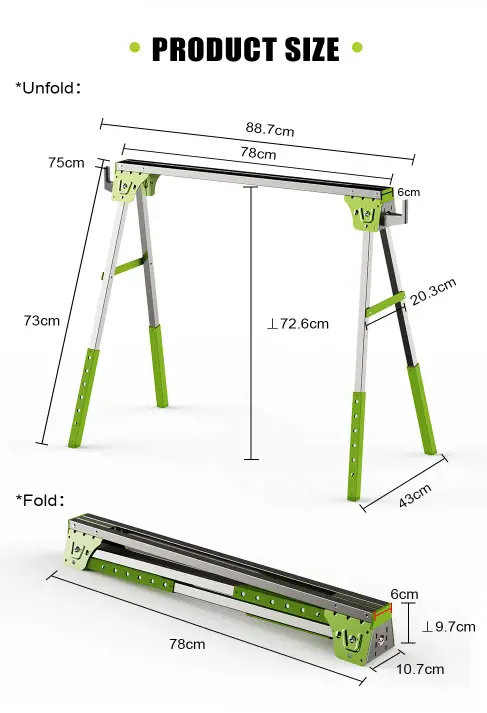
1.Product Dimensions and Weight
Dimensions are among the easiest specifications to compare, but buyers should still make sure every supplier uses the same measurement conditions.
For a folding sawhorse, record:
- Unfolded dimensions
- Folded dimensions
- Product weight
- Packaging dimensions
- Gross carton weight
- Quantity per carton
A supplier may list only the product dimensions while another provides shipping carton dimensions. These figures should not be mixed together.
Packaging information is particularly important for distributors and importers because transportation and warehouse planning depend on the packed product, not only the unfolded product.
2.Materials and Component Structure
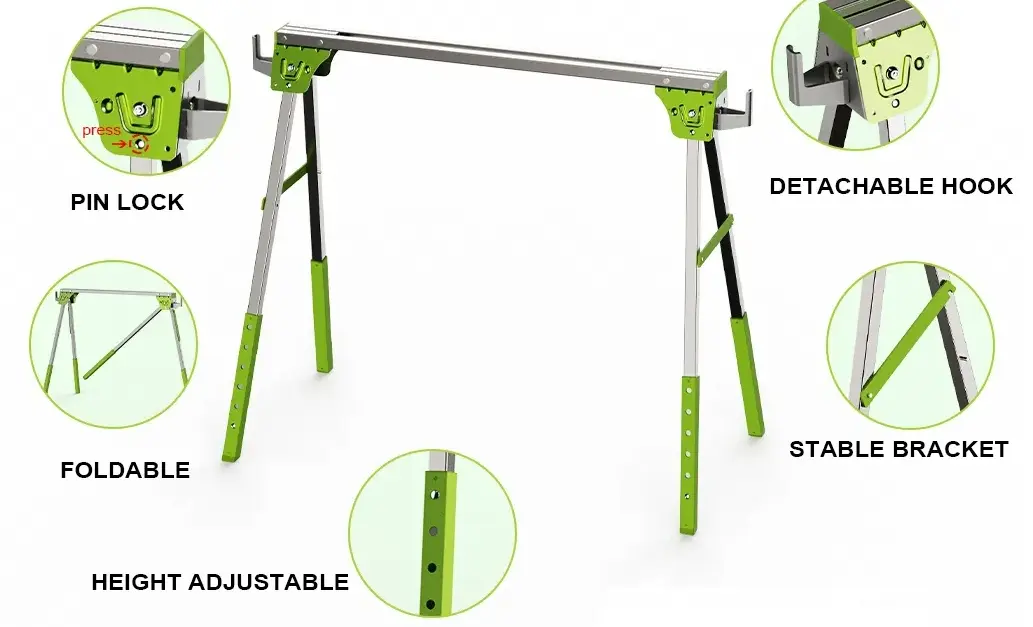
Material descriptions should be detailed enough to support a meaningful comparison.
For example, “metal + plastic” is a starting point, not a complete specification.
A buyer can ask:
- What material is used for the main frame?
- Which components are plastic?
- Which parts contact the floor?
- What material is used for connection components?
- Are the plastic components injection molded?
- What type of surface protection is used on metal parts?
- Are fasteners standardized?
- Which components are supplier-made and which are externally sourced?
The purpose is not to turn a procurement discussion into a laboratory report.
The purpose is to understand whether the products are actually built to the same basic specification.
3.Capacity and Testing Information
Load capacity should be compared using the same basis.
If one supplier states capacity per unit and another states capacity per pair, the figures cannot be compared directly.
The buyer should confirm:
- Capacity basis
- Test method
- Load distribution conditions
- Test frequency
- Whether testing is performed during production
- Whether inspection records are available
A supplier that can explain how a specification is measured provides more useful information than one that simply publishes a large number.
For buyers, the key issue is traceability of the claim, not the size of the marketing number.
Why Specification Evidence Matters
A product specification becomes more useful when the supplier can connect it to a production or inspection process.
For example, a supplier may provide:
- Product drawings
- Material specifications
- Inspection checklists
- Load test records
- Sample approval records
- Final inspection records
- Packaging standards
Not every buyer needs every document for every order.
The important point is that suppliers should be able to explain how the product specification is controlled.
Evaluate Quality Claims by Looking at the Manufacturing Process
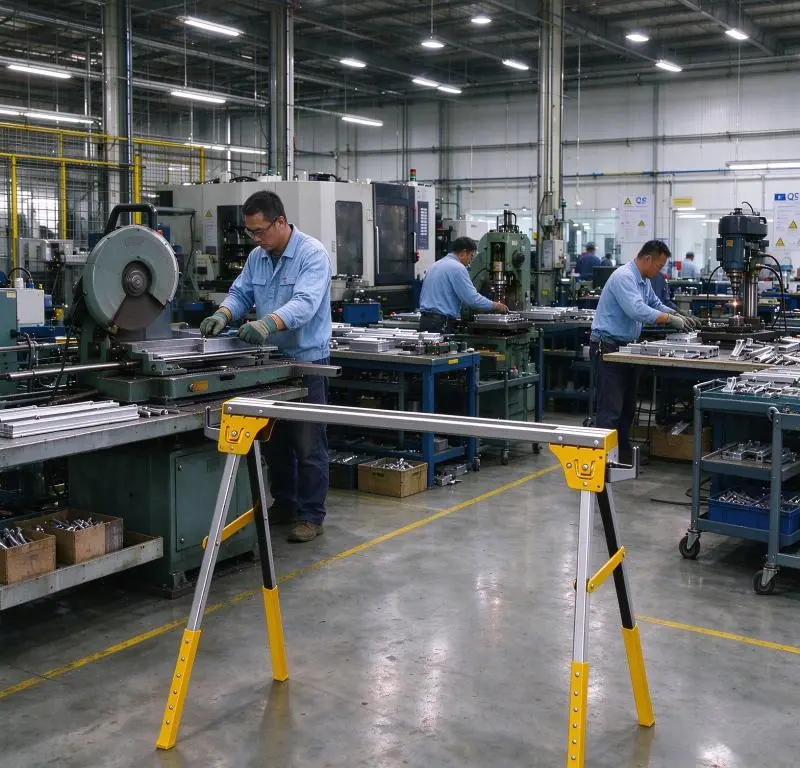
Supplier websites often use similar language: high quality, durable, heavy duty, professional, reliable, factory direct.
These descriptions are not enough to distinguish suppliers.
The more useful question is:
What manufacturing process supports the quality claim?
1.Look for In-House Manufacturing Capability
A supplier with relevant in-house manufacturing capability may be able to control more stages of the product than a company that only coordinates external production.
For a folding sawhorse, relevant capabilities can include:
- Product engineering
- Mold development
- Plastic injection molding
- Metal stamping
- Metal fabrication
- Component inspection
- Product assembly
- Final quality inspection
- Packaging
This does not automatically make one supplier better than another. However, it gives the buyer more information about where quality can be controlled.
2.Ask How Components Are Controlled
A finished product can only be as consistent as its critical components.
For example, if a supplier produces plastic connection parts in-house, it may have greater control over mold accuracy, material processing, and dimensional consistency.
Similarly, if metal components are produced or inspected within the supplier’s own manufacturing system, the buyer can ask more detailed questions about those components.
The goal is to identify the critical control points in the product.
3.Check the Supplier's Quality Control Stages
A useful supplier comparison should identify when inspections are performed.
A mature process may include several stages:
- Incoming material inspection
- Component inspection
- In-process inspection
- Assembly inspection
- Functional testing
- Final inspection
- Packaging inspection
The exact process will vary by supplier and product.
What matters is whether the supplier can clearly explain what is checked and at which stage.
Compare Production Consistency, Not Just One Approved Sample
A supplier sample is important, but a sample is not the same thing as mass-production consistency.
This is one of the most overlooked parts of supplier evaluation.
A buyer may receive one excellent pre-production sample. The more important question is whether the supplier can reproduce the same product across hundreds or thousands of units.
1.Compare Sample and Bulk Production Controls
Ask how the approved sample is controlled after the order is placed.
Useful questions include:
- Is the approved sample retained as a production reference?
- Are critical dimensions documented?
- Are production materials specified?
- Are packaging samples approved?
- Are functional checks repeated during mass production?
- How are deviations handled?
- Who approves changes to components or materials?
These questions are particularly important for private-label products.
A distributor or brand may invest significant time creating product packaging, colors, labels, and specifications. Unexpected changes in later batches can create customer complaints or additional costs.
2.Ask About Batch-to-Batch Consistency
A supplier comparison should also consider the supplier’s ability to maintain repeat-order consistency.
For repeat purchasing, buyers should pay attention to:
- Consistent product dimensions
- Consistent colors
- Consistent accessories
- Consistent packaging
- Consistent markings
- Consistent functional performance
The objective is not to demand that every component be visually identical to laboratory precision.
The objective is to establish whether the supplier has a controlled process that reduces unnecessary variation between production batches.
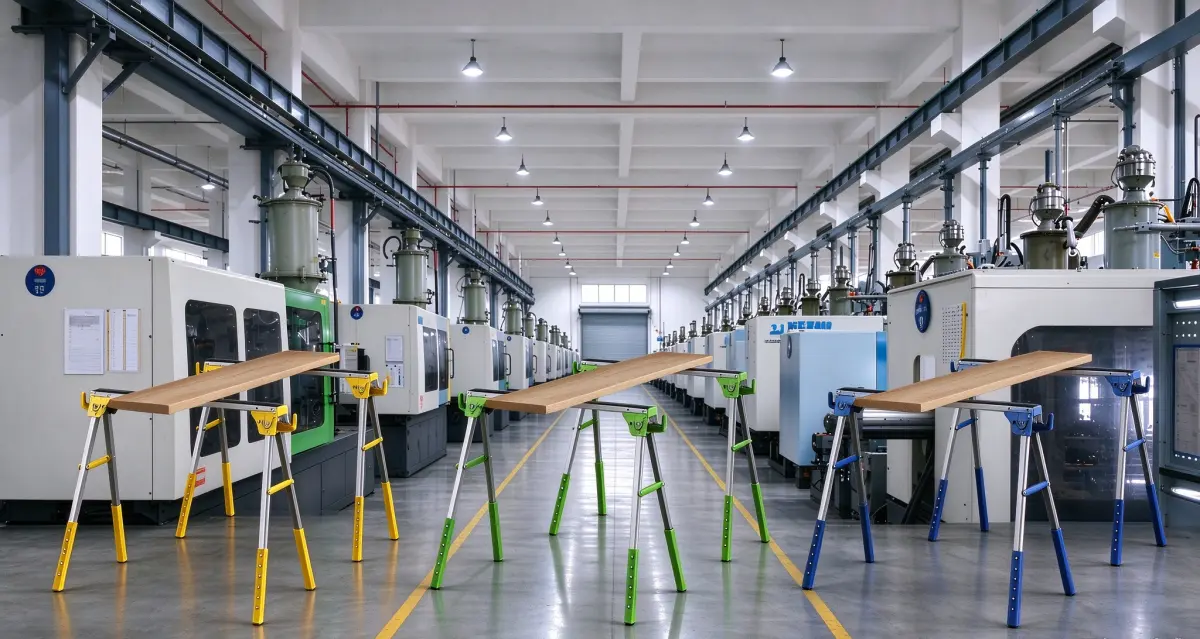
Compare MOQ, Lead Time, Packaging, and Commercial Terms
Product quality is only one part of supplier suitability.
A supplier can offer a technically suitable sawhorse but still be difficult to work with commercially.
1.MOQ Should Match the Buyer's Business Model
MOQ is especially important for distributors testing a new product.
A very high MOQ can increase inventory risk, while an extremely low MOQ may indicate a different production or pricing structure.
Rather than asking whether an MOQ is “low” or “high,” evaluate whether it fits:
- Expected launch quantity
- Warehouse capacity
- Sales forecast
- Trial-order strategy
- Packaging requirements
- Reorder frequency
2.Compare Lead Time Using the Same Definition
“Fast delivery” is too vague for supplier comparison.
Confirm whether the stated lead time means:
- Sample production time
- Manufacturing time
- Time after deposit
- Time after artwork approval
- Time after packaging approval
- Shipping time
These are different stages.
For a buyer comparing suppliers internationally, the most useful question is:
How many working days are required from final order confirmation to finished goods ready for shipment?
This creates a clearer basis for comparison.
3.Packaging Can Change the Real Cost
A quotation should be reviewed together with packaging requirements.
Compare:
- Product packaging
- Inner boxes
- Master cartons
- Carton dimensions
- Quantity per carton
- Carton weight
- Retail packaging requirements
- Barcode or label requirements
For importers and distributors, packaging is part of the product’s commercial system.
A supplier offering a lower unit price may require different packaging arrangements that affect shipping, warehouse handling, or retail preparation.
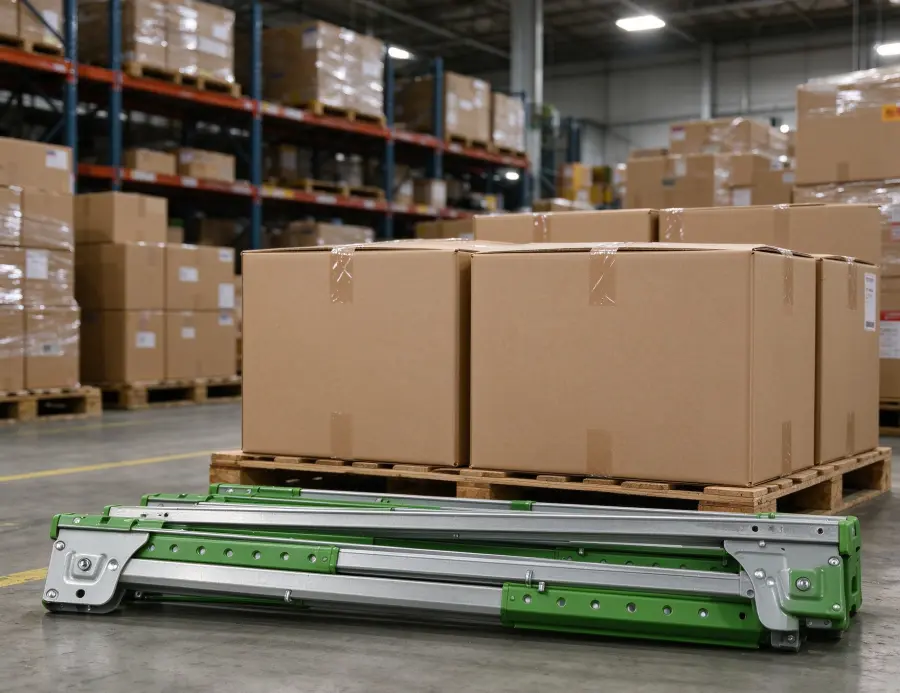
Examine OEM, ODM, and Private-Label Capability
For a tool brand or distributor, the supplier’s ability to customize the product can be as important as the standard model itself.
Not every customization project requires a completely new product.
There are several levels of customization.
1.Basic Private-Label Customization
The simplest level can include:
- Logo printing
- Product labeling
- Packaging artwork
- Retail carton design
- Color selection
This can be suitable when the buyer wants to launch an established product under its own brand.
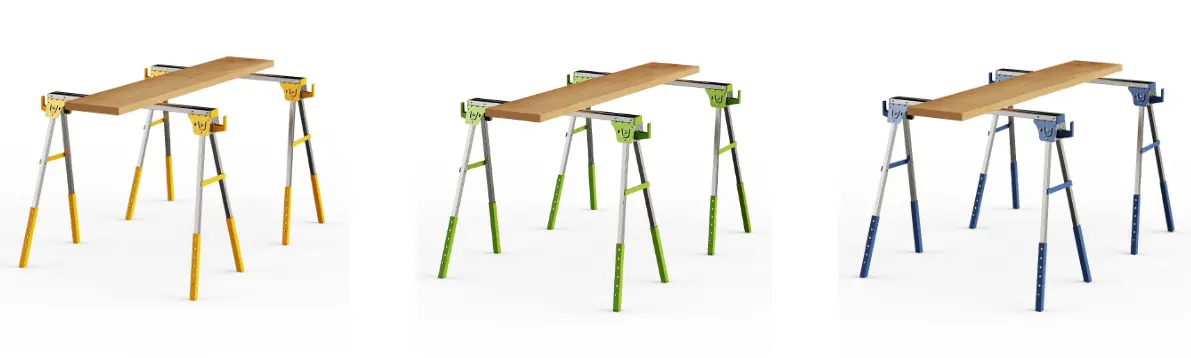
2.Product Configuration Customization
A more advanced project may involve:
- Different accessories
- Modified component layouts
- Customized dimensions
- Different color combinations
- Adjusted packaging configurations
The supplier should be able to explain which changes can be made using an existing product platform and which changes require new tooling.
3.New Product Development
ODM or new-product development requires a deeper evaluation.
The buyer should understand whether the supplier can support:
- Product concept development
- Engineering design
- Prototype development
- Mold design
- Sample approval
- Testing
- Mass production
This is where a manufacturing company with product development capability can provide a different level of support from a company that mainly coordinates finished products.
Use a Supplier Comparison Matrix Instead of Relying on Memory
When comparing three or more suppliers, a written comparison matrix is more reliable than reviewing separate quotation emails.
The matrix should keep the same criteria for every supplier.
| Comparison Area | Supplier A | Supplier B | Supplier C |
|---|---|---|---|
| Product model | |||
| Material configuration | |||
| Dimensions | |||
| Folded dimensions | |||
| Product weight | |||
| Capacity basis | |||
| Accessories | |||
| Packaging | |||
| MOQ | |||
| Sample lead time | |||
| Bulk lead time | |||
| Private label | |||
| OEM/ODM capability | |||
| Inspection process | |||
| Documentation | |||
| After-sales process | |||
| Quoted price |
The purpose of this matrix is not to create a universal ranking.
Different buyers have different priorities.
A tool brand may place greater importance on engineering and private-label development. A distributor may focus more heavily on consistent production, packaging, and replenishment. An importer may pay particular attention to MOQ, carton dimensions, and lead time.
The matrix simply ensures that each supplier is evaluated using the same questions before commercial preferences are considered.
A Practical Example: Comparing Folding Sawhorse Suppliers
Consider a buyer sourcing a folding sawhorse for a professional tool distribution channel.
Three suppliers provide quotations.
Supplier A offers a low price but provides limited information about materials and testing.
Supplier B offers a slightly higher price, provides detailed specifications, and can supply inspection documentation.
Supplier C offers similar specifications to Supplier B but has a substantially different MOQ and packaging configuration.
At this point, choosing the supplier should not be based on the first price comparison.
The buyer should compare the suppliers through several stages.
Stage 1 — Confirm Product Equivalence
Check whether all three suppliers are quoting the same basic configuration.
If Supplier A’s price applies to one unit and Suppliers B and C quote per pair, the prices need to be normalized.
Stage 2 — Confirm Specification Evidence
Review the product dimensions, materials, capacity basis, accessories, and testing information.
If one supplier cannot clearly explain a critical specification, record the difference rather than assuming that the products are identical.
Stage 3 — Compare Production Capability
Ask how the product is manufactured and inspected.
Look at:
- Engineering capability
- Component production
- Assembly
- Quality inspection
- Production capacity
- Repeat-order control
Stage 4 — Compare Commercial Fit
Review MOQ, packaging, lead time, customization, and payment requirements.
A supplier with a suitable product but unsuitable commercial terms may create problems after the initial order.
Stage 5 — Check Long-Term Support
Finally, evaluate communication, sample revisions, documentation, product changes, complaint handling, and repeat-order support.
The point of supplier comparison is not to find the lowest quotation in isolation.
It is to determine which supplier can provide a repeatable product and workable supply relationship under the buyer’s actual purchasing requirements.
How Jingyan Tools Fits a B2B Supplier Evaluation
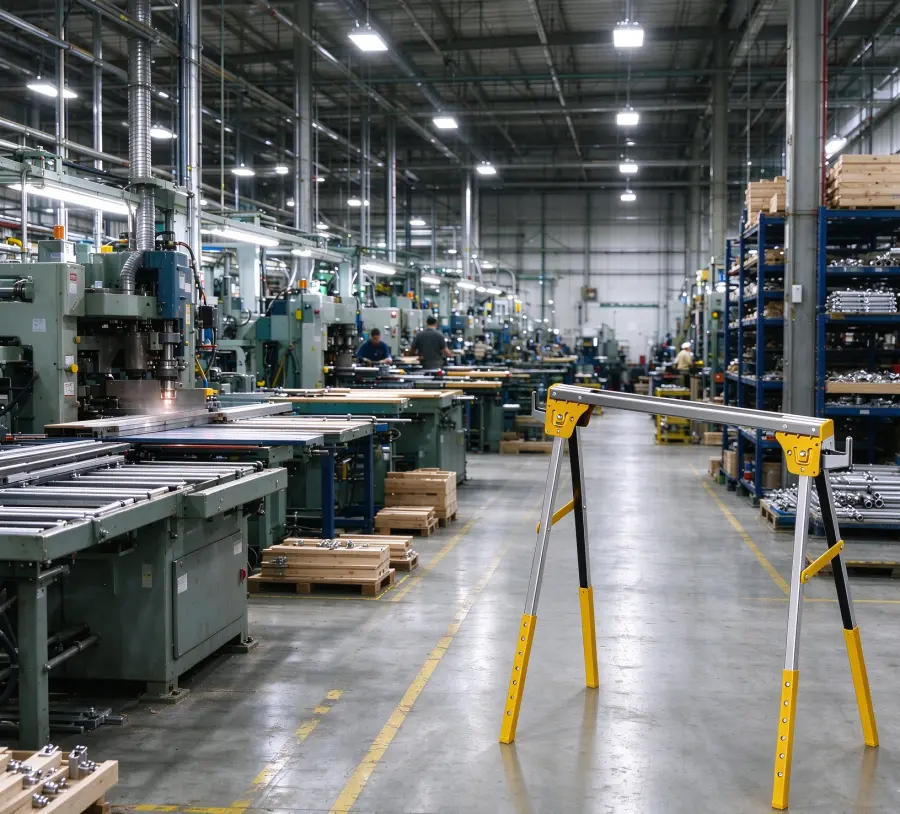
A manufacturer should be able to provide enough information for a buyer to perform this type of comparison objectively.
Ningbo Jingyan Tool Industrial Co., Ltd. was established in 2003 and operates a self-owned manufacturing base of more than 16,000 square meters with more than 140 staff. Its manufacturing system includes R&D, mold design, plastic injection molding, metal processing, assembly, quality control, and customer service.
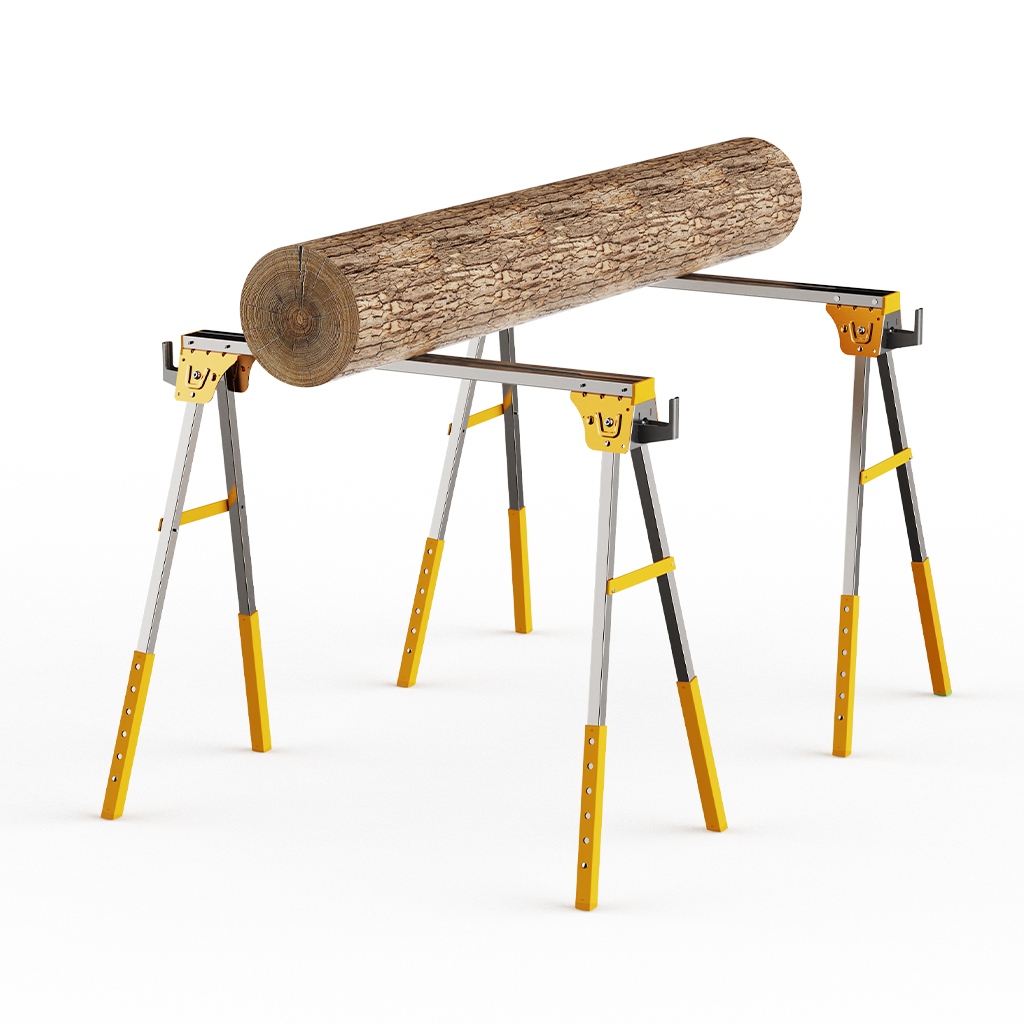
For sawhorses, the company provides folding models with different configurations. For example, the NH-SH001 folding sawhorse uses a metal + PP + TPR construction, weighs approximately 4.5 kg, has folded dimensions of approximately 78 × 10.7 × 9.7 cm, and is specified at 2,650 lbs per pair.
These figures should not be interpreted as proof that any one specification automatically makes a product suitable for every buyer. Instead, they provide a concrete reference point that buyers can place into their supplier comparison matrix.
The same principle applies to customization.
For standard private-label projects, customization may involve logo and packaging requirements. For more involved projects, the buyer may require engineering, tooling, product revisions, and sample development.
Jingyan Tools provides OEM and ODM manufacturing support covering product development, mold design, samples, production, inspection, and delivery. Buyers evaluating the company should still compare these capabilities against their own project requirements, quotation, specifications, and quality expectations.
This approach keeps supplier evaluation practical: compare what is required, verify what is offered, and document the differences before making a purchasing decision.
What Questions Should Buyers Ask a Sawhorse Supplier?
Before moving from quotation to sample or production, buyers can use the following questions.
1.Product Questions
- What exact model is being quoted?
- Is the price based on one unit or a pair?
- What are the product and folded dimensions?
- What materials are used for the main components?
- What accessories are included?
- What capacity is specified, and on what basis?
2.Quality Questions
- What inspections are performed before shipment?
- Are load or functional tests performed?
- Can inspection records be provided?
- How are approved samples controlled during mass production?
- How are quality deviations handled?
3.Manufacturing Questions
- Which production processes are performed in-house?
- Does the supplier have its own mold and engineering capability?
- Which components are outsourced?
- What is the monthly or daily production capacity?
- How are repeat orders controlled?
4.Commercial Questions
- What is the MOQ?
- What is the sample lead time?
- What is the bulk production lead time?
- What packaging is included?
- What customization is available?
- What are the terms for repeat orders?
A supplier does not need to answer every question with the same type of document.
However, clear answers and consistent documentation make comparison much easier.
FAQ: Comparing Sawhorse Suppliers
1.How many sawhorse suppliers should a buyer compare?
There is no fixed number that fits every project. The important point is to compare enough suppliers to understand the available product and supply options without creating unnecessary administrative work.
For a new B2B product, comparing several qualified suppliers using the same specification sheet is generally more useful than collecting a large number of unstructured quotations.
2.Should price be the most important factor when comparing sawhorse suppliers?
Price is important, but it should be compared only after the product, packaging, MOQ, customization, lead time, and quality requirements have been normalized.
A lower quotation does not necessarily represent a lower total procurement cost when the underlying product or commercial conditions are different.
3.How can buyers tell whether two sawhorses are genuinely comparable?
Compare the same basic data points:
configuration, materials, dimensions, weight, capacity basis, accessories, packaging, and production requirements.
If important information is missing from one quotation, ask the supplier to provide it before making a direct comparison.
4.Is a manufacturer always preferable to a trading company?
Not automatically.
The relevant question is whether the supplier can provide the manufacturing control, product knowledge, customization capability, quality management, and commercial support that the project requires.
A manufacturer can offer direct access to production and engineering capabilities, while the buyer should still verify the supplier’s actual processes rather than relying only on the word “factory.”
5.What should buyers verify before placing a bulk order?
Before committing to mass production, buyers should verify the final specification, sample approval, packaging, price basis, MOQ, production lead time, quality requirements, customization details, and inspection arrangements.
For private-label products, approved artwork and product configuration should also be clearly documented.
Final Takeaway: Compare Suppliers by Evidence, Not Price Alone
Comparing different sawhorse suppliers is not simply a matter of collecting three quotations and selecting the lowest number.
A more reliable B2B comparison process begins by putting every supplier on the same starting point.
First, define the same product specification.
Then normalize the quotations so that product configuration, capacity basis, accessories, packaging, MOQ, lead time, and customization are genuinely comparable.
After that, examine the evidence behind quality claims. Look at manufacturing capability, inspection procedures, production consistency, and the supplier’s ability to repeat the approved specification across future orders.
Finally, evaluate the commercial relationship itself.
The most useful supplier for a particular buyer is the one whose product, manufacturing process, quality controls, commercial terms, customization capability, and long-term support align with that buyer’s actual requirements.
For businesses sourcing folding sawhorses for distribution, private label, or professional tool channels, this approach reduces the risk of making a purchasing decision based only on catalogue images or headline pricing.
A supplier comparison is ultimately a process of turning similar-looking quotations into verifiable differences.
That is what allows importers, distributors, retailers, and tool brands to make a more informed sourcing decision and build a more reliable supply program.
Need a Portable Work Bench with Fast, Tool-Free Setup?
Tell us your target market, required quantity, packaging requirements, and customization needs.
Related products