How to Use a 3 Tier Tool Cart for Workshop Tool and Parts Management
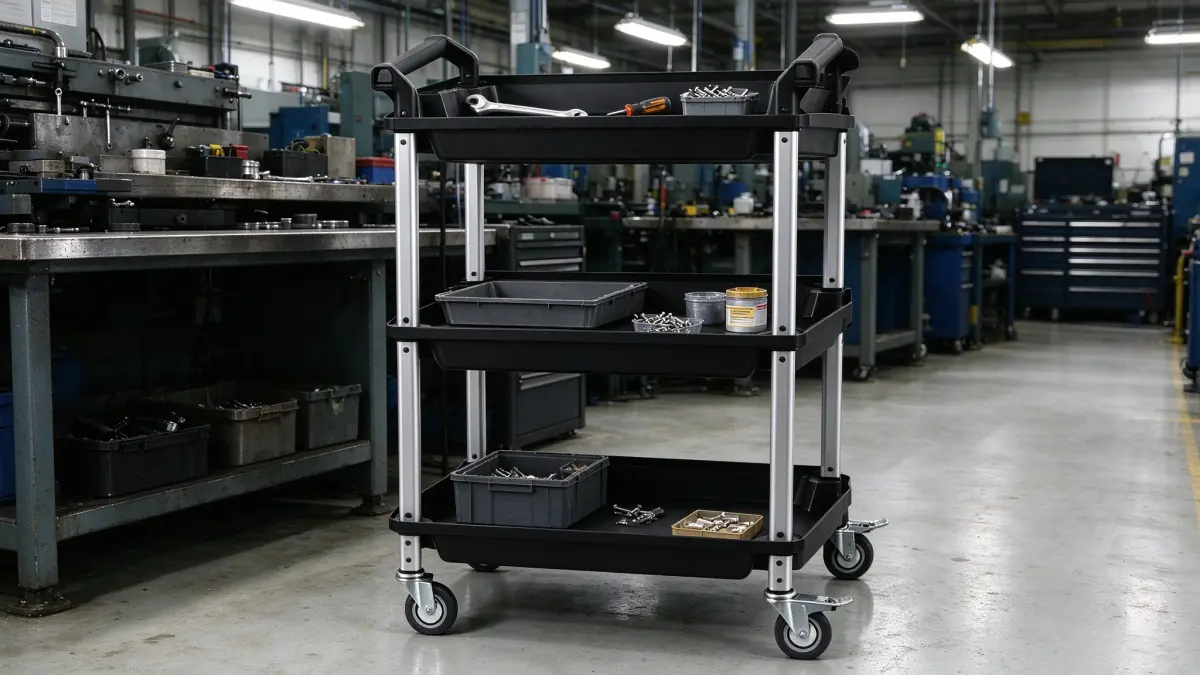
A busy workshop needs more than a place to keep tools. Employees must prepare for each job, move the right components to the correct workstation, access equipment during the task, and return everything to a controlled location when the work is complete. When these activities depend on scattered storage points or inconsistent habits, even routine jobs can become difficult to coordinate.
A 3 tier tool cart can help connect these activities by providing mobile support for workshop tasks. Instead of treating the cart as a small storage unit, a team can use it to prepare work orders, deliver tools and parts, support several stages of a job, and simplify handovers between employees.
The most effective arrangement depends on the workflow rather than a universal shelf-by-shelf formula. A repair team, an assembly operation, and a maintenance department may all use three-tier carts differently because their work sequences and material requirements are different.
This article explains how to integrate a three-tier tool cart into everyday workshop operations, establish a repeatable work routine, and evaluate whether the arrangement actually helps the team.
Define the Cart's Role in the Workshop Workflow
Before introducing a cart, identify the problem it is expected to solve. A cart should support a recognizable part of the work process, not simply create another place where miscellaneous items accumulate.
1.Connect the Cart to a Specific Job or Workstation
Start by reviewing a recurring workshop task. It might involve equipment maintenance, mechanical assembly, inspection, component replacement, or another activity that requires tools and supporting materials.
Document the basic sequence:
-
What must be prepared before the job starts?
-
Which tools and parts are needed during the task?
-
Where will the work take place?
-
Will the employee move between several workstations?
-
What needs to be returned, checked, or replenished afterward?
The answers help determine whether the cart should remain near a particular workstation, accompany an employee along a defined route, or be shared by a team performing similar jobs.
For example, a maintenance technician working on several machines may benefit from a mobile cart that travels with the planned task. A production station with a stable, repeated process may benefit more from a cart that remains nearby and is prepared before each production run.
The cart’s role should be defined by a real work requirement. This makes it easier to establish a useful layout and prevents the cart from becoming an unplanned extension of general storage.
2.Treat the Cart as Point-of-Use Support
A point-of-use arrangement places necessary tools and materials close to where they are needed. The objective is not to move every item in the workshop onto a cart. It is to bring the selected items closer to the current job.
A practical system distinguishes between three locations:
-
Central storage: the main location for general inventory, less frequently used equipment, and reserve supplies.
-
Mobile work support: the cart holding items required for a planned task or group of tasks.
-
Workstation: the area where the actual operation takes place.
These locations should complement each other. If every spare component is loaded onto the cart, the cart can become difficult to manage. If the cart carries too little, employees may need to return to storage repeatedly.
A defined boundary between central storage and mobile work support helps teams prepare the cart according to actual demand.
Turn Work Orders into a Repeatable Cart Preparation Process
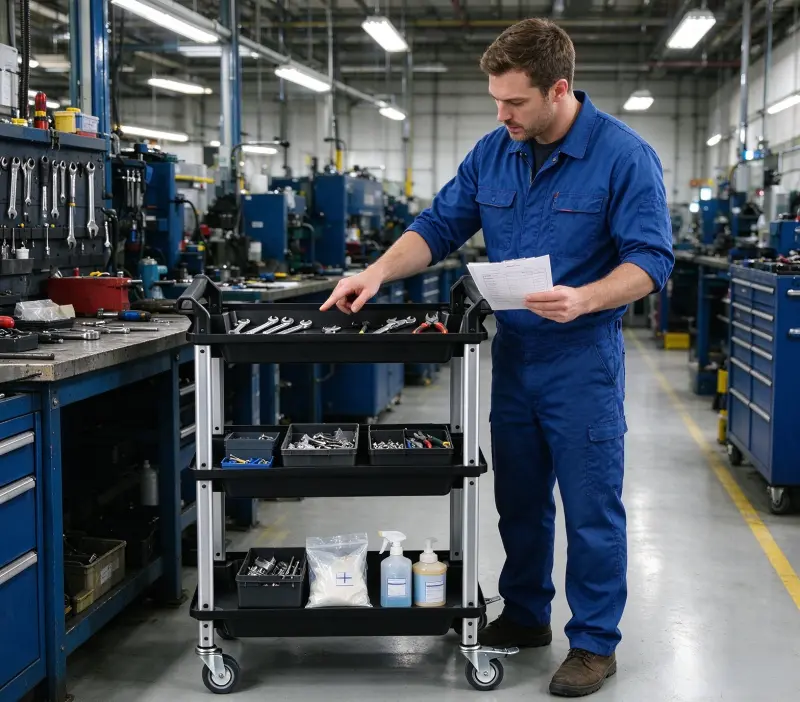
A cart is most useful when employees know what it should contain before work begins. Preparing it from a work order or task list creates a link between the planned job and the physical tools and parts available at the workstation.
1.Build the Cart Around the Planned Task
Begin with the job instructions, maintenance schedule, or production plan. Identify the tools and components that are genuinely required rather than loading the cart with everything that might conceivably be useful.
For a recurring maintenance task, the preparation list could include the required hand tools, specified replacement components, measuring equipment, and consumables. An assembly task may require a different set of tools and a defined quantity of fasteners.
The list should be practical enough for an employee to follow without interpreting every item from memory.
A work-order-based preparation routine helps connect the planned task with the materials actually taken to the job. It also gives the next employee a clear basis for checking whether the cart is ready.
2.Separate Essential Items from Optional Supplies
Not all items have equal importance. Some are essential to completing the task; others are useful backups or are required only under certain conditions.
Identify the essential items first. Then determine whether supplementary supplies are necessary based on the task’s known requirements.
This distinction matters because a cart that carries too many unrelated items can make critical tools harder to access. It can also make preparation less predictable when employees select different combinations of supplies for the same job.
For repeated work, use an agreed preparation list and document legitimate variations. Employees should not need to rebuild the entire arrangement from scratch every time a familiar task is assigned.
3.Use a Pre-Start Check Before Moving the Cart
A brief pre-start check should confirm that:
-
The scheduled task and destination are clear.
-
The required tools and components are present.
-
Containers and equipment are secure for movement.
-
Items awaiting inspection are not being treated as approved components.
-
The planned load complies with the cart manufacturer’s instructions.
This check does not need to become a lengthy administrative exercise. A short checklist is often sufficient when the task is routine.
If a required item is missing, the employee should identify the shortage before beginning the job rather than discovering it halfway through the operation. Over time, recording repeated shortages can also reveal gaps in the preparation list or replenishment process.
Use the Three Tiers to Support the Work Sequence
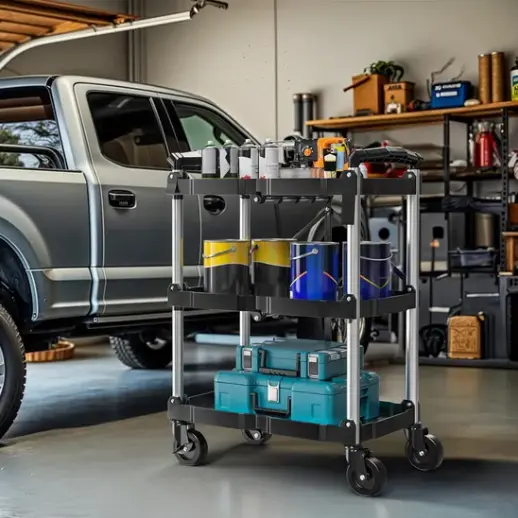
The three levels of a cart can represent stages of a task, operational priorities, or different material states. The best arrangement is the one that reflects how the workshop actually works, not simply the one that looks neatest.
1.Assign Each Level a Clear Operational Purpose
A team can configure the cart around the sequence of work instead of relying only on general item categories.
For example, a workshop may use separate levels for materials prepared for the next task, equipment needed during the active task, and items that must be checked or returned afterward. Another operation may need a different configuration because tools remain in use throughout the process while components move through several stages.
The important point is consistency. If a particular level has a defined purpose, employees should be able to recognize that purpose quickly and understand what does and does not belong there.
Do not assume that every workshop should use the same top-middle-bottom arrangement. The correct setup depends on the items involved, their dimensions, the job sequence, accessibility requirements, and the manufacturer’s operating guidance.
2.Keep Material Status Visible
One source of confusion in workshop operations is the failure to distinguish between materials that are ready for use and materials whose status is still uncertain.
For example, replacement parts prepared for an approved job should not be casually mixed with removed components that need inspection. Likewise, materials that have been counted and checked should be distinguishable from quantities that have not yet been verified.
A three-tier cart can support this distinction by keeping material groups physically separated. Where necessary, use suitable containers or clear labels to identify their status.
The cart is not a substitute for quality-control procedures. It is a practical way to make those procedures easier to follow at the point of work.
3.Avoid Moving Items Between Levels Without a Reason
If employees repeatedly rearrange the cart during a task, the original layout may not match the real workflow.
Observe when and why these changes happen. Do workers need to reach a tool that is stored inconveniently? Are supplies mixed with materials awaiting inspection? Does the task sequence change more often than expected?
Adjust the layout based on these observations. A useful cart arrangement should remain stable during normal work while still allowing justified changes when the task requirements differ.
The aim is not to prohibit movement. It is to avoid unnecessary rearrangement that interrupts work or makes the next employee uncertain about where items belong.
Coordinate Movement Between Workstations
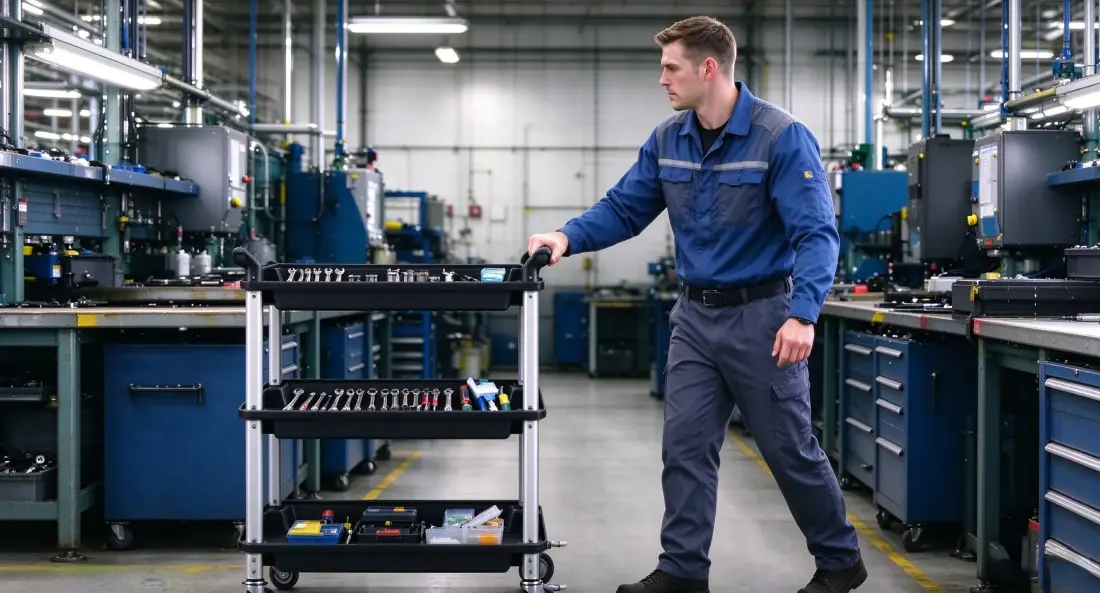
Some workshop tasks take place at one fixed bench. Others involve several machines, assembly areas, inspection points, or maintenance locations. In the latter case, the cart can act as a mobile link between stages of the job.
1.Plan the Route Before Loading the Cart
Consider the order in which the work will be performed. If a task requires preparation, assembly, and inspection, determine where each step takes place and which materials must be available at each point.
A planned route can reduce unnecessary returns to central storage. It can also help prevent employees from delivering tools or components to the wrong workstation.
The route does not need to be complicated. A simple sequence of work locations may be sufficient for a small workshop. More complex operations may need a standard route or workstation-specific preparation list.
Load the cart for the planned work sequence, not for an undefined journey around the workshop.
If the job changes after work has started, review what additional materials are needed before continuing. This helps avoid repeatedly moving the cart back and forth because the original preparation did not match the revised task.
2.Establish Rules for Shared and Dedicated Carts
A dedicated cart is assigned to a particular workstation, task, or piece of equipment. A shared cart supports multiple employees or jobs.
Both arrangements can work, but each requires a clear rule for responsibility.
For a dedicated cart, define who checks its condition and replaces consumed supplies. For a shared cart, establish who prepares it, how employees reserve or take it, and where it must be returned after use.
Without these rules, a shared cart may be available physically but not operationally ready. One employee may remove an essential tool, while another assumes the complete kit is still available.
Where carts are shared across shifts, a visible status indicator or simple handover record can make availability easier to understand.
3.Keep the Cart Compatible with the Work Area
The route should reflect the physical layout of the workshop. Narrow passages, uneven flooring, nearby equipment, and other moving activities can affect how easily a cart can be positioned and accessed.
Before adopting a route, test it in the actual working environment. Check that employees can position the cart without obstructing the task or placing materials in unsafe locations.
Also confirm that the cart’s dimensions and loading arrangement fit the intended application. Its rated capacity, movement restrictions, and operating instructions must be respected. Avoid assuming that a product suitable for one work area will automatically suit every location in the facility.
Establish Tool Accountability and Standard Work
A mobile cart needs a routine that makes its contents understandable to more than one employee. Otherwise, its usefulness may depend on the memory and habits of the person who prepared it.
1.Define Responsibility at the Start and End of a Job
Before beginning a task, the assigned employee should check the required equipment. When the work is complete, the employee should return reusable tools to their designated storage locations and identify any tools that are missing, damaged, or awaiting inspection.
The process should distinguish between returning an item and confirming that the item is ready for use. Where workplace procedures require inspection, cleaning, calibration, or maintenance, the relevant procedure must still be followed.
This prevents the cart from becoming a place where unverified tools remain mixed with ready-to-use equipment.
2.Use a Simple Reset Routine
After a job, employees should remove unrelated materials, return tools to their assigned locations, secure small-component containers, and record any shortages that require follow-up.
The routine should be short enough to perform consistently. If it is excessively detailed, employees may bypass it under time pressure. If it is too vague, different people may interpret it differently.
A practical standard might specify who performs the reset, what must be checked, and how exceptions are reported. The exact procedure should reflect the workshop’s existing safety, maintenance, and quality requirements.
3.Standardize the Layout Without Ignoring Real Differences
Consistency is particularly valuable where multiple employees perform similar tasks. A common layout reduces the need to learn a completely different arrangement each time a cart is shared.
However, standardization should not mean that every job must use the same contents. Different machines, repair procedures, and production runs may require different tools and parts.
The better approach is to standardize the preparation method, location rules, and handover process, while allowing the required contents to change with the job.
This creates a repeatable management system without forcing unrelated tasks into an unsuitable arrangement.
Control Parts at the Point of Use
Tools are only one part of workshop management. Small components and consumables can also disrupt work when their availability, identity, or status is unclear.
1.Prepare Parts in the Quantities Required for the Job
Where practical, prepare the expected quantity of components before starting the task. The appropriate quantity depends on the work order, normal consumption, and whether additional parts are routinely required.
Preparing a defined quantity makes it easier to check what was issued and whether anything remains at the end of the job. It can also help employees identify when actual consumption differs from the plan.
This does not require a complex inventory system for every cart. A task list and clearly identified containers may be adequate for a small number of recurring jobs.
2.Prevent Confusion Between Similar Components
Parts that look similar may have different dimensions, specifications, or intended applications. When these differences affect compatibility or quality, keep the parts distinguishable during transport and use.
Follow the organization’s part-identification and quality-control rules. Do not rely on memory or container appearance when an exact part number, specification, or inspection status matters.
A cart can support this system by carrying the components prepared for the current work order rather than acting as a general box for assorted spare parts.
If your team also needs a detailed method for classifying individual components and containers, keep that as a separate procedure rather than expanding the mobile-workflow system into an unnecessarily complicated storage standard.
3.Refill the Cart Based on Actual Use
At the end of a task or shift, identify which supplies need to be replaced before the next job. The person responsible for replenishment should know where replacement stock comes from and how shortages are reported.
For recurring operations, use a practical minimum-stock or replenishment trigger when appropriate. The threshold should reflect real usage and replenishment requirements rather than being copied indiscriminately across every component.
The purpose is to make restocking predictable. A cart should be prepared for its next assigned task, not filled automatically to its maximum available space.
Make Shift Handovers More Reliable
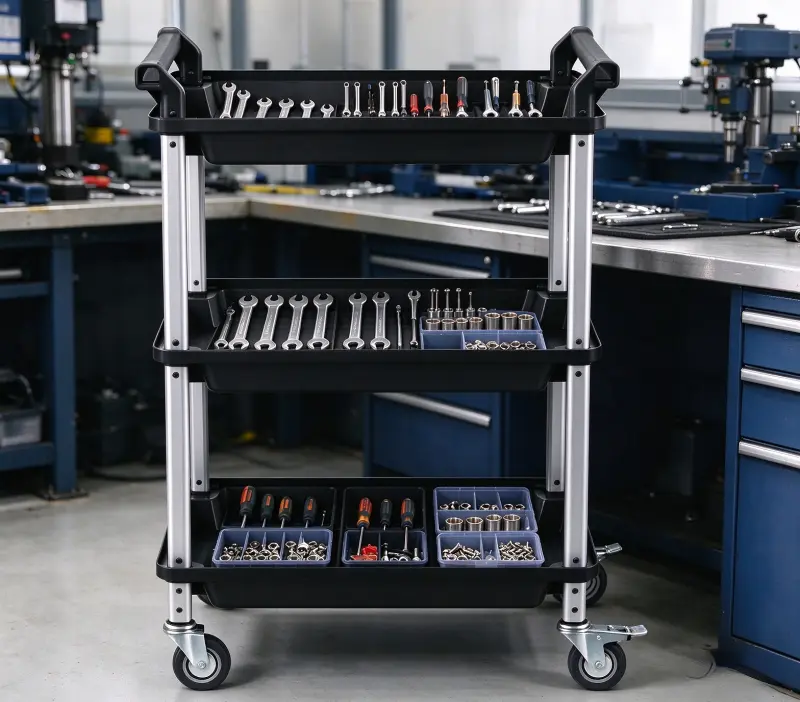
When a cart is shared between shifts, poor handover can undermine even a well-designed preparation process. The incoming employee needs to understand what has been completed, what remains in progress, and whether the cart is ready for the next task.
1.Record the Status of the Current Job
A useful handover should identify the task, the work completed, any outstanding step, and any item that requires follow-up. Where relevant, record missing tools, shortages, parts awaiting inspection, or changes to the planned work.
The record can be a short checklist, a work-order update, or another method already used by the workshop. The important point is that the information should be accessible and consistent.
The cart itself should not be expected to communicate all task status through its physical contents. A component left on a shelf does not necessarily explain whether it is unused, removed, rejected, or awaiting verification.
2.Confirm Readiness Before the Next Shift Takes Over
The incoming employee should be able to determine whether the cart is ready for the next assigned task or needs preparation first.
A clear status such as ready, in progress, or awaiting replenishment may be sufficient for a simple operation. Larger teams may need more formal records tied to their work orders.
The process should also establish responsibility for unresolved problems. If a required tool is missing or a part shortage remains, the next shift needs to know who will address it and whether the job can proceed.
A reliable handover transfers both the cart and the information needed to use it correctly.
Measure Whether the Cart Improves Workshop Management
Introducing a cart does not automatically make a process more efficient. To assess its usefulness, choose a small number of observable measures and compare performance before and after the new arrangement.
1.Establish a Baseline Before Changing the Process
Start by observing a recurring task under the current system. Record information that matters to the workshop, such as preparation time, trips back to central storage, missing-tool incidents, material shortages, or handover problems.
Choose measures that employees can record consistently. There is no need to collect every available data point.
For example, a workshop could record the number of times a technician leaves the workstation to retrieve a missing item during a selected group of similar jobs. Another team might track how often a cart is unavailable because the previous shift has not reset it.
The baseline provides a reference point. Without it, a team may believe a new arrangement has improved performance simply because it looks more organized.
2.Run a Controlled Trial
Select one recurring task or workstation for an initial trial. Prepare the cart using an agreed checklist and keep the work sequence reasonably consistent while collecting observations.
During the trial, ask the employees who use the cart whether the setup matches the work. Record practical problems rather than relying only on general impressions.
Possible questions include:
-
Were any essential tools missing when the task began?
-
Did employees make unnecessary trips to retrieve supplies?
-
Were components difficult to identify or access?
-
Did the cart return to a ready state after the job?
-
Could another employee understand its status during a handover?
Adjust the arrangement in response to actual findings. A trial is meant to reveal what works and what needs improvement, not to prove that the first layout was correct.
3.Compare Like with Like
When reviewing results, compare similar tasks, similar working conditions, and comparable observation periods where possible.
A reduction in preparation time may be meaningful, but it should not be attributed solely to the cart if the job, staff, or workload changed substantially at the same time.
Similarly, an increase in recorded shortages might mean that the new process makes shortages more visible, not that the cart caused more shortages.
Document what changed and what the observations can reasonably support. If a small pilot produces mixed results, refine the system and collect more evidence before applying it across the whole workshop.
Common Mistakes When Using a Three-Tier Tool Cart
1.Treating the Cart as General Storage
When unrelated items accumulate on a cart, its purpose becomes unclear. Employees may need to move items around before they can start a job.
Assign each cart a defined role and remove items that do not support its current task or documented purpose.
2.Preparing the Cart from Memory Alone
Employees may forget a less frequently used tool or assume a part is available when the stock has already been consumed.
Use a task-based preparation checklist for recurring work, and update it when requirements change.
3.Mixing Materials with Different Statuses
Ready-to-use parts, used components, and items awaiting inspection may need different handling. Keep their status identifiable and follow the workshop’s established quality procedures.
4.Ignoring the Product's Operating Limits
A cart should not be loaded beyond its stated capacity or used in a way that conflicts with the manufacturer’s instructions. The intended contents, container arrangement, working environment, and movement route all need to be considered.
Before standardizing a cart for a particular task, check the product specifications and confirm that the actual arrangement is suitable.
5.Failing to Assign Ownership
If nobody is responsible for preparing, resetting, and replenishing the cart, standards may gradually break down.
Assign responsibilities that fit the existing workflow. Keep the routine proportionate to the task and make exceptions easy to report.
Applying the Method to Jingyan's Three-Tier Rolling Utility Cart
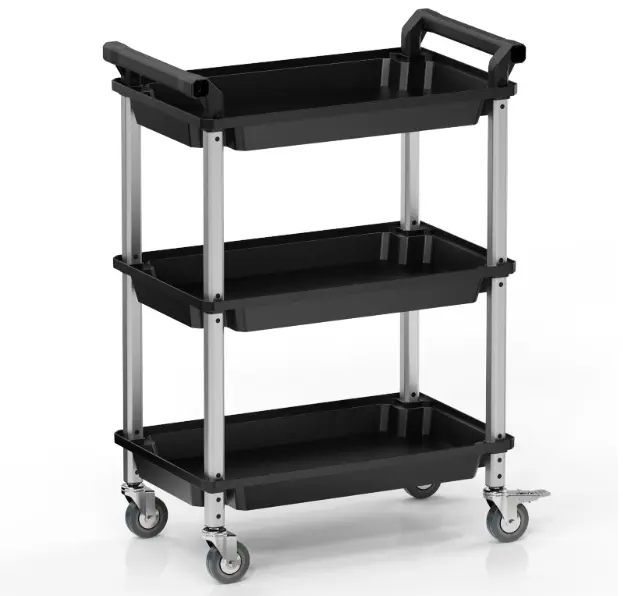
A product example helps illustrate how the workflow approach can be applied without treating one cart layout as suitable for every workshop.
Jingyan’s black 3-Tier Rolling Utility Cart has the following published specifications:
-
Overall dimensions: 25.6 inches wide × 34.3 inches high × 14.6 inches deep.
-
Shelf dimensions: 23.6 inches wide × 19.5 inches deep.
-
Clearance between shelves: 12 inches.
-
Stated load capacity: 300 lbs.
-
Shelf material: High-density polypropylene.
-
Frame material: Thickened aluminum tubing.
For a workshop considering this model, the first step is to identify the actual job requirements. Determine whether the planned tools, parts containers, and other task materials fit the available shelf space and clearance. Then confirm that the complete load and intended operating conditions comply with the product’s instructions.
The cart could serve as mobile support for a defined maintenance task, a prepared set of tools for repeated workshop work, or a way to bring task-related supplies between workstations. The exact setup should be tested with the intended contents rather than assumed from the number of shelves alone.
For procurement teams, product suitability is only one consideration. Consistent specifications, appropriate packaging, order quantities, and the supplier’s ability to support repeat purchases may also matter.
Ningbo Jingyan Tool Industrial Co., Ltd., founded in 2003, manufactures industrial tools and storage-related products and provides OEM/ODM services. Its stated manufacturing resources include a 16,000 m² production base, more than 140 professionals, and over 50 sets of production equipment. These capabilities are relevant to importers, distributors, and private-label buyers evaluating a potential supply relationship.
If a cart is being considered for a product range rather than one isolated purchase, buyers can discuss the intended application, market requirements, packaging, branding needs, and expected order quantity with the supplier.
Frequently Asked Questions
1.What is the main purpose of a 3 tier tool cart in a workshop?
Its main purpose is to bring the tools and parts required for a defined job closer to the point of use. When prepared around a work order, it can support task preparation, movement between workstations, and consistent handovers.
2.How should a workshop decide what goes on each tier?
Start with the work sequence and the actual materials needed. Assign each level a clear operational purpose, such as supporting preparation, active work, or items requiring follow-up. The correct arrangement varies by task, and all loading must follow the manufacturer’s guidance.
3.Can a three-tier cart support more than one workstation?
Yes, provided the route, contents, and responsibility for the cart are clearly defined. For repeated jobs across several workstations, prepare the cart for the planned sequence and confirm that it fits the physical working environment.
4.How can a cart help reduce missing-tool problems?
Use a preparation checklist before the task and a reset check afterward. Record missing items and determine whether the problem resulted from preparation, removal, storage, or handover. The cart provides a physical framework, but responsibility and consistent procedures are still necessary.
5.How is workshop workflow management different from general cart organization?
General cart organization focuses on where items belong and how they are identified. Workflow management focuses on whether the right items are prepared for the right task, reach the correct location, remain in an understandable state, and are ready for the next employee. The two approaches complement each other but answer different operational questions.
6.How can a buyer evaluate whether a cart is suitable for workshop use?
Begin with the intended task and the items that need to travel together. Confirm that the cart’s dimensions, shelf space, clearance, load rating, materials, and operating instructions match the application. Test the proposed arrangement with representative contents before standardizing it.
7.Is a 3 tier storage cart useful for repeat maintenance jobs?
It can be useful when recurring jobs need a predictable set of tools and parts. A task-based preparation list, consistent cart layout, and reset routine make it easier for different employees to follow the same process. Actual results depend on how well the arrangement matches the job and how consistently the team uses it.
Conclusion
A 3 tier tool cart is most useful when it supports a defined workshop process, rather than serving as an extra place to store miscellaneous items.
Start by connecting the cart to a specific work order or workstation. Prepare it for the planned task, use the levels to support the work sequence, define how it moves between locations, and establish a clear routine for tool accountability, parts status, and shift handovers.
Then measure the results against the previous process. Preparation time, missing-tool incidents, unnecessary trips, and cart readiness can all provide useful evidence when they are recorded consistently.
For manufacturers, workshop operators, importers, and distributors, the central principle is the same: the cart’s value comes from how effectively it fits the work being done. A suitable product combined with a clear operating routine can provide a practical foundation for repeatable workshop tool and parts management.
Related products