3-Tray vs 5-Tray Toolboxes: Which Configuration Fits Different Users?
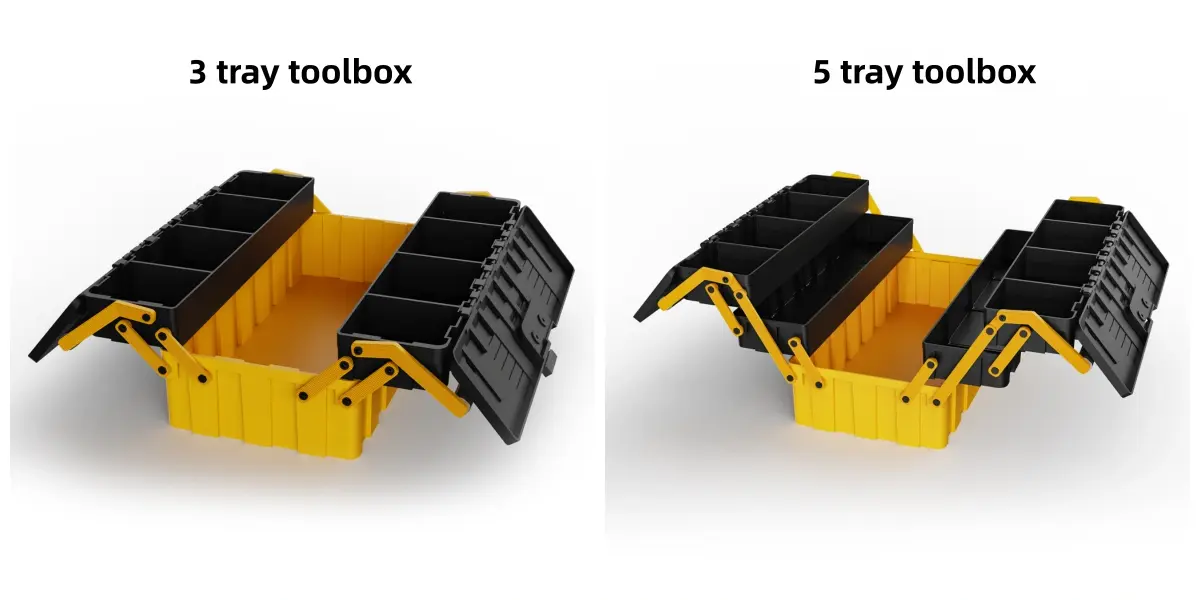
Choosing between a 3-tray and a 5-tray toolbox is not simply a matter of deciding how many storage levels a product should have. The better configuration depends on the tools customers carry, the tasks they perform, and the way they expect to organize their equipment.
A field technician working with a consistent set of tools may have very different requirements from a maintenance team responsible for several types of equipment. A distributor also needs to consider whether both configurations serve distinct customer groups or whether one model would meet most of the market’s needs.
For buyers comparing a small tool box for a wholesale, distribution, or private-label product range, the key question is not which configuration has more trays. It is which configuration fits the customer’s actual tool assortment and working routine.
A 3-tray toolbox may suit a defined set of frequently used tools, while a 5-tray toolbox may be more appropriate when customers need to separate several different categories of tools and accessories. These are useful starting points rather than universal rules. The final choice should be based on the intended application, actual tool dimensions, product specifications, and customer feedback.
This guide compares both configurations by user type, tool assortment, purchasing requirements, and B2B product positioning to help buyers make a more informed selection.
Table of Contents
- The Quick Comparison: 3-Tray vs 5-Tray Toolboxes
- What Does the Number of Trays Mean for the User?
- Which Configuration Fits Different Types of Users?
- Match the Configuration to the Actual Tool Assortment
- Comparing the Actual 3-Tray and 5-Tray Toolbox Specifications
- How Should Distributors Position Both Configurations?
- What B2B Buyers Should Confirm Before a Bulk Order
- Choosing a Toolbox Supplier for Your Product Range
- Frequently Asked Questions
- Final Recommendation: Choose by User Requirements, Not Tray Count Alone
The Quick Comparison: 3-Tray vs 5-Tray Toolboxes
The easiest way to begin is to identify the type of tool kit the customer needs to manage.
| Selection factor | 3-tray toolbox | 5-tray toolbox |
|---|---|---|
| Typical tool assortment | A defined set of frequently used tools | A wider mixture of tools, accessories, and components |
| Number of storage categories | Suitable when a few clear categories cover the kit | Useful when more categories need to be separated |
| Standardized maintenance kit | A practical option for a fixed task list | Worth considering when the kit includes several distinct groups |
| Mixed service requirements | Suitable when the tool selection remains relatively consistent | May suit users working with different equipment or repair tasks |
| Main selection question | Can the required tools be organized into a few practical groups? | Will the extra divisions be useful to the customer? |
| Distributor’s decision | Offer as a focused configuration where demand supports it | Offer as an alternative where customers need more distinct categories |
Neither configuration is automatically better for every user. A toolbox with more trays is not necessarily a better match for someone who carries a limited, standardized tool kit. Equally, a three-tray model may not be the most practical choice when the intended kit contains many different types of items that users need to distinguish.
The comparison should begin with the actual contents of the toolbox rather than an assumption about product quality or market position.
What Does the Number of Trays Mean for the User?
Tray count is a design characteristic. Its value comes from how well the arrangement matches the contents and the user’s way of working.
1.When a 3-Tray Toolbox Is a Practical Choice
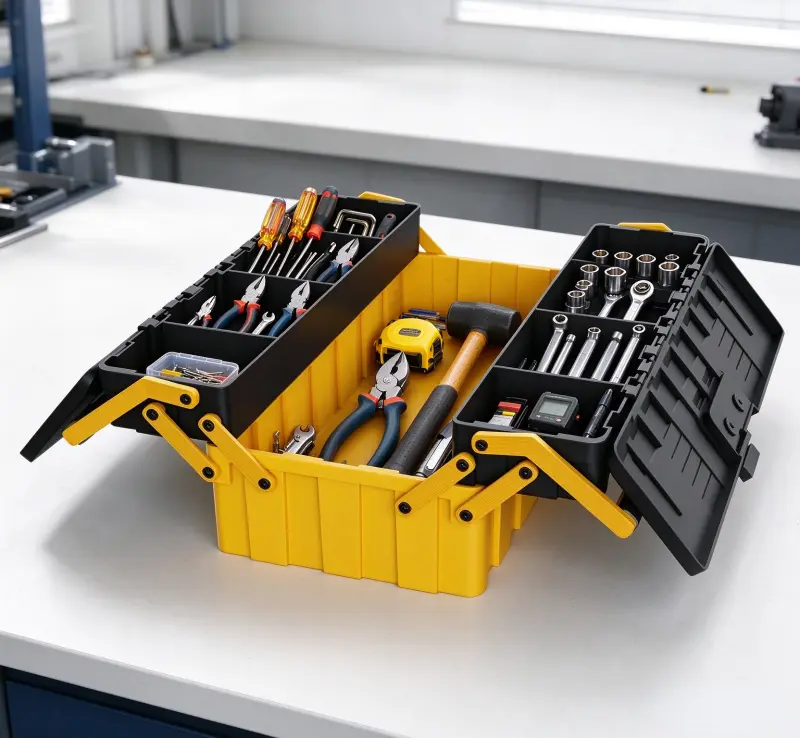
A 3-tray toolbox is worth considering when the tool assortment is relatively predictable. The user may carry a set of screwdrivers, pliers, wrenches, measuring tools, and a limited selection of accessories.
If those contents can be divided into a few clear groups, three trays may provide all the separation the user needs. The organization remains straightforward, and the product can be positioned around a defined range of essential tools rather than an unrestricted collection of equipment.
This configuration can be particularly relevant to standardized service kits, installation tasks with a known tool list, and maintenance routines where the same tools are used repeatedly.
For B2B buyers, the key advantage is a clear product proposition. A distributor can describe the model in terms of the tool assortment it is intended to organize instead of making a broad claim that it suits every kind of work.
However, three trays do not automatically mean the kit must be small or basic. A professional user may prefer a three-tray design simply because the required tools form a consistent set and do not need additional divisions.
For model specifications and available variants, buyers can review the three-tray toolbox.
2.When a 5-Tray Toolbox Is Worth Considering
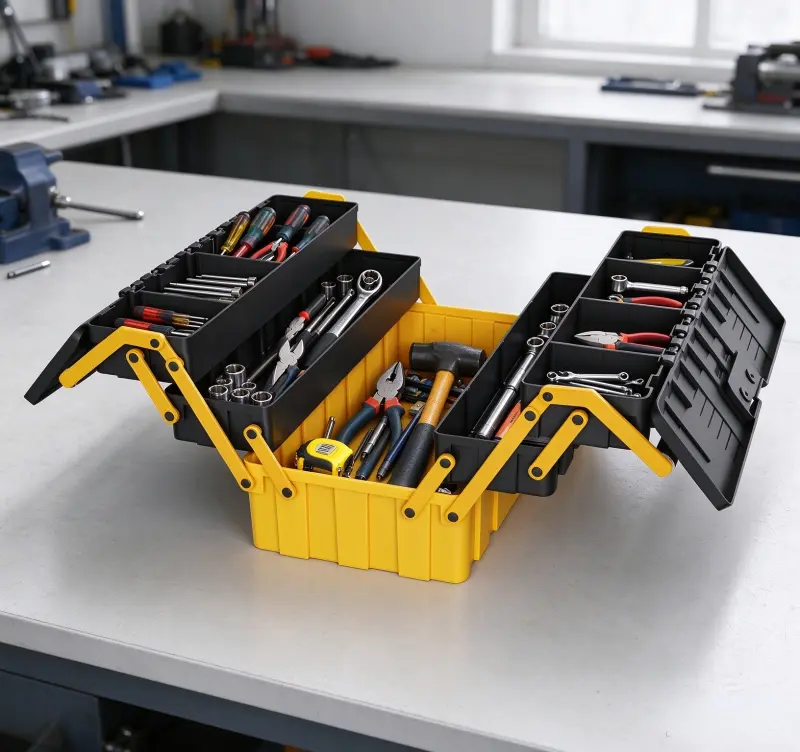
A 5-tray toolbox may be a better fit when the contents include several recognizable categories that should not all be grouped together.
For example, a mixed maintenance kit may contain hand tools, measuring accessories, fasteners, replacement components, and task-specific items. A five-tray arrangement provides more opportunities to assign different categories to separate levels.
The value comes from making those categories easier to distinguish, not from assuming that every additional tray will be filled.
A five-tray configuration can be useful when a user handles multiple equipment types, performs different kinds of repair work, or maintains a broader set of accessories and parts.
Before choosing it, buyers should ask whether the extra divisions solve a real problem. If customers would use only a few of the available categories, the additional trays may not justify maintaining a separate product configuration.
Buyers can review the five-tray toolbox specifications and available variants before matching the model to their target customers.
The best reason to select five trays is that the customer’s tool assortment benefits from more distinct categories.
For a closer look at how layered designs improve tool organization and access, read our guide to multi-layer toolbox organization.
Which Configuration Fits Different Types of Users?
Different occupations can use similar toolboxes in different ways. The actual selection should follow the work being performed, rather than relying on a job title alone.
1.Field Service and Installation Technicians
Field service and installation technicians often work from a defined list of tools. Their requirements may remain consistent across jobs, even when they visit different customer locations.
A three-tray configuration may be suitable when the kit contains a predictable range of hand tools and accessories. Buyers should check whether the tools can be grouped in a way that makes sense for the technician’s routine.
A five-tray model may be worth considering when installation work involves several different systems, additional replacement components, or a wider range of task-specific accessories.
For this group, the best starting point is the technician’s standard tool list. It is more useful to determine which categories must be separated than to assume that all field service workers need the same configuration.
2.Repair and Maintenance Teams
Repair and maintenance teams may deal with a broader range of equipment and replacement parts than technicians working on a single standardized task.
A five-tray toolbox can make sense when the kit needs to distinguish between hand tools, small components, fasteners, and items used for specific maintenance activities. This may also be relevant when multiple users rely on the same toolbox and need to follow a consistent arrangement.
However, a three-tray toolbox can be equally appropriate for a team assigned to a repeatable inspection or servicing routine. If the contents are already standardized, the additional divisions of a five-tray design may offer limited value.
Purchasing managers should therefore evaluate the actual maintenance checklist, the required tool categories, and whether the proposed arrangement will be used consistently.
3.Workshop Stations and Shared Tool Kits
A shared toolbox needs an understandable layout. Different employees may use the same equipment throughout the day, so the organization should not depend on one person’s memory.
A three-tray model may fit a standardized station kit containing a defined selection of tools. A five-tray model may be more suitable when several categories of tools and accessories need to remain distinct.
For either configuration, the product should support a repeatable way of organizing the kit. A team can decide which category belongs in each tray and establish a simple return-to-place routine.
The purpose is not to maximize the number of divisions. It is to help different users understand the same arrangement and maintain it over time.
4.Importers, Distributors, and Private-Label Buyers
For importers and distributors, the configuration decision affects product positioning as well as end-user suitability.
A three-tray toolbox may serve customers looking for a clearly defined tool storage solution. A five-tray model may appeal to customers whose assortments require more categories and separation.
Private-label buyers should also consider how the two configurations will be presented within their own catalogues. The difference needs to be clear enough for a sales team or downstream retailer to explain without relying on technical knowledge of the manufacturing process.
If both models are offered, each should have a recognizable role. A higher tray count alone is not a sufficient reason to describe one model as universally superior.
Match the Configuration to the Actual Tool Assortment
Before selecting a model, buyers should prepare a representative list of the tools and accessories the intended customer will carry. This helps turn a general product preference into a specific requirement.
1.Separate Tools by Function
The total number of tools does not tell the whole story.
A kit containing many similar screwdrivers may be easier to organize than a smaller kit containing tools, measuring accessories, irregularly shaped items, and assorted small components.
Buyers should therefore consider both the number of items and the variety of categories. A five-tray configuration becomes more relevant when the range of contents creates a genuine need for additional separation.
2.Verify Tool Dimensions Before Confirming the Model
Tray count should never replace a dimensional check.
Buyers should identify the longest and widest items in the intended tool assortment, then confirm that the usable tray dimensions and compartment arrangements can accommodate them.
If certain tools cannot fit within the intended configuration, the product should not be marketed as a complete storage solution for that kit.
This is particularly important when the toolbox will be sold as part of a pre-defined assortment. The product description and any accompanying tool list should match the actual configuration rather than suggest universal compatibility.
Comparing the Actual 3-Tray and 5-Tray Toolbox Specifications
The product specifications provide a useful starting point, but the configuration should still be selected according to the intended customer and tool assortment.
| Specification | 3-tray model | 5-tray model |
|---|---|---|
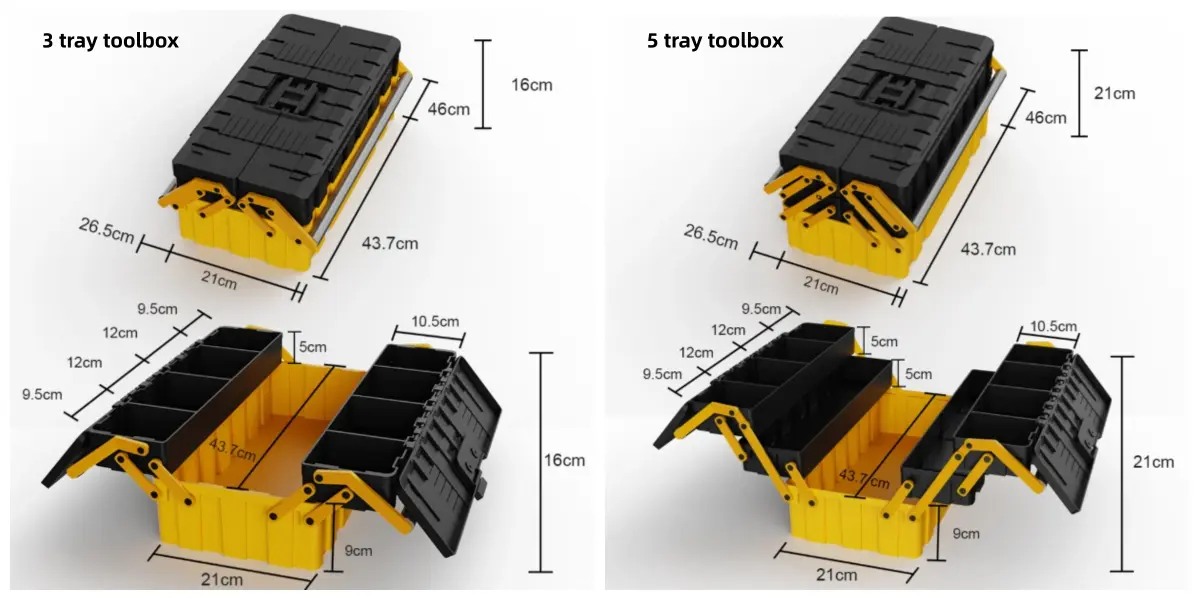
| External dimensions | 46 × 26.5 × 15.8 cm | 46 × 26.5 × 21 cm |
| Product weight | 9.5 kg | 12.5 kg |
| Stated load capacity | 30 kg | 30 kg |
| Storage levels | 3 trays | 5 trays |
| Listed material and color combinations | Green/yellow: ABS+PA; red: Metal+PP+TPR | Green/yellow: ABS+PA; red: Metal+PP+TPR |
Both configurations have a stated load capacity of 30 kg. A higher tray count does not automatically mean a higher load rating. Buyers should confirm the applicable specification for the exact model and ask whether any individual tray limits apply.
The two models also differ in external height and product weight. These details matter when buyers evaluate the product for a specific assortment, packaging arrangement, or customer requirement.
Material and color should be evaluated separately from tray count. If material choice is also part of the buying decision, our guide to plastic toolbox vs metal toolbox explains the key factors buyers should compare.
For buyers considering a three-tray toolbox or a five-tray toolbox, the next step is to review the required tool list alongside the usable tray dimensions and model-specific specifications. This gives the purchasing team a clearer basis for selecting the appropriate model.
How Should Distributors Position Both Configurations?
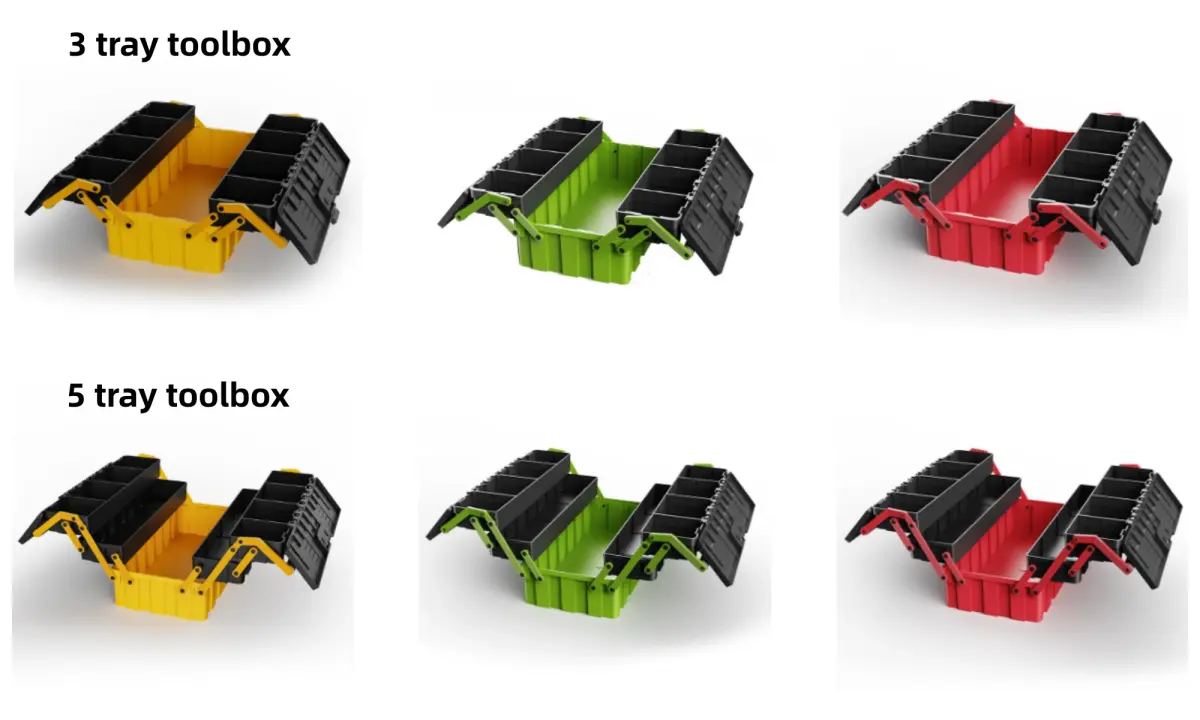
Carrying both configurations can create a useful product choice, but only when each has a distinct role in the range.
1.Define the Target Customer for Each Model
A distributor should be able to explain the difference between the models in one or two sentences.
For example, the three-tray version may be positioned around a defined selection of frequently used tools, while the five-tray version may be presented to customers who need more separate categories.
These positioning statements should be grounded in customer requests, sales feedback, product trials, or purchasing patterns. It is not necessary to describe the five-tray model as a premium choice simply because it has more storage levels.
A clear distinction helps sales teams recommend the appropriate product without suggesting that one configuration is suitable for every application.
2.Decide Whether Both Models Deserve a Place in the Range
The decision to stock two models should reflect the market.
If customer enquiries and sales records show distinct demand for both configurations, carrying both may make sense. If most customers have similar tool assortments and requirements, starting with one model may simplify inventory and purchasing decisions.
Importers should also consider minimum order quantities, carton dimensions, available storage space, forecast sales, and the cost of maintaining multiple SKUs.
These considerations should be evaluated together with the end user’s needs. The aim is to build a product range that customers can understand and that the distributor can manage commercially.
3.Keep the Difference Easy to Explain
Product listings should make it clear how the models differ. Useful comparison points include the number of trays, external dimensions, product weight, stated load capacity, available variants, and the tool assortments each configuration is intended to serve.
Avoid vague claims such as “more professional” or “best for every user.” Such phrases do not explain what the customer gains from a different configuration.
Instead, connect each model to a clear requirement. That approach gives buyers a practical reason to choose one product over another and helps reduce confusion when similar configurations appear in the same catalogue.
Planning a toolbox range for distribution or private-label sales? Discuss model selection and OEM/ODM options with our team.
What B2B Buyers Should Confirm Before a Bulk Order
Once a likely configuration has been selected, buyers should check the details that affect actual product suitability and the consistency of the delivered order.
First, evaluate a sample using representative tools. Load the toolbox with the intended assortment and confirm that the contents fit, the categories make sense, and the arrangement works for the user. A product should be assessed with realistic contents, not solely by looking at an empty sample.
Second, request the specification for the exact model. Confirm external and usable tray dimensions, product weight, stated load capacity, materials, colors, and supplied components. Do not assume that specifications are identical across all versions of a product family.
Third, confirm the model’s commercial requirements. Discuss MOQ, carton dimensions, packing quantity, sample availability, lead time, and the quantities required for the intended market. If different variants have different packaging or ordering conditions, these should be stated clearly in the quotation.
Fourth, agree on quality expectations before production. Depending on the product and order, relevant checks may include dimensions, appearance, assembly consistency, tray movement, handle and latch operation, and confirmation of the approved color and material.
Finally, confirm the private-label requirements where applicable. Branding, labels, packaging, and other customization requests should be discussed before the order is finalized. The supplier should confirm which requirements are available for the specific model and order quantity.
These steps give both parties a clear basis for approving the product and reducing misunderstandings during mass production.
Choosing a Toolbox Supplier for Your Product Range

For buyers developing a toolbox range, the supplier’s manufacturing capabilities matter alongside the suitability of the configuration itself.
Ningbo Jingyan Tool Industrial Co., Ltd. was founded in 2003. The company has a 16,000 m² self-owned production base, more than 140 employees, and over 50 sets of production equipment. Its operations cover R&D, mold design, production, quality control, and customer service. For buyers developing a branded product range, Jingyan offers OEM/ODM services that can be discussed according to the product and order requirements. The company has also maintained designated-supplier cooperation with brands including Stanley and Bosch for more than 11 years.
These capabilities provide a starting point for a sourcing discussion, but the requirements of each order should still be confirmed individually. Buyers should identify the intended model, material, color, quantity, packaging, and inspection requirements before approving a bulk order.
Whether the product range starts with one configuration or includes both, the objective is the same: select a product that fits the customer’s needs, establish a clear specification, and agree on the requirements for consistent supply.
Frequently Asked Questions
1.Is a 5-Tray Toolbox Always Better Than a 3-Tray Toolbox?
No. A five-tray toolbox provides more storage levels, but those additional divisions are useful only when the customer’s tool assortment needs them. A three-tray model may be the better fit for a defined and consistent selection of tools.
2.Does a 5-Tray Toolbox Have a Higher Load Capacity?
Not necessarily. The listed three-tray and five-tray configurations both have a stated load capacity of 30 kg. Buyers should confirm the current specification for the exact model and check whether individual tray limits apply.
3.Which Configuration Is Better for a Standardized Maintenance Kit?
A three-tray toolbox is a sensible starting point when the tool list is fixed and can be organized into a few clear groups. A five-tray model may be more useful when the kit contains several different categories that users need to keep separate.
4.Should a Distributor Stock Both Configurations?
That depends on customer demand. Carrying both can make sense when each model addresses a distinct requirement. If customers do not recognize a meaningful difference between the configurations, stocking both may add complexity without creating a clear sales advantage.
5.What Should Buyers Check Besides Tray Count?
Buyers should check usable tray dimensions, product weight, stated load capacity, the actual material and color for the selected SKU, packaging, MOQ, and the supplier’s ability to meet the order requirements. A sample evaluation can help verify that the intended tools fit and that the arrangement works in practice.
Final Recommendation: Choose by User Requirements, Not Tray Count Alone
The choice between a three-tray and a five-tray toolbox should begin with the customer’s tool assortment and working routine. A three-tray configuration may suit a defined set of tools, while a five-tray configuration deserves consideration when customers need more distinct storage categories.
For importers, distributors, and private-label buyers, the goal is not to promote the model with the highest tray count. It is to establish a clear match between the product configuration and the customer group it is intended to serve.
Prepare a representative tool list, verify the exact model specifications, and evaluate a sample where practical. If both configurations meet distinct market needs, they can support a well-defined product range. If one model already meets the requirements of most customers, a focused range may be the more practical commercial decision.
Ready to source a toolbox for your market? Send us your target configuration and estimated order quantity for a wholesale quotation.
Related products