What Makes a Portable Toolbox Practical for Professional Use?
A portable tool box is often judged too quickly.
A buyer may see a carrying handle, several storage levels, and a compact body and assume the product is practical. But professional use introduces a much more demanding standard. The toolbox may need to be carried repeatedly, opened many times during the day, loaded with different types of tools, stored in limited spaces, and transported between work areas.
That means portability is not simply a question of weight.
A practical portable toolbox needs to balance several factors at the same time: size, usable storage, organization, accessibility, carrying comfort, structural reliability, and application fit.
The same principle applies to B2B purchasing.
A distributor or importer is not only asking whether a toolbox works for one user. The buyer also needs to consider whether the product has a clear market position, whether different configurations can serve different customer groups, whether the product is practical to package and ship, and whether the manufacturer can maintain consistent quality across repeat orders.
For a small hand-held plastic toolbox, these considerations become especially important because the available space is limited. Instead of simply making the product larger, the design needs to make better use of the space already available.
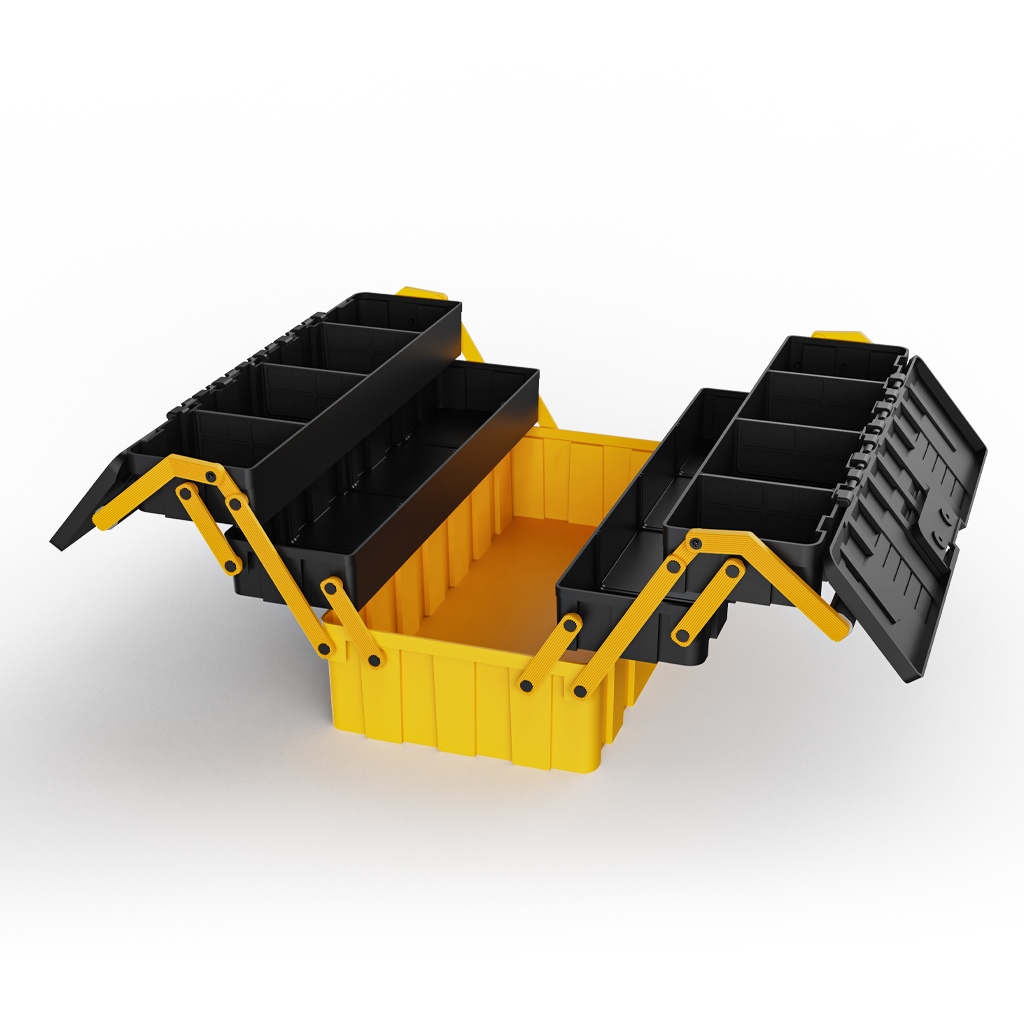
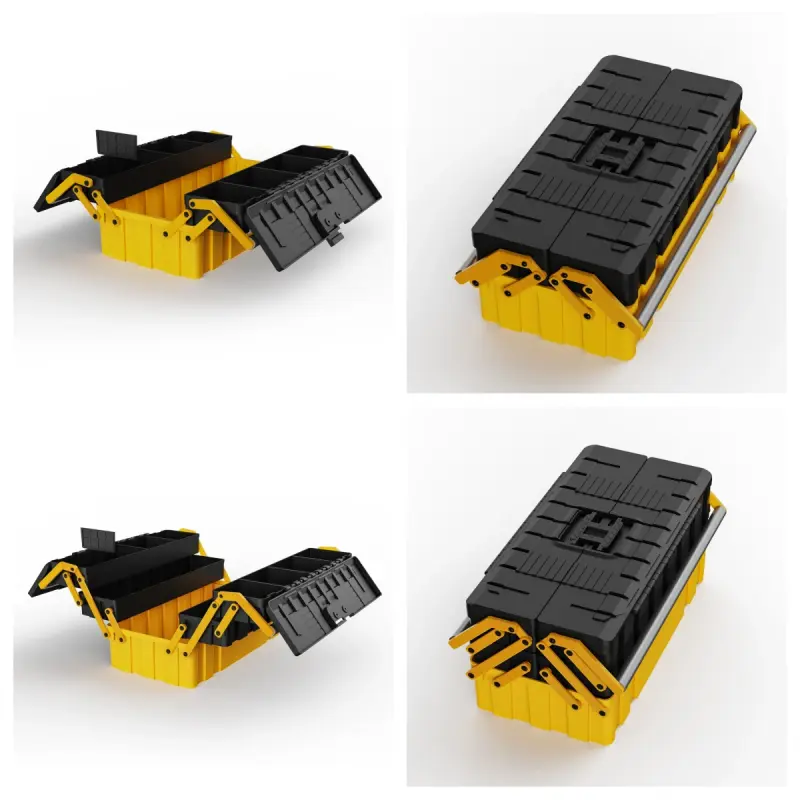
A multi-tray cantilever structure can be one solution. It separates storage vertically and allows multiple areas to become visible when the toolbox is opened, while keeping the product relatively compact when closed.
So what makes a portable toolbox genuinely practical for professional use?
The answer is not one feature. It is the way the complete product works together.
- Portability Is More Than Being Easy to Carry
- How Size and Storage Capacity Should Work Together
- Why Multi-Tray and Cantilever Design Matter
- What Makes a Hand-Held Toolbox Comfortable for Professional Use?
- How Plastic Construction Supports a Portable Toolbox
- What Should Professional Users and B2B Buyers Evaluate?
- How to Choose a Portable Toolbox Supplier for B2B Projects
- Portable Toolbox Buying Checklist
- FAQ About Portable Toolboxes
- Final Takeaway
Portability Is More Than Being Easy to Carry
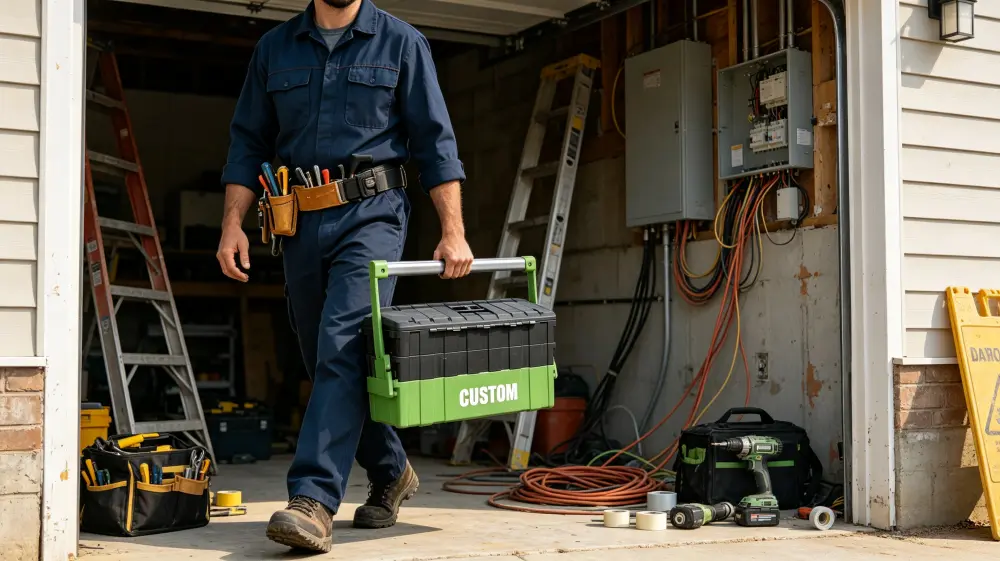
Portability begins with movement, but professional portability involves much more than lifting a box by its handle.
A portable toolbox may travel from a workshop to a vehicle, from a service area to another workstation, or from one job site to another. During that process, the product has to remain manageable and secure.
It also has to work once the user reaches the destination.
A typical working cycle may look like this:
carry → open → identify → remove → use → return → close → carry again
When that sequence is repeated throughout the day, small design weaknesses become obvious.
A toolbox that is awkward to carry will remain awkward every time it is moved. A toolbox with poor internal organization will make the user search repeatedly. A toolbox that becomes unstable when loaded will affect the carrying experience every time the user picks it up.
This is why a professional portable tool box should be considered as a working system rather than simply a storage container.
1.Portable Does Not Mean As Small As Possible
Making a toolbox smaller can improve portability, but reducing dimensions without considering usability can create new problems.
If the storage area becomes too restricted, larger hand tools may not fit properly. Smaller components may become mixed together. Users may have to remove several items before reaching the tool they need.
The better design objective is compact efficiency.
A compact toolbox should use its available dimensions effectively while keeping the overall product comfortable to carry.
For a multi-tray product, this can be achieved by using vertical space rather than continually increasing width or depth.
This is particularly useful for professional users who need a focused set of tools rather than an entire workshop inventory.
2.Real Portability Should Be Evaluated Under Load
Empty-product demonstrations do not tell the whole story.
A buyer should consider the toolbox when it contains the tools it is actually intended to carry.
Questions worth asking include:
- What will the normal tool assortment look like?
- How heavy will the toolbox be when loaded?
- How often will it be carried?
- How far will it normally be moved?
- Will the user carry it with one hand?
- Will the toolbox be opened and closed repeatedly?
These questions help distinguish between a toolbox that is merely movable and one that is genuinely designed for mobile work.
How Size and Storage Capacity Should Work Together
A small portable toolbox faces a practical design challenge:
How can it provide enough useful storage without becoming bulky?
Increasing width and depth can create more volume, but it also increases the footprint. For a hand-held product, this can reduce the convenience that makes the toolbox attractive in the first place.
A more effective approach is to make better use of the existing footprint.
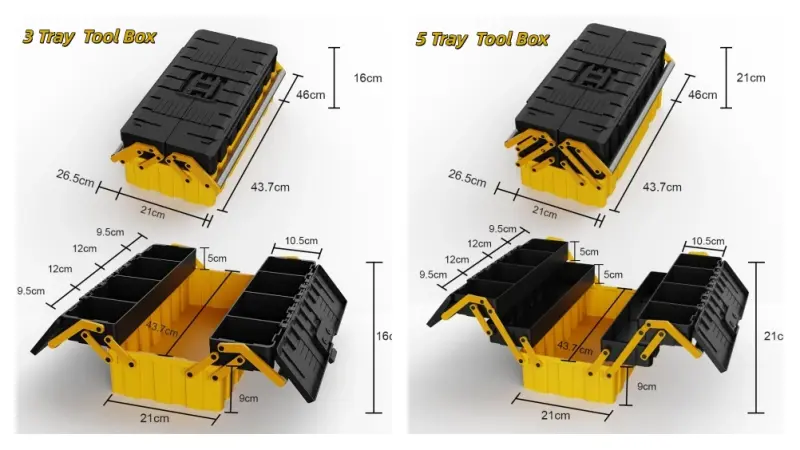
The 3-layer and 5-layer plastic configurations provide a useful example of how this principle can work. For a deeper look at how multi-layer construction improves tool organization and accessibility, see our Why Multi-Layer Toolboxes Are Designed for Better Tool Organization and Access guide.The 3-layer model measures 46 × 26.5 × 15.8 cm, while the 5-layer model measures 46 × 26.5 × 21 cm. Both retain the same width and depth while the additional layers increase the available vertical storage.
The 3-layer model has a listed weight of 9.5 kg, while the 5-layer model weighs 12.5 kg. Both configurations have a listed 30 kg load capacity.
This means the two configurations can provide different storage options without requiring a substantially wider or deeper toolbox.
1.Usable Capacity Matters More Than Empty Volume
A toolbox can appear spacious and still be inefficient.
Imagine a single deep compartment filled with screwdrivers, pliers, wrenches, fasteners, and small components. The total volume may be reasonable, but the user may still need to move several items before finding one specific tool.
Usable capacity is therefore different from empty volume.
A well-organized multi-tray toolbox can assign different storage areas to different categories of tools.
For example:
- upper areas can hold frequently accessed hand tools,
- separate areas can be used for smaller accessories,
- and other sections can accommodate tools or parts used less frequently.
The objective is not simply to fit more items.
It is to make the contents easier to manage.
2.Similar Footprints Can Support Different Product Configurations
This principle also matters to B2B buyers.
A related 3-layer and 5-layer product family can address different storage requirements while keeping a similar basic footprint.
This can make product development and assortment planning more practical.
A distributor can position one configuration toward customers who need a focused storage solution and another toward customers who require more separation between tool categories.
This is a more useful commercial distinction than simply calling one product “small” and another “large.”
Why Multi-Tray and Cantilever Design Matter
A portable toolbox becomes more useful when its internal structure supports the way people actually retrieve tools.
A basic single-compartment box keeps everything in one place, but it also forces the user to search through the same space repeatedly.
A cantilever design works differently.
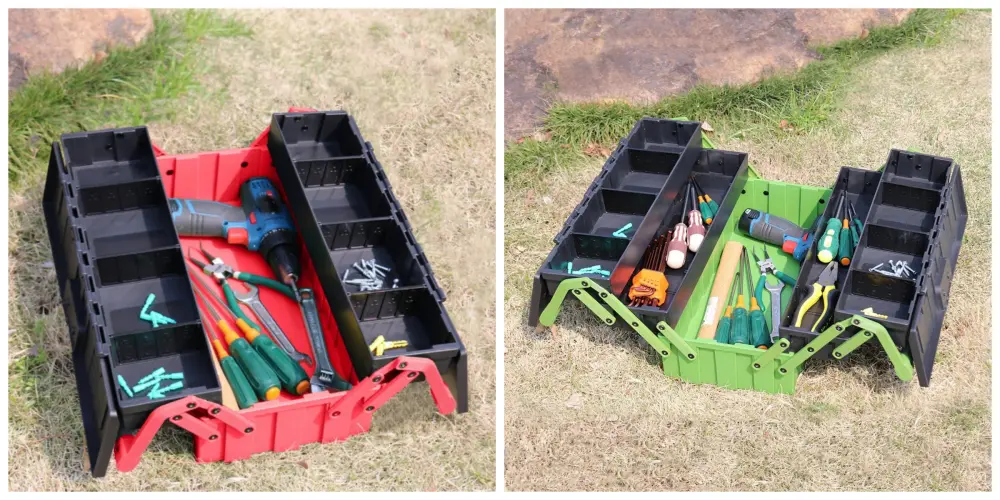
When opened, the storage trays extend outward and expose different levels of the toolbox. This can make more of the contents visible without requiring the closed product to become a large storage unit.
For a small hand-held toolbox, that is an important distinction.
1.Vertical Storage Can Improve Space Efficiency
When a toolbox cannot grow much wider or deeper, vertical organization becomes valuable.
Instead of increasing the footprint, multiple levels can be used to separate tools.
This can help accommodate different categories such as:
- hand tools,
- smaller accessories,
- fasteners,
- measuring tools,
- or application-specific components.
The benefit is not automatically “more storage.”
It is better use of limited storage space.
2.Cantilever Opening Can Make Tools Easier to See
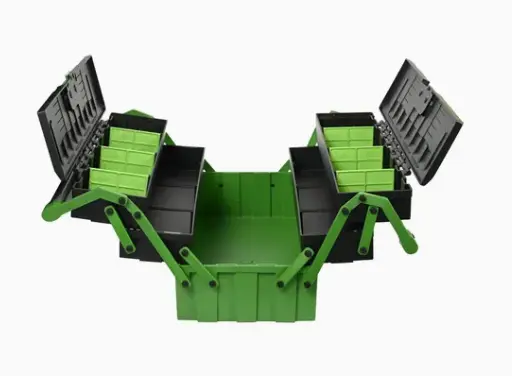
Tool visibility affects practical efficiency.
A deep storage cavity may force users to look down into the box and move items around.
A multi-level cantilever structure can expose several areas at once.
This gives the user a clearer answer to three simple questions:
What is stored in this area?
Where is the tool I need?
Where should it go when I finish using it?
That kind of visual organization can be especially valuable in repetitive professional work.
3.Three-Layer and Five-Layer Models Can Serve Different Tool Assortments
The choice between three and five layers should not be treated as a competition where more layers automatically means a better product.
Instead, the configuration should match the tool assortment.
A three-layer toolbox can work well for a relatively focused selection of tools.
A five-layer toolbox can be more appropriate where the customer needs greater separation between categories or additional storage levels.
The correct configuration depends on:
- number of tools,
- variety of tools,
- amount of small hardware,
- frequency of access,
- and carrying requirements.
That makes 3-layer and 5-layer models useful as different product configurations rather than simply different sizes.
What Makes a Hand-Held Toolbox Comfortable for Professional Use?
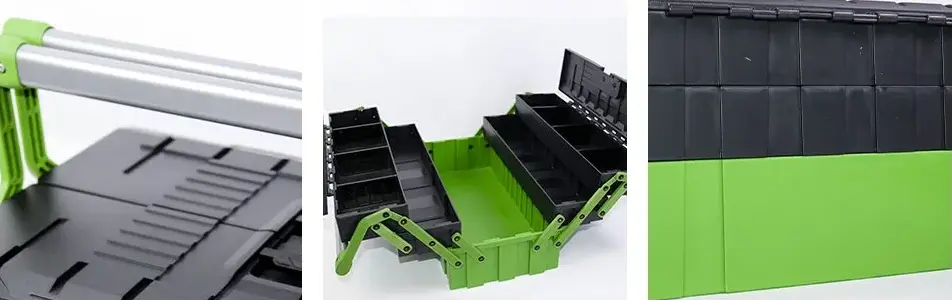
A hand held tool box needs to be evaluated as a product that people physically carry.
Once it is loaded, the handle, connection points, weight distribution, body structure, and storage configuration all influence the experience.
1.Handle Design
The handle should provide a stable and comfortable grip.
This matters more when the toolbox is carried frequently.
A handle that looks good but creates excessive pressure on the hand is not necessarily a successful portable design.
For professional applications, carrying comfort should be considered under realistic load conditions rather than when the toolbox is empty.
2.Handle Connection Matters Too
The visible handle is only one part of the carrying system.
The connection between the handle and the toolbox transfers the load into the body.
For B2B buyers, it is therefore worth evaluating:
- handle attachment,
- surrounding structure,
- fasteners,
- assembly consistency,
- and long-term repeated-use performance.
A toolbox should not be judged only by the appearance of its handle.
3.Balance Affects Carrying Comfort
Two toolboxes with similar total weight can feel different to carry.
One reason is weight distribution.
If heavier items are concentrated in one area, the toolbox may feel less balanced even though its total weight is within the expected range.
This is another reason why internal organization and ergonomics should be considered together.
4.Repeated Carrying Is More Important Than a One-Time Test
Professional users may open, close, lift, move, and reposition a toolbox many times.
That makes repeated use more revealing than a single demonstration.
The product should remain practical as those actions are repeated over time.
How Plastic Construction Supports a Portable Toolbox
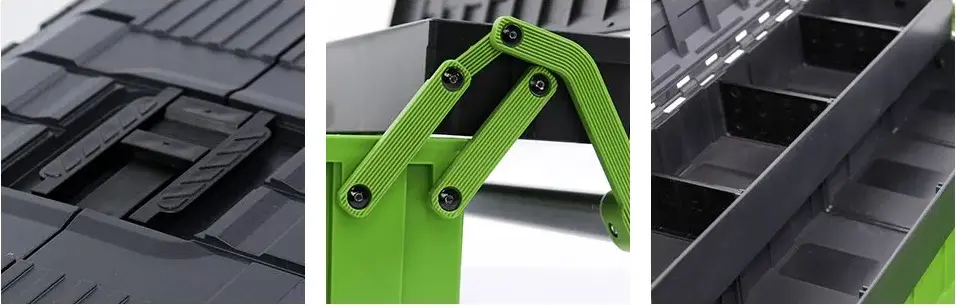
For a small multi-tray toolbox, plastic is not simply a lightweight alternative to metal.
The material also gives manufacturers flexibility when designing a compact product with shaped storage areas and multiple components.
The current 3-layer and 5-layer plastic models use ABS+PA according to the product specifications.
But the material name alone does not determine whether a toolbox is suitable for professional use.
A more useful way to evaluate the product is:
material + structure + components + manufacturing + assembly
1.Plastic Can Support Compact Product Geometry
Molded plastic components can be designed around the intended storage function.
This makes it possible to create:
- shaped trays,
- molded storage sections,
- reinforcement features,
- connection zones,
- and other geometry that helps use the available space.
For a portable toolbox, those possibilities can help combine:
compact dimensions + multi-tray organization + hand-held portability
within one product architecture.
2.Material Alone Does Not Determine Durability
A toolbox made from a suitable plastic can still underperform if the product structure or manufacturing process is inconsistent.
Buyers should consider:
- material consistency,
- molding quality,
- structural design,
- moving components,
- connections,
- assembly,
- and inspection.
For B2B sourcing, the real question is not simply whether the material is “strong.”
The better question is whether the complete product system is appropriate for the intended use.Buyers looking specifically at plastic toolbox selection for workshops and professional applications can also explore our How to Choose a Plastic Toolbox for Garage Workshops and Professional Use guide.
What Should Professional Users and B2B Buyers Evaluate?
A professional user and a B2B buyer may evaluate the same toolbox, but their decision criteria are not identical.
1.Professional User Perspective
A professional user should focus on whether the toolbox makes everyday work easier.
Important considerations include:
- portability,
- tool access,
- organization,
- size,
- usable capacity,
- carrying comfort,
- and repeated-use reliability.
The toolbox should fit the user’s workflow rather than force the user to work around the product.
2.Distributor and Importer Perspective
A distributor or importer needs to think beyond individual use.
The product should have a clear reason to exist within the market.
Buyers may evaluate:
- product positioning,
- model configurations,
- dimensions,
- packaging,
- shipping requirements,
- quality consistency,
- and supply capability.
A small portable toolbox can occupy a different market position from large stationary storage products.
Its value may come from mobility and organized storage, rather than maximum storage volume.
3.Private-Label Perspective
Private-label buyers need an additional layer of consideration:
How can the product be differentiated?
Depending on the project, customization may involve:
- color,
- branding,
- packaging,
- internal layout,
- dimensions,
- accessories,
- or product positioning.
A strong private-label strategy should go beyond putting a logo on a standard product.
The product should be adapted to the customer group and market it is intended to serve.
How to Choose a Portable Toolbox Supplier for B2B Projects
For a B2B buyer, a good product sample is only the beginning.
The supplier must also be able to manufacture the product consistently and support the commercial requirements of the project.
1.Product Development Capability
A capable manufacturer should be able to support product development when customization is required.
For example:
- structural modifications,
- color development,
- internal configuration changes,
- packaging,
- branding,
- and sampling.
This becomes especially relevant for private-label projects.
2.Plastic Manufacturing Capability
Because this product relies on molded plastic components, buyers should look at the manufacturer’s actual production capability.
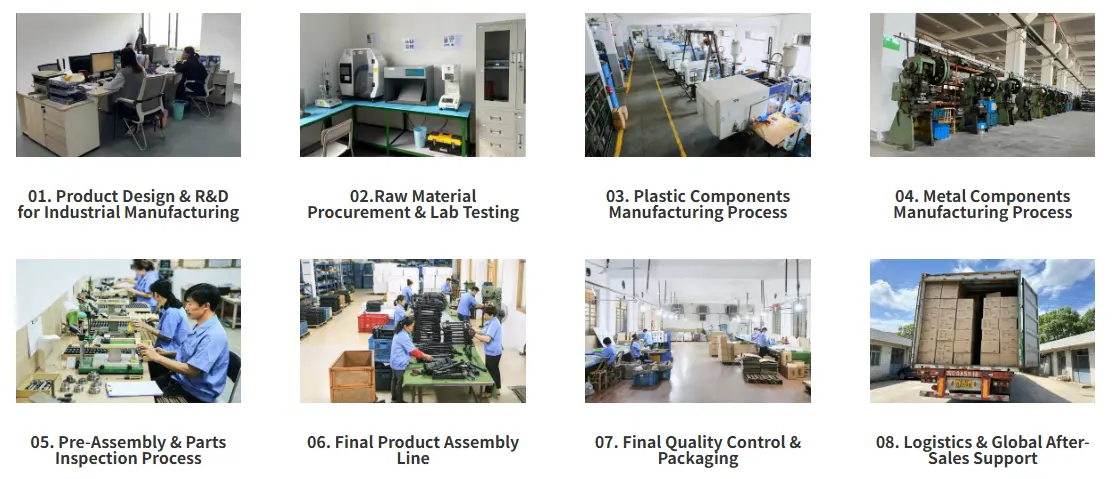
Jingyan’s published manufacturing process includes Product Design & R&D, Raw Material Procurement & Lab Testing, Plastic Components Manufacturing, Parts Inspection, Final Product Assembly, Final Quality Control & Packaging, and Logistics & Global After-Sales Support.
This type of integrated process can be relevant when buyers are evaluating whether a supplier can control the product through multiple manufacturing stages.
3.OEM and ODM Support
For private-label development, OEM/ODM capability can simplify the transition from concept to finished product.
Jingyan describes an OEM/ODM process covering customer requests or drawings, quotation, product design, sample making, mold development, injection molding, assembly, inspection, and delivery.
For a buyer developing a customized toolbox, the important question is whether those stages can be coordinated consistently rather than handled by unrelated suppliers.
4.Quality Control and Production Consistency
B2B buyers should ask more than whether the sample is good.
A more important question is:
Can the manufacturer reproduce the approved sample consistently across future production?
Relevant evaluation points include:
- raw materials,
- molded components,
- dimensional consistency,
- parts inspection,
- assembly,
- finished-product inspection,
- packaging,
- and shipment preparation.
Jingyan states that it operates an independent testing laboratory and lists ISO 9001, CE, RoHS, FDA, BSCI and CPC among its certifications.
5.Production Reliability
Long-term cooperation also depends on:
- production scheduling,
- communication,
- repeat orders,
- packaging support,
- quality response,
- and delivery.
Jingyan’s company information states that the business was founded in 2003 and has a 16,000㎡ self-owned production base, more than 140 professionals, and more than 50 sets of production equipment.
These company credentials should support the product story, not replace product-specific evidence.
Portable Toolbox Buying Checklist
Before selecting a portable toolbox for professional or commercial use, buyers can evaluate the following:
| Evaluation Area | What to Check |
|---|---|
| Portability | Is it comfortable for frequent carrying? |
| Size | Does the footprint suit the intended application? |
| Capacity | Does the usable space match the target tool assortment? |
| Organization | Can different categories be separated logically? |
| Tray Structure | Do the storage levels improve access and visibility? |
| Cantilever Design | Does the opening structure expose multiple storage areas effectively? |
| Handle | Is the grip comfortable under load? |
| Balance | Does the toolbox remain manageable when loaded? |
| Material | Is the plastic construction suitable for the intended use? |
| Durability | Are structural and moving components suitable for repeated use? |
| Configuration | Is a 3-layer or 5-layer model more appropriate for the target customer? |
| Customization | Can the product be adapted for branding or market requirements? |
| Manufacturing | Can the supplier maintain consistent production quality? |
The checklist should not be used to find the toolbox with the largest number of features.
It should be used to determine whether the product is appropriate for the intended user, tool assortment, and market.
FAQ About Portable Toolboxes
1.What is a portable tool box?
A portable toolbox is a storage product designed to move with the user rather than remain permanently installed in one location. Its practical value depends on portability, organization, accessibility, size, and structural reliability.
2.What makes a portable toolbox suitable for professional use?
A practical professional toolbox should be easy to carry, appropriately sized, logically organized, easy to access, and reliable under repeated use.
3.Is a small toolbox suitable for professional users?
4.What is a cantilever toolbox?
A cantilever toolbox uses connected storage trays that extend outward when the product is opened. This can expose multiple storage levels while maintaining a relatively compact form when closed.
5.What is the difference between a three-layer and five-layer toolbox?
The main difference is the amount of storage separation available. A three-layer model can suit a more focused tool assortment, while a five-layer model can provide additional organization for customers who need more storage levels.
6.Is ABS+PA suitable for a portable plastic toolbox?
ABS+PA can be used for portable molded toolbox applications when the material is combined with suitable structural design, component quality, manufacturing control, assembly, and inspection. Material should not be evaluated independently from the complete product.
7.What should B2B buyers ask a portable toolbox manufacturer?
Buyers should ask about specifications, material, load capacity, product configuration, tooling, samples, MOQ, quality inspection, packaging, production capability, customization, OEM/ODM support, lead time, and repeat-order consistency.
Final Takeaway
A practical portable tool box is not defined by one feature.
Being lightweight is not enough.
Having a handle is not enough.
Providing more storage is not enough.
Professional usability comes from the relationship between size, useful storage, tool organization, visibility, carrying comfort, structural design, and durability.
For a small hand-held plastic toolbox, this balance becomes even more important because the available footprint is limited.
A well-designed multi-tray or cantilever structure can use vertical space more effectively, provide better visibility, and organize different tool categories without turning the product into a large stationary storage system.
For professional users, the result can be a more manageable way to transport and access everyday tools.
For distributors, importers, and private-label brands, the evaluation goes further.
The product also needs to support:
- clear market positioning,
- appropriate configurations,
- practical packaging,
- consistent manufacturing,
- and customization where required.
That is what makes a portable toolbox practical for professional use.
The best design is not necessarily the largest, the smallest, or the one with the greatest theoretical capacity.
It is the product that provides the right balance between mobility, organization, accessibility, durability, and commercial practicality.For distributors, importers, retailers, and private-label buyers looking for a practical portable toolbox, product specifications, customization, and bulk production can be discussed directly with Jingyan Tools.
Related products