How Folding Worktable Design Affects Setup, Transport and Daily Use

Folding work table design affects three practical decisions: how quickly a table opens, how stable it is when locked, and how much space it occupies when folded. For importers, distributors, retailers and tool brands, these details also affect carton planning, warehouse storage and product positioning.
Before adding a folding work table to a product range, compare its working and folded dimensions, frame and tabletop materials, load rating and test conditions, locking mechanism, setup time, product weight and packaging requirements. This guide explains how these specifications affect use, transport and sourcing.
Table of Contents
- Why Folding Worktable Design Matters to Professional Users
- How Folding Design Affects Setup Speed
- How Folding Work Tables Affect Transport
- Folded Dimensions Are an Important B2B Specification
- Why Portability Is More Than Lightweight Construction
- How Folding Design Affects Daily Use
- Load Capacity and Structural Design
- The Tabletop Also Affects Daily Work
- What Makes a Folding Work Table Suitable for Professional Applications?
- Why Multi-Function Design Can Strengthen Product Positioning
- How Design Influences Product Value for B2B Buyers
- Comparing a Folding Work Table With a Conventional Fixed Work Table
- What Buyers Should Check Before Sourcing a Folding Work Table
- Why These Design Factors Matter When Developing a B2B Product Line
- What Professional Buyers Should Look for in a Manufacturer
- The NH-W004 Approach to Folding Work Table Design
- Final Takeaway: Folding Design Should Improve the Entire User Experience
- Frequently Asked Questions
Why Folding Worktable Design Matters to Professional Users
The basic purpose of a work table is simple: provide a stable and usable working surface.
The engineering challenge becomes more complicated when that work table also needs to fold.
A professional foldable work table needs to perform two different jobs.
When opened, it needs to behave like a reliable workstation.
When folded, it needs to become compact enough to transport and store efficiently.
These requirements can sometimes compete with each other.
A rigid structure may provide excellent stability but become difficult to transport. A very lightweight structure may be easy to carry but may not provide the working performance expected by professional users.
For this reason, folding design should not be evaluated by the folding mechanism alone.
Professional buyers should consider the complete structure, including:
- Frame construction
- Tabletop material
- Leg structure
- Height adjustment
- Locking points
- Folding mechanism
- Working dimensions
- Folded dimensions
- Product weight
- Stability
- Load capacity
- Transport and storage requirements
The objective is not simply to make a table that folds.
The objective is to create a work table that remains useful before, during, and after folding.
How Folding Design Affects Setup Speed
Setup is one of the first places where product design becomes visible to the user.
A professional user may need to move a work table from a vehicle to a jobsite, open it, adjust its working height, and begin working within a short period.
If the folding mechanism requires multiple complicated steps, setup becomes a source of friction.
A well-engineered folding work table should make the transition from transport mode to working mode as straightforward as possible.
1.Simple Folding Mechanisms Reduce Setup Friction

A folding structure is most useful when users can understand its operation quickly.
The mechanism should ideally provide:
- Clear movement direction
- Stable opening action
- Secure locking
- Minimal setup steps
- Consistent operation
- Easy transition between folded and working positions
This is particularly important for professional products because a workstation may be opened and closed repeatedly.
A design that works well during a one-time demonstration may not necessarily provide the same experience after hundreds or thousands of operating cycles.
For B2B buyers, this means the folding mechanism should be evaluated as a long-term functional component rather than simply as a visual feature.
2.Height Adjustment Can Make Setup More Flexible

Folding is only one part of workstation setup.
For professional users, working height can also affect usability.
Different tasks may require different working positions. A user cutting material may prefer a different height from someone assembling components, inspecting products, or performing maintenance work.
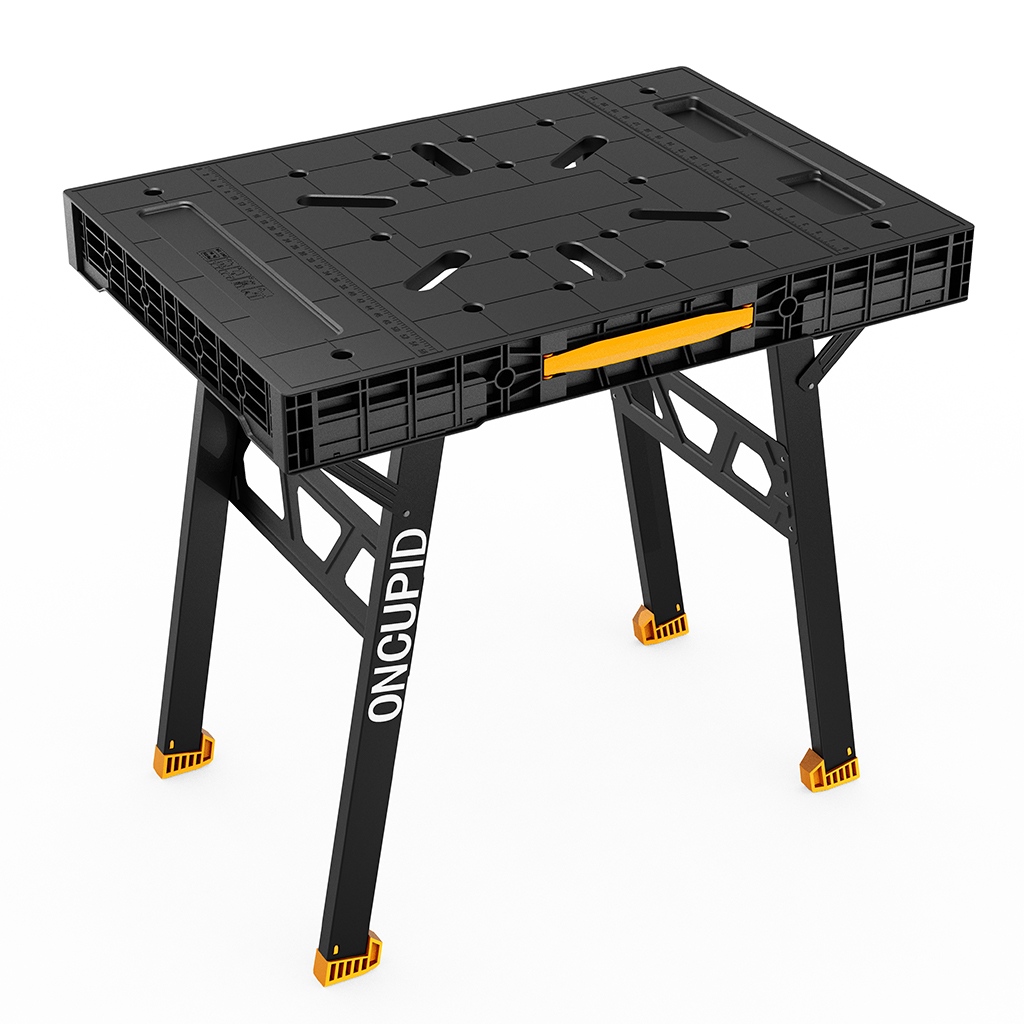
The NH-W004 Adjustable Height Mobile Work Table is designed with eight height settings from 34.25 inches to 48.03 inches.
This allows the same basic workstation platform to serve different working conditions.
For distributors and product brands, height adjustment can also create a stronger product proposition than a basic fixed-height table.
Instead of selling only:
“a table that folds”
the product can be positioned as:
a flexible workstation that folds for transport and adjusts for different working requirements.
That distinction can be valuable in a professional product range.
How Folding Work Tables Affect Transport
Transport is one of the clearest reasons professional users choose folding equipment.
A fixed work table may provide a large and stable working surface, but moving it between locations can be inconvenient.
A folding structure changes the transportation equation.
When the product is folded, its overall dimensions can be significantly reduced, making it easier to move between workshops, vehicles, warehouses, retail environments, and jobsites.
This is where the concept of a portable work table becomes particularly relevant.
Portability is not simply about product weight.
It is the combination of:
weight + folded size + carrying convenience + structural strength + setup efficiency.
A product that weighs less but occupies a large amount of space may not be genuinely convenient to transport.
Likewise, a very strong work table may become commercially less attractive if its folded configuration is difficult to handle.
Folded Dimensions Are an Important B2B Specification

For professional buyers, folded dimensions deserve the same attention as working dimensions.
When evaluating a folding work table, buyers should consider both:
Working configuration
and
Transport configuration.
The working configuration determines whether the product provides enough usable workspace.
The folded configuration determines how efficiently the product can be:
- Transported
- Stored
- Packaged
- Loaded into vehicles
- Placed in warehouses
- Displayed in retail environments
This can have a direct impact on logistics.
For example, a retailer may need to calculate how many units can fit into a warehouse area. An importer may need to evaluate carton utilization. A contractor may need to determine whether several units can fit into a service vehicle.
Therefore, folded dimensions are not merely technical specifications.
They can become part of the product’s commercial value.
Why Portability Is More Than Lightweight Construction
The term portable work table is often associated with low weight.
However, professional portability requires a more complete balance.
A product needs to be light enough to move but strong enough to perform its intended function.
This is particularly relevant for products used in professional environments where users may transport equipment frequently.
The NH-W004, for example, combines a reinforced carbon steel frame with a PP tabletop and has a product weight of approximately 10.5 kg.
This combination is designed to balance structural performance with practical mobility.
For a B2B product, this balance can be more valuable than minimizing weight at any cost.
A very lightweight product may be attractive in a product listing, but if its structure does not meet customer expectations for professional use, the apparent advantage can quickly disappear.
How Folding Design Affects Daily Use

A folding work table is ultimately judged by what happens after setup.
Once the product has been opened, users expect it to behave like a dependable workstation.
This means folding design should not create unnecessary compromises in:
- Stability
- Working height
- Surface usability
- Load performance
- User comfort
- Accessibility
- Workspace flexibility
A good foldable work table therefore needs to transition from “portable product” to “functional workstation.”
That transition is an important part of product engineering.
1.Stability Should Remain a Priority After Folding
A folding mechanism introduces moving components.
These components must not compromise the basic stability of the table when it is in working position.
For professional applications, stability may affect the user’s confidence when handling materials, tools, components, or equipment.
The frame, legs, locking mechanism, and contact points all contribute to the final result.
This is why buyers should avoid evaluating folding products only by looking at the folded size.
The real question is:
How stable is the product once it is fully opened and locked into its working configuration?
Load Capacity and Structural Design
Load capacity is another major consideration.
The load rating of a work table should be considered together with its structural design rather than viewed as an isolated number.
The NH-W004 is designed with a stated 750 kg load capacity, supported by a reinforced carbon steel frame.
For B2B buyers, however, a load figure should always be understood in context.
When comparing suppliers, ask:
- Is the rating for static or working load?
- How was the load tested?
- Is the load evenly distributed?
- Does the rating apply to the complete product?
- What quality-control procedures are used during production?
A credible specification should be supported by a repeatable manufacturing and inspection process.
This is particularly important for importers and distributors because specifications are ultimately passed on to downstream customers.
The Tabletop Also Affects Daily Work

The folding frame receives much of the attention, but the tabletop is equally important to the user’s daily experience.
The tabletop determines:
- Available working area
- Surface feel
- Product weight
- Ease of cleaning
- Resistance to routine handling
- Integration with the frame
- Overall product appearance
The NH-W004 uses a PP tabletop combined with a reinforced carbon steel frame.
This multi-material approach allows different components to perform different functions.
The metal structure provides the main structural support, while the PP tabletop provides the working surface without requiring the entire product to be constructed from metal.
For product developers and distributors, this can provide flexibility in balancing performance, weight, appearance, and manufacturing requirements.
What Makes a Folding Work Table Suitable for Professional Applications?
A professional work table needs to solve more than one problem.
It needs to provide a usable working surface while also supporting mobility, flexibility, and efficient storage.
A strong professional product typically combines several characteristics:
| Feature | Why It Matters |
|---|---|
| Folding structure | Reduces transport and storage requirements |
| Adjustable height | Supports different working conditions |
| Strong frame | Supports professional workloads |
| Stable locking | Maintains confidence during use |
| Practical tabletop | Provides a functional working surface |
| Reasonable product weight | Improves portability |
| Compact folded form | Supports transportation and storage |
| Consistent manufacturing | Reduces quality variation |
The combination is more important than any individual specification.
This is why a B2B buyer should evaluate the entire product architecture rather than choosing based on one headline feature.
Why Multi-Function Design Can Strengthen Product Positioning
For distributors and tool brands, product differentiation matters.
A basic folding table may compete primarily on price.
A more thoughtfully engineered product can compete on several dimensions simultaneously.
For example:
folding + height adjustment + mobility + load capacity + professional construction
creates a more complete value proposition.
This can give distributors more ways to position the product in their catalogs.
Instead of describing the product only as a folding table, they can present it as a flexible workstation for professional environments.
For brands developing their own tool ranges, this can also create opportunities for different packaging, colors, specifications, and positioning.
How Design Influences Product Value for B2B Buyers
The design of a work table can affect more than user experience.
It can also influence the product’s commercial potential.
For example:
1.Product Differentiation
A product with adjustable height and a compact folding structure may be easier to distinguish from basic fixed-height tables.
2.Retail Presentation
Clear product features can make it easier for retailers to communicate value to customers.
3.Logistics
4.Customer Experience
5.Product Line Expansion
A successful platform can potentially be adapted through colors, packaging, accessories, or other specifications depending on the manufacturer’s capabilities.
These factors explain why B2B buyers should evaluate folding work table design from both the user perspective and the commercial perspective.
Comparing a Folding Work Table With a Conventional Fixed Work Table

A fixed work table can be an excellent choice when the workstation remains in one location.
However, professional environments are not always static.
A mobile workshop, temporary worksite, service operation, or shared workspace may require equipment that can be moved or stored.
A folding structure therefore provides a different value proposition.
| Consideration | Folding Work Table | Fixed Work Table |
|---|---|---|
| Transport | Easier to relocate | Usually more difficult |
| Storage | Can be folded | Requires permanent space |
| Workspace flexibility | High | Lower |
| Jobsite use | Suitable | Less convenient |
| Temporary work areas | Highly suitable | Less flexible |
| Setup | Requires opening | Usually ready to use |
| Mobility | Designed for movement | Often location-based |
The best choice depends on the application.
For professional buyers targeting mobile or flexible work environments, folding design can provide a meaningful advantage.
What Buyers Should Check Before Sourcing a Folding Work Table
Use this checklist to compare product specifications and supplier capabilities before adding a folding work table to a retail or distribution range.
|
Specification |
What buyers should verify |
|---|---|
|
Working dimensions |
Open dimensions, usable tabletop area and working height. |
|
Folded dimensions |
Folded length, width and height, plus separate carton dimensions for logistics planning. |
|
Materials and structure |
Confirmed tabletop and frame materials, leg construction, hinges and locking mechanism. |
|
Load rating |
Stated capacity, load distribution, test conditions and whether the rating applies to the complete assembled product. |
|
Setup and adjustment |
Opening steps, verified folding time, height settings and locking procedure, where applicable. |
|
Bulk sourcing |
MOQ, available colors, logo and packaging options, sample availability and production lead time. |
The most suitable product is not necessarily the lightest or the one with the largest load rating. Buyers should evaluate how its specifications fit the intended market, logistics requirements and product positioning.
Why These Design Factors Matter When Developing a B2B Product Line
For a professional tool brand or distributor, a work table is not simply a single SKU.
It can become part of a larger product category.
Design decisions made at the development stage can influence:
- Retail positioning
- Product photography
- Packaging
- User instructions
- Logistics
- Customer expectations
- Product differentiation
- Future product variations
This is why supplier capability matters when developing a folding work table.
A manufacturer needs to understand not only how to produce the frame, but also how to integrate materials, moving mechanisms, quality inspection, assembly, packaging, and mass production.
For buyers interested in broader workbench sourcing, the existing Portable Workbench Buying Guide for Retailers and Workshop Users covers a wider range of portable workstation purchasing considerations.
For buyers focused specifically on folding woodworking workbenches, the Folding Woodworking Workbench Guide provides a different product category perspective.
These topics should be treated as complementary rather than interchangeable: the current article focuses specifically on how folding worktable design affects the user’s experience.
What Professional Buyers Should Look for in a Manufacturer
The product itself is only one part of a successful B2B sourcing project.
Manufacturing capability can influence whether a product remains consistent after the first sample.
Professional buyers should consider:
- Product development capability
- Engineering support
- Material control
- Assembly capability
- Quality inspection
- Production capacity
- Packaging
- OEM/ODM support
- Delivery consistency
Jingyan Tools provides OEM and ODM manufacturing for industrial tools and operates R&D, mold, production, quality-control, and customer-service functions.
For buyers who want to understand the company’s broader manufacturing background, the Jingyan Tools company introduction provides more information about its manufacturing capabilities and quality system.
The NH-W004 Approach to Folding Work Table Design

The NH-W004 Adjustable Height Mobile Work Table illustrates how several design priorities can be combined into one professional workstation.
The product uses:
- PP tabletop
- Reinforced carbon steel frame
- 750 kg load capacity
- 10.5 kg product weight
- Eight height settings
- Height range from 34.25 to 48.03 inches
- Approximately three-second folding
- Mobile and folding construction
The purpose of this configuration is not simply to make a table that folds.
It is to combine a functional work surface with mobility, height flexibility, structural performance, and compact storage.
This type of multi-function design can be particularly relevant for distributors and brands looking to build a professional workstation product category.
For buyers evaluating the NH-W004, the product specifications provide the detailed information needed to assess its construction, capacity, dimensions, and intended applications.
Final Takeaway: Folding Design Should Improve the Entire User Experience
A folding work table should not be evaluated simply by asking whether it folds.
The more important question is:
What does the folding design improve?
A well-designed structure can improve setup speed, transportation, storage efficiency, workspace flexibility, and daily usability.
For professional users, these advantages become especially important because equipment may be moved, opened, adjusted, and stored repeatedly.
For B2B buyers, the implications extend further.
A well-engineered foldable work table can provide a stronger product proposition, support better differentiation, and offer practical advantages for retailers, distributors, contractors, and professional tool brands.
The most useful design approach is therefore not to maximize folding capability alone.
It is to balance:
folding efficiency + structural strength + portability + height adjustment + working usability + storage efficiency.
The NH-W004 follows this approach by combining a reinforced carbon steel frame, PP tabletop, adjustable height, substantial load capacity, and rapid folding into one mobile workstation.
For importers, distributors, and brands evaluating a portable folding work table for professional markets, these design characteristics are worth examining before deciding whether a product is suitable for a new product line.
If you are developing a professional workstation range or looking for a manufacturer capable of supporting customized production, you can contact Jingyan Tools for OEM and ODM cooperation to discuss product specifications, branding, packaging, and bulk production requirements.
Frequently Asked Questions
1.What makes a folding work table suitable for professional use?
A professional folding work table should combine a stable working structure with practical portability. Important factors include frame strength, load capacity, locking reliability, working dimensions, folded dimensions, height adjustment, and ease of setup.
2.Is a folding work table easier to transport than a fixed work table?
Generally, the folding structure can make transportation easier because the product can be reduced to a more compact configuration. However, actual transport convenience depends on the product’s weight, folded dimensions, carrying design, and overall structure.
3.Why is height adjustment important on a folding work table?
Height adjustment allows users to adapt the workstation to different tasks and working conditions. For professional users, this can increase the range of applications served by one product.
4.Does folding design affect daily stability?
It can. A folding structure introduces moving and locking components, so the quality of the mechanism and frame design matters. A properly engineered product should maintain stable working performance after it is fully opened and locked.
5.What is the difference between a folding work table and a portable work table?
A folding work table emphasizes the ability to reduce its configuration for storage and transportation. A portable work table emphasizes mobility. A product can combine both characteristics, which is why portable folding work tables can be attractive for professional applications.
6.What should B2B buyers evaluate besides folding functionality?
Buyers should also consider load capacity, frame construction, working dimensions, folded dimensions, height adjustment, product weight, material selection, quality control, packaging, production capability, and OEM/ODM support.
7.Can folding work tables be customized for distributors or brands?
Depending on the manufacturer’s capabilities, customization may include colors, branding, packaging, specifications, and other product-development requirements. Buyers should discuss the exact customization scope with the manufacturer before placing an order.
8.Why is folded size important for importers and distributors?
Folded dimensions can affect warehouse utilization, transportation efficiency, packaging design, vehicle loading, and retail logistics. Therefore, folded size can have both operational and commercial importance.
Related products