How Can a Small Toolbox Maximize Storage Without Becoming Difficult to Carry?

A small toolbox has to solve a surprisingly difficult design problem.
It needs to provide enough space for useful tools and accessories while remaining compact enough to carry, store, transport, and use comfortably. Making a toolbox larger can create more volume, but it can also increase weight, footprint, and handling difficulty. Making it smaller can improve portability, but it may leave users without enough practical storage.
For professional users, this balance becomes even more important because a toolbox is rarely used as an empty container.
It is normally loaded with screwdrivers, pliers, wrenches, fasteners, accessories, measuring tools, repair components, or other equipment. Once the toolbox is loaded, its real dimensions, internal organization, weight distribution, and access system become much more important than the empty box seen in a product photograph.
This is why the question is not simply:
How much can a small toolbox hold?
A more useful question is:
How can a small toolbox maximize usable storage without becoming difficult to carry?
For B2B buyers, this question also has a commercial dimension.
Importers, distributors, retailers, and product managers need to determine whether a compact toolbox offers a clear advantage for its intended market. They also need to decide whether different configurations can serve different customer groups without creating an unnecessarily complicated product line.
A well-designed small toolbox therefore does not depend on external volume alone.
Its effectiveness comes from the relationship between external dimensions, internal layout, storage levels, accessibility, product weight, and the way customers actually use the product.
This article explains how compact toolbox design can make better use of limited space, how vertical storage can increase usable capacity, why three-layer and five-layer configurations may serve different users, and what B2B buyers should consider before adding a small toolbox to a professional or retail product range.
- Why Small Toolbox Design Is a Capacity Problem, Not Just a Size Problem
- How a Small Toolbox Can Use Vertical Space More Efficiently
- How to Balance Storage Capacity and Carrying Weight
- Why Internal Organization Determines Usable Capacity
- Three-Layer vs. Five-Layer Small Toolbox: Which Configuration Uses Space Better?
- How Cantilever Structure Helps a Small Toolbox Stay Compact
- How Different Tool Categories Affect Small Toolbox Capacity
- What B2B Buyers Should Consider When Selecting a Small Toolbox
- How Small Toolbox Design Can Support Retail and Distribution
- Manufacturing and Customization Considerations for B2B Toolbox Buyers
- A Practical Small Toolbox Evaluation Framework
- Frequently Asked Questions About Small Toolboxes
- Final Takeaway: Maximize Useful Storage, Not Just Storage Volume
Why Small Toolbox Design Is a Capacity Problem, Not Just a Size Problem
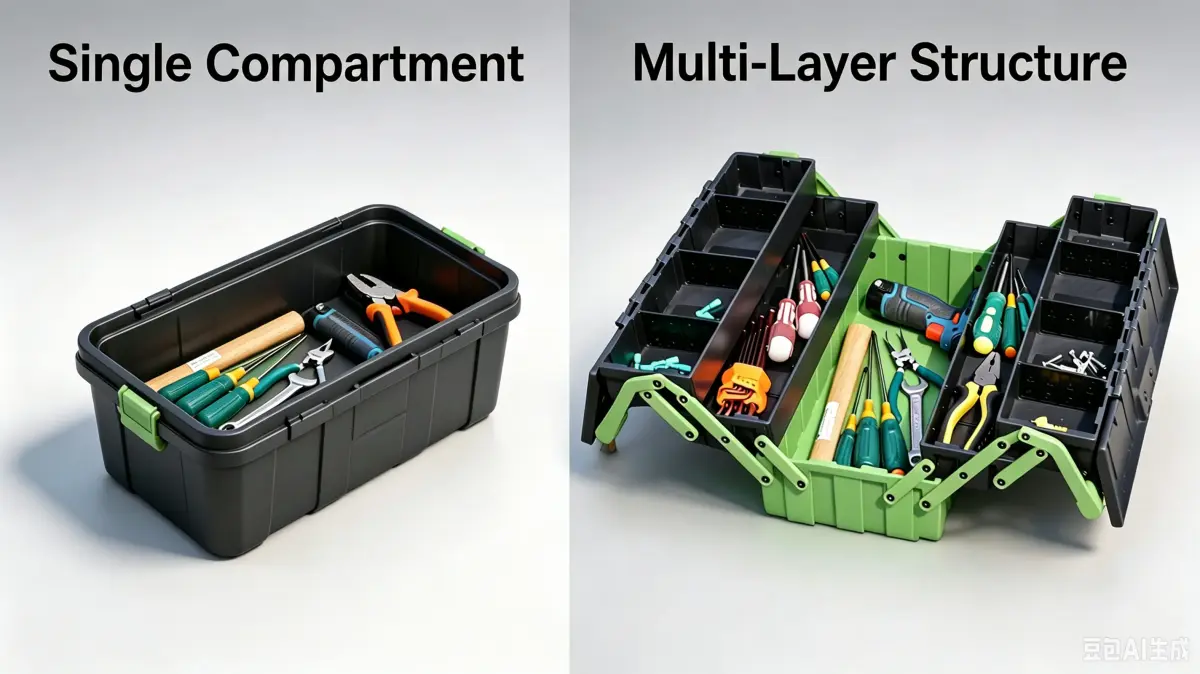
The first reaction to a storage problem is often to make the container larger.
Increasing width, depth, or height can certainly create more internal volume. However, every additional centimeter also changes the external footprint and the carrying experience.
For a hand-carried toolbox, this creates a clear trade-off.
A larger box may hold more tools, but it may also become more difficult to place in a vehicle, store on a shelf, move around a workshop, or carry over a longer distance.
A very small box creates the opposite problem. It may be convenient to carry, but the user may have to leave useful tools behind or pack the contents so tightly that access becomes inefficient.
The better approach is to focus on effective capacity.
1.External Size and Internal Capacity Are Not the Same
Two toolboxes with similar external dimensions can provide very different storage experiences.
One may use a single deep compartment that technically provides substantial volume. Another may divide a similar footprint into several functional areas.
The second design can offer greater practical value because users can assign different storage spaces to different types of tools.
The objective is therefore not simply to increase the amount of empty space.
It is to increase the amount of usable space.
A storage area is useful when users can put appropriate items there, retrieve them without excessive rearrangement, and return them to the same location after use.
This distinction becomes particularly important when a toolbox is intended for professionals who may retrieve tools repeatedly throughout the day.
2.Small Does Not Have to Mean Limited
A compact toolbox can remain small while becoming more capable.
Instead of continually expanding width and depth, designers can use height, internal separation, and dedicated storage areas to improve the use of available space.
This approach makes it possible to create a compact product that still supports a meaningful tool assortment.
For product managers, this is also important because the value of a small toolbox can come from how efficiently it uses space, not from how large it is.
How a Small Toolbox Can Use Vertical Space More Efficiently
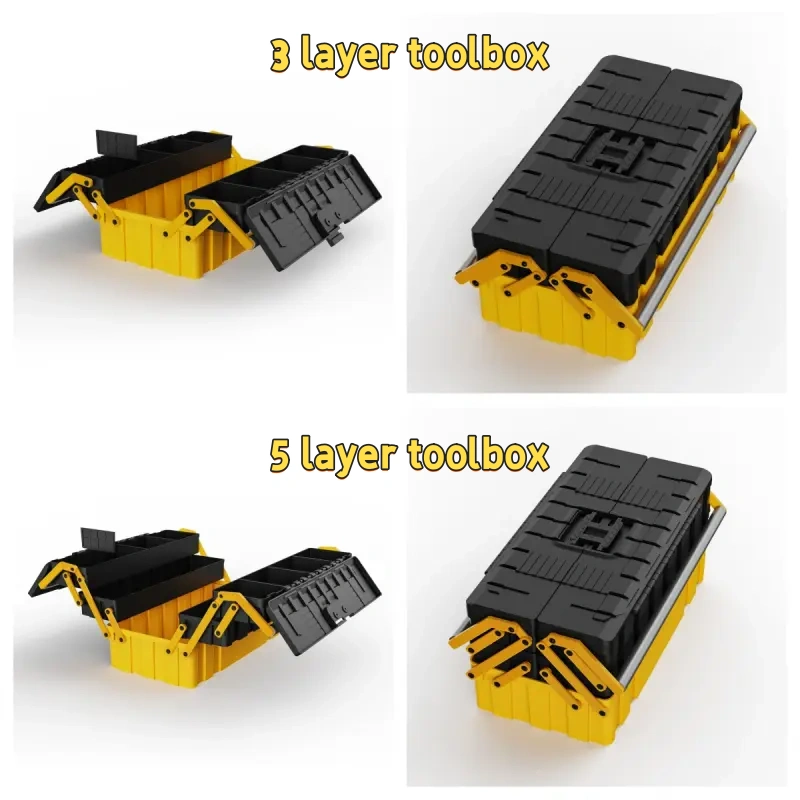
When width and depth need to stay controlled, vertical space becomes one of the most valuable resources available to a toolbox designer.
A conventional single-compartment box treats its interior largely as one storage volume.
A multi-level design takes a different approach by dividing available height into several storage areas.
This can increase organization without requiring the same increase in footprint.
1.Vertical Storage Can Add Capacity Without Expanding the Base Footprint
Consider two products with similar length and width.
The first uses one main compartment.
The second uses several storage levels.
The second product can create additional organization by using the height of the toolbox rather than continuously expanding its base.
This can be especially useful for a compact toolbox because the product can maintain a manageable footprint while providing more distinct storage areas.
Jingyan’s three-layer and five-layer configurations illustrate this design approach.
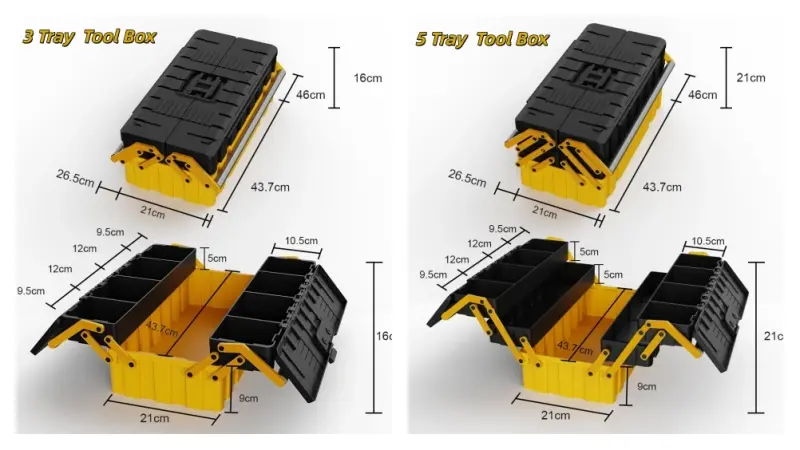
The three-layer model measures 46 × 26.5 × 15.8 cm, while the five-layer model measures 46 × 26.5 × 21 cm.
Both configurations retain a length of 46 cm and a width of 26.5 cm. The main dimensional increase in the five-layer version comes from height.
This means the additional storage structure is created vertically rather than by substantially increasing the footprint.
2.Layer Count Should Match the Tool Assortment
Adding layers is not automatically an improvement.
A customer carrying a focused collection of tools may not need five storage levels.
Another customer may need additional separation between hand tools, accessories, small components, and less frequently used items.
The right question is therefore:
How much storage organization does the customer actually need?
rather than:
How many layers can the product provide?
For B2B buyers, this distinction can also support clearer product segmentation.
A three-layer version can serve one customer group while a five-layer version provides a higher-capacity option for another.
How to Balance Storage Capacity and Carrying Weight
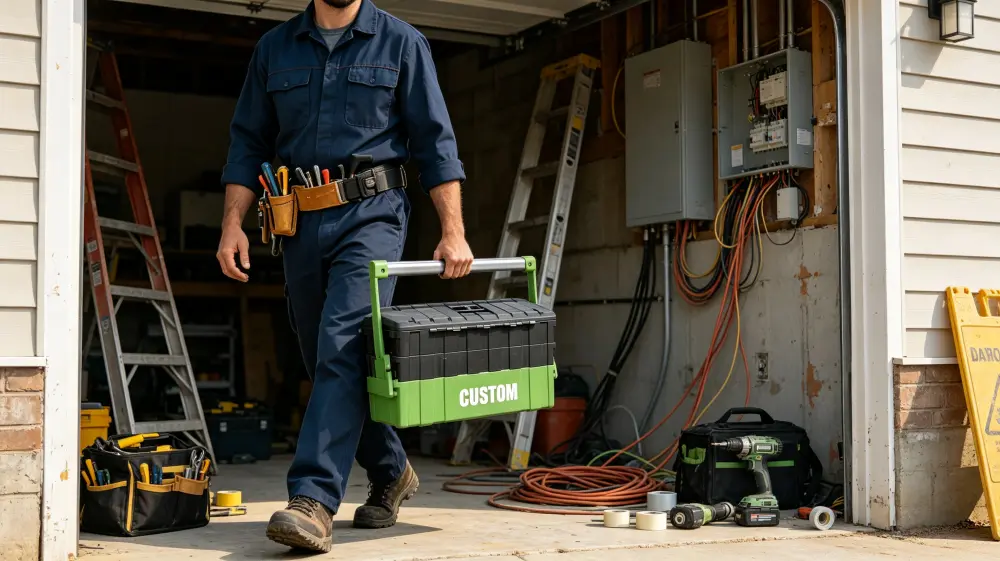
Storage capacity and portability cannot be separated completely.
Every additional tool becomes part of the loaded weight, and the more storage a toolbox provides, the more likely customers are to fill it.
This means that product weight should be evaluated together with storage capacity.
1.Product Weight Is Only Part of the Carrying Equation
The carrying experience is influenced by more than the empty weight of the toolbox.
Other factors include:
- handle design;
- weight distribution;
- product height;
- body dimensions;
- storage arrangement;
- carrying frequency;
- travel distance.
A toolbox with slightly greater empty weight may still feel manageable if its contents are well distributed and the carrying structure is practical.
By contrast, a very light product can become uncomfortable if its loaded contents are poorly positioned or if the overall shape makes it difficult to control.
2.More Storage Can Encourage More Loading
Additional storage creates more room, but that room can also encourage users to carry more tools.
For this reason, storage capacity should be considered together with the structural capacity of the product.
The three-layer and five-layer configurations in this range are each rated at 30 kg load capacity.
The three-layer model weighs 9.5 kg, while the five-layer model weighs 12.5 kg.
These figures show why capacity and weight should not be evaluated independently.
A buyer may prefer the five-layer version because of the additional organization, while another buyer may prefer the three-layer version because the lower weight better matches the target customer.
3.Storage Efficiency Is More Valuable Than Maximum Volume
A compact toolbox should not try to maximize volume at any cost.
It should provide enough useful storage for the intended tool assortment while preserving practical handling.
The better product-development objective is therefore:
maximum useful storage within a manageable carrying format.
That principle is particularly relevant for professional tool products because customers often care more about access and organization than about theoretical internal volume.
Why Internal Organization Determines Usable Capacity
A toolbox’s stated volume does not fully describe its practical storage capacity.
Users experience capacity through the way tools are arranged, retrieved, and returned.
A large undivided compartment can contain many items, but it may also create wasted space around irregularly shaped tools and make smaller components difficult to locate.
1.Different Tools Need Different Storage Areas
A screwdriver does not require the same storage geometry as a wrench.
Small fasteners do not need the same type of space as a power-tool accessory.
Longer tools may need open sections, while small components benefit from separation and visibility.
A compact toolbox can therefore use space more efficiently by matching storage areas to the physical characteristics of the tools.
This can make a smaller product more functional than a larger box with poor organization.
2.Accessibility Changes the Value of Storage
Storage only creates value when users can access it efficiently.
A compartment that requires several other tools to be removed first is technically available, but its practical usefulness is lower.
For professional users, this difference becomes noticeable when the same tools are retrieved repeatedly throughout the day.
A well-planned storage system should make it easier to answer:
Where is the tool?
Can I reach it quickly?
Where should I put it back?
These questions are fundamental to effective compact storage.
Three-Layer vs. Five-Layer Small Toolbox: Which Configuration Uses Space Better?
Layer configuration provides one of the clearest ways to change storage capacity while keeping the basic footprint relatively controlled.
The three-layer and five-layer models provide different storage configurations within the same general product family.
The three-layer model measures 46 × 26.5 × 15.8 cm and weighs 9.5 kg.
The five-layer model measures 46 × 26.5 × 21 cm and weighs 12.5 kg.
Both models have a stated 30 kg load capacity.
The length and width remain the same at 46 cm × 26.5 cm, while the five-layer configuration adds height and additional storage separation.
1.When a Three-Layer Configuration Makes Sense
A three-layer toolbox can be a practical choice when the target customer needs organized storage but wants to maintain a relatively compact format.
It can suit focused tool assortments where the user carries a defined group of frequently used tools and does not require extensive separation.
The lower height and lower product weight can also make it attractive for applications where carrying convenience is particularly important.
For a distributor, this configuration can serve as an entry or compact option within a product range.
2.When a Five-Layer Configuration Adds Value
A five-layer toolbox can make more sense when customers need greater separation between tool categories.
The additional layers can provide more opportunities to organize:
- hand tools;
- accessories;
- small components;
- fasteners;
- less frequently used items.
Because the five-layer model keeps the same basic length and width, the additional storage is achieved mainly by increasing height.
This creates a useful product distinction without requiring a completely different footprint.
3.Why More Layers Do Not Automatically Mean Better Portability
The five-layer version weighs 12.5 kg, compared with 9.5 kg for the three-layer version.
The additional 3 kg may be justified for customers who need the extra storage organization.
However, customers who prioritize lighter handling may prefer the three-layer configuration.
For B2B product planning, this demonstrates an important principle:
more capacity should only be added when the target customer will actually benefit from it.
How Cantilever Structure Helps a Small Toolbox Stay Compact
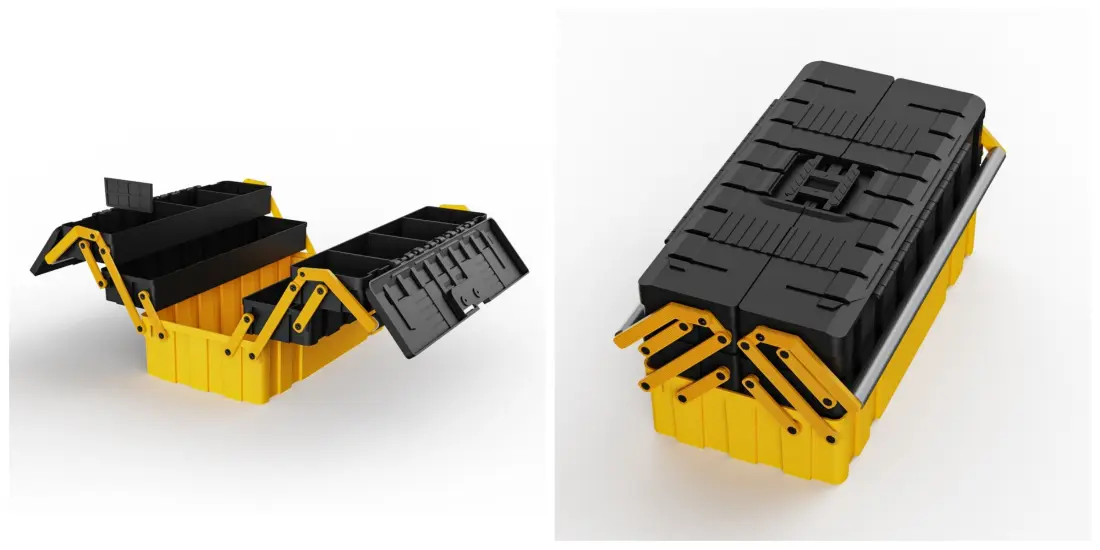
Cantilever construction offers another way to combine compact transport dimensions with expanded access during use.
When the toolbox is closed, the storage levels remain within a relatively compact overall configuration.
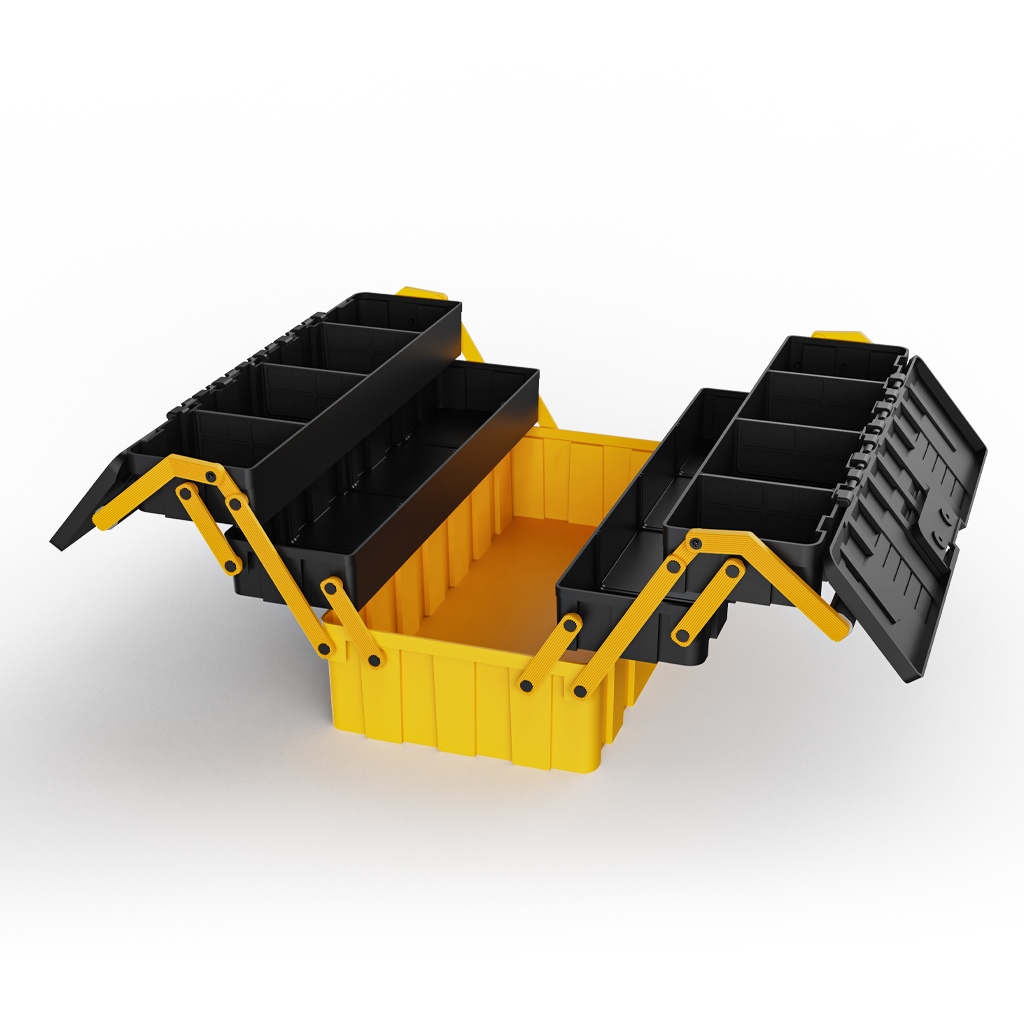
When opened, the trays extend outward, exposing different storage areas.
This changes the relationship between the product’s closed size and its working accessibility.
1.Closed and Open Configurations Serve Different Needs
The closed form is primarily concerned with:
- transport;
- carrying;
- storage;
- packaging.
The open form is primarily concerned with:
- access;
- visibility;
- tool organization;
- retrieval.
A good compact toolbox needs to work in both states.
2.Multi-Level Access Can Reduce Reliance on Deep Compartments
A deep single compartment is an easy way to create volume, but it can make smaller items harder to identify.
A multi-level structure distributes storage across several areas.
This can reduce the need for one very deep main compartment and provide a clearer visual relationship between tools and their storage locations.
3.Compactness Should Be Evaluated in Real Working Conditions
Professional buyers should not evaluate compactness based only on a closed product photograph.
They should consider:
- how the product opens;
- how much access each level provides;
- whether loaded trays remain manageable;
- whether the open configuration remains practical;
- how the toolbox is stored after use.
The compactness of a toolbox is therefore a working characteristic, not just a dimensional specification.
How Different Tool Categories Affect Small Toolbox Capacity
The best toolbox layout depends on what customers actually need to carry.
A toolbox for a narrow group of hand tools has different storage requirements from a toolbox intended for mixed tools, accessories, and small components.
1.Hand Tools and Small Components Require Different Space
Larger hand tools generally require larger storage areas.
Small components require separation, visibility, and easy identification.
A practical compact toolbox should therefore assign storage based on tool characteristics rather than simply dividing the box into identical sections.
This allows more of the available space to perform a useful function.
2.Frequency of Access Should Influence Storage Position
Frequently used tools should generally be easier to reach.
Less frequently used items can occupy secondary or lower-access storage areas.
This approach can improve workflow without increasing the product’s external dimensions.
3.Tool Variety Can Matter More Than Tool Quantity
A toolbox holding 20 similar tools may require less organizational complexity than a toolbox holding 10 different categories of components.
For product development, this means that “how many tools can it hold?” may not be the most useful capacity question.
A better question can be:
How many different tool categories can it organize efficiently?
That is particularly relevant for professional users who carry mixed tool assortments.
What B2B Buyers Should Consider When Selecting a Small Toolbox
Buyers evaluating the broader criteria for selecting a plastic toolbox can also explore How to Choose a Plastic Toolbox for Garage Workshops and Professional Use.For distributors, retailers, importers, and product managers, product capacity is only one part of the decision.
A small toolbox also needs a clear commercial position.
1.Match the Configuration to the Target Customer
A compact three-layer model can serve customers who prioritize manageable carrying and focused storage.
A five-layer configuration may appeal to customers who require additional organization.
The product should therefore be matched to the customer’s workflow rather than presented as universally suitable.
2.Explain What the Additional Capacity Solves
A larger storage structure should have a clear benefit.
Instead of simply claiming:
“More capacity.”
A stronger product proposition can explain:
- more separation;
- easier access;
- better organization of mixed tools;
- more room for accessories;
- clearer storage by function.
This gives distributors more meaningful selling points.
3.Build a Product Family Around Different Storage Needs
Different configurations can support market segmentation without requiring an entirely unrelated product design for every customer group.
A three-layer and five-layer range can create clear product tiers.
This can be useful for distributors and retailers that want:
- a compact option;
- a higher-capacity option;
- different price positions;
- different target applications.
How Small Toolbox Design Can Support Retail and Distribution
Compact design can also create value beyond the end user’s carrying experience.
For retailers and distributors, product dimensions influence handling, storage, presentation, and assortment planning.
1.Compact Products Can Simplify Handling
A smaller external footprint can make products easier to move within retail and warehouse environments.
It can also make the product easier to position in displays where shelf and floor space are limited.
2.Different Configurations Can Improve Product Segmentation
Three-layer and five-layer versions can create clear differences within one product family.
That can allow a retailer to target customers with different storage requirements without making the product range difficult to understand.
3.Product Differentiation Should Focus on Function
Small toolbox products can look similar from a distance.
The strongest differentiation can therefore come from useful functions such as:
- storage configuration;
- organization;
- compact footprint;
- carrying design;
- material selection;
- colors;
- private-label customization.
For B2B buyers, functional differentiation can provide a stronger product position than competing only on purchase price.
Manufacturing and Customization Considerations for B2B Toolbox Buyers
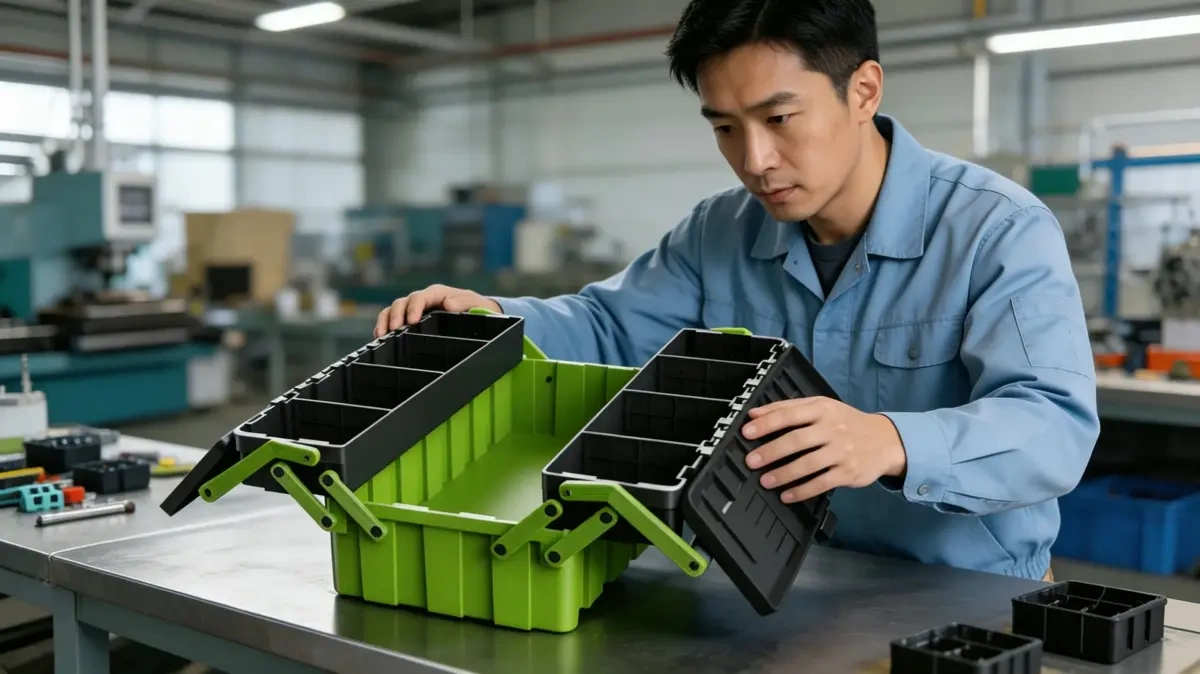
Buyers comparing toolbox material options in greater detail can also review Toolbox Comparison: Plastic Toolbox vs Metal Toolbox for Professional Tool Storage. A successful small toolbox program requires more than an attractive sample.
The manufacturer needs to reproduce the design consistently while supporting the commercial requirements of the buyer.
1.Material and Component Consistency
A multi-layer toolbox contains multiple components that need to fit and operate together correctly.
Tray dimensions, connections, handles, latches, and other parts need consistent production tolerances.
Even a small variation can affect fit, movement, or assembly.
2.Customization Can Support Different Market Positions
For private-label buyers, customization can help create a more differentiated product.
Depending on the project, this may include:
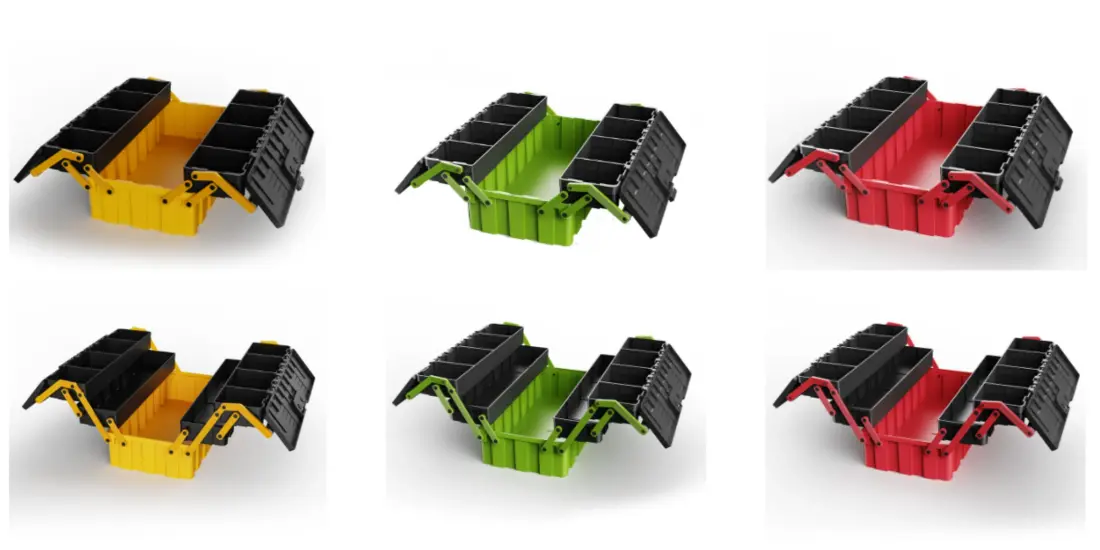
- product color;
- branding;
- packaging;
- internal configuration;
- layer configuration;
- selected specifications.
The purpose of customization should be to serve a defined customer segment rather than simply adding changes without a commercial reason.
3.Why Production Capability Matters
Ningbo Jingyan Tool Industrial Co., Ltd. was founded in 2003 and operates a self-owned production base of more than 16,000㎡, with more than 140 professionals and more than 50 sets of production equipment.
Its capabilities cover R&D, mold development, production, quality control, and customer service.
For B2B buyers, these capabilities matter because product quality needs to be repeatable at commercial scale.
The important question is not only whether a manufacturer can produce a good sample.
It is whether the manufacturer can reproduce the required dimensions, components, assembly quality, and product performance across repeat production.
A Practical Small Toolbox Evaluation Framework
Before adding a small toolbox to a product line, buyers can use a structured evaluation process.
Step 1 — Define the Tool Assortment
Identify the tools and accessories the target customer is expected to carry.
Determine whether the product is intended for a focused set of hand tools, mixed tools, maintenance components, or a broader assortment.
Step 2 — Check the External Footprint
Review the length, width, and height.
Consider where the toolbox will be carried, stored, displayed, and transported.
Step 3 — Evaluate Usable Storage
Do not focus only on theoretical internal volume.
Check whether tools can be organized, identified, accessed, and returned efficiently.
Step 4 — Compare Layer Configurations
Determine whether three layers or five layers better match the target customer’s requirements.
More storage levels should be treated as a functional choice rather than an automatic quality improvement.
Step 5 — Consider Loaded Handling
Evaluate the toolbox after loading it with a realistic assortment of tools.
An empty toolbox does not represent the final carrying experience.
Step 6 — Review the Supplier
Consider:
- component consistency;
- material control;
- assembly;
- quality inspection;
- packaging;
- customization;
- production reliability.
The goal is to select a product that is practical for the end user and commercially manageable for the buyer.
Frequently Asked Questions About Small Toolboxes
1.How can a small toolbox hold more tools without becoming larger?
A compact toolbox can increase usable capacity by making better use of its existing footprint. Vertical storage, multiple layers, dedicated storage areas, and more efficient internal organization can provide additional useful space without simply increasing width and depth.
2.Is a five-layer toolbox better than a three-layer toolbox?
Not necessarily. A five-layer toolbox provides additional storage separation and increased vertical capacity, but it also weighs more. The better configuration depends on the target tool assortment and how often the toolbox needs to be carried.
3.What size is considered a small toolbox?
There is no universal dimensional definition. A toolbox is generally considered small when it maintains a relatively compact footprint for its intended application while still providing useful storage. The appropriate size depends on the users, tools, and carrying requirements.
4.Does more storage always make a toolbox more useful?
No. Storage becomes less useful when items are difficult to organize or access. The quality of the storage layout can be more important than the amount of empty volume.
5.Is a small toolbox suitable for professional users?
Yes. A compact toolbox can be useful for professionals who need to transport a focused set of tools for maintenance, repair, installation, service, workshop, or mobile applications.
6.Why is vertical storage useful in a compact toolbox?
Vertical storage allows additional storage levels to be created without increasing width and depth to the same extent. This can help maintain a manageable footprint while increasing organization.
7.What should B2B buyers compare between small toolbox models?
They should compare external dimensions, usable storage, layer configuration, product weight, load capacity, accessibility, material, carrying requirements, packaging, customization options, and manufacturing consistency.
8.Can small toolboxes be customized for private-label brands?
Depending on the supplier’s capabilities and project requirements, customization may include colors, branding, packaging, internal configuration, layer configuration, and other specifications.
Final Takeaway: Maximize Useful Storage, Not Just Storage Volume
The challenge of a small toolbox is not simply to fit more tools into a smaller box.
It is to create a product that uses limited space intelligently while remaining practical to carry, store, and use.
That requires a balance between:
external dimensions + usable storage + organization + accessibility + product weight + carrying requirements.
Making a toolbox larger can increase volume, but it may also reduce the practical advantage of compact portability.
Making it extremely small can improve handling, but it may leave users without enough useful storage.
A multi-layer structure provides another option.
By using vertical space, the toolbox can create additional storage levels without expanding its basic length and width to the same extent.
The three-layer and five-layer configurations demonstrate this principle.
The three-layer model measures 46 × 26.5 × 15.8 cm and weighs 9.5 kg, while the five-layer model measures 46 × 26.5 × 21 cm and weighs 12.5 kg. Both have a stated 30 kg load capacity.
These differences show why the best toolbox configuration depends on the customer.
A focused tool assortment may be better served by the three-layer version.
A broader assortment may justify the additional organization of the five-layer version.
The goal is not to choose the toolbox with the greatest theoretical volume.
The goal is to select the configuration that provides the target user with the most useful storage without making the product unnecessarily difficult to carry.
For B2B buyers, this same principle applies at the product-line level.
Efficient space utilization + appropriate configuration + practical handling + consistent manufacturing
can create a stronger commercial proposition than simply increasing the physical size of the toolbox.
A well-designed small toolbox should therefore be judged by how effectively it turns limited physical space into useful, accessible, and manageable storage.
For distributors, importers, retailers, and private-label brands, that balance can become a meaningful product advantage when developing a compact toolbox range for professional users.
For distributors, importers, retailers, and private-label brands looking to develop or source compact toolbox products, customization and bulk production requirements can be discussed directly with Jingyan Tools.
Related products